




- My Forums
- Tiger Rant
- LSU Recruiting
- SEC Rant
- Saints Talk
- Pelicans Talk
- More Sports Board
- Fantasy Sports
- Golf Board
- Soccer Board
- O-T Lounge
- Tech Board
- Home/Garden Board
- Outdoor Board
- Health/Fitness Board
- Movie/TV Board
- Book Board
- Music Board
- Political Talk
- Money Talk
- Fark Board
- Gaming Board
- Travel Board
- Food/Drink Board
- Ticket Exchange
- TD Help Board
Customize My Forums- View All Forums
- Show Left Links
- Topic Sort Options
- Trending Topics
- Recent Topics
- Active Topics
Started By
Message


 1
1


Posted on 12/16/24 at 8:17 pm to Timeoday
Freedom ain’t free. Most of those other “wealthy” places have various ways of curtailing the availability and freedom to enjoy what you want to enjoy, for the most part.
This post was edited on 12/16/24 at 8:18 pm
Posted on 12/16/24 at 8:21 pm to Timeoday
Input > transformation > output
Inputs are patients
Transformation is the system
Outputs are patient outcomes
We have issues with the system, but there’s only so much it can possibly do with inputs that poor
Inputs are patients
Transformation is the system
Outputs are patient outcomes
We have issues with the system, but there’s only so much it can possibly do with inputs that poor
This post was edited on 12/16/24 at 8:22 pm

Posted on 12/16/24 at 8:25 pm to Wildcat1996
All of our kids have cars that can travel over 100 mph. Almost every graduating class has 1 or more members who die in accidents before they graduate.
Posted on 12/16/24 at 9:27 pm to RollTide1987
quote:
Diet and exercise. We suck at both.
Yes…and…
- Poisonous food
- Drug abuse
- Black people shooting each other

Posted on 12/16/24 at 9:28 pm to Timeoday
quote:Because health is far more complex than a simple one-variable model. Any more questions?
We spend far more on health but have the lowest life expectancy of wealthy nations. Why???
Posted on 12/16/24 at 9:32 pm to Taxing Authority
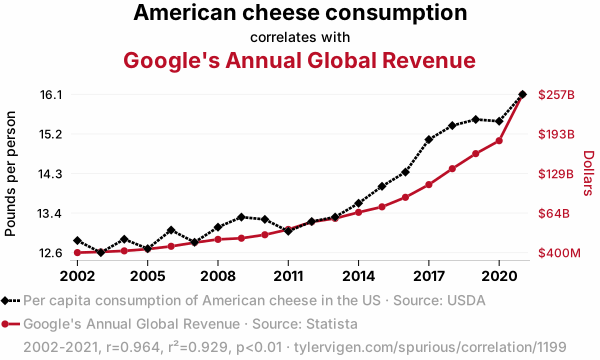
Better question might be why is the conumption of cheese driving google's revenue?
Or why does the declning popularity of the name Thomas causing France to use less gasoline?
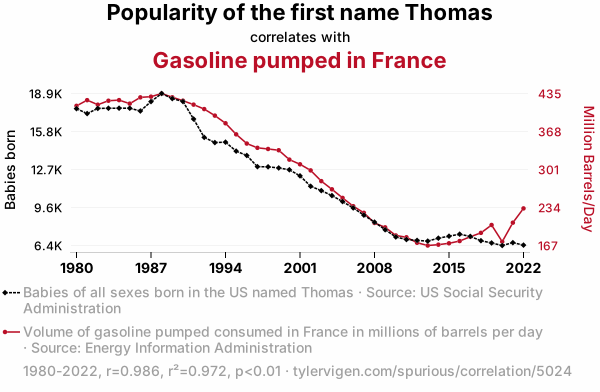

Or why does the declning popularity of the name Thomas causing France to use less gasoline?


Posted on 12/16/24 at 9:36 pm to Timeoday
quote:
We spend far more on health but have the lowest life expectancy of wealthy nations. Why???
We likely are also the least healthy of the wealthy nations.
Posted on 12/16/24 at 9:37 pm to Timeoday
Processed food
Maintenance medication/polypharmacy
Insurance companies
Maintenance medication/polypharmacy
Insurance companies
Posted on 12/16/24 at 9:39 pm to Timeoday
America is the most obese country in the world. And it’s no surprise when you look at the ads being played during football games. Pure artery clogging junk food
This post was edited on 12/16/24 at 9:39 pm

Posted on 12/16/24 at 9:42 pm to Timeoday
This is a question for Bill Gates since not only is he the largest unofficial donor to the World Health Organization, but also nations which receive the most Gates’ money see the worst health outcomes. Also, in 2020, he donated at least $250 million in grants to media outlets such as NPR, The Guardian, The Daily Telegraph, The New York Times, etc. Finally, quarantines increased Gates’s wealth by $22 billion in 12 short months. He and Fauci just get away with murder. Literally.
Posted on 12/16/24 at 9:42 pm to Timeoday

Posted on 12/16/24 at 9:46 pm to Timeoday
Follow the money $$$
There’s no money in cures.
Patient s get scripts leaving the ER instead of education.
There’s no money in cures.
Patient s get scripts leaving the ER instead of education.
Posted on 12/16/24 at 11:33 pm to Timeoday
quote:
Among other things, we reward doctors more for medical procedures than for keeping people healthy
“healthy” is hard to define and thus a proverbial “slippery slope.” But taking that away, looked at another way, you can view this as penalizing doctor’s for their patients’ decisions. Not really appealing and a good way to get a lot of doctors to stop caring for lower income and lower educated folks.
quote:
keep costs hidden from customers
This is terrible and should change. Part of the problem is this:
1) there is one cost the clinic/hospital/surgery center is allowed to charge for each of the 10,000+ CPT codes out there. To increase reimbursement rates, the charge is often significantly more than what any payer will pay. IE- procedure X may reimburse $200 from BCBS, $100 from Aetna, $70 from Medicare, $30 from Medicaid, and $400 from Humana (haha). To effectively capture all available dollars, the charge needs to be at least $400 even if you don’t make it from everyone. So you may expect the “blended” or average rate (based on payer mix) of something like $130 or so for this particular procedure. The problem is insurances each have rules. So the BCBS patient may owe $25 up front. The Aetna patient may owe nothing up front but be responsible for 100% of the cost after, and several combinations of copays, coinsurance (which will change throughout the year based on what’s been paid so far). It’s extremely complex, and the vast majority of the reason it is complex is because payers directly reimburse providers, and they each make their own rules for doing so. There’s unlikely to be a solution to this short of:
A) single payer
B) heavily regulated/centralized reimbursement rates
C) reverting back to not using insurance as a direct 3rd party payer and having patients pay directly then file for reimbursement from their insurance company themselves
I’m neither advocating for one of these solutions or for the status quo to stay the same, by the way. Simply sharing experience and pessimism in the buzzword ‘reform.’
The last major reform (ACA) now includes the concept of paying physicians for ‘quality’ of care. But the quality of care is largely numbers on a page that don’t really apply to individuals and don’t really lead to better outcomes. A quick example: December is a month where people often gets colds. People with colds often take cold medicines. Cold medicines often increase blood pressures. Physicians are graded by their payers based on how well they control blood pressure. Sounds great in theory, but they take the last BP of the year and count it as “in” or “out.” So you may be 117/70 and be in the office every other week. But if you take Sudafed, clock in at 145/91 on Sudafed, the doctor loses points/grades/etc. There is no data required on the payers’ part to drive their decisions like this one. They simply get to implement the rules and act on them (and I think any sane person would agree that 25 visits with normal BP and 1 with an elevated pressure induced by medication known to cause it doesn’t mean that doctor does a bad job at controlling blood pressure). Many other metrics work similarly poorly in terms of actually capturing what “healthy” means on a big scale.
They released alternative payment models, which is why these metrics came into existence. Problem is that it is difficult and even risky for physicians to do what is effectively “bet” that they can take care of their patients for less than the average cost and keep some of what would have been paid to the “worse” physicians who spend more. So they’ll hold back newer, sometimes better (over a 30-year life) drugs to save money short term and pocket it. But they can’t do it alone, so they’ll hold jump into large groups of physicians doing this (an Accountable Care Organization). So they’ll hold accidentally created a new middle man of healthcare who takes a substantial cut off the top (the one i am part of is a cool 50%) who incentivizes doctors to spend less and code more, neither of which are really tied to patient outcomes (death at age 20, 30, 80, 90, etc isn’t a metric that is used). It’s all about dollars, not years or quality of years lived.
quote:
spend money on tasks that have nothing to do making patients feel better
Not sure exactly what this means. But it could mean ‘spending money on tasks that don’t improve health but make patients feel better,’ and that’s true. Healthcare is, sadly, a business that sometimes caters to consumer demands. I try to avoid those scenarios as much as possible and am not a big fan of treatments without particularly well established effects.
Fortunately, it’s still very easy to ignore most of this and just practice good medicine. Not a great business model. Tons of money left on the table. But I can sleep at night with it.
Posted on 12/16/24 at 11:43 pm to Vincenzo Pantangelli
quote:
There’s no money in cures.
There’s a metric frickton of money in cures, my friend.
Re: Gleevec cures a specific type of cancer. It’s >$10,000 per course.
There are, of course, plenty of other examples especially in the immunotherapy range.
The real problem is that “lifestyle” diseases such as hypertension, diabetes, smoking (which lead to atherosclerosis, renal dysfunction, etc) require people to learn and change the way that they act because there’s no medication that can make eating 10-15g of sodium a day while lying around on the couch, knocking down a pack a day ok. There’s tons of money in the cures for those as well- gyms, diets, hypnotists, etc. This list, also, is non-exhaustive.
People don’t really want change, though.

Posted on 12/17/24 at 12:09 am to Timeoday
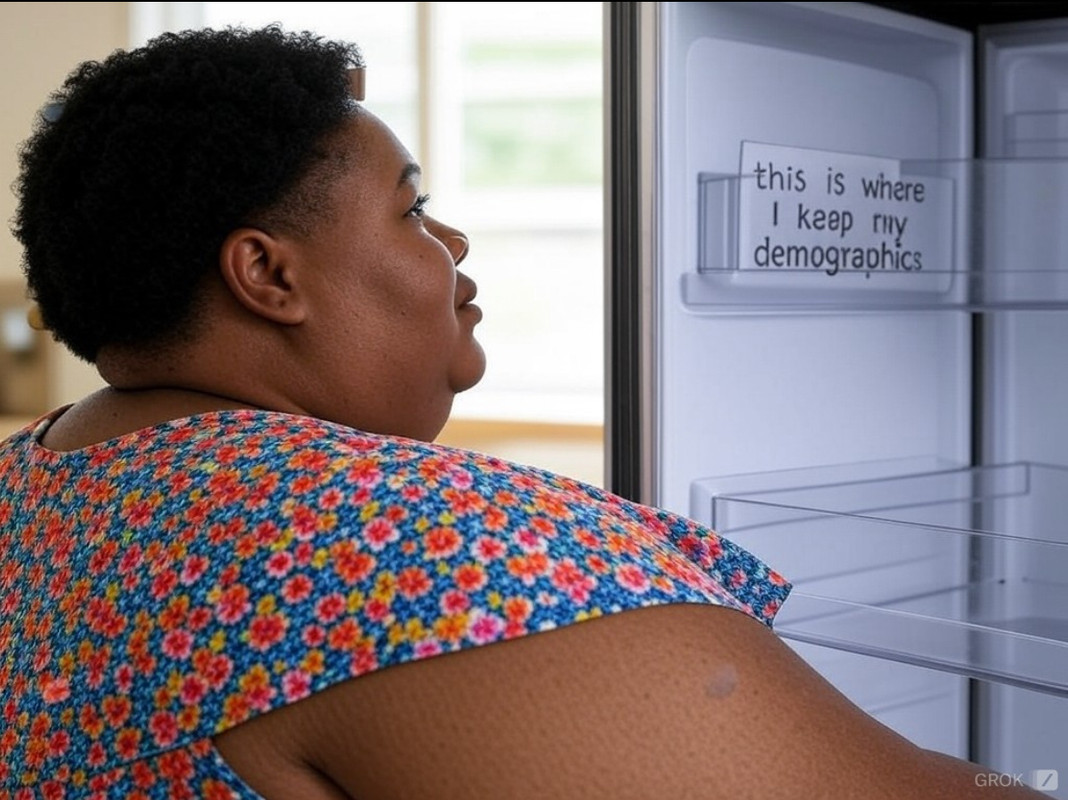
Comparing America's diverse population with mostly white homogenous populations is wrong and misleading. If you want to see how the healthcare system actually compares, like subsets of culture have to be compared to like peers across different countries and healthcare systems.
Anything else is meaningless and worse, misleading.
Anything else is meaningless and worse, misleading.

Posted on 12/17/24 at 12:18 am to Timeoday
They want you sick.
They are poisoning us via our food supply.
Tons of chemicals in our foods to make them shelf stable. GMO foods where your vegetables and your corn and you wheat is all GMO. Ultraprocesed foods. Sugar in food that never had sugar in it before. Misapplication of vaccines. And now the use of a mRNA shot that was NEVER successfully used in the past.
They want you dead and they want to make money off of the process of killing you.
They are poisoning us via our food supply.
Tons of chemicals in our foods to make them shelf stable. GMO foods where your vegetables and your corn and you wheat is all GMO. Ultraprocesed foods. Sugar in food that never had sugar in it before. Misapplication of vaccines. And now the use of a mRNA shot that was NEVER successfully used in the past.
They want you dead and they want to make money off of the process of killing you.
Posted on 12/17/24 at 12:30 am to Timeoday
Replace "healthcare" with "education" and you get pretty much the same results.
The dumbing down and fattening up of America are both planned destructions
The dumbing down and fattening up of America are both planned destructions

Posted on 12/17/24 at 12:37 am to Timeoday
The number of obese people employed in the medical industry is staggering.
The amount of otherwise dead weight (simple business operational efficiency) in the medical industry, which is 1/5th of the economy, is staggering.
The hubris and greed of these fat, overpaid, and mostly incompetent people employed in medicine, is staggering.
The amount of otherwise dead weight (simple business operational efficiency) in the medical industry, which is 1/5th of the economy, is staggering.
The hubris and greed of these fat, overpaid, and mostly incompetent people employed in medicine, is staggering.

Posted on 12/17/24 at 1:40 am to SloaneRanger
quote:
And don’t forget about the gun violence in big cities.
Once you adjust for US gun violence, our life expectancy jumps significantly into middle of the road (IIRC).

 Page 2 of 3

Popular
Back to top
 Follow TigerDroppings for LSU Football News