




- My Forums
- Tiger Rant
- LSU Recruiting
- SEC Rant
- Saints Talk
- Pelicans Talk
- More Sports Board
- Fantasy Sports
- Golf Board
- Soccer Board
- O-T Lounge
- Tech Board
- Home/Garden Board
- Outdoor Board
- Health/Fitness Board
- Movie/TV Board
- Book Board
- Music Board
- Political Talk
- Money Talk
- Fark Board
- Gaming Board
- Travel Board
- Food/Drink Board
- Ticket Exchange
- TD Help Board
Customize My Forums- View All Forums
- Show Left Links
- Topic Sort Options
- Trending Topics
- Recent Topics
- Active Topics
Started By
Message
re: Milton Friedman quotes on protective tariffs
Posted on 8/18/23 at 9:02 pm to MAADFACTS


Posted on 8/18/23 at 9:02 pm to MAADFACTS
quote:
2. There are things we need to produce here for national security. What was done to US Steel in the name of free trade is essentially treason
^^^ this. ^^^
A textbook case of the theft of an entire industry segment … just like textiles, …electronics, …. optronics, …. etc., … etc., … etc. … This is the globalist way of theft on a grand scale ….. with the tacit support of their allied media.
Tariffs are useful in getting opponents/partners to the bargaining table …. very useful, in fact.

 0
0


Posted on 8/18/23 at 10:40 pm to HailHailtoMichigan!
I've never studied economics, and have never read any of Friedman's works, but understand he is revered by many. Perhaps he's right about tariffs always being bad, but nothing in this post/thread proves this point imho, and the argument as presented seems simplistic to me. So, I'm going to play devil's advocate here. Since I don't know the depth of MF's thought, I will be limited to what you've posted as well as my basic opinions.
Some of my critique will touch upon the nature of the relationship with the trading partner (reciprocity)-- China in this case-- which he (or you) broaches, but dismisses without really addressing the issues. This dismissal without proving anything is my primary objection.
-----
Regarding the first quote about benefits of a tariff being visible, especially to "protected" union workers at the expense of others who don't know they don't have jobs because of tariffs...
As this quote stands, it is a mere statement without proof. Friedman tacitly admits union jobs are protected. So, some jobs are protected then, yes? Yes! And these are jobs that actually produce something, so they're productive jobs, yes? Yes, they are. While I doubt Milton Friedman is a fan of unions, I'd be curious to see him argue they aren't productive jobs-- even if not ideally productive.
But his implied critique is otherwise completely unsubstantiated unless he can explain what jobs are not created? It may well be the dumb example he provides in the second quote about useless jobs with people digging and refilling holes without being truly productive (in the context of providing a good or service) are the only jobs that the tariff prevents from being created. Of course, that's not what he means. But what does he mean? I'm not a Friedman scholar, but from what you posted, it's just an empty series of words like a rallying cry against tariff without any real substance. It's a bit of a tautology to say the jobs that are protected by tariffs prevent other jobs from being created.
And I'm suddenly reminded of Merry telling the Ent in Lord of the Rings that, "the closer we are to danger, the further we are from harm".
----
Regarding the 2nd quote, that tariff proponents imply that all jobs are good when we really just want productive ones; that work can be its own reward but is mostly the price we pay to geth the things we want...
In the context of framing the idea that jobs should be productive and drive the creation of goods and services, I agree, and I get why he posited the exaggerated example of the unproductive job of digging and refilling holes as the counterpoint. But before citing the example of useful vs useless jobs, he says, "supporters of tariffs treat it as self-evident that the creation of jobs is a desirable end, in and of itself, regardless of what the persons employed do. That is clearly wrong." I question the accuracy of this portrayal. It appears to me that he's taking liberties to frame tariff supporters as a simplistic monolith. Are all tariff supporters the same and do they all think every single useless job is a good job? I doubt it, and this makes his argument disingenuous. It's akin to Democrats saying if you support Trump, you're racist, which is preposterous. Or, if-- according to Biden-- you're an African American and you don't vote for him, you ain't black. These modern examples try to slyly assume a moral high ground on a flimsy reductio al absurdum-ish premise, and the arguments don't pass muster under the weight of any critical thought. Neither does Milton's argument here. He paints with too broad of a brush, attempting to singlularly dismiss all critics with one brush stroke: that his opponents are all the same and only he has the capacity to understand the nuance between a useful and useless job. He should explain how tariff proponents are of one stripe and don't want productive jobs as he does to make this claim credible.
Beyond treating tariff proponents with a reductionist brush, and I suspect unfairly trying to say they uniformly want to treat useless jobs as being just as valuable as genuinely productive jobs, he doesn't really make any effort to otherwise say how these proponents are wrong. The argument is weak.
----
Regarding the typed out part of your post, there are three paragraphs, but only the first one has quotes. Are the 2nd & 3rd paragraphs a continuation of his words or are they yours?
I see the 1st paragraph states in quotes the position of Chinese tariff proponents. The 2nd paragraph says despite the reasonable appearance of the 1st paragraph, it is "utter nonsense". Okay, but how? He (or you) then claims with the definitive air of a gotcha that, "Exports are the cost of trade, imports the return from trade, not the other way around." That's a nice soundbite, but does it really prove the claim in the previous paragraph is nonsense. I've never taken an econ class, so might be missing something, but all I see is him making a counterclaim without backing it up.
If the 3rd paragraph is supposed to support the counterclaim, it doesn't appear to do so to me. In fact, he (or you, since there aren't quotes here) is guilty of the same lack of nuance he accused his opponents of. If China blocks all US imports and unloads all their exports on the US, he laughs it off that we have all the stuff, and they just have a bunch of useless paper or numbers on a computer ($USD). That's paraphrasing everything he says to justify his counterpoint.
He doesn't really even address the concept of reciprocity / fairness. He side-steps it by saying, "they get our useless paper dollars and we get stuff, heh heh!" If the quotes & thoughts presented here are the extent of his thought, it is incomplete.
Does Milton address what happens to the US produced goods the US cannot export to China or otherwise sell? Remember, Milton presumably likes "productive" jobs, so I doubt he wants the US to lose productive jobs (just the unproductive ones). Where does he draw the line? Does he offer guidance to protect and encourage useless jobs-- especially in the face of a trading partner who uses unfair tactics the way China seems to do?
What is his opinion on losing the advantage of both useful manufacturing ability and useful technical know how of whole industries the way the US has lost them for whole industries like battery tech?
What does he think when the imbalance results in China converting all the trillions of USD they acquired into monopolistic control of natural resources in Africa and other parts of the world to further dictate trade imbalance against the US? (instead of letting those USD sit in either a US or China bank as he short-sightedly joked)?
Does Milton, who at the time of these quotes already seems to have a low opinion of the USD as relatively worthless paper, consider how losing industries and assets to Asia (China in particular) affects the underlying worth of the USD, the ability of US companies to create productive jobs, and for people working in those productive jobs to utilize the increasingly worthless USD to live free, happy, and productive lives?
This is off the top of my head as someone not well versed in economics-- at all. I'm open to hearing how Milton addresses some of these issues... something hopefully more in depth than SFP's mocking assertion that Milton so addressed that in the 70s ('that' being exceptions to unrestricted free trade to make things fair).
Until then, based on what's in this thread, Milton Friedman just seems like the Dick Vitale hype man of libertarian free trade... "C'mon, tariffs are utter nonsense! Give us free trade, baby!"
Some of my critique will touch upon the nature of the relationship with the trading partner (reciprocity)-- China in this case-- which he (or you) broaches, but dismisses without really addressing the issues. This dismissal without proving anything is my primary objection.
-----
Regarding the first quote about benefits of a tariff being visible, especially to "protected" union workers at the expense of others who don't know they don't have jobs because of tariffs...
As this quote stands, it is a mere statement without proof. Friedman tacitly admits union jobs are protected. So, some jobs are protected then, yes? Yes! And these are jobs that actually produce something, so they're productive jobs, yes? Yes, they are. While I doubt Milton Friedman is a fan of unions, I'd be curious to see him argue they aren't productive jobs-- even if not ideally productive.
But his implied critique is otherwise completely unsubstantiated unless he can explain what jobs are not created? It may well be the dumb example he provides in the second quote about useless jobs with people digging and refilling holes without being truly productive (in the context of providing a good or service) are the only jobs that the tariff prevents from being created. Of course, that's not what he means. But what does he mean? I'm not a Friedman scholar, but from what you posted, it's just an empty series of words like a rallying cry against tariff without any real substance. It's a bit of a tautology to say the jobs that are protected by tariffs prevent other jobs from being created.
And I'm suddenly reminded of Merry telling the Ent in Lord of the Rings that, "the closer we are to danger, the further we are from harm".
----
Regarding the 2nd quote, that tariff proponents imply that all jobs are good when we really just want productive ones; that work can be its own reward but is mostly the price we pay to geth the things we want...
In the context of framing the idea that jobs should be productive and drive the creation of goods and services, I agree, and I get why he posited the exaggerated example of the unproductive job of digging and refilling holes as the counterpoint. But before citing the example of useful vs useless jobs, he says, "supporters of tariffs treat it as self-evident that the creation of jobs is a desirable end, in and of itself, regardless of what the persons employed do. That is clearly wrong." I question the accuracy of this portrayal. It appears to me that he's taking liberties to frame tariff supporters as a simplistic monolith. Are all tariff supporters the same and do they all think every single useless job is a good job? I doubt it, and this makes his argument disingenuous. It's akin to Democrats saying if you support Trump, you're racist, which is preposterous. Or, if-- according to Biden-- you're an African American and you don't vote for him, you ain't black. These modern examples try to slyly assume a moral high ground on a flimsy reductio al absurdum-ish premise, and the arguments don't pass muster under the weight of any critical thought. Neither does Milton's argument here. He paints with too broad of a brush, attempting to singlularly dismiss all critics with one brush stroke: that his opponents are all the same and only he has the capacity to understand the nuance between a useful and useless job. He should explain how tariff proponents are of one stripe and don't want productive jobs as he does to make this claim credible.
Beyond treating tariff proponents with a reductionist brush, and I suspect unfairly trying to say they uniformly want to treat useless jobs as being just as valuable as genuinely productive jobs, he doesn't really make any effort to otherwise say how these proponents are wrong. The argument is weak.
----
Regarding the typed out part of your post, there are three paragraphs, but only the first one has quotes. Are the 2nd & 3rd paragraphs a continuation of his words or are they yours?
I see the 1st paragraph states in quotes the position of Chinese tariff proponents. The 2nd paragraph says despite the reasonable appearance of the 1st paragraph, it is "utter nonsense". Okay, but how? He (or you) then claims with the definitive air of a gotcha that, "Exports are the cost of trade, imports the return from trade, not the other way around." That's a nice soundbite, but does it really prove the claim in the previous paragraph is nonsense. I've never taken an econ class, so might be missing something, but all I see is him making a counterclaim without backing it up.
If the 3rd paragraph is supposed to support the counterclaim, it doesn't appear to do so to me. In fact, he (or you, since there aren't quotes here) is guilty of the same lack of nuance he accused his opponents of. If China blocks all US imports and unloads all their exports on the US, he laughs it off that we have all the stuff, and they just have a bunch of useless paper or numbers on a computer ($USD). That's paraphrasing everything he says to justify his counterpoint.
He doesn't really even address the concept of reciprocity / fairness. He side-steps it by saying, "they get our useless paper dollars and we get stuff, heh heh!" If the quotes & thoughts presented here are the extent of his thought, it is incomplete.
Does Milton address what happens to the US produced goods the US cannot export to China or otherwise sell? Remember, Milton presumably likes "productive" jobs, so I doubt he wants the US to lose productive jobs (just the unproductive ones). Where does he draw the line? Does he offer guidance to protect and encourage useless jobs-- especially in the face of a trading partner who uses unfair tactics the way China seems to do?
What is his opinion on losing the advantage of both useful manufacturing ability and useful technical know how of whole industries the way the US has lost them for whole industries like battery tech?
What does he think when the imbalance results in China converting all the trillions of USD they acquired into monopolistic control of natural resources in Africa and other parts of the world to further dictate trade imbalance against the US? (instead of letting those USD sit in either a US or China bank as he short-sightedly joked)?
Does Milton, who at the time of these quotes already seems to have a low opinion of the USD as relatively worthless paper, consider how losing industries and assets to Asia (China in particular) affects the underlying worth of the USD, the ability of US companies to create productive jobs, and for people working in those productive jobs to utilize the increasingly worthless USD to live free, happy, and productive lives?
This is off the top of my head as someone not well versed in economics-- at all. I'm open to hearing how Milton addresses some of these issues... something hopefully more in depth than SFP's mocking assertion that Milton so addressed that in the 70s ('that' being exceptions to unrestricted free trade to make things fair).
Until then, based on what's in this thread, Milton Friedman just seems like the Dick Vitale hype man of libertarian free trade... "C'mon, tariffs are utter nonsense! Give us free trade, baby!"
Posted on 8/18/23 at 10:49 pm to frogtown
quote:
There are "zero" modern economists who advocate the use of tariffs. None.
Cool story, bro. There is no economic and political pressure I'm not in favor of to permanently destroy China.
This post was edited on 8/18/23 at 11:05 pm
Posted on 8/18/23 at 10:53 pm to SlowFlowPro
And the populist votes down votes rain down!
But they are the "real" conservatives.
But they are the "real" conservatives.
Posted on 8/18/23 at 11:06 pm to MAADFACTS
quote:
There’s a difference between someone who doesn’t want to work in an area where there are jobs to be had. It’s another thing entirely when entire regions lose their jobs at the same time. Go to the rust belt or Appalachia and tell those folks they are lazy losers to their faces
A train ride from NY to DC shows a great many empty former factories along the side of the track.
Interestingly, a lot of Chinese manufacturing done for American companies is not moving to other countries.
Robotics and maybe AI is the key.
Posted on 8/19/23 at 4:34 am to HailHailtoMichigan!
What they do with the money is build up their military, build more bases around world, support Iran, threaten Tawain and buy up more land around our military bases in US. They pay off the Bidens.
They are out number one threat
They are out number one threat

Posted on 8/19/23 at 4:56 am to HailHailtoMichigan!
quote:In current context, and d/t horrible TDS, you seem to conflate "protective tariffs" and "corrective tariffs."
Milton Friedman quotes on protective tariffs
Protective tariffs are unilateral, unprovoked, protective and often ultimately harmful to those whom the action was intended to protect.
Corrective tariffs are designed to compensate for unfair trade practice. E.g., China wants to crush and control the international steel industry. So they heavily subsidize their steel exports, creating an artificially low price for steel. After they've driven competitors out of business, they use their monopoly and restart-up cost buffer to raise prices. Corrective tariffs compensate for the predatory subsidies.
This post was edited on 8/19/23 at 4:59 am


Posted on 8/19/23 at 6:37 am to MAADFACTS
quote:
There are things we need to produce here for national security
That is a different argument and that policy has to be applied somewhat limitedly or else you're just effectively a hardcore socialist.
Posted on 8/19/23 at 6:40 am to SlowFlowPro
quote:
But but my unskilled, lower level union manufacturing jobs! We must devolve our economy to save them from adapting to modern life! Bootstraps don't exist for them!
If we've evolved past using those products then the tariffs are pointless, right?
Posted on 8/19/23 at 6:40 am to NC_Tigah
quote:
In current context, and d/t horrible TDS, you seem to conflate "protective tariffs" and "corrective tariffs."
quote:
Corrective tariffs are designed to compensate for unfair trade practice. E.g., China wants to crush and control the international steel industry. So they heavily subsidize their steel exports, creating an artificially low price for steel.
HHTM may have confused something, but Friedman did not
Cartoon version
Live action version
This post was edited on 8/19/23 at 6:41 am

Posted on 8/19/23 at 6:44 am to JimNat
quote:
They are out number one threat
The current corruption in DC is our clear number one threat …. to both our Liberty and our prosperity

Posted on 8/19/23 at 6:45 am to Azkiger
quote:
If we've evolved past using those products
Nobody argued this. We clearly use them. We clearly purchase them.
The argument is whether or not making US consumers pay more to subsidize these jobs (a socialist redistribution) and removing that surplus spending on other goods made in the US from more advanced outputs (thus, destroying those jobs and industries) is efficient and makes our economy more productive, especially if this reduces China's purchase of our goods at the same time.
Posted on 8/19/23 at 6:57 am to SlowFlowPro
quote:
The argument is whether or not making US consumers pay more to subsidize these jobs (a socialist redistribution) and removing that surplus spending on other goods made in the US from more advanced outputs (thus, destroying those jobs and industries) is efficient and makes our economy more productive, especially if this reduces China's purchase of our goods at the same time.
I'm for avoiding these sorts of tariffs if we lower taxes and or regulations on these sorts of businesses, because that's really what's making them seem necessary.
Our government is sitting on these businesses and the Chinese government isnt.
Posted on 8/19/23 at 6:59 am to Azkiger
quote:
I'm for avoiding these sorts of tariffs if we lower taxes and or regulations on these sorts of businesses, because that's really what's making them seem necessary.
Sure. Fine. I'm trying to get government out of the economy, not add more government to the economy (like Trump's socialism). You know what Socialists like to say, "we'll get it right this time." In this context, "this time" = tariffs.
Posted on 8/19/23 at 7:03 am to HailHailtoMichigan!
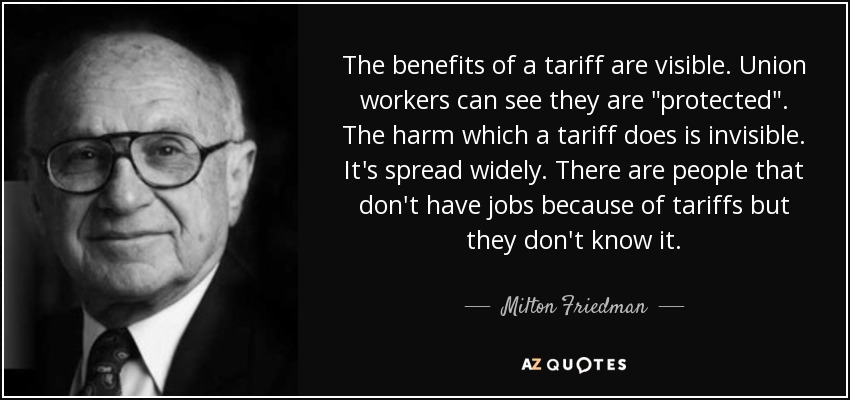
Spot on.
Its great for unions where market forces are loathed and woke corporations, but not so much for anyone else.
Posted on 8/19/23 at 7:06 am to Azkiger
quote:
If we've evolved past using those products then the tariffs are pointless, right?
We have evolved beyond manufacturing those products which is why lesser skilled, lower paid workers are required.
We mfg what is efficient, we don't mfg what is less efficient. Tariffs propose to prop up inefficient industry.
Posted on 8/19/23 at 7:09 am to SlowFlowPro
quote:
Sure. Fine. I'm trying to get government out of the economy, not add more government to the economy (like Trump's socialism). You know what Socialists like to say, "we'll get it right this time." In this context, "this time" = tariffs.
Not biting.
The point of socialism is wealth redistribution.
The point of these tariffs is to level the playing field the government fricked up.
Reverse the frick up or take corrective measures for said frick up.
Posted on 8/19/23 at 7:18 am to Azkiger
quote:
The point of these tariffs is to level the playing field the government fricked up.
For whom?
The alternative is automation.
Posted on 8/19/23 at 7:25 am to Azkiger
quote:
The point of socialism is wealth redistribution.
That's the point of these tariffs
quote:
The point of these tariffs is to level the playing field the government fricked up
Adding more government to fix the problems of government is the Hallmark of socialist political philosophy
You're even using terms of level the playing field which is a key phrase for socialists
Posted on 8/19/23 at 7:39 am to Azkiger
quote:
The point of socialism is wealth redistribution.
Same with tariffs or any other protectionist measures.

 Page 3 of 9

Popular
Back to top
 Follow TigerDroppings for LSU Football News