


- My Forums
- Tiger Rant
- LSU Recruiting
- SEC Rant
- Saints Talk
- Pelicans Talk
- More Sports Board
- Coaching Changes
- Fantasy Sports
- Golf Board
- Soccer Board
- O-T Lounge
- Tech Board
- Home/Garden Board
- Outdoor Board
- Health/Fitness Board
- Movie/TV Board
- Book Board
- Music Board
- Political Talk
- Money Talk
- Fark Board
- Gaming Board
- Travel Board
- Food/Drink Board
- Ticket Exchange
- TD Help Board
Customize My Forums- View All Forums
- Show Left Links
- Topic Sort Options
- Trending Topics
- Recent Topics
- Active Topics
Started By
Message


 1
1


Posted on 2/14/25 at 10:12 pm to anc
You use the fact that (x,x) lies on the hypotenuse.
Put the triangle on a graph where the base is the x axis and the height is the y-axis.
Determine the slope of the hypotenuse using (y1-y2)/(x1-x2).
You get -(20+x)/(5+x).
Now that you have the slope, derive the equation of the line using point-slope form: (y-y1)=m(x-x1)
Which is: y=(20+x)/(5+x)*5
Since we know that (x,x) lies on the hypotenuse, we know that we can substitute x for y in the line’s equation:
X=(20+x)/(5+x)*5
Simplify to x^2=100; x=10
Therefore the area of the square is x*x=100
Put the triangle on a graph where the base is the x axis and the height is the y-axis.
Determine the slope of the hypotenuse using (y1-y2)/(x1-x2).
You get -(20+x)/(5+x).
Now that you have the slope, derive the equation of the line using point-slope form: (y-y1)=m(x-x1)
Which is: y=(20+x)/(5+x)*5
Since we know that (x,x) lies on the hypotenuse, we know that we can substitute x for y in the line’s equation:
X=(20+x)/(5+x)*5
Simplify to x^2=100; x=10
Therefore the area of the square is x*x=100
Posted on 2/14/25 at 10:13 pm to anc
Looks like they are similar triangles.
Would have same ratio for sides.
I would go with 10 for the sides of the square.
20:10 for the bigger triangle. 10:5 for the smaller.
So 100 sq units for area of square.
Would have same ratio for sides.
I would go with 10 for the sides of the square.
20:10 for the bigger triangle. 10:5 for the smaller.
So 100 sq units for area of square.


Posted on 2/14/25 at 10:16 pm to anc
This is one of those stupid internet math problems where they intentionally make it deceiving to make people have a debate over it. To begin, it’s not drawn to scale.


Posted on 2/14/25 at 10:17 pm to anc
I can but she couldn't. But she also can meet someone and tell you all their secrets and faults within 5 minutes. I think everyone is my friend.


Posted on 2/14/25 at 10:19 pm to anc
Quick first glance... 100 square units.
Could probably check that pretty easily with the pythagorean theorem.. but ain't nobody got time for that on a Friday night.
Could probably check that pretty easily with the pythagorean theorem.. but ain't nobody got time for that on a Friday night.
Posted on 2/14/25 at 10:48 pm to anc
It's quite simple. No algebra needed. Only 4th grade geometry and 5th grade fractions.
A square has equal sides. (Geometry)
1/2 × 20 =10 (Fractions/Decimals)
5 ÷ 1/2 =10 (Fractions/Decimals)
10 ×10 =100 (I'm not lazy. I can figure this out.)
It's not lack of intelligence. It's lack of motivation to find a way. People in general are too lazy to try, so they come up with excuses; then go back to watching Married at First Sight.
ETA: Probably the same phucktards that procreate with guys from the other post that never asked a girl out.
A square has equal sides. (Geometry)
1/2 × 20 =10 (Fractions/Decimals)
5 ÷ 1/2 =10 (Fractions/Decimals)
10 ×10 =100 (I'm not lazy. I can figure this out.)
It's not lack of intelligence. It's lack of motivation to find a way. People in general are too lazy to try, so they come up with excuses; then go back to watching Married at First Sight.
ETA: Probably the same phucktards that procreate with guys from the other post that never asked a girl out.
This post was edited on 2/14/25 at 11:07 pm

Posted on 2/14/25 at 10:54 pm to castorinho
quote:
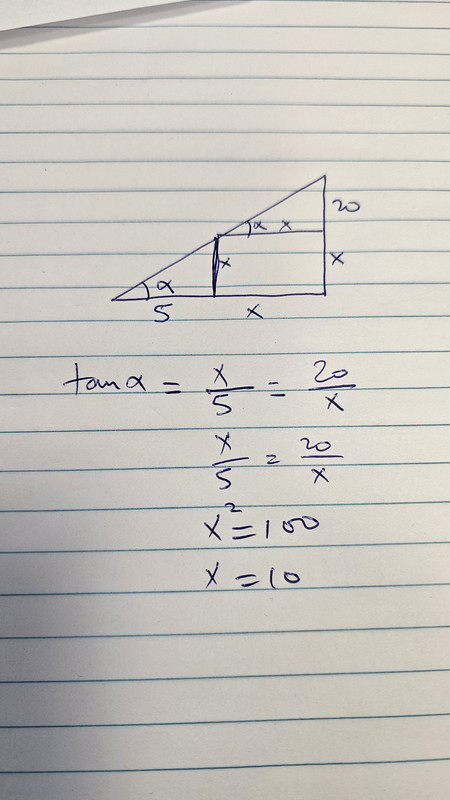
If X = 10, does the hypotenuse of the largest triangle then equal the sum of the hypotenuses of the 2 smaller triangles?
EDIT: I was trying to find different ways to check answer. Like if x = 10 then area of the large triangle minus the areas of the 2 smaller ones should equal the area of the square - 10 x 10.
This post was edited on 2/14/25 at 11:27 pm

Posted on 2/14/25 at 11:39 pm to Ingeniero
quote:
For fun, there's a way to do it without trig functions at all. You know the area of the whole shape and the area of the parts have to be equal. You can set up equations, set them equal to each other, and solve for x.
I took every advanced math my high school offered and tested out of almost all college requirements. As a result, I've not done any math beyond simple carpentry and percentages/interest in years.
What's funny is rather than my brain recalling any of the math I had learned in school, it instead went to a practical application...which took this route over the trig functions.
Posted on 2/14/25 at 11:41 pm to dallastigers
quote:
If X = 10, does the hypotenuse of the largest triangle then equal the sum of the hypotenuses of the 2 smaller triangles?
Respect having ruled paper around......


Posted on 2/15/25 at 1:49 pm to BlackAdam
quote:
Nobody can solve that without making assumptions.
I used my dial calipers on the image on my computer screen.
The bottom dimension of the green area was 40% longer than the "5" dimension line. Whatever "5" represents, inches, feet or miles?
So this means that the green area is "7" squared, so the green area is 49 square whatever.

Posted on 2/15/25 at 2:00 pm to X123F45
quote:
I took every advanced math my high school offered and tested out of almost all college requirements. As a result, I've not done any math beyond simple carpentry and percentages/interest in years.
What's funny is rather than my brain recalling any of the math I had learned in school, it instead went to a practical application...which took this route over the trig functions.
That's exactly why I decided to post that solution. I took every math available in high school then calc 1-3 and diff eq in college, but my brain said "hey just find the areas"

Posted on 2/15/25 at 2:24 pm to anc
Assume sides of square are each "x", so ?=x^2
Area of overall triangle: 1/2*(5+x)*(20+x)
Break big triangle into: ? + A + B where ?=x^2, A=1/2*5*x, B=1/2*20*x
Area of overall Triangle is equal to sum of 3 smaller areas.
Therefore, 1/2*(5+x)*(20+x) = ? + A + B = x^2 + 1/2*5*x + 1/2*20*x
Solve for x, you get x = -10 and 10. Then ? = x^2, so ? = 100 units^2
Area of overall triangle: 1/2*(5+x)*(20+x)
Break big triangle into: ? + A + B where ?=x^2, A=1/2*5*x, B=1/2*20*x
Area of overall Triangle is equal to sum of 3 smaller areas.
Therefore, 1/2*(5+x)*(20+x) = ? + A + B = x^2 + 1/2*5*x + 1/2*20*x
Solve for x, you get x = -10 and 10. Then ? = x^2, so ? = 100 units^2
Posted on 2/15/25 at 2:36 pm to anc
answer is 100.
I started to solve this using Pythagoras but that creates three equations and three unknowns. Forget that.
Simple answer is to add up the area of the triangles and square and set equal to the area of the whole and just solve for x.
I don't know a single woman who could solve this outside of my high school calculus teacher. I only mention her because she was hot blonde that could do calculus. It was hard to learn under her.
I started to solve this using Pythagoras but that creates three equations and three unknowns. Forget that.
Simple answer is to add up the area of the triangles and square and set equal to the area of the whole and just solve for x.
I don't know a single woman who could solve this outside of my high school calculus teacher. I only mention her because she was hot blonde that could do calculus. It was hard to learn under her.
Posted on 2/15/25 at 2:41 pm to anc
I started doing the math and ended up with a fourth power polynomial. I proceeded to give up.
Posted on 2/15/25 at 2:44 pm to anc
Square area = x^2
(1/2)5x = small triangle
(1/2)20x = big triangle
(5+x)(20+x)(1/2) = 10x + (5/2)x +x^2
(100+25x +x^2)(1/2)
50+(25/2)x+(×^2)/2 = (25/2)x + x^2
50 = (1/2)x^2
100= x^2
X=10
Area=100
(1/2)5x = small triangle
(1/2)20x = big triangle
(5+x)(20+x)(1/2) = 10x + (5/2)x +x^2
(100+25x +x^2)(1/2)
50+(25/2)x+(×^2)/2 = (25/2)x + x^2
50 = (1/2)x^2
100= x^2
X=10
Area=100
Posted on 2/15/25 at 2:56 pm to anc
The illustration doesn't jibe with the dimensions given.
The "5" dimension is half as long as the "20" dimension.
The "5" dimension is half as long as the "20" dimension.

Posted on 2/15/25 at 3:18 pm to auggie
quote:That's deliberate. Years ago in JrHigh, when they accurately diagramed similar stuff, I "solved" a couple of "trig" problems on an achievement test using a makeshift ruler. LOL
The illustration doesn't jibe with the dimensions given.

This post was edited on 2/15/25 at 3:20 pm
Posted on 2/15/25 at 3:28 pm to anc
That's a 1-2-3 triangle (base (a) being 1, height (b) being 2, hypotenuse (c) being 3. That means the base length is half the height.
The square has to have equal sides, so the only way 2a=b is if a=15 and b=30 and each side of the square is 10, so then 10x10=100.
The square has to have equal sides, so the only way 2a=b is if a=15 and b=30 and each side of the square is 10, so then 10x10=100.
Posted on 2/15/25 at 3:38 pm to Planetarium
quote:
Hell, I can’t solve that.
You got to be kidding me...

 Page 9 of 10
Popular
Back to top
 Follow TigerDroppings for LSU Football News