




 1
1




- My Forums
- Tiger Rant
- LSU Recruiting
- SEC Rant
- Saints Talk
- Pelicans Talk
- More Sports Board
- Fantasy Sports
- Golf Board
- Soccer Board
- O-T Lounge
- Tech Board
- Home/Garden Board
- Outdoor Board
- Health/Fitness Board
- Movie/TV Board
- Book Board
- Music Board
- Political Talk
- Money Talk
- Fark Board
- Gaming Board
- Travel Board
- Food/Drink Board
- Ticket Exchange
- TD Help Board
Customize My Forums- View All Forums
- Show Left Links
- Topic Sort Options
- Trending Topics
- Recent Topics
- Active Topics
Started By
Message
re: Employer 401k vs Roth 401K
Posted on 5/15/26 at 12:16 pm to GoCrazyAuburn
Posted on 5/15/26 at 12:16 pm to GoCrazyAuburn
quote:
My opinion is that taxes have to go up between now and the time I retire
Agree.
I am telling my kids to plan as if Roth will not exist in the future. Therefore, treat it with white gloves today while it is here.
Posted on 5/15/26 at 12:43 pm to Bestbank Tiger
This is an incredibly lazy internet answer. The assumption being TCJA never gets repealed once the Republicans screw this all up? Seems like a big "never".
Assuming they do...
220k now is a marginal bracket of 22% and after standard deduction, spins off $31,144 in federal tax.
180k after it's repealed, marginal tax rate of 28% and after standard deduction is $31,461 in federal tax.
Assuming they do...
220k now is a marginal bracket of 22% and after standard deduction, spins off $31,144 in federal tax.
180k after it's repealed, marginal tax rate of 28% and after standard deduction is $31,461 in federal tax.
Posted on 5/15/26 at 2:36 pm to LSUFanHouston
quote:12% every time. It's not about cumulative taxes paid. It is which yields highest withdrawals net of taxes.
Would you rather save 24% on 10k or 12% on $80k?
If you pay higher rate up front it leaves you with less invested capital. That's why if current rate and rate at withdrawal are equal it is a wash.
This post was edited on 5/15/26 at 2:38 pm
Posted on 5/15/26 at 4:48 pm to TorchtheFlyingTiger
quote:
12% every time. It's not about cumulative taxes paid. It is which yields highest withdrawals net of taxes. If you pay higher rate up front it leaves you with less invested capital.
That’s a very short term strategy.
Years of tax free growth will override short term cash outlay.
Assuming of course you think there will be growth.
Long term, giving less cumulative taxes to government could mean a lot
Posted on 5/15/26 at 5:58 pm to LSUFanHouston
It's basic math not "a very short term strategy" 
If given $X to invest for the same # of years and growth rate the net result is the same whether you pay tax up front or at the end. So, if the tax rates are known (12% vs 22%) the lower rate is going to yield the best outcome whether or not it is paid up front (Roth) or at end ((traditional.)
That's also known as the commutative property of multiplication.
If given $X to invest for the same # of years and growth rate the net result is the same whether you pay tax up front or at the end. So, if the tax rates are known (12% vs 22%) the lower rate is going to yield the best outcome whether or not it is paid up front (Roth) or at end ((traditional.)
That's also known as the commutative property of multiplication.
This post was edited on 5/15/26 at 5:59 pm
Posted on 5/15/26 at 6:34 pm to LSUFanHouston
Maybe this will better illustrate the concept using the scenario #s you provided. 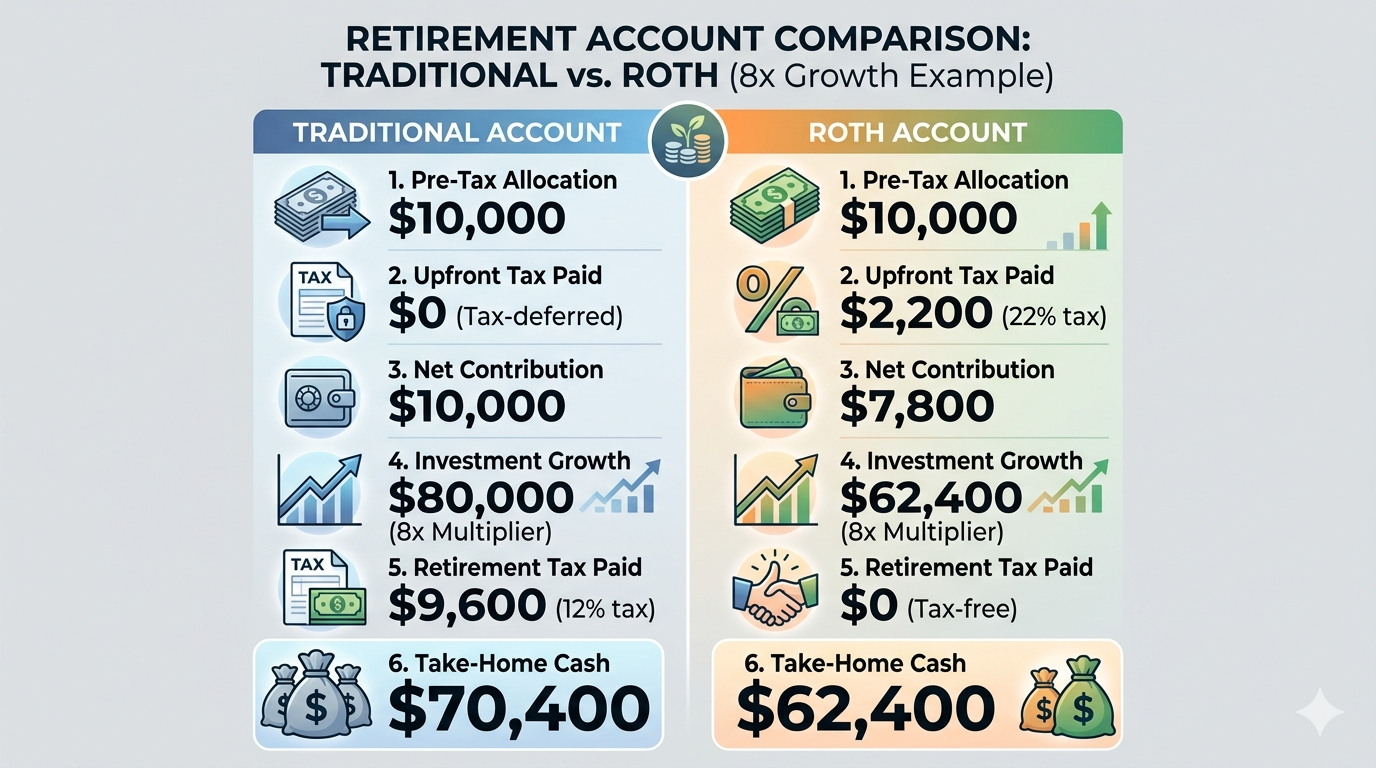
Posted on 5/15/26 at 6:47 pm to TorchtheFlyingTiger
So you are not contributing the same amount In your example.
Posted on 5/15/26 at 6:59 pm to LSUFanHouston
Of course I'm starting each example with $10k available to invest just as you suggested. If an individual has excess cash to pay the taxes then the starting amount in both cases should include that $. Why wouldn't they contribute it if we are solving for tax optimized strategy? Eta: (Addressing behavioral economics inefficiencies is another matter)
This post was edited on 5/15/26 at 8:08 pm
Posted on 5/15/26 at 8:37 pm to TorchtheFlyingTiger
Also there is the other issue I mentioned.
Good chance the retiree won’t be in a 12 percent bracket.
Good chance the retiree won’t be in a 12 percent bracket.
Posted on 5/15/26 at 10:49 pm to LSUFanHouston
This is correct, very little chance I’m in the 12% bracket at retirement. Will either be in the same 24% bracket I am now or 22% at lowest.
Posted on 5/16/26 at 9:15 am to SETH6180
Your age is a key factor. The more years the money can grow makes Roth a better choice. Most of us can make a good return on our investments. The length of time t has to grow tax free is probably the highest criteria for this decision.
Posted on 5/16/26 at 9:25 am to KTiger85
Again, that's not how the math works!
Given same number of years (and other variables) the results are same Roth vs Traditional.
Given same number of years (and other variables) the results are same Roth vs Traditional.
Posted on 5/16/26 at 9:51 am to Everyday Is Saturday
quote:
I am telling my kids to plan as if Roth will not exist in the future. Therefore, treat it with white gloves today while it is here.
Actually, it looks like the Gov. prefers for people to go Roth over Trad, gives them more revenue now.
If they tax the Roth, they will do it indirectly by counting it in you MAGI or similar method so that they can raise the taxes on your taxable income and still claim to have kept their promises. At least at first.
Posted on 5/16/26 at 11:42 am to TorchtheFlyingTiger
quote:
Maybe this will better illustrate the concept using the scenario #s you provided.
This makes quite a few assumptions though. Maybe they are able to get down to the 12% bracket but that’s a big assumption. It also makes a big difference if the person can max out the Roth regardless of the upfront tax, which is obviously plenty possible. So, just assuming that they wouldn’t be able to invest the full $10k into it out post tax isn’t really a fair comparison unless you actually know they couldn’t. I get the point of the comparison to doing $10k flat number, but a true analysis for most would be looking at investing the same number into the account, so both investments should be a full 10k to show what the actual investment growth levels are.
Not saying the analysis is wrong by any means, but it is just picking and choosing certain things to illustrate a specific point and not really a blanket example of reality completely.
This post was edited on 5/16/26 at 11:48 am
Posted on 5/16/26 at 12:09 pm to SETH6180
I'm 51, going to cut back a little on my 401k contributions and max out my Roth ($8600/yr) each year until I retire since I plan to retire around 58 and will have the option to withdraw capital from my Roth tax-free until I turn 59 1/2. Basically I'm treating my Roth as a bridge between when I retire and when I can withdraw from my larger 401k penalty-free.
ETA: I'm a government employee and don't receive a 401k employer-match benefit, which makes a private Roth IRA that much more appealing to me.
ETA: I'm a government employee and don't receive a 401k employer-match benefit, which makes a private Roth IRA that much more appealing to me.
This post was edited on 5/16/26 at 12:11 pm
Posted on 5/16/26 at 1:15 pm to SETH6180
I think this really depends on your age. I think there is a time for both. I’ve been doing the Roth 401k now for at least the last four years but I’m 53. As you get older, you want to make sure all of your money is not stuck in pre-tax accounts.
Posted on 5/17/26 at 10:04 pm to CockHolliday
quote:
I'm 51, going to cut back a little on my 401k contributions and max out my Roth ($8600/yr) each year until I retire
If your income levels prevent you from investing directly in a Roth, a back door Roth conversion may allow you to max your 401k AND get $8600/yr into Roth (including 50yo catch ups).
Posted on 5/19/26 at 5:52 pm to Bestbank Tiger
We do have a considerable amount of deductions that really help out
Posted on 5/20/26 at 8:48 am to LSUFanHouston
quote:
Good chance the retiree won’t be in a 12 percent bracket.
Why not? The image is about a 12% effective tax, as in paying a total of 12% in taxes. To get a 12% effective tax rate, using the standard deduction, would require $178k taxable income for the year. I feel like that is going to cover pretty close to 98-99% of retirees.
This post was edited on 5/20/26 at 8:50 am
Posted on 5/20/26 at 9:16 am to notsince98
I'm not sure I follow (but I'm also not confident in my#'s),
$178K - $32,200-$6,400-$12,000=$138,400 so 38,400 will be taxed at 22% correct?
There is a reason I'm not an accountant lol
$178K - $32,200-$6,400-$12,000=$138,400 so 38,400 will be taxed at 22% correct?
There is a reason I'm not an accountant lol

 Page 2 of 3


Popular

Back to top
 Follow TigerDroppings for LSU Football News