




 1
1




- My Forums
- Tiger Rant
- LSU Score Board
- LSU Recruiting
- SEC Rant
- SEC Score Board
- Saints Talk
- Pelicans Talk
- More Sports Board
- Fantasy Sports
- Golf Board
- Soccer Board
- O-T Lounge
- Tech Board
- Home/Garden Board
- Outdoor Board
- Health/Fitness Board
- Movie/TV Board
- Book Board
- Music Board
- Political Talk
- Money Talk
- Fark Board
- Gaming Board
- Travel Board
- Food/Drink Board
- Ticket Exchange
- TD Help Board
Customize My Forums- View All Forums
- Show Left Links
- Topic Sort Options
- Trending Topics
- Recent Topics
- Active Topics
Started By
Message
re: Self-esteem & the “Crisis of the Young”
Posted on 7/7/26 at 3:21 pm to 4cubbies
Posted on 7/7/26 at 3:21 pm to 4cubbies
quote:
External validation?
If it was only internal, why bother to post? You think what you think and if you (royal you) didn't care what anyone else thought, you'd just think it to yourself, right?
quote:
Do you think posters who are routinely heavily downvoted are seeking external validation?
Yeah. I am one of those posters roughly half the time.
This board is very predictable. I know what opinions will get downvoted and which ones will be upvoted.
My wife recently decided to put color in her hair and I asked her after Sunday if anyone had commented on it. She said she only talked to a couple of women after church, but they seemed to be deliberately avoiding saying anything about it (silently judging, mentally downvoting, as it were).
I told her that was a positive response. Given the taste of those two, if they had liked it and told her so, it probably wouldn't have been a look she really wanted to have.
And so it is with the downvotes I get here. It's still validation.
If I got nothing but upvotes here I'd worry that I had joined the MAGA cult. Every downvote I get is a reminder that I'm not in that cult.
This post was edited on 7/7/26 at 3:27 pm
Posted on 7/7/26 at 3:27 pm to 4cubbies
quote:
External validation? Do you think posters who are routinely heavily downvoted are seeking external validation?
Any attention is good attention when you’re a narcissist
Posted on 7/7/26 at 3:41 pm to wackatimesthree
quote:The poster is seeking stimulation, connection, competition, conflict, something.
If it was only internal, why bother to post? You think what you think and if you (royal you) didn't care what anyone else thought, you'd just think it to yourself, right?
quote:You don't need this place to remind yourself of that. You already know that. So what does posting here actually validate for you?
If I got nothing but upvotes here I'd worry that I had joined the MAGA cult. Every downvote I get is a reminder that I'm not in that cult.
Posted on 7/7/26 at 5:02 pm to 4cubbies
quote:
In the Introduction, Becker mentions the "Crisis of the Young," arguing that youth in the late 60s/early 70s were dropping out of social expectations (like college or practicing a religion) because they realized society deprives them of a chance to be find dignified meaning.
What "dignified meaning" were they being denied?
Posted on 7/7/26 at 6:46 pm to Bard
At the time Becker was writing, young men were being sent to die in Vietnam in a highly contentious war. Many didn’t experience dying in Vietnam as dignified or meaningful. They weren’t fighting Nazis or defending their homeland in the way previous generations understood their sacrifices. Instead, many saw themselves as expendable participants in a bureaucratic conflict whose purpose they neither understood nor believed in.
Civil rights struggles exposed contradictions in American ideals. The upheaval surrounding Vatican II and broader secularization caused many people to question religious authority. Divorce rates were climbing. Confidence in government collapsed during Vietnam and Watergate. The intellectual foundations of neoliberalism were beginning to spread, emphasizing individual responsibility over traditional institutions.
There was a pervasive sense of social instability. The traditional trajectory (go to college, get married, buy a home, spend forty years with one employer, retire with a pension) was losing credibility. Becker’s point, I think, is that many of the institutions that had historically provided people with a sense of dignified meaning were all being questioned, or perhaps exposed, at roughly the same time.
Civil rights struggles exposed contradictions in American ideals. The upheaval surrounding Vatican II and broader secularization caused many people to question religious authority. Divorce rates were climbing. Confidence in government collapsed during Vietnam and Watergate. The intellectual foundations of neoliberalism were beginning to spread, emphasizing individual responsibility over traditional institutions.
There was a pervasive sense of social instability. The traditional trajectory (go to college, get married, buy a home, spend forty years with one employer, retire with a pension) was losing credibility. Becker’s point, I think, is that many of the institutions that had historically provided people with a sense of dignified meaning were all being questioned, or perhaps exposed, at roughly the same time.
Posted on 7/7/26 at 11:23 pm to 4cubbies
quote:
The poster is seeking stimulation, connection, competition, conflict,
Which ultimately resolves into a validation of some kind.
"I won the competition, therefore I am worthy."
"I was able to make a connection, therefore I am worthy."
That just describes the nature of the validation.
This is one of those times I feel like I'm repeating the same thing over and over again failing to move the needle of the conversation, but also not knowing how else to say it.
I asked Google, "Is everything we do ultimately a strategy for validation?"
Google AI answer below:
quote:
It is a deep question. Ultimately, every human action can be tied to a core psychological need for validation.
We seek to validate our existence, our worth, and our place in the world.
However, "validation" means more than just fishing for compliments.
It is about understanding reality and maintaining a secure sense of self.
It breaks down into two main areas:
1. Social Validation. As human beings, we are wired to connect. Seeking external validation is often a basic drive to belong.
Social survival: When early humans cooperated, they survived. When they were rejected from a tribe, they died. Our brains still treat social approval as a reward. This reward is called dopamine.
Real-world example: Getting a degree, posting on social media, or buying a new car. These actions show others we are capable, which earns us respect and security.
2. Internal Validation. We also do things to validate ourselves. This means proving we are competent, safe, and true to our own values.
Self-discovery: We do hard things or make art to prove we are capable. This builds our confidence and helps us trust our own judgment.Real-world example: Practicing a sport, finishing a puzzle, or keeping a promise. These actions validate our self-image.
Maybe Google AI will help. What I just quoted above is what I think, what I've been trying to communicate.
Posted on 7/7/26 at 11:27 pm to 4cubbies
You are the female version of SFP
Posted on 7/7/26 at 11:48 pm to Sofaking2
quote:
You are the female version of SFP
Maybe literally.

Posted on 7/8/26 at 6:55 am to wackatimesthree
quote:
This is one of those times I feel like I'm repeating the same thing over and over again failing to move the needle of the conversation, but also not knowing how else to say it.
I think I understand what you’re getting at now. I just think “validation” is too broad a motive. If everything is validation, then the word doesn’t explain very much.
It seems like everything could be attributed to seeking validation, but sometimes perceived validation is actually profoundly invalidating.
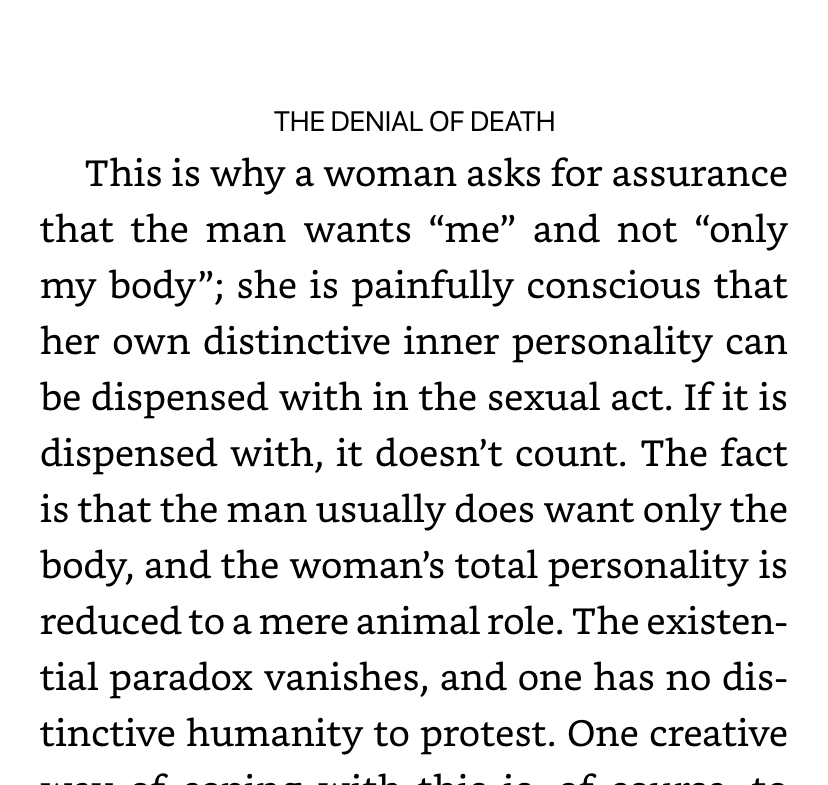 >
> This is probably the paragraph in the book that has resonated most with me so far and it touches on exactly the tension I’m discussing.
I could write a dissertation on why this passage resonated so deeply with me, how perfectly it captures my experience of being a woman, and why I think the underlying existential tension extends far beyond sexual relationships.
Posted on 7/8/26 at 6:59 am to Sofaking2
quote:
You are the female version of SFP
What similarities do you notice? The only thing we have in common is that our posts are heavily downvoted.
Posted on 7/8/26 at 8:13 am to 4cubbies
quote:
At the time Becker was writing, young men were being sent to die in Vietnam in a highly contentious war. Many didn’t experience dying in Vietnam as dignified or meaningful. They weren’t fighting Nazis or defending their homeland in the way previous generations understood their sacrifices. Instead, many saw themselves as expendable participants in a bureaucratic conflict whose purpose they neither understood nor believed in.
Civil rights struggles exposed contradictions in American ideals. The upheaval surrounding Vatican II and broader secularization caused many people to question religious authority. Divorce rates were climbing. Confidence in government collapsed during Vietnam and Watergate. The intellectual foundations of neoliberalism were beginning to spread, emphasizing individual responsibility over traditional institutions.
There was a pervasive sense of social instability.
I have to wonder how much of that was driven by the natural inclination towards rebellion by young adults? The Baby Boomer generation was massive (60%-70% larger than the previous generation) and they also came along right as broadcast technology was bringing video to the masses (television sets went from being something only the rich had to something most people had and that was in only around a decade (in 1950 only ~1% of households had tvs, by 1960 that was up to 75%-80%). A lot of the focus for those early years was at least partially on the Boomers (Howdy Doody, Leave It To Beaver, American Bandstand, Mickey Mouse Club, etc) with some estimates being has high as 70% of the shows from 1950-1960 being geared towards them. As they moved through life, that aspect of having the focus of society grew as they moved into adulthood.
This all had the impact (whether intentional or not) of feeling like they were the center of the universe. That sort of feeling of power from such a massive group of young people in that naturally rebellious stage has to have had an effect. Along with that, the larger a group is the more momentum it naturally generates as it moves toward some objective.
All this is to say that I wonder how much of that pervasive sense of social instability was driven more by such a large and "privileged" group (using that term a bit loosely, to give a category to the outsized attention they received) than by the actual issues they took up.
Posted on 7/8/26 at 8:23 am to 4cubbies
quote:
It seems like everything could be attributed to seeking validation, but sometimes perceived validation is actually profoundly invalidating.
Sometimes you swing and miss.
But you still swing.
And missing usually means that you start swinging harder to compensate.
quote:
This is probably the paragraph in the book that has resonated most with me so far and it touches on exactly the tension I’m discussing.
I could write a dissertation on why this passage resonated so deeply with me, how perfectly it captures my experience of being a woman, and why I think the underlying existential tension extends far beyond sexual relationships.
For some reason (actually, likely due to feminism) a myth exists that only men primarily respond to physical or social cues driven by reproductive drive, but that data doesn't support that.
Women overwhelmingly choose men who are taller than they are and make more money than they do. That's the same thing as choosing women who have big breasts, and for the same reason. Men's biological reproductive imperative is quantity, women's is security.
Both sexes do that same thing.
Posted on 7/8/26 at 9:11 am to wackatimesthree
quote:
Sometimes you swing and miss.
But you still swing.
And missing usually means that you start swinging harder to compensate.
Unless someone doesn't have a bat, or arms to swing one with.
There are so many variables that impact validation.
quote:
For some reason (actually, likely due to feminism) a myth exists that only men primarily respond to physical or social cues driven by reproductive drive, but that data doesn't support that.
I don't think you're addressing the distinction I'm making. I'm not denying that both sexes evaluate potential partners using physical or social cues. My point, and I believe this was Becker's point as well, is that being reduced only to those traits can be profoundly alienating.
Men can experience this, too. I'm sure some people see being sought after for one's ability to provide a paycheck as validating. Maybe some people think being desired because of how someone looks is validating.
Becker's point resonated because it addresses my deeper fear, which isn't being disliked or even rejected. It's being reduced to a body whose value exists only in relation to someone else's desires. Perhaps years of objectification have made me especially sensitive to noticing it, but .I often feel inundated with confirmation that the being I invest in and cultivate is unimportant, while the vessel that temporarily houses that being is what actually matters.
Posted on 7/8/26 at 9:36 am to Bard
quote:
I have to wonder how much of that was driven by the natural inclination towards rebellion by young adults?
That's a good point, and one that I considered when I first read it. It all seems very cyclical, at least starting with the Boomer generation. Maybe previous generations didn't have the luxury of rebellion due to the economic realities of the times.
quote:This is definitely a legitimate question. I think Becker's point, and the point which you initially addressed by questioning the missing "dignified meaning," is why so many young people experienced traditional institutions as psychologically hollow. Something did change that caused a whole generation to question and often abandon the traditional paths toward purpose and meaning (marriage, military, religion, etc.). Maybe television and media amplified that shift, like you suggested. Maybe they didn't create the crisis so much as expose it and accelerate it.
All this is to say that I wonder how much of that pervasive sense of social instability was driven more by such a large and "privileged" group (using that term a bit loosely, to give a category to the outsized attention they received) than by the actual issues they took up.
I think the deeper question is why the traditional institutions that had long provided purpose and meaning ceased to satisfy the existential needs of so many young people. I outlined some of the social upheaval of the period in an earlier post. Maybe there wasn't a single cause at all. Maybe it was the convergence of all those changes at once that made the old answers stop feeling sufficient.
To your point, I can't help but notice echoes of this in subsequent generations. Millennials came of age amid the financial crisis, crushing student debt, post-college underemployment, stagnant wages, and rapidly rising housing costs. Gen Z is confronting many of those same challenges alongside unprecedented housing and education costs. Every generation seems to inherit its own crisis, and each crisis reshapes what people perceive as meaningful, attainable, or worth sacrificing for. I do think American culture exacerbates this by increasingly encouraging people to seek identity through consumption, status, and image.
Posted on 7/8/26 at 9:45 am to 4cubbies
quote:It's a very sloppy, poorly expressed contention, and indicative of Becker's background as an anthropologist rather than psychologist. The implication that a man partners with a woman for the sole physical satisfaction of sex is ridiculous. Becker would have done much better approaching his point anthropologically than as a pretend psychoanalyst.
The anthropologic/evolutionary approach addresses men's instinctive draw to healthy/attractive/reproductive-capable women vs women's draw to men deemed likely to be stable long-term provider-protectors. The evolutionary advantage of those components is self-evident, and we've discussed them previously. But it is foundational to a woman's inherent disinterest in the proverbial one-night stand.
That does not mean a woman is not physically attracted to a nice looking man though, nor does it mean a man is not attracted to intelligence, personality, or professional capacity in a woman. To the contrary, most men seek fairly comparable intelligence in a partner, e.g., someone who will not be out of place in his social circles, or in conversation. Certainly Becker would not contend otherwise were he questioned about it, but the piece you cite does a pathetic job in teasing out the argument.
Insofar as sex is a physically pleasurable act between adults, but carries psychosocial baggage, let's try to strip that away with an analogy. The analogy would be massage, another physically pleasurable activity. If you visit a massage therapist, you gain pleasure from the physical act. There is no cognizance of the therapist's own distinctive inner personality in the equation. OTOH, if your husband gives you a massage your attachment of those thoughts accompanying the physical act is far more likely if not inevitable. Sex itself follows a similar equation, for men in particular.
Posted on 7/8/26 at 9:47 am to beerJeep
quote:
That would be your modern feminism at work, sweetums.
Modern feminism coupled with social media will be the death of America
Posted on 7/8/26 at 9:59 am to 4cubbies
In my opinion, self esteem comes from 4 sources: a sense of purpose, a feeling of accomplishment, praise from others, and belonging to something larger than yourself.
The problem with how self-esteem psychology in the 60’s was taught was that it confused the causes with effects. They saw self-esteem as a pre-requisite for achievement rather than self-esteem as a result.
The secularism of the latter 20th century rapidly eroded the institutions that gave children belonging to something larger than themselves and their families. The Great Society program annihilated the nuclear family the result of which was destabilized child-rearing and family financial situations. They were taking children who felt lost because their parents weren’t around (often dad out of the picture, mom always working), who had no connection with a church or similar organization, that what was holding them back was a lack of praise. So, they focused on praising people who didn’t perform, avoiding praising people who did, and exempted from negative consequences those who failed in order to protect their self-esteem. The lack of consequences eroded any sense of purpose or incentives for accomplishment, and the praise was fake. What resulted should have been predictable (it wasn’t good).
Religion is not a pre-requisite for self-esteem and accomplishment, but religion, particularly Christianity, does provide some pretty useful things that aid children in building self-esteem. Christianity has forgiveness of sins, which helps absolve guilt and leads to self-acceptance (guilt and shame are highly corrosive to self-esteem). Religion can give a person a clear sense of purpose and place in the universe as well as can provide a community that they will feel a sense of belonging within. Many churches offer service opportunities that can build that sense of accomplishment as well. I don’t believe that religion is essential IF there are sufficient other activities or organizations in the child’s life that can fill the same niches. However, religion is such an obvious choice that can kill multiple birds with one stone that it’s removal from public life should not be ignored as a contributing factor to nation-wide declines in self-esteem.
The problem with how self-esteem psychology in the 60’s was taught was that it confused the causes with effects. They saw self-esteem as a pre-requisite for achievement rather than self-esteem as a result.
The secularism of the latter 20th century rapidly eroded the institutions that gave children belonging to something larger than themselves and their families. The Great Society program annihilated the nuclear family the result of which was destabilized child-rearing and family financial situations. They were taking children who felt lost because their parents weren’t around (often dad out of the picture, mom always working), who had no connection with a church or similar organization, that what was holding them back was a lack of praise. So, they focused on praising people who didn’t perform, avoiding praising people who did, and exempted from negative consequences those who failed in order to protect their self-esteem. The lack of consequences eroded any sense of purpose or incentives for accomplishment, and the praise was fake. What resulted should have been predictable (it wasn’t good).
Religion is not a pre-requisite for self-esteem and accomplishment, but religion, particularly Christianity, does provide some pretty useful things that aid children in building self-esteem. Christianity has forgiveness of sins, which helps absolve guilt and leads to self-acceptance (guilt and shame are highly corrosive to self-esteem). Religion can give a person a clear sense of purpose and place in the universe as well as can provide a community that they will feel a sense of belonging within. Many churches offer service opportunities that can build that sense of accomplishment as well. I don’t believe that religion is essential IF there are sufficient other activities or organizations in the child’s life that can fill the same niches. However, religion is such an obvious choice that can kill multiple birds with one stone that it’s removal from public life should not be ignored as a contributing factor to nation-wide declines in self-esteem.
Posted on 7/8/26 at 10:00 am to 4cubbies
quote:
At the time Becker was writing, young men were being sent to die in Vietnam in a highly contentious war. Many didn’t experience dying in Vietnam as dignified or meaningful. They weren’t fighting Nazis or defending their homeland in the way previous generations understood their sacrifices. Instead, many saw themselves as expendable participants in a bureaucratic conflict whose purpose they neither understood nor believed in.
But these types of conflicts have happened throughout time. We just went through the longest period, in our history, of that type of conflict. It doesn't seem that those who went to Iraq and A-stan felt even close to the same.
There has to be other reasons.
quote:
The intellectual foundations of neoliberalism were beginning to spread, emphasizing individual responsibility over traditional institutions
Individual responsibily was baked into tUSA from its founding. I would argue that these "traditional institutions", of which were mostly less than 60 years old, had little to do with anything as well as the conflict in Vietnam. I mean, we still see the same today.
quote:
The traditional trajectory (go to college, get married, buy a home, spend forty years with one employer, retire with a pension) was losing credibility
That was not the traditional trajectory for the masses. Blue collar work was where most went and was much more traditional. We only saw the shift to most native born Americans desiring college sometime around the late 80's/early 90's, but it still took until late 90's/early 00's to flip the script totally and we saw most native born attending college rather than blue collar.
Posted on 7/8/26 at 10:00 am to 4cubbies
quote:... or the nidus of a bungled 12-yr war, with poorly defined objectives, terrible leadership, in the face of involuntary service forced through the draft. The dynamic for young people was very different than that of WWII.
Maybe previous generations didn't have the luxury of rebellion due to the economic realities of the times.
Posted on 7/8/26 at 10:37 am to 4cubbies
quote:
Unless someone doesn't have a bat, or arms to swing one with.
I can't imagine what you mean by that. The entire point is that the whole human race seeks validation, therefore we are all swinging as best we can.
quote:
My point, and I believe this was Becker's point as well, is that being reduced only to those traits can be profoundly alienating.
Yeah, I know what you're saying. But here's where I think you're not understanding me.
Men and women are different and complimentary. Inherently. Which is why feminism is so toxic. It seeks to glorify masculine traits and roles and to convince women that they are only valuable if they act like men have traditionally acted (and there's a reason that they have acted so...because men and women are different.)
The sociological research is clear that one of the inherent differences between women and men is that women strongly care more about relationships and people and men strongly care more about things—not necessarily collecting material possessions, although that can be part of it, but just things out in the world.
Because of a woman's biological imperative to seek security around reproduction, she wants to know that she has someone who is going to stick around to help provide for and protect the offspring. Thus, she's looking for a relationship, not just a sperm donor.
My points is:
1. Even your desire to be valued for "more than my body" is biologically wired, and so is the behavior you have experienced from men.
2. Instead of internalizing that behavior as a statement on a lack of worth on your part, if you understand it and respond appropriately, it doesn't have to be a bring-down-bummer.
Men do not ONLY care about sex. But that IS men's first priority, and it's just as biologically wired as women's priority for relationship.
Female chastity before marriage plus taking marriage seriously per the dictates of the Bible solves the whole problem and allows everyone to rise above their biology. (Why do I only mention female? Because women are the ones with the most at stake, both physically and emotionally, and they have always traditionally been the gatekeepers.)
Men only get sex once they have learned to love their wife and made a serious, lifelong commitment to her. Courtship is about everything BUT sex.
And feminism vehemently opposes that solution. (What a surprise.)
This post was edited on 7/8/26 at 10:39 am

 Page 7 of 9



Popular

Back to top
 Follow TigerDroppings for LSU Football News