




 4
4









- My Forums
- Tiger Rant
- LSU Recruiting
- SEC Rant
- Saints Talk
- Pelicans Talk
- More Sports Board
- Fantasy Sports
- Golf Board
- Soccer Board
- O-T Lounge
- Tech Board
- Home/Garden Board
- Outdoor Board
- Health/Fitness Board
- Movie/TV Board
- Book Board
- Music Board
- Political Talk
- Money Talk
- Fark Board
- Gaming Board
- Travel Board
- Food/Drink Board
- Ticket Exchange
- TD Help Board
Customize My Forums- View All Forums
- Show Left Links
- Topic Sort Options
- Trending Topics
- Recent Topics
- Active Topics
Started By
Message
re: 7% Mortgage Rates 30-Year
Posted on 9/23/26 at 2:38 pm to Tiger1955
Posted on 9/23/26 at 2:38 pm to Tiger1955
quote:
My first mortgage was 15.5% FHA on $62,000. The monthly payment was almost $900. So tell me more about how things were before you were born.
There seems to be a problem with binary thinking on this issue. Folks like yourself think that if things were bad in the 80's, then now they're good. They can both be bad.
If you look at a pile of recent data around home purchasing and your only takeaway is "things were worse for me," then you don't understand the issue.
Posted on 9/23/26 at 2:42 pm to Stonehog
quote:
There seems to be a problem with binary thinking on this issue. Folks like yourself think that if things were bad in the 80's, then now they're good. They can both be bad.
The same thing happens when they intentionally frame a discussion around interest rates to include the period with the literal worst interest rates, so they can hyper-focus the argument on that slightly worse period or use "average" data that is skewed by this outlier-bad time period.
Posted on 9/23/26 at 2:42 pm to BBONDS25
 [/url]
 This you BBONDS? Nah can't be
This post was edited on 9/23/26 at 2:44 pm
Posted on 9/23/26 at 2:45 pm to Stonehog
Correct, they can’t seem to grasp that you could buy a decent house for 50k and we didn’t have 40 trillion in debt which makes the dollar much less valuable than in 1980. The housing market would have to see a 50% drop in value to be anywhere near affordable for most Americans looking to buy. Which is why raising interest rates is a dumb idea that will negatively impact those same America consumers, yet the same people complaining now were largely “celebrating” it as a necessary evil. It won’t do a thing for energy driven inflation but will make affordability much more difficult
Posted on 9/23/26 at 2:55 pm to TideCPA
quote:
That depends. A "starter" home for a multi-earner household with two college graduates, as in your illustration, should not be significantly below the median, because they're already earning 1.4x the median household income. Does that not register? I'll say it again - as you illustrated, you have to make 1.4x above the median household income to comfortably afford a house significantly below the median.
They are earning the median for a 2-college graduate starting income household: $120,000-$140,000.
Just like a "house" is dynamic across time: size and features change, so too are households. You compared prices and situations to several generations ago. What the average or median household looks like today is very different than it was in the past. You are comparing apples-to-apples either in what constitutes a "house" today vs. then, nor are "households" the same.
Households with single mothers of 1 or more children living in the household have doubled over the past 50 years. That has major effect on any median "household income" stat and that has virtually nothing to do with wage growth, nor the price of housing. It is a broader social and economic issue.
Posted on 9/23/26 at 2:56 pm to Stonehog
quote:It's not even that complex an analysis. It's basically two variables - prices and interest rates.
There seems to be a problem with binary thinking on this issue. Folks like yourself think that if things were bad in the 80's, then now they're good. They can both be bad.
High interest rates and historically average prices can result in the same affordability problem that average interest rates and historically high prices do.
One is arguably worse because you can always refinance a long-term loan with a high interest rate if those rates ever come down. You can't re-buy a home with an inflated purchase price.
Posted on 9/23/26 at 2:57 pm to TideCPA
Im not sure what is funny thats the starter home price
All of those linked are quakity homes that the mortgage would be the same as rent
Ppl just need to deal with it. Values have gone down 6 years out of the last 100yrs
All of those linked are quakity homes that the mortgage would be the same as rent
Ppl just need to deal with it. Values have gone down 6 years out of the last 100yrs
Posted on 9/23/26 at 2:57 pm to Tomatocantender
Starter homes haven’t been this affordable in 30 years!
Posted on 9/23/26 at 3:09 pm to SlowFlowPro
I hope not. We bought 7 houses in COVID era that now rent at 400% of their note. That was the best time to buy, rates were 1-2%.
Posted on 9/23/26 at 3:32 pm to JimEverett
quote:Ok, let's compare to 2011 rather than "generations" ago. Median household income = $50,000. Median existing home price = $165,000. Interest rates ~4.5%. So the median U.S. household could comfortably afford a median home (not a "starter home") at a 3.3x multiple. I can attest to this because I, as a new accounting grad, comfortably bought (with my wife, a student at the time) a $200k 2,000sf house in a nice neighborhood/school district.
Just like a "house" is dynamic across time: size and features change, so too are households. You compared prices and situations to several generations ago. What the average or median household looks like today is very different than it was in the past. You are comparing apples-to-apples either in what constitutes a "house" today vs. then, nor are "households" the same.
Households with single mothers of 1 or more children living in the household have doubled over the past 50 years. That has major effect on any median "household income" stat and that has virtually nothing to do with wage growth, nor the price of housing. It is a broader social and economic issue.
Compare to today. Median household income is $87,500. Median existing home price is $429,000, a 4.9x multiple. To be able to comfortably afford a house at 3.3x household income as in 2011, the price would have to be no more than $289,000 (and realistically less, due to rate changes).
In other words, the crackhouses and "starter homes" that used to be reserved for the lower quartile earners are now the baseline for median earners.
Posted on 9/23/26 at 4:03 pm to Stonehog
quote:
Folks like yourself think that if things were bad in the 80's, then now they're good. They can both be bad.
Folks like you seem to think that there's some standard besides history that can be used to objectively determine "good" or "bad" in this context.
Why are both "bad?"
Because you say so?
Posted on 9/23/26 at 4:09 pm to Tomatocantender
I would like a different house/more land, but I’m too cheap to give up my low rate, and not OT rich enough to pay cash.
Talk historical averages all you want, but that doesn’t register with people who didn’t experience high rates before buying their current house.
They need middle aged people like me to upgrade at this stage and old people to downsize to keep everything flowing, but we ain’t moving and its clogging up the system.
Talk historical averages all you want, but that doesn’t register with people who didn’t experience high rates before buying their current house.
They need middle aged people like me to upgrade at this stage and old people to downsize to keep everything flowing, but we ain’t moving and its clogging up the system.
Posted on 9/23/26 at 4:17 pm to TideCPA
quote:
It's basically two variables - prices and interest rates.
Nope.
There's a third variable that matters in the context of what's happening now compared to historical trends.
The size of the house. People used to buy much smaller houses on average.
Which is why the only apples to apples comparison is an inflation adjusted per square foot comparison that also factors in the mortgage rates.
You Trophy Generation kids aren't going to like the apples to apples comparison...
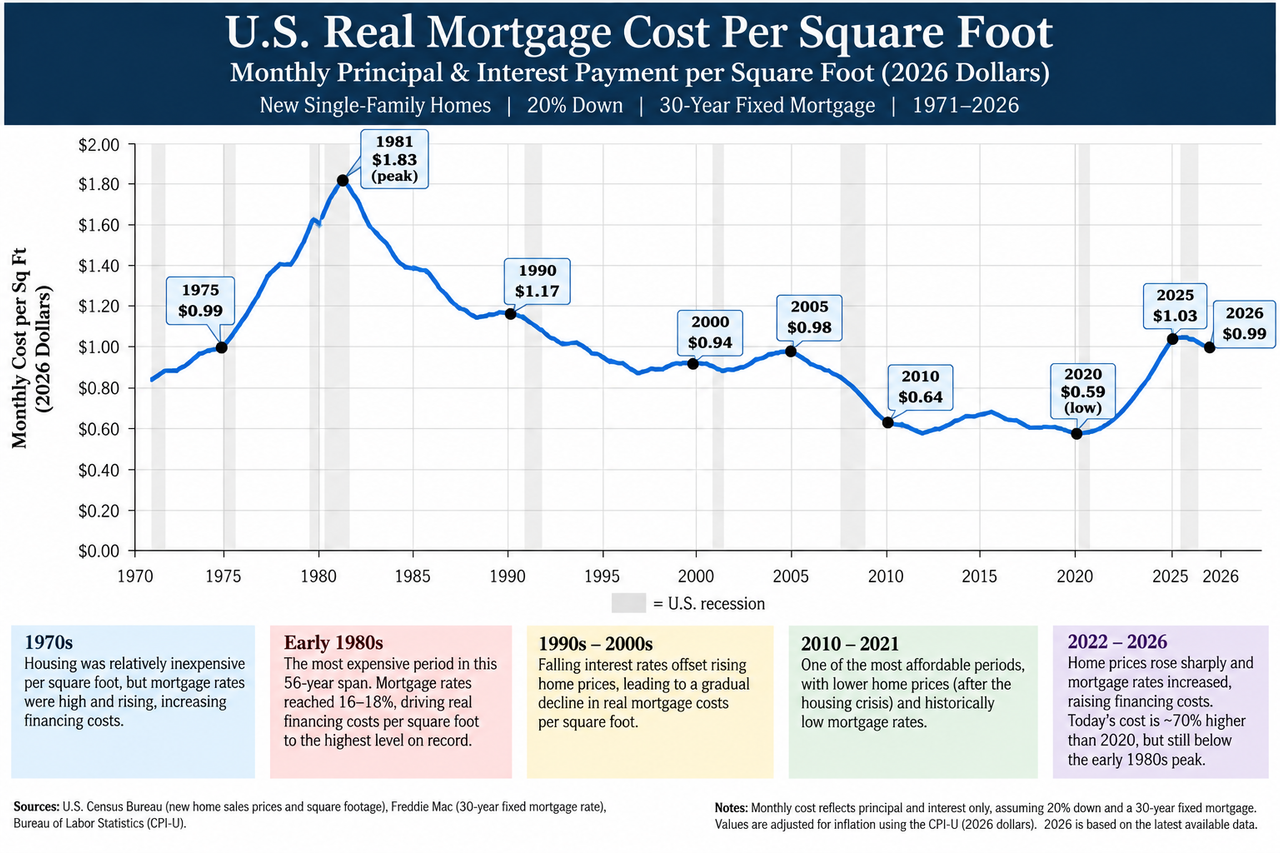
Apples to apples there's been one 15 yearish period over the last 50 years when the housng market was significantly better than it is right now, which just ended.
Now we're back about where it's been for the other 2/3 of that period (except the 80s, which was much worse).
This post was edited on 9/23/26 at 4:19 pm
Posted on 9/23/26 at 4:26 pm to lgtiger
quote:
Better than the 18% in the early 80s
Mortgage rates hit 18% in October of 1981.
In October of 1981, the median home price was $69,800.
Posted on 9/23/26 at 4:29 pm to wackatimesthree
Houses were smaller in Mill towns or in rural areas but bigger suburban housing was abundant in the 70’s and 80’s.
Posted on 9/23/26 at 4:32 pm to Rip Torner
quote:Define "bigger ... "abundant" in the 70’s"
bigger suburban housing was abundant in the 70’s and 80’s.

Posted on 9/23/26 at 4:38 pm to lgtiger
quote:Indeed.
Low rates in the early 2000s and 2010s were an unusually low in history.
There is a lot of retrospective GenY remorse about sitting on the sidelines when home prices dropped 25% combined with zirp rates 2009-2012. It was a historical opportunity.
Posted on 9/23/26 at 4:50 pm to NC_Tigah
quote:yep
There is a lot of retrospective GenY remorse about sitting on the sidelines when home prices dropped 25% combined with zirp rates 2009-2012. It was a historical opportunity.
Should have bought a house instead of studying for algebra I
Posted on 9/23/26 at 4:53 pm to Tomatocantender
Has anybody checked on Catturd?


 Page 7 of 9


Popular

Back to top
 Follow TigerDroppings for LSU Football News