




- My Forums
- Tiger Rant
- LSU Recruiting
- SEC Rant
- Saints Talk
- Pelicans Talk
- More Sports Board
- Fantasy Sports
- Golf Board
- Soccer Board
- O-T Lounge
- Tech Board
- Home/Garden Board
- Outdoor Board
- Health/Fitness Board
- Movie/TV Board
- Book Board
- Music Board
- Political Talk
- Money Talk
- Fark Board
- Gaming Board
- Travel Board
- Food/Drink Board
- Ticket Exchange
- TD Help Board
Customize My Forums- View All Forums
- Show Left Links
- Topic Sort Options
- Trending Topics
- Recent Topics
- Active Topics
Started By
Message
re: The Federal Reserve is running huge losses. Who pays for it?
Posted on 11/30/23 at 3:40 am to stuntman

Posted on 11/30/23 at 3:40 am to stuntman
You’re correct in that the Fed is not a traditional private commercial bank. It’s private in the sense that its stockholders are commercial banks and thus it is not owned by the government. It is also not on the federal budget.
The Fed’s structure was a political compromise between the rural, sparsely populated states and the densely populated, more industrial states when the Federal Reserve Act was passed in 1913.
The rural states feared a government owned central bank would only benefit the more populous, heavily industrialized states. So the Act created 12 Federal Reserve districts across the U.S. with each Fed district bank serving a specific geographical area. The commercial banks within each district would buy stock in just its own Fed district bank thus providing the initial capital for each district bank. The government would own no stock in any Fed district bank.
Ever wonder why the rural, farming state of Missouri has TWO Fed district banks and the financial center state of New York only has one Fed district bank? It’s because the Chairman of the senate finance committee which had to approve the bill creating the Fed in 1913 was a senator from Missouri.
The structure was intended to prevent a concentration of financial power while still creating a lender of last resort function along with a way to implement monetary policy while attempting to avoid political interference as much as possible.
The Fed’s structure was a political compromise between the rural, sparsely populated states and the densely populated, more industrial states when the Federal Reserve Act was passed in 1913.
The rural states feared a government owned central bank would only benefit the more populous, heavily industrialized states. So the Act created 12 Federal Reserve districts across the U.S. with each Fed district bank serving a specific geographical area. The commercial banks within each district would buy stock in just its own Fed district bank thus providing the initial capital for each district bank. The government would own no stock in any Fed district bank.
Ever wonder why the rural, farming state of Missouri has TWO Fed district banks and the financial center state of New York only has one Fed district bank? It’s because the Chairman of the senate finance committee which had to approve the bill creating the Fed in 1913 was a senator from Missouri.
The structure was intended to prevent a concentration of financial power while still creating a lender of last resort function along with a way to implement monetary policy while attempting to avoid political interference as much as possible.
 1
1


Posted on 11/30/23 at 4:24 am to LSURussian
Thanks for that reply.

Posted on 11/30/23 at 5:00 am to Timeoday
The working middle class as usual. Bend over and take it.
Posted on 11/30/23 at 7:45 am to LSURussian
quote:
..... why hasn’t there been any noticeable consequences since then?
As if the MSM (Lying media) is going to announce anything wrong with the Fed. C'mon man, you know better than that. We do not want a bunch of bank runs.
This post was edited on 11/30/23 at 7:46 am
Posted on 11/30/23 at 8:00 am to Timeoday
quote:The MSM loves "the sky is falling" stories. It even makes those types of stories up. You know that, right? Besides, you read about it but you assume no one else has? Are you THAT special?
As if the MSM (Lying media) is going to announce anything wrong with the Fed.
quote:Why would there be a "bunch of bank runs" just because the Fed is experiencing losses?
We do not want a bunch of bank runs.
Since you "know" the Fed is losing money have you taken all of your money out of your bank?
I'd really like to hear you explain why bank runs would happen if the Fed is losing money.

Posted on 11/30/23 at 8:17 am to LSURussian
quote:
The government is borrowing more than expected, increasing the supply of Treasurys and dinging their value. Meanwhile, the Federal Reserve is selling down its own holdings, dumping yet more bonds into a market that doesn’t really want them.
Why is the Federal Reserve, "The Creature From Jeckyll Island", selling into a soft market? After all, according to you, The Creature From Jeckyll Island, "Federal Reserve", does not EVER need to cover!!
End The FED Now!!
Posted on 11/30/23 at 8:26 am to Timeoday
quote:Because the Fed announced over a year ago it was going to be drawing down its Treasury holdings (Quantitative Tightening) as part of its inflation mitigation strategy of removing bank reserves from the banking system.
Why is the Federal Reserve, "The Creature From Jeckyll Island", selling into a soft market?
The last I looked the Fed is reducing its Treasury portfolio, and thus its balance sheet, by about $100 billion per month.
I would think even you knew about that. But once again you've proven you're basically clueless about anything when it comes to the Fed.
ETA: You avoided answering my question. Why would there be bank runs just because the Fed is experiencing losses?
This post was edited on 11/30/23 at 8:28 am

Posted on 11/30/23 at 8:32 am to LSURussian
quote:quote:
The Fed doesn't print money
Where do they get the money to buy up trillions in securities?
Is the Federal Reserve printing money in order to buy Treasury securities?
I read that link and it did not address the question directly, where does the Fed get its money to purchase treasury bonds?


Posted on 11/30/23 at 8:36 am to Timeoday
I see the usual suspects are here defending the Fed. Big gov't requires big business and a central bank. You can't fund an empire with monetary restrictions. I still argue that 1913 is the worst year in American history and was the beginning of the end.

Posted on 11/30/23 at 8:43 am to GumboPot
quote:
I read that link and it did not address the question directly, where does the Fed get its money to purchase treasury bonds?
Yes, it did.
The Fed increases the reserve balance of the bank it bought the Treasury security from. (By law the Fed is not allowed to buy Treasury securities directly from the Treasury Department. It must use a Primary Dealer Bank for Treasury security purchases and sales.)
From the link you asked about:
quote:
Although Federal Reserve purchases of Treasury securities do not involve printing money, the increase in the Federal Reserve's holdings of Treasury securities is matched by a corresponding increase in reserve balances held by the banking system.
Increasing the balance of any bank's reserve account is the same as transferring money into that bank's account.

Posted on 11/30/23 at 8:46 am to LSURussian
So were does the Federal Reserve get the money to purchase Treasuries from any of the Primary Dealers?
Posted on 11/30/23 at 8:46 am to Aubie Spr96
A more clear picture of The Creature From Jeckyll Island could not be drawn!!

Posted on 11/30/23 at 8:47 am to Aubie Spr96
quote:And I see the same ignorant usual suspects here screaming at the sky because they don't understand the function of central banks. All they (you) can come up with are trite, repetitive sayings that you heard someone say and it sounded real smart to you while you didn't comprehend a thing that was said.
I see the usual suspects are here defending the Fed.
Posted on 11/30/23 at 8:55 am to GumboPot
quote:Gumbo, I can keep explaining it to you but I can't understand it for you.
So were does the Federal Reserve get the money to purchase Treasuries from any of the Primary Dealers?
The "money" is an electronic entry on the selling bank's account at the Fed increasing the bank's reserve balance. The commercial bank can then use the increase in reserves to make loans, sell in the overnight Fed Funds market, leave in its account at the Fed or sell back to the Fed in a reverse repo operation thus earning a return on its funds.
Posted on 11/30/23 at 9:25 am to LSURussian
quote:
Gumbo, I can keep explaining it to you but I can't understand it for you.
That's why I keep asking questions.
Full disclosure, I'm not trying to be a dick or contrarian or anything like that, I want to understand.
quote:
The "money" is an electronic entry on the selling bank's account at the Fed increasing the bank's reserve balance.
So the Primary Dealer has an account number at the Federal Reserve that when they purchase Treasuries the Fed Balance sheet increases (or decrease if they sell)?
quote:
The commercial bank can then use the increase in reserves to make loans,
How did the reserves increase? Whether the reserves switched from cash to Treasuries how did the reserves increase?
Posted on 11/30/23 at 9:50 am to GumboPot
quote:I've followed your posts long enough to know you're not trying to be obtuse. So relax about that.
Full disclosure, I'm not trying to be a dick or contrarian or anything like that, I want to understand.
quote:All Primary Dealers have accounts at the Fed. When the Primary Dealer buys a T-security from the Fed, the Fed delivers the T-security to the PD (electronically) and debits (decreases) the PD's account balance (reserves) kept at the Fed.
So the Primary Dealer has an account number at the Federal Reserve that when they purchase Treasuries the Fed Balance sheet increases (or decrease if they sell)?
When the Fed buys a T-security from a PD, the T-security is delivered to the Fed (again, electronically via the security's CUSIP) and the Fed credits (increases) the PD's balance (reserves) on the Fed's accounting system.
quote:There is no "cash" in this transaction. It's simply electronic accounting entries on the Fed's books.
How did the reserves increase? Whether the reserves switched from cash to Treasuries how did the reserves increase?
When the Fed increases a commercial bank's reserves (balance) the Fed is adding liquidity to the banking system, usually to encourage more lending to stimulate the economy.
When the Fed decreases a commercial bank's reserves (balance) the Fed is reducing liquidity in the banking system usually to cool an overheated economy by discouraging loans to prevent or reduce unacceptably high inflation rates. This is the scenario the Fed finds itself in now as it allows its T-securities to mature and not replacing them or by outright selling its T-securities.


Posted on 11/30/23 at 10:39 am to LSURussian
quote:
And a central bank is not intended to make a profit. Unique to a central bank is it can defer losses to be offset by profits in the future. Nothing to see here. The OP is sky screaming over a fake crisis.
I agree that central banks aren’t designed to make profits, but are they designed to be cost centers? Naturally, they’ll incur expenses with their operations, whether it be monetary policy or regulatory oversight. It’s unfortunate that the CFPB funding muddies the waters.
I think the question still remains that if it’s incurring expenses, who ultimately pays for them? And if the rate environment never turns to where the capital losses can be recovered, how is that funded?
It’s a simplistic view of central banking, but sometimes the fundamental questions, with an understanding of the intricacies of the Fed’s operations, still remain and deserve answers.
Posted on 11/30/23 at 10:42 am to TerryDawg03
quote:
And if the rate environment never turns to where the capital losses can be recovered, how is that funded?
Interest gained and profit gained on buying and selling treasury bonds via primary dealers, right?
Once FR operating expense is subtracted the profits are sent back to the U.S. Treasury Department, right?


Posted on 11/30/23 at 10:47 am to Aubie Spr96

Posted on 11/30/23 at 11:13 am to GumboPot
quote:
quote:Gumbo, I can keep explaining it to you but I can't understand it for you.
That's why I keep asking questions.
Full disclosure, I'm not trying to be a dick or contrarian or anything like that, I want to understand.
Deep knowledge and understanding of the banking system is not easy and it wasn't intended to be easily understood by street level Americans......if you truly understood the banking system as it operates you would likely be a pissed off individual.
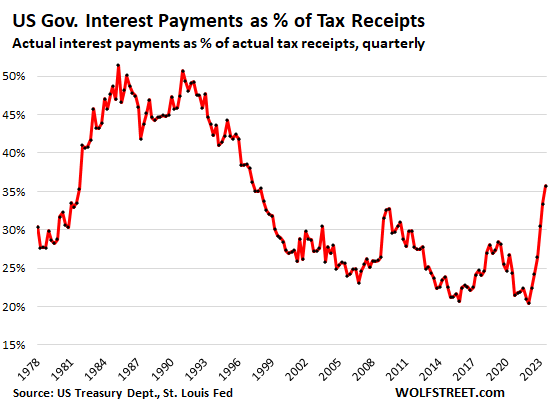
What bank in their right mind would loan money to a customer with $33-34 trillion of debt (that will never be paid) with a $1 trillion debt service and continue to lend that customer money knowing they will never get it back?
I have watched the Federal Reserve and US government repeatedly use monetary policies to save the rat bastards in banking/finance and on occasion too big to fail large corporations who have made risky business decisions......it's always in the name of saving the banking/financial system and maintaining global economic stability.
Any person with 8 years of university studies in banking, finance and economics could likely wow you with their technical knowledge in all those fields but you don't need to have that knowledge to see the less than desirable results of the current banking system and how it benefits the well connected, many times to the detriment of the American people.
In the end the Federal Reserve banks get their cut for operating the fractional reserve fiat monetary system and the USD continues down the path of devaluation.

 Page 4 of 5

Popular
Back to top
 Follow TigerDroppings for LSU Football News