




- My Forums
- Tiger Rant
- LSU Recruiting
- SEC Rant
- Saints Talk
- Pelicans Talk
- More Sports Board
- Fantasy Sports
- Golf Board
- Soccer Board
- O-T Lounge
- Tech Board
- Home/Garden Board
- Outdoor Board
- Health/Fitness Board
- Movie/TV Board
- Book Board
- Music Board
- Political Talk
- Money Talk
- Fark Board
- Gaming Board
- Travel Board
- Food/Drink Board
- Ticket Exchange
- TD Help Board
Customize My Forums- View All Forums
- Show Left Links
- Topic Sort Options
- Trending Topics
- Recent Topics
- Active Topics
Started By
Message


 1
1



Posted on 2/1/26 at 8:41 am to Penrod
quote:
Amen! But government by the people can be controlled. And without it, we will have government by authoritarians. There is no option besides balancing on that unstable spot where to one side lies tyranny of government and to the other lies tyranny of anarchy.
I think that anarcho capitalism would disincentives all kinds of bad choices/behaviors that society is loaded w/. The relentless protection of property rights tends to keep people in line.
That said, if people say they are minarchists, constitutionalists, individualist, or whatever else would reduce the size and scope of government, I'm here for it.

Posted on 2/1/26 at 8:43 am to AlxTgr
I've run the gambit, Alx. I started out as a Prog, then neocon, then conservative, then minarchist, and now am philosophically an ancap.
Like I just mentioned above, I won't hate on anyone who wants to reduce the size and scope of government. I'm just saying that if you look at it, it's kind of foolish to believe that politicians know best how to organize society.
Like I just mentioned above, I won't hate on anyone who wants to reduce the size and scope of government. I'm just saying that if you look at it, it's kind of foolish to believe that politicians know best how to organize society.
Posted on 2/1/26 at 8:44 am to NC_Tigah
quote:
The problem is the instability created from disregard of dependent consumers, as well as avoidable damage to them in the interim. All while the supply-side profiteers, in this case from a disaster which has already damaged the same consumer base.
It is a politically untenable situation.
It’s been tenable.

I just don’t understand what solution you think is better. If you cap the price of, say gasoline, you will have less gasoline in the affected area. But what is desperately needed is MORE gasoline. Just let the price go up. This will result in supply increasing. It also disincentivizes hoarding. This is the path to wisely allocating gasoline to its best and most efficient uses. And the only downside is that the very poorest might not be able to pay for some real necessities. But that’s what the Red Cross and other charities are for.
Posted on 2/1/26 at 8:48 am to SlowFlowPro
Fair enough.
Then they were not enforced in my experience.
Then they were not enforced in my experience.
Posted on 2/1/26 at 8:49 am to stuntman
quote:
Another thing that those gouging laws do is discourage much more supply flooding into areas that need those products/services, which would end up putting downward pressure on prices overall.
Price gouging happens BEFORE supply can increase. The supply increase always happens and prices come back down.
It’s the pack of water already in the store that costs $4 yesterday and $24 today, by the time the next shipment arrives it will be down to $4 again.
Posted on 2/1/26 at 8:50 am to Penrod
You actually did… I just don’t think you know enough to know what you don’t know yet…
Start with this graph to demonstrate:
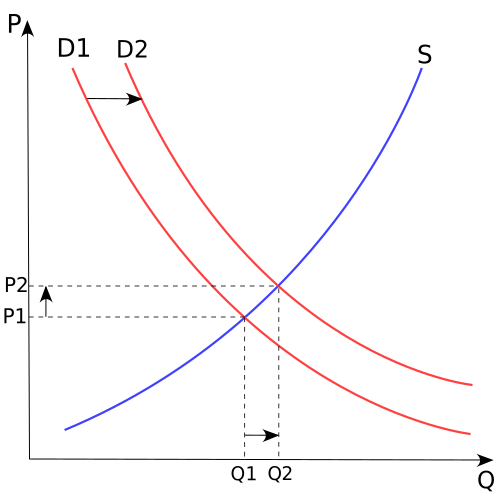
Assume this is the Texas natural gas wholesale market right before winter storm Uri. Demand increases for obvious reasons… so in your mind, shift the demand curve so that the asymptotic limit is about 3/4 of the way to the right edge of the image. Then supply collapsed. Unweatherized pipes froze and prevented natural gas from being shipped from producers to wholesalers, effectively cutting off new supply. To model this, shift the supply curve so that the asymptotic limit is about 1/4 of the graph away from the left edge.
The asymptotic limit of supply exists because, regardless of the price, there is a maximum production possible giving the existing, nonfrozen infrastructure. The asymptotic limit exists for demand because, regardless of price, retailers are required to provide natural gas to citizens by law. Regardless of how expensive natural gas gets, they have to keep buying whatever source they can get their hands on. And the minimum quantity they need exceeds what is available.
Thus, you have a supply and demand curve, each with an asymptotic limit, that never intersect. As the market keeps trying to adjust, prices go up and up and up. But there is no limit. Retailers in need continue to outbid each other for the finite supply available. But no successive round of price raises does anything to create new supply… we have reached the asymptotic limit of availability.
Now, where you are correct is in the assertion that this would be temporary… if the situation had stayed like this, new producers would have responded by setting up shop and producing more natural gas. Only problem is, it takes several years to build a new natural gas extraction facility. So your concept of “temporary” is inadequate to deal with the type of crisis being experienced.
What fixed this broken scenario was not a market solution… it was the eventual normalization of the weather. But if we had simply prevented wholesalers from extracting billions of dollars in excess profits from the retailers for just a single week, everyone across Texas would have saved hundreds of dollars in utility payments over the last several years.
Bottom line: the price gouging did nothing to improve the market conditions or to bring new supply online… it just drastically enriched a few hundred lucky people at the expense of millions.
Start with this graph to demonstrate:
Assume this is the Texas natural gas wholesale market right before winter storm Uri. Demand increases for obvious reasons… so in your mind, shift the demand curve so that the asymptotic limit is about 3/4 of the way to the right edge of the image. Then supply collapsed. Unweatherized pipes froze and prevented natural gas from being shipped from producers to wholesalers, effectively cutting off new supply. To model this, shift the supply curve so that the asymptotic limit is about 1/4 of the graph away from the left edge.
The asymptotic limit of supply exists because, regardless of the price, there is a maximum production possible giving the existing, nonfrozen infrastructure. The asymptotic limit exists for demand because, regardless of price, retailers are required to provide natural gas to citizens by law. Regardless of how expensive natural gas gets, they have to keep buying whatever source they can get their hands on. And the minimum quantity they need exceeds what is available.
Thus, you have a supply and demand curve, each with an asymptotic limit, that never intersect. As the market keeps trying to adjust, prices go up and up and up. But there is no limit. Retailers in need continue to outbid each other for the finite supply available. But no successive round of price raises does anything to create new supply… we have reached the asymptotic limit of availability.
Now, where you are correct is in the assertion that this would be temporary… if the situation had stayed like this, new producers would have responded by setting up shop and producing more natural gas. Only problem is, it takes several years to build a new natural gas extraction facility. So your concept of “temporary” is inadequate to deal with the type of crisis being experienced.
What fixed this broken scenario was not a market solution… it was the eventual normalization of the weather. But if we had simply prevented wholesalers from extracting billions of dollars in excess profits from the retailers for just a single week, everyone across Texas would have saved hundreds of dollars in utility payments over the last several years.
Bottom line: the price gouging did nothing to improve the market conditions or to bring new supply online… it just drastically enriched a few hundred lucky people at the expense of millions.
This post was edited on 2/1/26 at 8:54 am
Posted on 2/1/26 at 8:52 am to weagle1999
No. That is so drastically of a different argument than I am making that it proves just how insufficient your understanding of this event truly is. So I guess thank you: you proved my point 

Posted on 2/1/26 at 8:53 am to stuntman
quote:
It's happening for the world to see down in Argentina as we speak.
Apples and oranges. Milei's reforms are made possible by a less restrictive constitution that gives the Argentine president emergency powers that would be considered illegal here in the United States.
A socialist successor to Milei's office could just as easily change everything back.
This post was edited on 2/1/26 at 8:54 am

Posted on 2/1/26 at 9:01 am to SlowFlowPro
quote:
A. That he buys the gas for inflated/disaster prices and prices his good too high and takes a big L B. The market doesn't end with the immediate time post disaster. People in markets remember how vendors treated them and behaved C. They will still be competing in the post disaster market. It would take a cartel to work
I forgive you for not knowing how gas stations operate. I’m sure you don’t have to put much gas in your hybrid.

Posted on 2/1/26 at 9:02 am to SlowFlowPro
I agree that, in a scenario where widgets are moveable, letting market forces bring in more widgets is the preferable option.
Now will y’all please likewise acknowledge that, in many disasters, not all necessary widgets are moveable? Will y’all agree that in disasters wherein the supply of widgets has reached an asymptotic limit, putting a cap on the price growth of the widget is preferable to unchecked runaway pricing?
Now will y’all please likewise acknowledge that, in many disasters, not all necessary widgets are moveable? Will y’all agree that in disasters wherein the supply of widgets has reached an asymptotic limit, putting a cap on the price growth of the widget is preferable to unchecked runaway pricing?
Posted on 2/1/26 at 9:05 am to funnystuff
quote:
Thus, you have a supply and demand curve, each with an asymptotic limit, that never intersect. As the market keeps trying to adjust, prices go up and up and up. But there is no limit.
Wrong. There is a limit. Can you give me an example of a trade in which the price per MSCF exceeded a million dollars? Of course not. There is a maximum price at which zero natural gas will be purchased.
But that is an academic point not really bearing on our fundamental disagreement, which is, will the market always return to equilibrium after a disturbance. You did an admirable job of explaining what happens to the supply and demand curves during the disturbance. (You might recall that after the first time you implied I was an economic illiterate, I explained that not only were S & D curves of complex shapes, but also that they moved in real time. This is what you just demonstrated.) My point is that the disturbance passes, and when it does (at least in this case) it leaves us with an extremely high, but not infinite, price and supply/demand curves that heavily incentivize production and distribution.
Left alone, those conditions will return the market to an equilibrium. And in the meantime, the market will sort itself into conditions in which those who value the good the most will get it and those who can supply it at the lowest cost will sell it. In your case, that latter group will at first be everyone who can, but eventually will be the most efficient. This was shown by Vernon Smith who received the Nobel Prize for his work.
Posted on 2/1/26 at 9:06 am to stuntman
quote:One can believe this - I do- and still believe we need some law.
I'm just saying that if you look at it, it's kind of foolish to believe that politicians know best how to organize society.
Posted on 2/1/26 at 9:07 am to RollTide1987
Right but that's not the issue here. The issue is about libertarianism working.

Posted on 2/1/26 at 9:14 am to Penrod
quote:Except its not the supplier that would be the one jacking the price up in a disaster stricken area.
If you cap the price of, say gasoline, you will have less gasoline in the affected area. But what is desperately needed is MORE gasoline. Just let the price go up. This will result in supply increasing.
Its the local gas station owner taking advantage of a desperate situation.
Posted on 2/1/26 at 9:24 am to stuntman
quote:
The issue is about libertarianism working.
Elements of libertarianism can work in government, just like elements of socialism can also work. However, pure forms of libertarianism and socialism have and (most likely) can never work. As libertarian as Milei is, he has had to make compromises in Argentina. They are not a pure libertarian state. Socialist safety nets still exist and won't be going away anytime soon.
Posted on 2/1/26 at 9:42 am to Tiger Prawn
quote:
Except its not the supplier that would be the one jacking the price up in a disaster stricken area.
Its the local gas station owner taking advantage of a desperate situation.
It’s both. The increased price he gets at his pump motivates him to raise the price he will pay to a supplier.
Posted on 2/1/26 at 9:43 am to stuntman
quote:
if people say they are minarchists, constitutionalists, individualist, or whatever else would reduce the size and scope of government, I'm here for it.
Me too. Government is way too large.

Posted on 2/1/26 at 9:43 am to SlowFlowPro
quote:The same summary corresponds to any nonanarchist holding. Laws for Order. Order serves community benefit to a point. Then at some point, Order begins to limit individual productivity.
if you didn't realize.
quote:

This post was edited on 2/1/26 at 10:26 am
Posted on 2/1/26 at 9:45 am to Flats
quote:All is relative my friend.
So is eliminating welfare, I guess I should be against eliminating welfare.

 Page 6 of 7
Popular
Back to top
 Follow TigerDroppings for LSU Football News