




- My Forums
- Tiger Rant
- LSU Recruiting
- SEC Rant
- Saints Talk
- Pelicans Talk
- More Sports Board
- Fantasy Sports
- Golf Board
- Soccer Board
- O-T Lounge
- Tech Board
- Home/Garden Board
- Outdoor Board
- Health/Fitness Board
- Movie/TV Board
- Book Board
- Music Board
- Political Talk
- Money Talk
- Fark Board
- Gaming Board
- Travel Board
- Food/Drink Board
- Ticket Exchange
- TD Help Board
Customize My Forums- View All Forums
- Show Left Links
- Topic Sort Options
- Trending Topics
- Recent Topics
- Active Topics
Started By
Message
re: Sensor damaged by a foreign object on Ethiopian Airlines 737 MAX triggered fatal crash
Posted on 4/4/19 at 12:27 pm to baldona

Posted on 4/4/19 at 12:27 pm to baldona
quote:
...THe newest Ive seen is that the pilots did NOT follow the procedure and turned off the MCAS before pulling the nose up. So that threw off their procedures...
I remember initially reading that the pilot flying, I think first officer but can’t remember, hadn’t done the updated training sent out after Lion Air. I also remember reading that before moving switches to cutout that you were supposed to use electric trim first to neutralize nose pointing down.
But if MCAS turned on with a bird strike it’s more proof of how bad it was designed to have something so powerful to rely only one AOA that only switched between the 2 with each subsequent flight after powering up (not sure if by FCC of pilot flying or just switching each subsequent take off regardless of who was pilot flying). Lion Air had a bad AOA sensor as well albeit not struck by a bird, so if a bird strike doesn’t switch off MCAS from using the hit AOA sensor I am wondering what it actually took to switch to the other or just avoid MCAS activating if sensor being used at take off is damaged during a flight.
Only way Boeing is not held 100% responsible is if pilot due to not going over MACS material reacted first to IAS Disagree warning ignoring update that bad AOA input could trigger IAS warning & gained way too much speed especially considering how close to ground they were before focusing on MCAS procedures and then didn’t follow the MCAS procedures correctly (like not using electric trim first before cutout and not staying manual trim for rest of flight). It would also have to be obvious it was erroneous AOA data causing IAS warning as Boeing initially made the AOA Disagree alert optional.

This post was edited on 4/4/19 at 4:11 pm
 0
0


Posted on 4/4/19 at 12:44 pm to Tempratt
quote:
I've always thought that being an air crash investigator would be fascinating and depressing job to have.
I would hate to be one of those early responders walking into that smoldering debris field where only a wheel or a piece of fuselage is recognizable.
If the plane looks like that, imagine what the people look like.

Posted on 4/5/19 at 10:03 am to RollTide1987
It looks like the pilots forgot to take the plane off of maximum thrust which made it near impossible to manually trim when the MCAS was turned off.
Not saying they're solely to blame but this looks like a major contributing factor in why they turned it back on when they couldn't manually trim at 420 mph.
Bloomberg
The plane took off at 94 percent of full power, according to the report. That is normal for liftoff, but pilots then typically pull back the power soon afterward. Even though the captain called for setting the speed at 238 knots, or 274 miles per hour, about a minute after takeoff, the engine thrust remained at the same level for the entire short flight, according to the report.
Not saying they're solely to blame but this looks like a major contributing factor in why they turned it back on when they couldn't manually trim at 420 mph.
Bloomberg
The plane took off at 94 percent of full power, according to the report. That is normal for liftoff, but pilots then typically pull back the power soon afterward. Even though the captain called for setting the speed at 238 knots, or 274 miles per hour, about a minute after takeoff, the engine thrust remained at the same level for the entire short flight, according to the report.
This post was edited on 4/5/19 at 10:41 am

Posted on 4/5/19 at 10:10 am to barry
quote:
Can I ask the basic question if is MCAS trying to solve a problem that didn’t exist?
If the angle of attack gets too steep, you stall.
In this case, the sensor failed and the computer gave warnings saying watch for a stall, the pilots said no we're fine and tried to over ride the MCAS, the MCAS said frick that, we're in trouble, and essentially pushed the nose down so far to correct the angle of attack that it put the plane into an irreconcilable dive.
The computer basically suicides the entire plane because of a faulty sensor even though the pilots tried and failed to override.
Posted on 4/5/19 at 10:46 am to barry
quote:
is MCAS trying to solve a problem that didn’t exist?
In this case, yes. The faulty sensor made it believe a problem did exist. The real problem was strapping a bigger engine farther forward from the Center of Gravity on an old plane. The MCAS was added to make up for it.


Posted on 4/5/19 at 10:55 am to Muthsera
quote:
Step 1 to surviving a plane crash: Avoid flying on any airline whose name makes you ask "Who the frick would fly there?"
quote:
Ethiopian Airlines
Case in point.
quote:
Florida Man
Checks out.
Posted on 4/5/19 at 11:32 am to Saintsisit
quote:
Before it picked up speed in its final dive, the plane was flying as fast as 365 knots, or 420 miles an hour -- almost twice the usual top speed at that low altitude. In addition to the multiple warnings prompted by the MCAS failure, the pilots were also getting audible alerts indicating they had exceeded the safe flying speed, according to the report.
I had not heard there were audible warnings about exceeding the safe flying speed.
quote:
struggles to keep the plane climbing apparently led them to switch power back on to the trim system. About 30 seconds before they crashed, it was activated by the pilots to slightly raise the nose. Five seconds later, MCAS engaged again, once more pushing down the nose. At that speed, they couldn’t overcome the dive using their control column alone, according to John Cox and Guzzetti. For reasons that haven’t been explained, they didn’t try to also trim the plane using switches on their control yokes.The plane eventually pointed down by 40 degrees and the plane reached speeds of 575 miles per hour.
If turning it back on to get assistance moving stabilizer why would they not use electric switches more which would also served to pause MCAS actions for 5 seconds? I know they were running out of time, but it seems like at their speed they should have also done more of this before cutouts to get pitch back to where it was before MCAS (trim at 4.6 when MCAS brought it to 2.1 then to 0.4 before they got it up to 2.3 before cutout) and if making choice to turn back on you had to be ready to counter MCAS trying to point down again (I did read at that speed when MCAS kicked back on aggressively they may have momentarily lost control of stick increasing nose drop even more).
The Lion Air did something similar right before they crashed where captain handed control to first office while captain looked through procedures to find fix, but the first officer didn’t counter with the electric switches as much as captain had been doing (I also guess since MCAS continued after First Officer took control MCAS just continued to use same faulty AOA & only switches between AOAs each new flight not each switch to FCC of person flying). They, Lion Air flight, were not aware of MCAS, but the Ethiopian pilots were & deserve a little of the blame.
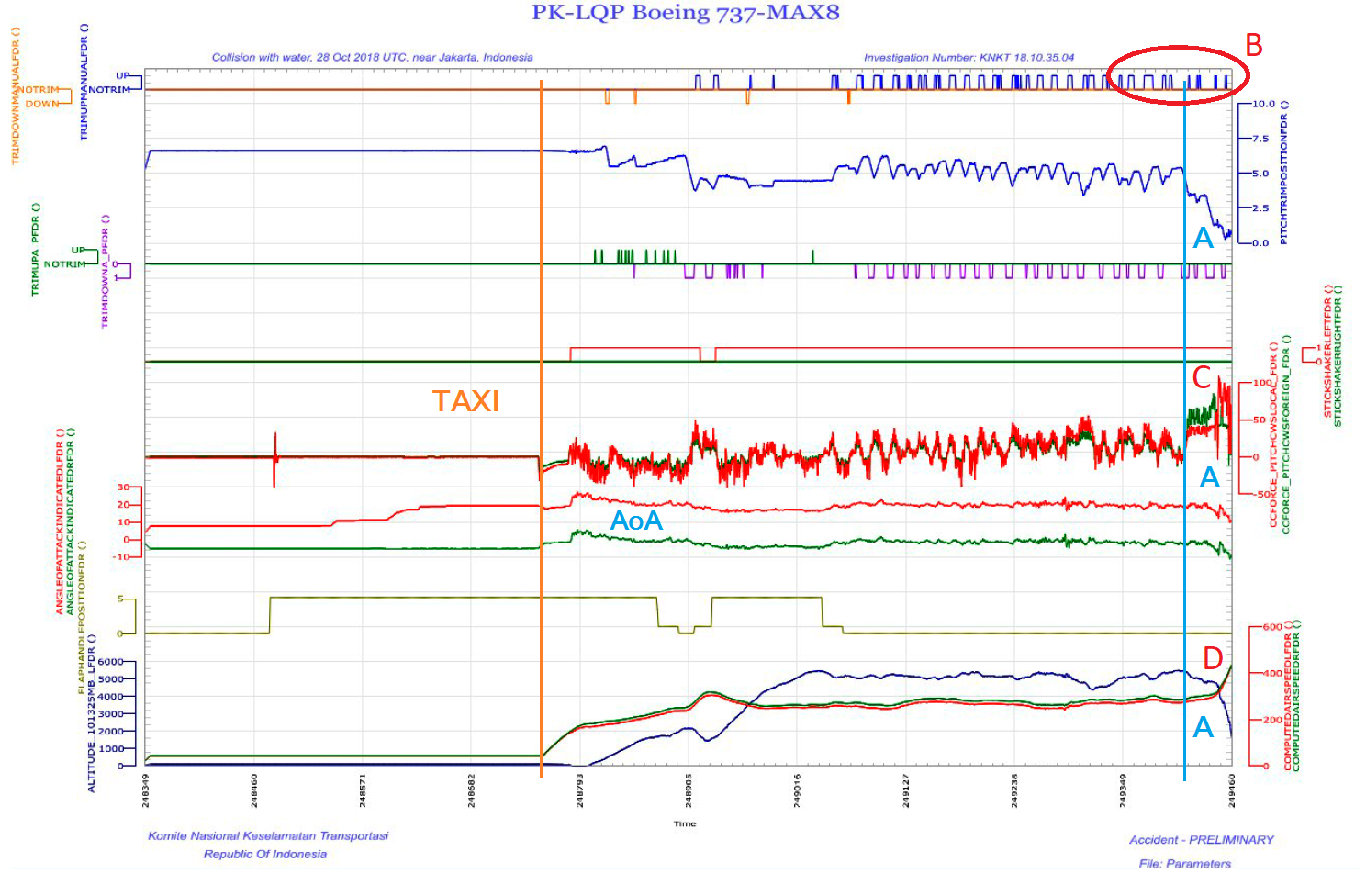
But still Boeing tied this powerful override to just 1 sensor which would rotate between the 2 each flight (powering on would restarted cycle). The Lion Air sensor showed difference even during taxi and the 2 ended up like 20 degrees off but MCAS stayed with the one it was programmed to read from for that flight. On Ethiopian flight the sensors were almost 60 degrees off (will be interesting to see when this started). AOA Disagrees cause multiple warnings & alarms including possibly a IAS Disagree warning yet MCAS initially programmed to not take disagrees into account & AOA disagree warning on display was an upsell.
quote:
Sensors in the aircraft that report how high its nose is pointed relative to oncoming air varied by almost 60 degrees. One of the “angle-of-attack” gauges read 15.3 degrees, likely an accurate reading for a plane taking off. The other erroneously read 74.5 degrees -- which would suggest a plane pointing almost straight skyward.
Below is Lion Air data, and you can see there was AOA disagreement from before take off yet MCAS set up to not pay attention to that. After lift off their movements are the same just 20 degrees apart.
This post was edited on 4/5/19 at 7:53 pm


Posted on 4/5/19 at 11:54 am to RollTide1987
Anyone else amazed that even with today's technology a frickin bird can take down an airplane?


Posted on 4/5/19 at 12:41 pm to SM6
A big issue now and going forward is the realization that Boeing had strong armed the FAA into letting them dictate a lot of the certification processes. Even if they come out with a software update validated by the FAA in the coming weeks, expect foreign regulators, like EASA in Europe to go through it with a MUCH finer comb.
Same thing is going to happen with the 777-X, hope Lufthansa and Emirates aren't expecting them in their fleets on time.
Same thing is going to happen with the 777-X, hope Lufthansa and Emirates aren't expecting them in their fleets on time.

Posted on 4/5/19 at 12:49 pm to The Mick
quote:
Anyone else amazed that even with today's technology a frickin bird can take down an airplane?
birds, wild pigs, deer, have all taken Vipers out, hell, I think a coconut could


Posted on 4/5/19 at 1:00 pm to RollTide1987
 The 25 year-old Ethiopian Airlines First Officer (Ahmednur Mohammed) had around 350 flight hours. He reportedly originally trained as an Architect and then went to flight school because he felt like he couldn’t make enough money in that field.
Posted on 4/5/19 at 1:06 pm to 777Tiger
quote:
birds, wild pigs, deer, have all taken Vipers out, hell, I think a coconut could
I went hunting with an air traffic controller who worked at the Memphis airport a few years ago. He had just moved from somewhere in Pennsylvania, and he said that they were constantly shooting deer on the runway there
Posted on 4/5/19 at 1:22 pm to RollTide1987
It may end up that a sensor was damaged by a foreign object as your title states, but the actual article you linked disputes that:
"We did not find any information regarding the FOD (foreign object damage) on the aircraft," Amdye Andualem, chairman of the Ethiopian Accident Investigation Bureau told reporters at Thursday's press conference. "The data provided by the FDR (flight data recorder) doesn't indicate that there is an FOD."
"We did not find any information regarding the FOD (foreign object damage) on the aircraft," Amdye Andualem, chairman of the Ethiopian Accident Investigation Bureau told reporters at Thursday's press conference. "The data provided by the FDR (flight data recorder) doesn't indicate that there is an FOD."
Posted on 4/5/19 at 1:23 pm to soccerfüt
The first officer is the one who forgot to throttle down then couldn't manually trim w/ MCAS off due to the excessive speed. Those low flight hours may have played a part.
This post was edited on 4/5/19 at 1:24 pm
Posted on 4/5/19 at 7:48 pm to Saintsisit
quote:
The first officer is the one who forgot to throttle down then couldn't manually trim w/ MCAS off due to the excessive speed. Those low flight hours may have played a part.
I might just not be getting pilot talk & not understanding where trim was supposed to be, but trim was just below 5 units when MCAS kicked in twice bringing it to 0.4. They did the CUTOUT when they had only gotten trim half way back up from where it started causing pilot to have to ride AFT on control column to keep pitch attitude up, and then just over a minute after cutout there was this comment:
quote:
At 05:41:46, the Captain asked the First-Officer if the trim is functional. The First-Officer has replied that the trim was not working and asked if he could try it manually. The Captain told him to try. At 05:41:54, the First-Officer replied that it is not working
Wasn’t it known after cutouts that trim had to be manual? It seems like a weird response and then question by first office. It also seems like something both would not have waited a minute to find out considering they had been giving non-stop AFT inputs to control column to keep the pitch attitude above 0 since MCAS kicked in.
Then a little over a minute after reply manual trim not working there is this right before reversing cutout:
quote:
At 05:43:04, the Captain asked the First Officer to pitch up together and said that pitch is not enough.
Not sure why it took another minute of pulling AFT non-stop while still struggling keeping nose up & then possibly didn’t prepare for how harshly MCAS was going to kick in at now faster speed losing control of stick making situation worse.
I still think this is mostly on Boeing as they basically hid MCAS that was itself trying to hide that this was no longer truly like flying a 737 & required more training & experience than they led on, but Even knowing about MCAS these pilots weren’t trained or experienced enough to properly follow updated instructions or adapt & think on their own based on their situation.
Posted on 4/5/19 at 11:16 pm to dallastigers
Easy to say now after the fact when you know the MCAS is what flew the plane into the ground. Those pilots didn’t have that luxury.
It’s not like everything was nice and quiet except for the dang MCAS turning on every 5 seconds. The faulty angle of attack sensor was telling the plane it was in a stall, making the stick shaker go nuts. So the pilots have to first confirm they’re not in a stall (despite the instruments saying they are) and then deal with software that they can’t even turn off making the plane suicide itself for no reason. Again, while the stick shaker stall warning is going off the whole time.
Oh and did I mention they only have about 5000 feet of altitude? Could a better trained crew have handled it? Maybe. I don’t know and I don’t care. Because that plane is a fricking death trap that I’m never going to step foot in (barring some serious modifications, and a software patch won’t cut it for me).
And yeah when the plane is screaming “STALL!” at the pilots it’s not very confusing as to why the thrust was high.
It’s not like everything was nice and quiet except for the dang MCAS turning on every 5 seconds. The faulty angle of attack sensor was telling the plane it was in a stall, making the stick shaker go nuts. So the pilots have to first confirm they’re not in a stall (despite the instruments saying they are) and then deal with software that they can’t even turn off making the plane suicide itself for no reason. Again, while the stick shaker stall warning is going off the whole time.
Oh and did I mention they only have about 5000 feet of altitude?
Could a better trained crew have handled it? Maybe. I don’t know and I don’t care. Because that plane is a fricking death trap that I’m never going to step foot in (barring some serious modifications, and a software patch won’t cut it for me). And yeah when the plane is screaming “STALL!” at the pilots it’s not very confusing as to why the thrust was high.
This post was edited on 4/5/19 at 11:18 pm


Posted on 4/5/19 at 11:42 pm to RollTide1987
Back when I was flying cargo out of Louisville we were always taught once you disengage a faulty system or even a relay you never reengage until you are on the ground.

Posted on 4/5/19 at 11:55 pm to Amadeo
quote:
If the plane looks like that, imagine what the people look like.
At an impact of 575mph they won’t look like anything. The crater was 40 feet deep!
Posted on 4/6/19 at 12:28 am to Cold Drink
quote:
Easy to say now after the fact when you know the MCAS is what flew the plane into the ground. Those pilots didn’t have that luxury.
Actually they knew several minutes before it “flew into the ground” & unlike Lion Air knew about MCAS for several months beforehand, but I get what you are trying to do. It just would have worked better with a Lion Air thread.
It’s ok to question some of the things pilots did while still thinking Boeing is still in the wrong.
Just in case you were not aware right around 05:40:39 is when they knew it was MCAS.
quote:
Oh and did I mention they only have about 5000 feet of altitude?...And yeah when the plane is screaming “STALL!” at the pilots it’s not very confusing as to why the thrust was high.
Also at that time they had much less than 5000 ft between them & the ground & actually getting GPWS warnings & others on top of stick shaker warning on left side. Would have helped make your point better and sound less like Lion Air.


 Page 3 of 4

Popular
Back to top
 Follow TigerDroppings for LSU Football News