




 8
8






- My Forums
- Tiger Rant
- LSU Recruiting
- SEC Rant
- Saints Talk
- Pelicans Talk
- More Sports Board
- Fantasy Sports
- Golf Board
- Soccer Board
- O-T Lounge
- Tech Board
- Home/Garden Board
- Outdoor Board
- Health/Fitness Board
- Movie/TV Board
- Book Board
- Music Board
- Political Talk
- Money Talk
- Fark Board
- Gaming Board
- Travel Board
- Food/Drink Board
- Ticket Exchange
- TD Help Board
Customize My Forums- View All Forums
- Show Left Links
- Topic Sort Options
- Trending Topics
- Recent Topics
- Active Topics
Started By
Message
Radiant barrier in attic
Posted on 7/29/26 at 10:41 am
Posted on 7/29/26 at 10:41 am
Has anyone here had the foil radiant barrier installed in their attic and did it help?
Right now my attic is extremely hot and the AC is struggling throughout the day. Furthermore, my dumb arse contractor used PEX piping instead of copper when my house was built and I didn't know any better at the time to stop it. Now during the summer, devils piss comes out of the "cold" water spout of my faucets because the attic is heating up the pipes.
Right now my attic is extremely hot and the AC is struggling throughout the day. Furthermore, my dumb arse contractor used PEX piping instead of copper when my house was built and I didn't know any better at the time to stop it. Now during the summer, devils piss comes out of the "cold" water spout of my faucets because the attic is heating up the pipes.
Posted on 7/29/26 at 11:38 am to Tygerfan
I installed this myself in about 1/4 of my attic but it's time and labor intensive so I haven't finished it. I work on it a little bit during the cooler months of the year but so far, I can tell a noticeable difference compared to before. If I'm in there underneath where it's installed then I walk to where it's not installed, there's probably a 10-15 degree difference and when I point my laser thermometer at the attic roof and then at the barrier, there's at least a 20 degree difference. I'm looking forward to the day when it's complete.
Posted on 7/29/26 at 12:31 pm to Tygerfan
quote:
Furthermore, my dumb arse contractor used PEX piping instead of copper when my house was built and I didn't know any better at the time to stop it. Now during the summer, devils piss comes out of the "cold" water spout of my faucets because the attic is heating up the pipes.
Copper pipe absorbs & transfers heat faster than PEX - not sure why you think that is making a difference. Insulate your attic pex cold water lines this winter when it’s cool.
quote:
Has anyone here had the foil radiant barrier installed in their attic and did it help? Right now my attic is extremely hot and the AC is struggling throughout the day.
Radiant barrier will typically lower attic temperatures 15-20 F. But you can also consider adding additional attic insulation, and sealing air filtration areas between attic and conditioned area below to reduce heat load of the conditioned area of your house as an alternative to a radiant barrier or as an addition to it. Also checking for other areas of hot, humid air infiltration into the conditioned area of your house (read up on blower door test and HVAC duct leakage test).
Hate to break it to you, but properly sized and functioning HVACs will have trouble maintaining set point temperatures when outside air temperatures exceed HVAC design temperatures, which for most of south LA range from 92-94 F - depends on your location. So when outside air temps are 96 F + for much of the afternoon, a HVAC is going to “struggle” for those 1 or 2 weeks when those heat extremes occur. That’s the trade off to insure your HVAC is not oversized for the other 50 to 51 weeks of the year. An oversized HVAC comes with a whole host of other issues you wouldn’t want to deal with.
Posted on 7/29/26 at 12:44 pm to Tygerfan
So I bought a duplex several years ago and found a big roll of radiant barrier in the attic. There also was no insulation in the attic so was going to install that but when I started looking around I realized there was knob & tube wiring running everywhere. I had assumed it was abandoned when I did by pre purchase inspection because there was a new panel and they had pulled romex into the attic from the panel but then connected it to the knob & tube wiring so it fooled me. So I knew I had to rewire before installing insulation but It was June and hot as hades up there so I tacked the radiant barrier to the rafters. Me and my handyman would swap off working 15 minutes up there and 15 minutes downstairs as thats all we could handle in the heat . It took us 3 or 4 days but once it was in place it dropped the attic temp dramatically . We were able to spend an hour at a time up there rewiring and so I recommend doing it.
This post was edited on 7/29/26 at 1:04 pm
Posted on 7/29/26 at 12:51 pm to Tygerfan
quote:
Furthermore, my dumb arse contractor used PEX piping instead of copper when my house was built and I didn't know any better at the time to stop it. Now during the summer, devils piss comes out of the "cold" water spout of my faucets because the attic is heating up the pipes.
My pipes are copper and run through a north facing wall that is shaded all day, and the water comes out at 90 degrees during the summer.
Posted on 7/29/26 at 1:22 pm to Tygerfan
quote:
Radiant barrier in attic
I am in the process of building. My original plan was to install a radiant barrier in the attic, along with blown-in cellulose insulation and Rockwool everywhere else.
After talking with my builder and HVAC contractor — both of whom I trust —they recommended skipping the radiant barrier and using 5/8-inch roof sheathing (OSB) instead.
Their concern is that, with our extreme attic temperatures, a radiant barrier can increase the risk of condensation ("sweating") in the attic. My roof will also have a ridge vent, so they feel the thicker roof decking is the better approach.
Their explanation made sense to me, but I'm also interested in hearing from people here who have more experience with this than I do. If anyone thinks there's a better approach or sees something I'm overlooking, I'd appreciate your thoughts.
This post was edited on 7/29/26 at 1:26 pm
Posted on 7/29/26 at 1:32 pm to CrawDude
quote:
Copper pipe absorbs & transfers heat faster than PEX - not sure why you think that is making a difference.
I have no idea about any of it. I just know my old house had copper and didn't have these issues and this new house has PEX, and it comes out hot. I was just assuming it was because of the PEX from things I've read online, but generally I'm talking out of my arse when it comes to this since I have zero experience with plumbing.
Posted on 7/29/26 at 2:01 pm to Will Cover
quote:
5/8-inch roof sheathing (OSB) instead.
The OSB with the reflective barrier on one side or just plain OSB? Just slightly thicker OSB will have negligible affect on heat buildup. I've never seen condensation in my attic from the barrier and I'm in Dallas. Its not as humid as south Louisiana but June is very humid up here.
Posted on 7/29/26 at 2:22 pm to Tygerfan
Sounds like you need better air flow in your attic? Do you have vents or whirl birds?
Posted on 7/29/26 at 2:32 pm to CrawDude
quote:
Hate to break it to you, but properly sized and functioning HVACs will have trouble maintaining set point temperatures when outside air temperatures exceed HVAC design temperatures, which for most of south LA range from 92-94 F - depends on your location
Isn't 20 degrees cooler than outside temperature considered good for an AC system?
Posted on 7/29/26 at 2:38 pm to Civildawg
quote:
Do you have vents or whirl birds?
I have ridge vents. Looked into getting a whirl bird as well but was looking at all the options to see which would be best.
Posted on 7/29/26 at 2:46 pm to Shexter
quote:
Isn't 20 degrees cooler than outside temperature considered good for an AC system?
For the typical home insulated to code, with HVAC cooling tonnage sized to ACCA LINK standards and operating properly, yes the 20 degrees cooler is a pretty good “rule of thumb”. That’s why its called air conditioning and not refrigeration.
This post was edited on 7/29/26 at 3:27 pm
Posted on 7/29/26 at 2:57 pm to Zappas Stache
quote:
The OSB with the reflective barrier on one side or just plain OSB?
Plain OSB.
quote:
Just slightly thicker OSB will have negligible affect on heat buildup.
I agree. The slightly thicker OSB probably won't make a meaningful difference when it comes to heat buildup. It may help a little with reducing air movement, but that isn't really the reason I am considering it.
The main benefit I see is the added strength and stiffness. A thicker deck should be less likely to show roof waviness, sag over time, and should provide better resistance in higher wind conditions.
I am going to look into what it would take to build a fortified roof, and I don't see a downside to using thicker OSB as part of that approach.
My HVAC contractor also mentioned they have been seeing a lot of attic sweating issues with radiant barrier installations. They have been in business for over 80 years, and they are the company that installed my current HVAC system, which is now on its 18th year with no issues. I trust their experience and advice.
That doesn't mean they are automatically 100% right or that their approach is the only way, but I haven't been steered wrong by them so far, so I am taking their concerns seriously, however, I will still remain open to those in this group who offer a different perspective.
Posted on 7/29/26 at 2:58 pm to Tygerfan
quote:
I have ridge vents. Looked into getting a whirl bird as well but was looking at all the options to see which would be best.
My current house is whirly birds. My new house will be ridge vents.
I've read positive and negative for both.
Posted on 7/29/26 at 3:00 pm to Will Cover
quote:
After talking with my builder and HVAC contractor — both of whom I trust —they recommended skipping the radiant barrier and using 5/8-inch roof sheathing (OSB) instead. Their concern is that, with our extreme attic temperatures, a radiant barrier can increase the risk of condensation ("sweating") in the attic. My roof will also have a ridge vent, so they feel the thicker roof decking is the better approach.
A radiant barrier does lower attic temperature and corresponding dew point temperature that does increase the risk of potential condensation (“sweating”) in the attic but doesn’t guarantee it. Just something the homeowner needs to be aware of before making that decision. Don’t want swap one problem for a potential other.
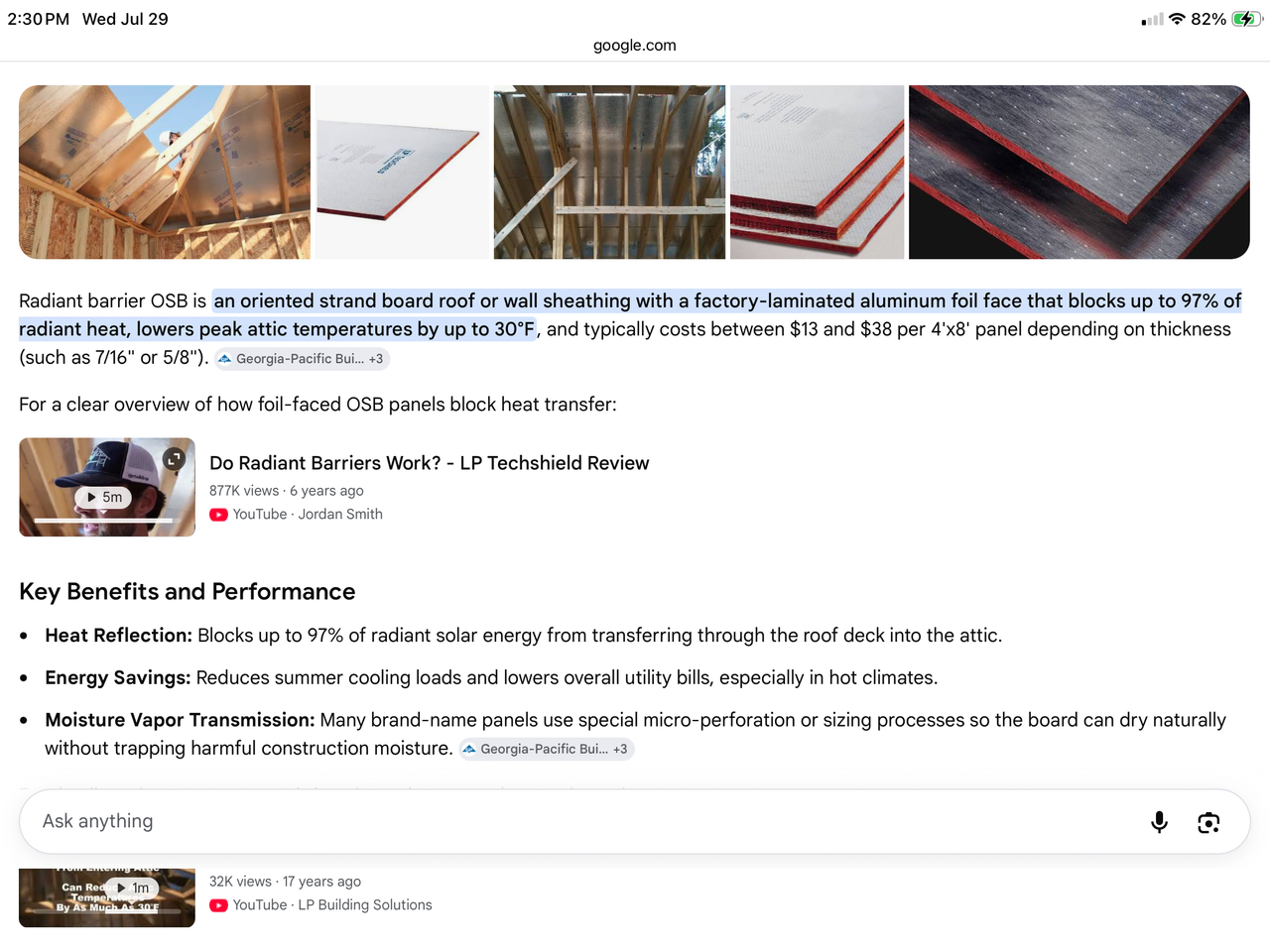
I agree with Zappas, your builder is likely referring to using radiant barrier OBS roof sheathing which would be way to go with new construction.
Posted on 7/29/26 at 3:10 pm to Tygerfan
quote:
I have no idea about any of it. I just know my old house had copper and didn't have these issues and this new house has PEX, and it comes out hot. I was just assuming it was because of the PEX from things I've read online, but generally I'm talking out of my arse when it comes to this since I have zero experience with plumbing.
I think something else is in play and not a Pex issue. My brother in law is a plumber and I asked him about insulating the copper water lines in the attic of my house, I was more concerned with the freezing-burst pipe issue. He told me just to insulate the cold water line. That would probably help you with the “hot” cold water if you insulate the Pex cold water line.
This post was edited on 7/29/26 at 7:56 pm
Posted on 7/29/26 at 3:33 pm to Will Cover
quote:
Their concern is that, with our extreme attic temperatures, a radiant barrier can increase the risk of condensation ("sweating") in the attic
That is a major problem with radiant barrier if it's not installed correctly and/or there is not proper attic ventilation. If it's properly ventilated, moisture shouldn't be a concern.
Posted on 7/29/26 at 5:23 pm to Will Cover
I would think that the radiant barrier would increase the heat at your roof surface and possibly damage shingles faster.
Posted on 7/29/26 at 7:38 pm to Will Cover
quote:
HVAC contractor also mentioned they have been seeing a lot of attic sweating issues with radiant barrier installations
This can and does happen fairly regular. More likely to happen if the radiant barrier is installed well and does a good job of reducing attic temps. The outer layer of duct needs to stay above dewpoint. With 50 degree air flowing only 1" of fiberglass insulation away, that can drop the temp of the outer mylar to an 80degree dewpoint pretty easily in a cooler attic.
Posted on 7/29/26 at 7:49 pm to mtcheral
quote:
I would think that the radiant barrier would increase the heat at your roof surface and possibly damage shingles faster.
A comprehensive study by the FL Solar Entergy Center shows a radiant barrier does increase shingle temperature 3 to 5 F, but doesn’t not reduce the functional life of the shingles, nor does it void the warranty by the shingle manufacturers.

 Page 1 of 2



Popular

Back to top
 Follow TigerDroppings for LSU Football News