




- My Forums
- Tiger Rant
- LSU Recruiting
- SEC Rant
- Saints Talk
- Pelicans Talk
- More Sports Board
- Fantasy Sports
- Golf Board
- Soccer Board
- O-T Lounge
- Tech Board
- Home/Garden Board
- Outdoor Board
- Health/Fitness Board
- Movie/TV Board
- Book Board
- Music Board
- Political Talk
- Money Talk
- Fark Board
- Gaming Board
- Travel Board
- Food/Drink Board
- Ticket Exchange
- TD Help Board
Customize My Forums- View All Forums
- Show Left Links
- Topic Sort Options
- Trending Topics
- Recent Topics
- Active Topics
Started By
Message
NBA Owners approve accepting bids to expand to Seattle and Las Vegas
Posted on 3/25/26 at 10:07 am

Posted on 3/25/26 at 10:07 am
Loading Twitter/X Embed...
If tweet fails to load, click here.This post was edited on 3/25/26 at 10:08 am
 12
12


Posted on 3/25/26 at 10:10 am to Fun Bunch
Good to see a return to Seattle. Insane it took this long
Hopefully they get their history back from OKC
Hopefully they get their history back from OKC
Posted on 3/25/26 at 10:11 am to WestCoastAg
quote:
Hopefully they get their history back from OKC
They are


Posted on 3/25/26 at 10:23 am to Fun Bunch
Having my Nitro Cold Brew at Starbies in a bit to celebrate 


Posted on 3/25/26 at 10:29 am to Fun Bunch
My childhood team is back baby!
Posted on 3/25/26 at 10:56 am to iwyLSUiwy
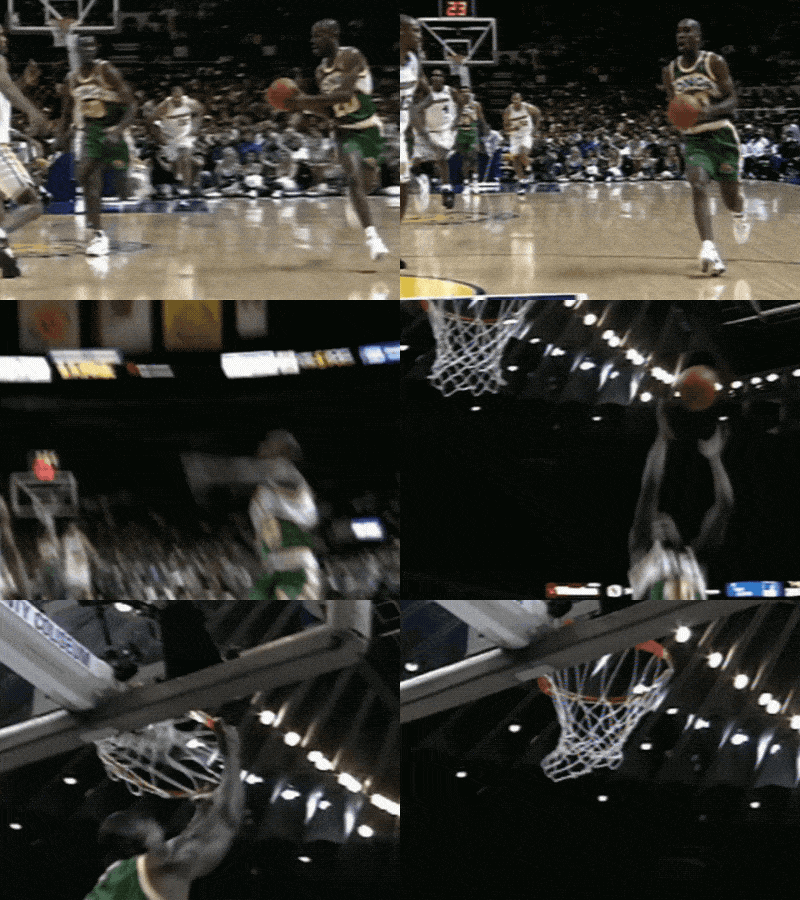
I remember when Michael Jordan and the Bulls killed them in the Finals


Posted on 3/25/26 at 11:02 am to Fun Bunch
Shawn Kemp
Posted on 3/25/26 at 11:14 am to 4x4tiger
quote:
I remember when Michael Jordan and the Bulls killed them in the Finals
Took it to 6 games with one of the greatest NBA teams ever assembled. Would have been a little different had they went with a different strategy the first few games. That Sonics team would have wrecked almost any other team they would have went up against, just had the unfortunate luck of going against one of the best teams ever.
Posted on 3/25/26 at 11:26 am to SirWinston
Have a gin and tonic mate.
Posted on 3/25/26 at 11:36 am to 4x4tiger
quote:
I remember when Michael Jordan and the Bulls killed them in the Finals
It was a 6 game series…

Posted on 3/25/26 at 11:40 am to Pedro
Rashard Lewis
Posted on 3/25/26 at 11:40 am to SirWinston
quote:
Starbies
Take a lap


Posted on 3/25/26 at 11:43 am to Pedro
quote:
Shawn Kemp
One of my favorite players growing up. Absolut nasty dunker.

Posted on 3/25/26 at 11:44 am to Pedro
Gary Payton

Posted on 3/25/26 at 11:45 am to Cosmo
Detlef Schrempf
Posted on 3/25/26 at 11:52 am to S
Sam Perkins
Posted on 3/25/26 at 12:04 pm to MikeD
George Karl

Posted on 3/25/26 at 12:11 pm to Cosmo
Hersey Hawkins

Posted on 3/25/26 at 12:27 pm to WestCoastAg
quote:
Hopefully they get their history back from OKC
Legally OKC owns it but OKC wants nothing to do with Sonics history and would voluntarily give it back:
In professional sports, when a team relocates, the league follows what is known as the “continuity rule.” Legally, a “team” is not the city, the fan base, or even the brand—it is the underlying franchise entity that holds the league membership. When Clay Bennett, the chairman of PBC, purchased the Seattle SuperSonics, he acquired that corporate entity, its NBA membership interest, and the entire historical record attached to it. Under the continuity rule, once that same entity relocated to Oklahoma City, the franchise’s competitive history relocated with it. The Sonics’ records, championships, statistics, and retired numbers therefore remained with the Thunder, not because of any cultural preference or branding choice, but because the legal entity that generated those achievements never ceased to exist.
The Cleveland Browns settlement stands as the singular doctrinal outlier in the law of franchise continuity—a rare instance in which a league affirmatively intervened to freeze a team’s identity and historical lineage in place while allowing the underlying business entity to relocate.[ii] The NFL’s decision to separate the Browns’ legal continuity from their historical continuity was not the product of owner consent or league custom, but of extraordinary political pressure, congressional scrutiny, and a negotiated settlement designed to preserve a piece of the city’s cultural infrastructure. Nothing comparable exists in the NBA context. The league has never imposed a compulsory reallocation of franchise history, has no structural incentive to do so, and faces none of the political dynamics that drove the NFL’s intervention in 1996.
The distinction between a franchise relocation and an expansion team is central to understanding who legally owns the Supersonics’ historical records from 1967 to 2008. Relocation preserves continuity: the same franchise entity simply operates in a new city. By contrast, an expansion team is a brand-new legal entity with no prior competitive history. If the NBA were to award Seattle an expansion franchise today, that team would begin with a clean slate, because nothing about expansion disrupts or transfers the lineage of an existing franchise. As a result, everything that occurred in Seattle from 1967 through 2008 would remain part of Oklahoma City’s official franchise history, regardless of how strongly the Sonics’ identity is culturally tied to Seattle.
Section 6 of the 2008 Settlement Agreement draws an explicit legal boundary around the SuperSonics’ brand by designating a defined set of assets as the franchise’s “Intellectual Property.” This category includes the names “Seattle Sonics” and “Seattle SuperSonics,” all associated logos, symbols, and visual designs, the team’s trade dress—including its iconic green-and-gold color scheme—and any other identifying marks linked to the franchise’s public identity.[iii] Under the agreement, PBC is expressly prohibited from using any of this Intellectual Property to identify, market, or promote the Oklahoma City Thunder. Instead, PBC must transfer all “right, title, and interest” in these assets to the owner of any future Seattle NBA team at no cost, contingent only on league approval of that franchise. The agreement treats competitive history differently: all statistics, records, player achievements, retired numbers, and the 1979 championship remain legally attached to the continuous franchise entity—the Oklahoma City Thunder. Physical artifacts, such as the 1979 championship trophy and retired-number banners, are separately categorized as “Memorabilia” and placed under curatorial stewardship at Seattle’s Museum of History & Industry until a new team arrives. Together, these provisions create a deliberate separation between the Sonics’ symbolic identity, which is preserved for Seattle, and the franchise’s competitive lineage, which remains with Oklahoma City.
If Seattle is awarded an expansion team, the settlement’s allocation of rights becomes fully operative. Seattle would regain exclusive control over the SuperSonics identity portfolio, including all protected intellectual property and the physical artifacts preserved under the agreement. The new franchise could immediately brand itself as the SuperSonics and revive the city’s basketball identity, but it would not inherit the competitive record of the 1967–2008 Sonics. Because a franchise is defined by the continuity of its underlying entity, PBC’s unbroken existence means that the entire competitive history generated in Seattle continues to belong to that same entity, now operating in Oklahoma City. This continuity gives the Thunder full legal ownership of the Sonics’ competitive past, even where Seattle is allowed to resume the Sonics’ identity.
The assumption that a new Seattle team would automatically reclaim the 1967–2008 SuperSonics history is understandable, but the transfer of competitive lineage is not automatic. The modern precedent for breaking the continuity rule, even when legal continuity remains intact, comes from Tom Benson and the New Orleans Pelicans. In 2013, Benson rebranded the New Orleans Hornets as the Pelicans, creating a new name, logo, color scheme, and cultural identity. As part of that rebrand, New Orleans voluntarily surrendered the Hornets identity and informed the NBA that it no longer wished to claim the pre-2002 Charlotte Hornets lineage.[iv] Following this voluntary cession, the NBA approved a formal historical reallocation and reclassified franchise lineage across three entities: the Charlotte Hornets inherited all Hornets history from 1988–2002 and absorbed the Charlotte Bobcats’ 2004–2014 history, becoming the legal successor to the original Hornets for historical purposes; New Orleans retained only the 2002–2013 New Orleans Hornets history and continued forward as the Pelicans from 2013 onward. To complete the transfer, the NBA updated all official records—media guides, statistical databases, Hall of Fame associations, franchise lineage charts, and historical summaries—reflecting the newly assigned historical structure.
The Pelicans precedent demonstrates that franchise history is not absolutely fixed to continuity; it can be reassigned, but only when the incumbent franchise voluntarily relinquishes it and the NBA formally authorizes the transfer. For Seattle, this means that any return of the 1967–2008 SuperSonics lineage would require Oklahoma City to initiate that process. And it is expected that they will do just that.[v] Oklahoma City has spent nearly two decades cultivating a strong, independent identity that stands entirely on its own. The franchise avoids using Sonics records and achievements in official team media guides, rarely references Seattle-era players in public campaigns, and has built a modern brand unconnected to its Seattle origins. It appears that Oklahoma City is just as eager to shed their Sonics history as Seattle fans are eager to reclaim it.
Article LINK

Posted on 3/25/26 at 12:51 pm to SirWinston
quote:I’m going to need you to tighten up my man. We aren’t winning any civil wars with that attitude.
Having my Nitro Cold Brew at Starbies in a bit to celebrate

 Page 1 of 3

Popular
Back to top
 Follow TigerDroppings for LSU Football News