




- My Forums
- Tiger Rant
- LSU Recruiting
- SEC Rant
- Saints Talk
- Pelicans Talk
- More Sports Board
- Fantasy Sports
- Golf Board
- Soccer Board
- O-T Lounge
- Tech Board
- Home/Garden Board
- Outdoor Board
- Health/Fitness Board
- Movie/TV Board
- Book Board
- Music Board
- Political Talk
- Money Talk
- Fark Board
- Gaming Board
- Travel Board
- Food/Drink Board
- Ticket Exchange
- TD Help Board
Customize My Forums- View All Forums
- Show Left Links
- Topic Sort Options
- Trending Topics
- Recent Topics
- Active Topics
Started By
Message
re: Well Political Talk, what's your answer?
Posted on 2/19/25 at 6:23 pm to Seldom Seen

Posted on 2/19/25 at 6:23 pm to Seldom Seen
I can’t explain why it’s so cold, but I do know that if we pay more taxes and support Ukraine more, then we can solve this problem together. We’re all in it together.
 0
0


Posted on 2/19/25 at 6:24 pm to Seldom Seen


Posted on 2/20/25 at 6:51 am to GumboPot
quote:
Anyone that has taken chemistry and thermo can calculate the earth's temperature with specificity based on the following inputs:
1. Atmospheric molecular constituent concentrations.
2. Initial temperature.
3. Initial pressure.
4. Solar flux.
Number 4 is the biggest factor. It is the game changer.
"Climate scientist" like to concentrate on number 1.
However, the global cool period during the Early Modern period to the late 19th century seems to at least be partly due several massive volcano eruptions. Worth noting: the particulate coverage in the atmosphere was enough to dim the sun according to first-hand reports that coincide to when we know or suspect the eruption happened. Also, it seems that a volcano eruption in 534 was the most extreme in that sense. The 18th months of darkness from a very dim sun during daylight likely sealed that there would be no recovery of Roman civilization in the West.
Anthropogenic climate change could be a contributing factor in the rise of global temperatures but the last 150 years has been fairly quiet on volcanic activity and the sun was providing more warmth during the late 19th through mid-20th centuries too. There is more going on than just hydrocarbons in the atmosphere. It is a good thing for us to find cleaner energy though. I am not a climate scientist but there is a lot to suggest that the rise in global temperatures is affected by many variables much like any complicated system.
It is more interesting to me that many of the disruptions that ended a civilization/regime were affected by climate - usually abnormal cooling periods - so it is a worthwhile to keep an eye on this stuff because it is probably one of the bigger threats to US dominance besides nuclear-armed competitors.


Posted on 2/20/25 at 6:53 am to Seldom Seen
They called it global warming for years until they realized the opposite was happening so they changed it to Climate Change.
Posted on 2/20/25 at 6:54 am to TrueTiger
quote:
Because only an idiot believes it's possible to measure the temperature of the entire planet.
Measuring ocean rises down to the inch when regular old waves are 2-3 feet is a neat trick, too.
Posted on 2/20/25 at 7:19 am to GumboPot
quote:
4. Solar flux.


Posted on 2/20/25 at 7:20 am to Seldom Seen
I dont know but somehow it's my fault for eating beef and owning a 4x4 and not everyone flying Gulfstreams to climate change conferences

Posted on 2/20/25 at 7:24 am to YumYum Sauce
It's Elon's fault, obviously. Too many Teslas on the roads. We need more ICE.


Posted on 2/20/25 at 8:30 am to the TUSK
quote:
expound on that, if you would... (dumb it down for me)
1. Atmospheric molecular constituent concentrations.
This is your material. This is the medium that is being heated up or cooled down. Every material can transfer heat at a specific rate. We measure that rate in energy (jouals, btus, etc.) per unit temperature (K, C, F or R). It's referred to as heat capacity. Some material have relatively high heat capacities versus others. In our atmosphere CO2 does have a slightly lower heat capacity than surrounding atmospheric constituents. That means it takes less energy to increase the same mass of CO2 than it does for example to increase the same mass of N2. But the opposite is also true. CO2 will cool faster than N2.
Water is the great atmospheric capacitor. It takes a lot more energy per unit mass to increase the temperature of water than it does for any other molecule in our atmosphere. Furthermore, water is the only molecule in our atmosphere that goes through phase changes which absorbs even more energy (latent heat of fusion - to and from ice and water and latent heat of condensation - to and from water and vapor). The latent heat of condensation is fully demonstrated in early mornings when the morning dew hits the ground and there is a temperature pause before the temperatures drops lower (and usually never drops below the dew point temperatures especially when the local atmosphere is saturated because the water is busy using that energy to phase change).
Now some will obfuscate the issue of energy absorption by introducing the natural frequencies of atmospheric molecules. This is true of the CO2 molecule and infrared frequencies from the sun. It's just how CO2 absorbs energy.
Regardless of how the material absorbs the energy, said material has a specified energy capacity until the temperature changes (according to our predefined discrete temperature resolution).
2. Initial temperature.
Temperature is the measure of the kinetic energy of a material or system. The initial temperature is the baseline. We need a point to start. A point of reference to measure or calculate from. From the initial temperature we can predict or model the final temperature.
3. Initial pressure.
The initial pressure tells us how many molecules we are dealing with in a specified control volume. If I have one pound of air in a tank versus two pounds of air in the tank and I want to raise both 10 degrees, its going to take twice as much energy to increase the tank with 2 pounds of air 10 degrees than the tank with 1 pound of air. (This assumes ideal gas equation of state conditions...which all humans live. Higher pressures and different mixtures than an ideal gas required different equations of state.)
4. Solar flux.
This simply the energy per unit area com from the sun. It's usually specified over a period of time so it becomes power per unit area (like in watts per square meter). It's analogous to the burner on your stove heating up water for pasta. Turn up the energy per unit area and you get more heat and vise versa.
Posted on 2/20/25 at 8:43 am to Diego Ricardo
quote:
However, the global cool period during the Early Modern period to the late 19th century seems to at least be partly due several massive volcano eruptions. Worth noting: the particulate coverage in the atmosphere was enough to dim the sun according to first-hand reports that coincide to when we know or suspect the eruption happened. Also, it seems that a volcano eruption in 534 was the most extreme in that sense. The 18th months of darkness from a very dim sun during daylight likely sealed that there would be no recovery of Roman civilization in the West.
Yes. This is related to number 4. More specifically shielding the atmosphere from solar energy.
quote:
Anthropogenic climate change could be a contributing factor
It is, but to what extent? I've run the calculations to answer this question:
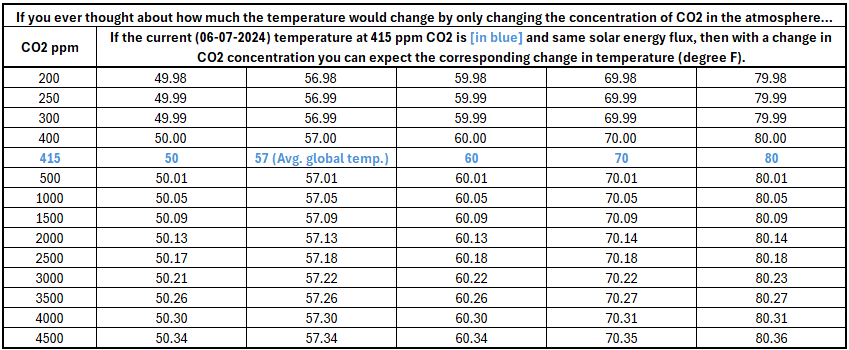
This a assumes steady energy input from the sun. The contribution from CO2 is negligible If we start at 57 degrees and reduce the CO2 concentration to 200 ppm from 415 ppm the temperature becomes 56.98 degrees. We also have dying plants at 200 ppm.
If we raise the concentration of CO2 from 415 ppm to 1000 ppm the temperature would be 57.05 degrees instead of 57 degrees.
Posted on 2/20/25 at 8:46 am to Seldom Seen
I didn't think it was called global warming anymore but they call it climate change now because they don't really know what the Earth is doing.
Basically:
Climate Quacks: The Earth is warming and it's all our fault
Earth: Psyche here's some crazy cold weather. Fooled ya.
Basically:
Climate Quacks: The Earth is warming and it's all our fault
Earth: Psyche here's some crazy cold weather. Fooled ya.
Posted on 2/20/25 at 8:48 am to Diego Ricardo
You have to be a retard to not understand all weather is cylical. Man has never had enough control to do the things "activists" claimed.
Please name 1, just 1, of Al Gore's Truth's that actually came to fruition?
You can't.
Please name 1, just 1, of Al Gore's Truth's that actually came to fruition?
You can't.
Posted on 2/20/25 at 12:58 pm to GumboPot
quote:
It is, but to what extent? I've run the calculations to answer this question:
This a assumes steady energy input from the sun. The contribution from CO2 is negligible If we start at 57 degrees and reduce the CO2 concentration to 200 ppm from 415 ppm the temperature becomes 56.98 degrees. We also have dying plants at 200 ppm.
If we raise the concentration of CO2 from 415 ppm to 1000 ppm the temperature would be 57.05 degrees instead of 57 degrees.
Right. I think climate science on the warming are important though. It is warming. No one should deny it. The important questions are "how can we adapt if the trends continue" in my opinion.
We're all here today because of adaption to climate circumstances we largely cannot dictate even with our level of science today. I'm more worried about the adapting not the blaming.
Posted on 2/20/25 at 1:22 pm to Diego Ricardo
Al Gore stated there would be no snowfall after 2013.
Posted on 2/20/25 at 1:25 pm to Bass Tiger
Our cold is now centered over North America. Its been a warm winter in AK.
Some places that should have 4' of snow on the ground are bone dry.
Some places that should have 4' of snow on the ground are bone dry.
Posted on 2/20/25 at 1:41 pm to Seldom Seen
The January 2022 underwater volcano in the Tonga Hunga area of the South Pacific injected megatons of water vapor into the stratosphere that might affect global temps for 5-10 years.
Though minuscule, it’s food for thought. But wonder why we don’t hear more about the Tonga event?
Though minuscule, it’s food for thought. But wonder why we don’t hear more about the Tonga event?

 Page 3 of 3


Back to top
 Follow TigerDroppings for LSU Football News