




- My Forums
- Tiger Rant
- LSU Recruiting
- SEC Rant
- Saints Talk
- Pelicans Talk
- More Sports Board
- Fantasy Sports
- Golf Board
- Soccer Board
- O-T Lounge
- Tech Board
- Home/Garden Board
- Outdoor Board
- Health/Fitness Board
- Movie/TV Board
- Book Board
- Music Board
- Political Talk
- Money Talk
- Fark Board
- Gaming Board
- Travel Board
- Food/Drink Board
- Ticket Exchange
- TD Help Board
Customize My Forums- View All Forums
- Show Left Links
- Topic Sort Options
- Trending Topics
- Recent Topics
- Active Topics
Started By
Message
re: Reminder:J.D. Vance Is Correct.“Ordo Caritas” Has Strong Antecedents In Catholic Doctrine.
Posted on 5/11/25 at 9:03 am to WildernessTraveler7

Posted on 5/11/25 at 9:03 am to WildernessTraveler7
I did misspell his name in that one post but, your list of superior theologians is unsupported by most scholars of the genre, so, I disagree with you.
The list is great and it is all subjective, but, I disagree.
And may I add that arguing about this is like arguing about "Who is the greatest guitar player of all time?" in that it's not an important argument.
The debate regarding whether Ordo Caritas is consistent with Jesus's Words regarding the issue is more important.
The list is great and it is all subjective, but, I disagree.
And may I add that arguing about this is like arguing about "Who is the greatest guitar player of all time?" in that it's not an important argument.
The debate regarding whether Ordo Caritas is consistent with Jesus's Words regarding the issue is more important.
This post was edited on 5/11/25 at 9:14 am
 0
0

Posted on 5/11/25 at 9:07 am to 4cubbies
quote:
There’s nothing to interpret about the words I quoted. It’s extremely straight forward.
Yes, and St. Thomas Aquinas was well aware of this passage of Scripture when he wrote his Ordo Caritas. There's no conflict between these words of Jesus and Ordo Caritas. Ordo Caritas is Aquinas's implementation of the Word of God.
If your argument is that Aquinas's Ordo Caritas wrongly interprets this Bible passage, then, I say that I trust Aquinas's interpretation more than I trust your interpretation.

Posted on 5/11/25 at 9:26 am to 4cubbies
quote:
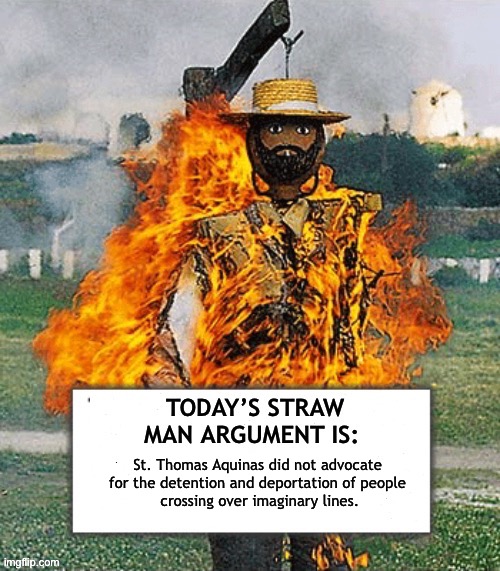
St. Thomas Aquinas did not advocate for the detention and deportation of people crossing over imaginary lines.
Why is sending people HOME so bad?


Posted on 5/11/25 at 9:49 am to 4cubbies
quote:You were citing Christian values and Biblical teachings. Were you not? Those teachings are considered anathema by public school proponents, and have been for at least two generations. I find the dichotomous approach absolutely absurd. It's a bit akin to the left shutting down conservative free speech on campus, then to the shagrin of leftist Jews, labeling subsequent efforts to extinguish campus antisemitism as anti-free-speech.
how would what is taught in public school influence anyone’s stance on immigration?
quote:We are $37TRILLION in debt. If you don't understand that to be "a real problem," I don't know what to tell you. For further perspective, $37T is twice the debt of the entire EU, and the EU ranks as the second highest "state" debt level.
If this were actually a real problem and not just first world tantrums, dissenters would move to a country without taxes, if such a place exists.
Associated with that debt is a national responsibility and consequence. Naivety predilects a dangerous disregard of those issues. Let's just assume all world income could be redistributed evenly on a per capita basis (reducing US pci about 6-fold). How friendly would the world really be? How long would countries like NoKo, China, Russia, the Arab ME, etc take to realize they could forcibly capture a share of their neighbor's wealth? For all our international meddling, there is but one reason we've come upon the first time in centuries with an 80yr span since the last war between global superpowers.
All that is to say, opening the country to unfettered immigration might seem a good Christian idea, but in practical application, not so much. The Vatican has a wall for a reason.


Posted on 5/11/25 at 11:41 am to Toomer Deplorable
More as an aside, not a knock at Christianity in particular, but it seems to me that many such observations or 'rules' from Religion are in fact 'common sense' stuff put down as some sort of 'Yeah, the deity says it, so that's why we do it' sort of stuff. IMO, it's more like we figured out over time and through experience that yeah, things DO work out better if we adhere to certain behaviors or ideals.


Posted on 5/11/25 at 12:11 pm to 4cubbies
quote:
St. Thomas Aquinas did not advocate for the detention and deportation of people crossing over imaginary lines.
Posted on 5/11/25 at 12:37 pm to GumboPot
quote:
St. Thomas Aquinas did not advocate for the detention and deportation of people crossing over imaginary lines.
Why is sending people HOME so bad?
The entire argument is absurd on it’s face. Yet it is especially wrong in it’s implication that Saint Thomas Aquinas would support mass immigration.
In the Middle Ages people largely were confined to live on the patch of land that their ancestors had lived. Indeed, for the vast majority of common people, journey to a foreign land was unheard of because of the perils involved.
Consequently, mere survival, livelihood, and law and order were largely dependent upon the 1.) the parents and 2.) the community in which one was born. This larger community — often feudal in nature — constituted a person’s “country” of origin.
The term “Patriot” is a derivative of the Latin word “patriota” which means “fellow countryman.” This Latin term itself is derived from “patria” meaning “fatherland”.
Thus the concept of patriotism is closely tied to love and devotion to one’s parents and their country of birth. Thomas Aquinas indeed argued that the principles of our existence itself is linked to God, our parents and our country of birth:
“Man becomes a debtor to other men in various ways, according to their various excellence and the various benefits received from them. On both counts God holds first place, for He is supremely excellent, and is for us the first principle of being and government. In the second place, the principles of our being and government are our parents and our country, that have given us birth and nourishment. Consequently man is debtor chiefly to his parents and his country, after God. Wherefore just as it belongs to religion to give worship to God, so does it belong to piety, in the second place, to give worship to one's parents and one's country.”
Aquinas thus drew a parallel between our worldly hierarchy and the eternal hierarchy of God and argued it is important for man to recognize the blessings bestowed upon him by both God and country. So though the modern notion of nationhood did not even exist in the time of Thomas Aquinas, certainly Aquinas recognized that respecting the laws of your country of birth was a good and necessary duty.
Posted on 5/11/25 at 12:57 pm to SouthEasternKaiju
quote:
More as an aside, not a knock at Christianity in particular, but it seems to me that many such observations or 'rules' from Religion are in fact 'common sense' stuff put down as some sort of 'Yeah, the deity says it, so that's why we do it' sort of stuff.
As further aside, many on this board may be unaware that you approach these arguments from an agnostic POV.
quote:
IMO, it's more like we figured out over time and through experience that yeah, things DO work out better if we adhere to certain behaviors or ideals.
I think the philosopher Edward Feser would agree with this proposition.
Though a well known apologist for an Aristotelian-Thomistic worldview, Feser likewise mentions that Ordo Caritas is compatible with any worldview — such as Confucianism — which emphasizes that the family is the primary building block of any harmonious and ethical society.
Loading Twitter/X Embed...
If tweet fails to load, click here.This post was edited on 5/11/25 at 1:13 pm

Posted on 5/11/25 at 1:11 pm to NC_Tigah
quote:
Meanwhile, as individuals we certainly are free to extend our own charity. The problem is, when tax dollars are involved, charitable provision is neither free, nor individually confined.
Socialism is not charity and indeed is the very definition of avariciousness.
“It is no exaggeration to say that the central aim of socialism is to discredit those traditional morals which keep us alive.” Frederick Hayek.
Posted on 5/11/25 at 1:12 pm to 4cubbies
quote:
You people will pervert anything to make it support MAGA.
You are a living exemplar of the rotten core that represents all that remains of the democrat party. It does no good to waste intellectual or moral thoughts on you.
You deserve every ounce of the contempt you receive here.
Posted on 5/11/25 at 1:31 pm to NC_Tigah
quote:
The Vatican has a wall for a reason.
well stated in its entirety - but this is the clincher.
IF he really thinks ALL must be treated as though they were you very own offspring coming to you for help, he needs to get rid of that wall, go out in the streets where these 'unfortunates' live and share his clean clothing and banquet meals with them instead of 'pontificating' from an elevated perch in the Vatican.

Posted on 5/11/25 at 1:47 pm to Toomer Deplorable
At the top of the order from Aquinas is to love God first. Not sure I saw that in any previous post. If we could all do that, I believe the rest would take care of itself.
Posted on 5/12/25 at 6:33 am to NineLineBind
quote:
At the top of the order from Aquinas is to love God first.
quote:
At the top of the order from Aquinas is to love God first.
Exactly.
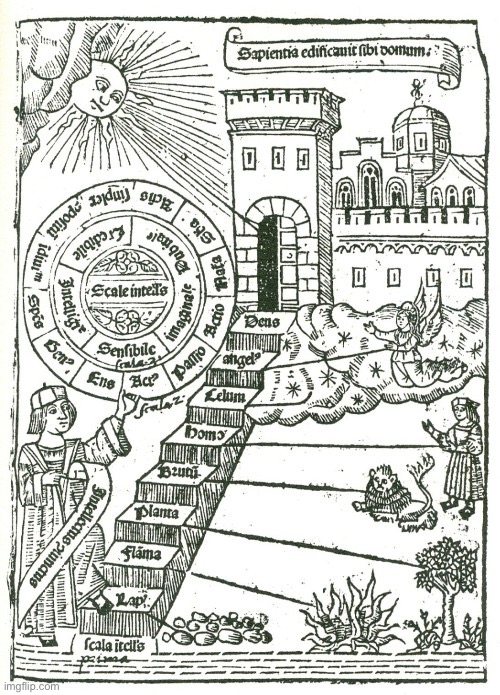
Saint Thomas Aquinas’ philosophical worldview emphasized the existence of a natural order established by God and rooted in Natural Law . Aquinas argued that every aspect of creation has a specific purpose and hierarchical place within God’s divine order.
Every being — from man to the lowest animal form — had its own role and dignity in the wonder of creation. This insight by Thomas Aquinas served as the basis for the Ladder of Being — also known as the Great Chain of Being — the medieval concept that the entire universe is based on a divine hierarchical structure.
Thomas and the later Scholastics also established that man’s capacity for reason grants him the ability to cognitively intuit — independent of divine revelation — that the natural world is governed by both moral and physical laws. Scholasticism thus demonstrated that philosophy can exist independently from theology and that man — through reason — is capable of comprehending both the systematic order of the natural world and man’s place in it.
St. Thomas Aquinas thus significantly influenced later thinkers in the Western philosophical tradition by integrating Aristotelian philosophy with Christian theology, emphasizing that moral principles are derived from the rational understanding of human nature and the divine order. These ideas laid the groundwork for Enlightenment thinkers, who further developed the notion that natural rights and ethical standards are inherent to human consciousness and can be discerned through reason, independent of religious doctrine.
As such, those rights are “inalienable” and are based on a preexisting moral order that serves as the basis for all human freedom and flourishing throughout history and cultures. All just forms of government are thus rooted in the concept of Natural Law.
Though the concept of Natural Law is traditionally attributed to a Divine Creator, it also has been attributed by differing philosophers to the underlying structure of the universe, the result of the human capacity to reason and/or man’s free will. C.S. Lewis — arguably the foremost Christian apologist of the 20th Century — indeed posited that a belief in a supernatural Godhead is not necessary for a belief in Natural Law:
“The Tao, which others may call Natural Law or Traditional Morality or the First Principles of Practical Reason or the First Platitudes, is not one among a series of possible systems of value. It is the sole source of all value judgments. If it is rejected, all value is rejected. If any value is retained, it is retained. The effort to refute it and raise a new system of value in its place is self-contradictory. There has never been, and never will be, a radically new judgment of value in the history of the world. What purports to be new systems or ideologies all consist of fragments from the Tao itself, arbitrarily wrenched from their context in the whole and then swollen to madness in their isolation, yet still owing to the Tao and to it alone such validity as they posses.” C.S. Lewis: The Abolition of Man.
Considering in all these factors, Aquinas is not only one if the most significant thinkers in the Catholic and Christian church but is likewise one of the seminal intellectual figures in Western Civilization itself. In short, Saint Thomas Aquinas’ role in the development of the Western philosophical tradition can’t be overstated.
pinterest.com


Posted on 5/12/25 at 8:13 am to 4cubbies
quote:
we’re supposed to be especially charitable to those who hate us and those who can do nothing to elevate or assist us, like the poor and migrants.
Sure. Come here legally and we'll talk.
Posted on 5/12/25 at 8:59 am to Toomer Deplorable
That is beautiful, Toom. Thanks for posting. Albeit the essential idea of a Natural Law-based Morality vs that of a Religious (think Jesus and the idea of a Divinely appointed and singular, Religious Guru) would be a critical point. Even if an Entity could and would climb the evolutionary ladder to the top, said Entity would then face the brick wall of Ego. The Eastern Philosophers know this and implement a Guru to remove personal volition and Ego from the equation, and enter the ‘Gate’. IMO, and given Jesus’s declaration that “no man cometh up but by me”, such is either THE most egotistical statement ever uttered by a man, or, it is Truth and He is indeed “only begotten Son of God” with power to forgive sin and allow entrance into ‘Heaven’. Wish CS was here to throw mud on the wall. Thanks again.
Posted on 5/12/25 at 9:04 am to Toomer Deplorable
But people like 4cubbies act like deportations are sending people to concentration camps. When all that is happening they are being sent back to the country they came from. And in many instances like on college campuses they are being sent back to nicer places than America.

 Page 4 of 4


Back to top
 Follow TigerDroppings for LSU Football News