Favorite team:
Location:Team Bitter Clinger
Biography:“I am not a bum. I'm a jerk. I once had wealth, power, and the love of a beautiful woman. Now I only have two things: my friends, and... uh... my thermos. Huh? My story? Okay. It was never easy for me. I was born a poor black child...”
Interests:
Occupation:
Number of Posts:24338
Registered on:5/15/2020
Online Status:Not Online

Recent Posts

Message
quote:


Good Lord ! Too much plain stupidity to try & respond to. But....just a quicky. Widely known & stated that Iran has always been the monetary & military backer of Hamas. This is not "per FOX". It's common knowledge. By sane people, anyway..


Good Lord ! Too much plain stupidity to try & respond to. But....just a quicky. Widely known & stated that THE CIA has always been the monetary & military backer of MILITANT SUNNI ISLAM. THOUGH LARGELY IGNORED BY THE LEFT AND RIGHT MEDIA ESTABLISHMENT. It's common knowledge. By sane people, anyway..

FIFY!

:cheers:

quote:

Yeah he only got us out of the Carter era and beat Russia. What a dumb arse he was.


The #never Trumpers in the GOP establishment will recoil in horror at the idea, but Reagan and Trump shared many similarities. As an accomplished Governor of California, Reagan of course was a much more polished and skillful politician than Trump when Reagan sought the nomination.

Yet like Trump, Reagan was a Washington outsider who was uniformly despised by the ruling political and media intelligentsia in Washington and New York. Reagan ran as a political wild card against the reigning Eastern political establishment when Reagan sought the GOP nomination in 1976 and 1980 since Reagan embodied the Goldwater libertarianism of the former Western frontier states.

In 1980, Reagan’s base represented the wing of the GOP that was opposed to globalist organizations (then called “internationalism”) like the Trilateral Commission which had been founded by David Rockefeller. Reagan railed on Padre Bush’s membership in the Trilateral Commission and the Council on Foreign Relations and likewise argued for a return to the Gold Standard:


However, these issues were summarily taken off the table after Reagan won the GOP nomination. Reagan himself was forced to embrace Rockefeller Republicanism when he named George Bush to be his VP pick.

The lesson here is that the UniParty® exists to perpetuate the Deep State and the Deep State exists to perpetuate our nation’s print-on-demand monetary system. This is ultimately why any vote in this UniParty® charade is a vote for the left or right wing of the CIA.

Trumpism, like Reaganism before it, will ultimately fail. Again, the current crisis continues until we return to sound monetary policies.


“The Trilateralist Commission is international and is intended to be the vehicle for multinational consolidation of the commercial and banking interests by seizing control of the political government of the United States. The Trilateralist Commission represents a skillful, coordinated effort to seize control and consolidate the four centers of power – political, monetary, intellectual, and ecclesiastical.” Barry Goldwater, No Apologies.


quote:

Lincoln


What President waged a war that was overwhelmingly unpopular in the nation’s largest urban cities?

What President unleashed combat troops from the battlefield to assault citizen protestors in New York City?

What President unilaterally suspended the writ of habeas corpus and arrested thousands of private citizens in the dark of night and held them in political prison camps?

What President ignored a Supreme Court Justice’s ruling that the suspension of the writ of habeas corpus was unConstitutional and should be reinstated?

What president had a newspaper editor arrested for criticizing the suspension of the writ of habeas corpus?

What President had a sitting member of Congress arrested for criticizing the suspension of the writ of habeas corpus?

What President had his soldiers bombard and destroy newspaper buildings and newspaper printing plants that were critical of the war effort or even dared questioned the President’s policies?

What President was involved in telegraphic censorship of newspapers critical of the President’s policies?

What President declared he would abandon the U.S. Constitution to save the Union?

What President said he cared not in freeing the slaves but only in saving the Union?

What President is uniformly hailed by the leaders of the bipartisan Uniparty® as one of the greatest Presidents ever for “saving the Union?”

Lincoln would love the Deep State.
quote:

Prepare to be disappointed


I wouldn’t say I was naive enough to be disappointed: I long have recognized that any vote in this Uniparty® charade is ultimately a vote for the left or right wing of the Deep State. So I always assumed it would be Trump’s profligate spending that would ultimately undermine his legacy.

Yet I will admit that I am a bit surprised that Trump’s 2nd term would be so readily coopted by the neoconservative wing of the GOP which once served as Trump’s primary opposition. That certainly wasn’t on my bingo card.

:crazy:

quote:

Low IQ inbred sheep trained from birth to hate da Joos.


FWIW, I have said on this forum repeatedly that if Israel wants to power up their armored bulldozer battalion and push Hamas into the sea, more power to them. What I oppose is another U.S. sponsored regime change operation in the Middle East. This is NOT what was promised.

Loading Twitter/X Embed...
If tweet fails to load, click here.
quote:

Yes. Many here are too young to remember the overthrow of the Shah and the American hostages that were held under Carter's term as POTUS. That was a long year and a half. I remember.


Let us not forget either that declassified documents revealed that the Carter Administration was indirectly communicating with Khomeini and other opposition leaders, contradicting the widely disseminated narrative that the Carter Administration was wholly surprised by the Iranian Revolution.

Iran And The Shah. What Really Happened?

…Long regarded as a U.S. ally, the Shah was pro-Western and anti-communist, and he was aware that he posed the main barrier to Soviet ambitions in the Middle East. As distinguished foreign-affairs analyst Hilaire du Berrier noted: “He determined to make Iran capable of blocking a Russian advance until the West should realize to what extent her own interests were threatened and come to his aid…. It necessitated an army of 250,000 men.” The Shah’s air force ranked among the world’s five best. A voice for stability within the Middle East itself, he favored peace with Israel and supplied the beleaguered state with oil.

On the home front, the Shah protected minorities and permitted non-Muslims to practice their faiths. “All faith,” he wrote, “imposes respect upon the beholder.” The Shah also brought Iran into the 20th century by granting women equal rights. This was not to accommodate feminism, but to end archaic brutalization.

Yet, at the height of Iran’s prosperity, the Shah suddenly became the target of an ignoble campaign led by U.S. and British foreign policy makers. Bolstered by slander in the Western press, these forces, along with Soviet-inspired communist insurgents, and mullahs opposing the Shah’s progressiveness, combined to face him with overwhelming opposition. In three years he went from vibrant monarch to exile (on January 16, 1979), and ultimately death, while Iran fell to Ayatollah Khomeini’s terror.

Houchang Nahavandi, one of the Shah’s ministers and closest advisers, reveals in his book The Last Shah of Iran: “We now know that the idea of deposing the Shah was broached continually, from the mid-seventies on, in the National Security Council in Washington, by Henry Kissinger, whom the Shah thought of as a firm friend.”

Kissinger virtually epitomized the American establishment: before acting as Secretary of State under Republicans Richard Nixon and Gerald Ford, he had been chief foreign-affairs adviser to Nelson Rockefeller, whom he called “the single most influential person in my life.” Jimmy Carter defeated Ford in the 1976 presidential election, but the switch to a Democratic administration did not change the new foreign policy tilt against the Shah.

Every presidential administration since Franklin D. Roosevelt’s has been dominated by members of the Council on Foreign Relations (CFR), the most visible manifestation of the establishment that dictates U.S. foreign policy along internationalist lines. The Carter administration was no exception.

What is the solution to modern Iran? Before listening to war drums, let us remember:

It was the CFR clique — the same establishment entrenched in the Bush and Obama administrations — that ousted the Shah, resulting in today’s Iran. That establishment also chanted for the six-year-old Iraq War over alleged weapons of mass destruction never found.

Therefore, instead of contemplating war with Iran, a nation four times Iraq’s size, let us demand that America shed its CFR hierarchy and their interventionist policy that has wrought decades of misery, and adopt a policy of avoiding foreign entanglements, and of minding our own business in international affairs.


quote:

I cheer for the CIA in Iran only with the hope they can help the Persians cast off their Muslim oppressors.


The overwhelming majority of Iranians are Muslim.

Putting that aside, the Iranian people can partially thank the CIA for the Iranian Revolution.

I periodically repost this book review and Trump’s SOTU speech tonight is as good a day as any to do so again…


The Great Game: America’s Long & Disastrous Foreign Policy Agenda In The Middle East:

Iran looks to be the biggest loser in the latest turmoil to rock the Middle East. Yet tragically, Iran’s current Revolutionary State is in many ways a reaction and lasting legacy of past American interventionism in the region. How so?

Recommended reading: America's Great Game: The CIA's Secret Arabists and the Shaping of the Modern Middle East by Hugh Wilford.

This book of deep history focuses primarily on three CIA agents and their regime change efforts in three countries after WWII: Syria, Egypt and Iran. The key figure that emerges in this narrative is Kermit “Kim” Roosevelt — grandson of Theodore. Roosevelt was recruited into the newly created Central Intelligence Agency to head the Office of Policy Coordination, the espionage and counter-intelligence branch of the CIA.

A rather complicated chess game of competing powers in the newly formed CIA emerges — the Zionists vs. the anti-Zionists. And what a wicked game it was. Wilford illustrates how these agent provocateurs were very short sighted in their schemes and largely viewed the indigenous populations of the Middle Eastern nations as simple pawns in a larger chess game between the Great Powers.

These CIA wunderkinds with blue-blood pedigrees viewed the nation states in the post-colonial era as blank slates to be shaped at will by their supposed knowledge and intellect. Yet rather than fundamentally transform power relations in the Middle East to pro-American sentiment as promised, this spy clique of the Eastern Establishment inculcated a residual and generational resentment toward American meddling in the region that is still evident today.

Along with Roosevelt, Miles Copeland — a Birmingham Alabama native and the father of the famed rock musician Stewart — is another CIA spook who was instrumental in shaping the Middle Eastern landscape after the end of WWII. Copeland helped orchestrate the first CIA military coup in the region: a 1949 bloodless putsch in Syria. The CIA installed Husni al-Za’im, a former Kurdish officer in the Ottoman Army.

Kim Roosevelt, along with assistance from his cousin Archibald Roosevelt, in turn masterminded the 1953 Iranian coup d'état which toppled nationalist prime minister Mohammed Mosaddeqh after Mosaddeqh nationalized the petroleum industry in Iran.

Archibald Roosevelt in turn orchestrated a second 1956 regime change operation in Syria after a violent counter-coup displaced the al-Za’im regime. This second regime change operation in Syria and the ensuing instability ultimately helped push Syria closer to the USSR.

This was a repeated pattern. The CIA’s initial backing of Egyptian General Mohamed Naguib — and his young protege General Gamal Abdel Nasser — likewise backfired when Nasser ousted his elder benefactor, turned his back on the West and nationalized the Suez Canal.

As a tweak to the West, Nasser also opened diplomatic channels to the Soviet Union and supported the creation of a socialist pan-Arabic State. And of course, we all know the results of the festering resentment over the installation of the Shah that ultimately resulted in the Iranian revolution.

Whether it was braggadocio, naïveté or misplaced idealism, the failures of these nation building efforts shaped the modern Middle East that we know today. Sadly, this “game” continues anew. The same doublespeak and false promises spew forth from the mouths of these Masters of the Universe types in our corrupt national security apparatus.

Perhaps it was possible at one time to posit that the chaos and violent fury released upon the region after the Iraq War was an unforeseen contingency. Yet we have now seen a succession of four Middle Eastern nations — Iraq, Libya, Yemen and now Syria — engulfed in violence and human catastrophe after US, NATO and Western military intervention. And now these Masters of the Universe want a war with Iran?

Not coincidentally, each of these repeated military interventions have been followed by a staggering refugee wave headed for Europe. Yet in the name of pluralism, Western nations are sternly lectured by many of these same ruling elites that it must open their borders to a deluge of immigrants whose values are wholly alien to pluralistic societies and must instead welcome these immigrants though many have demonstrated violent antagonism toward free societies?

At this late stage, naïveté can’t be blamed for these repeated failures. It is indeed sheer madness to claim the situation in the Middle East is all an unforeseen accident. The pattern is established and is crystal clear for anyone who doesn’t regurgitate Deep State talking points. The minute details and the exact coordination of the plan becomes irrelevant when the larger pattern is so clear: chaos — the more violent the better — is the goal of these repeated regime change operations.

We can’t change the past. But must we be doomed to repeat it? Endlessly on a loop? :dunno:


.


quote:

Is the attack starting during or after the SOTU address? I bet there’s a gambling site somewhere laying odds


Or before another “lone nut” assassination attempt on Trump?

:dunno:
quote:

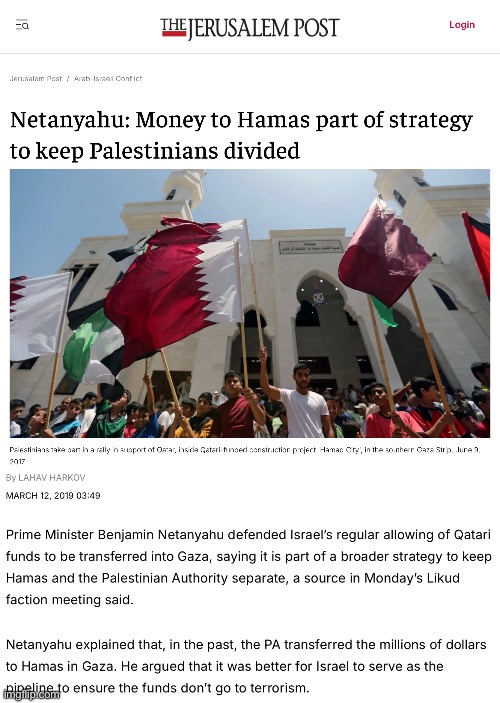
To end the financing of terrorism all over the world.


So the CIA is going to target itself?

:dunno:

quote:

It’s a fluid situation


It is dizzying seeing many of the same people who rightly recognized that the riots during the long, hot summer of 2020 were partially a CIA color revolution against the American people now seem to gleefully be cheering on that same entity as it apparently plots another regime operation in the Middle East?

:crazy:


quote:

So we only defend poor and innocent people in places with large oil deposits.


Certainly those whose regimes challenge the supremacy of the U$D and/or threaten Israel. Anyone who thinks anyone in Langley gives one rat’s @ss about the Mullahs suppressing their people are smoking meth.

:crazy:


quote:


A lot more when they work for Trump.


You got that bass awkwards.

Presidents come and go but the Deep State rules in perpetuity.


quote:

Afraid to help good people?


The problem here is the CIA is not good people.
Not surprising.

The failed War On Drugs® itself empowered the cartels just as prohibition empowered the mafia.

By criminalizing a high-demand product, the government created incentives for illicit markets to flourish, ultimately strengthening the very criminal organizations it sought to dismantle.
quote:

Nor the economy's reaction to such a transition.


If returning to free market pricing in the money supply upends the economy, that actually bolsters the argument — it is an indictment against centralized control over our monetary system. A genuinely free market does not collapse when artificial supports are removed.

quote:

Its a green field this might work.
Compare that to the trillions invested into the current economy on a second by second basis.


If normalization would trigger widespread disruption, then what we are describing is not a market economy but one sustained by continuous intervention, artificial credit expansion and continuous rate suppression. Certainly the political calculus is a tremendous obstacle, yet what Hayek offered was a concrete proposal designed to discipline money at its source.

The fact that reform would be resisted — particularly by the central planners who benefit from the present arrangement — does not diminish its economic validity. If anything, it clarifies who stands to lose from a return to free market discipline.

quote:

Yes, Walmart bitcoin.


Mocking Hayek’s ideas on currency privatization as “Walmart bitcoin” trivializes what was a legitimate structural critique of centralized monetary power. And again, actually underscores the point.

Who has more fiscal credibility: Walmart or the Feral Government of the United States? It damn sure ain’t Uncle Sam.

That is not an argument against reform. It is evidence of malicious misallocation.

The good news is, freeing control of the money supply from government manipulation would offset any temporary disruption in the economy: if interest rates were allowed to clear, if capital were priced honestly, and if credit were no longer administratively managed, the sectors most exposed would be those dependent on distortion — heavily leveraged finance, deficit-dependent public spending, and industries whose survival relies on subsidized borrowing and bailouts.

To be clear: the devastation would not fall evenly across productive enterprise. It would fall most heavily on the parasitic layer of the economy — the permanently deficit-financed government sector and those institutions whose business models rely on proximity to monetary expansion.

A system built on artificial liquidity will of course contract when that liquidity is withdrawn. Such a contraction would not be proof of failure; it is the correction of prior excess.

quote:

I'm not sure you can see that these ideas were never meant to actually be implemented.


Again, Friedrich Hayek’s proposals were not offering romantic abstractions as thought experiments. Hayek proposed a commodity basket reserve framework with defined operational mechanics and later advanced competing private currencies as an institutional check on the Feral Government’s monetary monopoly.

If the status quo cannot survive without perpetual intervention, then the problem is not the proposed reform — it is the system itself. Any “conservative” who recoils from structural monetary reform because it would be disruptive to the current economy is not defending markets; they afr defending an unsustainable status quo.
quote:


Its an idealogy, not a plan.

This is why no one takes this seriously, because even the proponents refuse to do the work involved in anything more than an abstract way.

Plus they reject all half steps.


Do you realize that Friedrich A. Hayek was one of the foremost free-market economists of the twentieth century? Hayek’s proposal for a commodity based reserve currency was not an abstract thought experiment; it was a serious and practical monetary reform advanced by a serious and highly respected scholar.

Though it did not include detailed legislative drafting on how to transition to the plan, Hayek’s idea of a basket of commodities was a concrete proposal that outlined the institutional mechanics on how to implement it. Hayek further fully addressed the primary problems we are now facing as a nation under our present monetary system.

Hayek’s broader monetary critique directly addressed the structural weaknesses of fiat currency and central banking. Hayek correctly criticized central banks for their manipulation of interest rates and the resulting disruption of market signals.

Such centralized planning necessarily leads to systematic misallocation of resources, recurring boom-bust cycles, and long-term economic instability. Hayek ultimately warned that persistent monetary centralization threatens not only economic stability but the institutional foundations of a free society itself.

A commodity based reserve currency was just one of Friedrich Hayek’s remedies against the ill effects of central banking. Later in his career, Friedrich Hayek proposed that governments should end their monopoly over the money supply and allow private institutions to issue competing currencies.

Hayek was in good stead with his criticism of central banking. Thomas Jefferson was likewise leery of central banking:

quote:

How are airstrikes war?


:lol:

This again? It is like a rank fart that won’t dissipate.

quote:

What war are we in currently in the ME


CENTCOM has been waging war against ISIS elements in Syria for the past two months.

quote:

What war are we in in the ME?


We have been in a near constant state of war in the Middle East since at least the First Gulf War.

US military reports a series of airstrikes against Islamic State targets in Syria…


The failed War On Drugs® empowered the cartels just as prohibition empowered the mafia.

By criminalizing a high-demand product, the government created incentives for illicit markets to flourish, ultimately strengthening the very criminal organizations it sought to dismantle.

Of course, that isn’t a conspiracy but a fundamental rule of a supply and demand economy.

:usa:
quote:

Thats a slogan, not a plan.


Freedom from the tyranny imposed upon us by the Federal Reserve most certainly is a plan. Central banking is a coercive, inflationary mechanism that monopolizes money creation, distorts the market and undermines individual liberty by transferring wealth from savers to the state.


quote:

Sure, but there is no actually thought out plan for something different.


There are plenty of alternatives that do not involve a massive Central Bank that requires a sprawling global military footprint to enforce it’s hegemony. A return to the Gold Standard would be a tremendous improvement over the inherently inflationary policies of the Federal Reserve.

Yet for those worried over pegging our currency to a single commodity, offering a basket of commodities is another free market based solution to replacing our nation’s inherently inflationary fiat currency. This was a proposal of F.A. Hayek: