




- My Forums
- Tiger Rant
- LSU Recruiting
- SEC Rant
- Saints Talk
- Pelicans Talk
- More Sports Board
- Fantasy Sports
- Golf Board
- Soccer Board
- O-T Lounge
- Tech Board
- Home/Garden Board
- Outdoor Board
- Health/Fitness Board
- Movie/TV Board
- Book Board
- Music Board
- Political Talk
- Money Talk
- Fark Board
- Gaming Board
- Travel Board
- Food/Drink Board
- Ticket Exchange
- TD Help Board
Customize My Forums- View All Forums
- Show Left Links
- Topic Sort Options
- Trending Topics
- Recent Topics
- Active Topics
Started By
Message

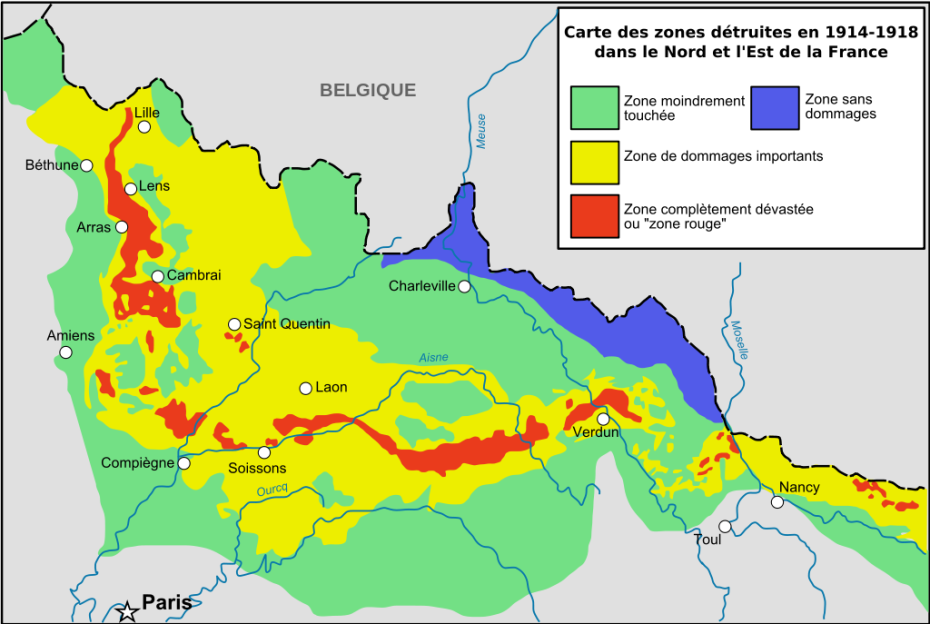
The “Zone Rouge”—dangerous post WWI site
Posted on 4/28/18 at 8:27 am


Posted on 4/28/18 at 8:27 am
tl;dr: massive WWI battle site in France lasting over 300 days is dangerous to this day because of dangerously toxic arsenic and other chemicals’ presence in water and animals, as well as inactivated chemical and explosive shells. Link at bottom


War History Online
quote:
The Zone Rouge (Red Zone) is a region near Verdun, France spanning some 460 square miles of mostly virgin forest – at least on the surface.
quote:
The Germans and the French faced off on the hills north of Verdun-sur-Meuse in north-eastern France two years later in February 1916.
quote:
Verdun has long held sentimental value to the French because the area around it held 20 large forts and 40 smaller ones which had protected France’s eastern border for centuries. The Germans were convinced that if they took the area, the French would go berserk and commit everything they had to secure it. In so doing, they’d bleed themselves dry.
While it worked, it didn’t go entirely the way the Germans had hoped. The result was one of the longest and bloodiest conflicts – not just within World War I, but in recorded history, as well. Lasting 303 days, the Battle of Verdun cost 377,231 French soldiers their lives and 337,000 German ones – about 70,000 casualties a month. Recent figures suggest, however, that that figure may actually be far higher – some 976,000 deaths and about 1,250,000 seriously injured, if you include civilians.
quote:
When WWI ended in 1918, the French realized that it would take several centuries to completely sweep the area clear – some experts suggest it could take between 300 to 700 years, maybe more
quote:
While some bits look like pristine forest, they hide millions of explosives – both the ones that have gone off, as well as those just waiting for someone or something to set them off. Weapons, helmets, and even skeletal fragments are still being found, something that’s likely to go on for centuries...
quote:
But explosives, even those already spent, are made out of dangerous chemicals. And remember how they used poison gas? Millions of tons of that gunk compacted together in such a confined area has had an impact on the soil and ground water of the region, resulting in patches where little grows and where animals die.
And it’s getting worse. Up until 2004, foresters and hunters were allowed in with special permits till scientists made an awful discovery. Soil analysis in some parts of the Red Zone found arsenic levels of up to 17%. That’s several thousand times higher than in previous decades, meaning those chemicals are acting up, not down.
quote:
scientists...also found an increase in the non-biodegradable lead from shrapnel. But it’s not just in the water. They’ve also discovered non-biodegradable lead in some animals, especially wild boars, so that turned the hunters off and with good reason.
quote:
Even on the outskirts of the Zone Rouge, however, farmers aren’t safe. Not a year passes without someone driving a tractor over an unexploded shell that goes off. Fortunately, there haven’t been any casualties in several decades… except for ruined tractors and badly shaken farmers.
The real danger, however, comes not from explosive shells. They come from the gas shells – the number one killer of those who work in munitions removal.
War History Online
 15
15

Posted on 4/28/18 at 8:33 am to Barbellthor
That's a very interesting read....upvote.
This is why we fight our wars on other people's soil now.
This is why we fight our wars on other people's soil now.

Posted on 4/28/18 at 8:49 am to Barbellthor
There may be as many as 100,000 German and French missing corpses in one red zone. The bodies were pulverized by incessant artillery shelling at Verdun. It is still not uncommon in that region to find bones, teeth, or skulls.

Posted on 4/28/18 at 8:51 am to Barbellthor
They named it after Baton Rouge because it was just as dangerous
Posted on 4/28/18 at 8:54 am to Barbellthor
I took a class on WWI at LSU. Dr. Karl Roider was a fantastic professor and it was my favorite class ever. I did a paper on the conditions in the trenches at the Battle of Verdun. I’d love to find that paper to read a again.

Posted on 4/28/18 at 8:56 am to el Gaucho



Posted on 4/28/18 at 8:56 am to el Gaucho

Posted on 4/28/18 at 9:11 am to Barbellthor

Posted on 4/28/18 at 9:19 am to Barbellthor
quote:
Not a year passes without someone driving a tractor over an unexploded shell that goes off. Fortunately, there haven’t been any casualties in several decades… except for ruined tractors and badly shaken farmers.
That's crazy to think about. You wouldn't think after 100 years of being exposed to the elements those shells would still be able to detonate
Posted on 4/28/18 at 9:39 am to Barbellthor
I saw something on this the other day and ended up reading about Verdun. Holy shite. Has to be one of the darkest chapters in humanity.

Posted on 4/28/18 at 9:46 am to Barbellthor
very interesting...thanks for posting this!
Posted on 4/28/18 at 10:22 am to Barbellthor
Thank the girlfriend for this (no pics!); she brought this to my attention.


Posted on 4/28/18 at 10:33 am to supadave3
quote:
Dr. Karl Roider
If I remember right, didn’t he just stand behind his podium and talk monotone for the entire class? I had him for the civil war.
And he was EASILY the worst professor I had in my 4 years at LSU. He put me to sleep in a class I should have otherwise loved.
This post was edited on 4/28/18 at 10:34 am

Posted on 4/28/18 at 10:46 am to Barbellthor
The best of humanity.

Posted on 4/28/18 at 10:55 am to Barbellthor
I have some artillery shell fragments, a damaged French army canteen, some leather equipment strap fragments and a 75mm or 77mm empty artillery shell that opened on only one side when it exploded. I picked them up during my time visiting the Verdun battle site. All of the items are from near Fort Vaux.
I did see what appeared to be unexploded ordnance lying on the ground.
In retrospect, I probably took an unnecessary risk in gathering that stuff.
I did see what appeared to be unexploded ordnance lying on the ground.
In retrospect, I probably took an unnecessary risk in gathering that stuff.
Posted on 4/28/18 at 11:54 am to elprez00
(no message)
Posted on 4/28/18 at 11:55 am to Champagne
quote:
In retrospect, I probably took an unnecessary risk in gathering that stuff.
YOLO
Posted on 4/28/18 at 1:41 pm to 777Tiger
It was the day after a hard rain in the area, so, lots of fragments were exposed in the ground. It was a Restricted Area, naturally. I was active duty Army at the time, so, I probably should not have taken the risk of getting in trouble with the law.
What can I say? My blood was up. I was feeling close to the men who suffered on that battlefield and in that surreal moment, I gathered some souvenirs.
The idiot I was with found some unexploded artillery shells and started tapping on one of them with his foot! What an idiot.
What can I say? My blood was up. I was feeling close to the men who suffered on that battlefield and in that surreal moment, I gathered some souvenirs.
The idiot I was with found some unexploded artillery shells and started tapping on one of them with his foot! What an idiot.
This post was edited on 4/28/18 at 1:44 pm

Posted on 4/28/18 at 4:31 pm to Barbellthor
GERMANS......
were involved!
were involved!

Posted on 4/28/18 at 7:43 pm to Barbellthor
My grandfather was sent to Verdun in July 1917.
He had to march all around France for about a year after the war ended, because it took so long to get all of the troops out.
He had to march all around France for about a year after the war ended, because it took so long to get all of the troops out.

 Page 1 of 2

Popular
Back to top
 Follow TigerDroppings for LSU Football News