




 3
3










- My Forums
- Tiger Rant
- LSU Recruiting
- SEC Rant
- Saints Talk
- Pelicans Talk
- More Sports Board
- Fantasy Sports
- Golf Board
- Soccer Board
- O-T Lounge
- Tech Board
- Home/Garden Board
- Outdoor Board
- Health/Fitness Board
- Movie/TV Board
- Book Board
- Music Board
- Political Talk
- Money Talk
- Fark Board
- Gaming Board
- Travel Board
- Food/Drink Board
- Ticket Exchange
- TD Help Board
Customize My Forums- View All Forums
- Show Left Links
- Topic Sort Options
- Trending Topics
- Recent Topics
- Active Topics
Started By
Message
Posted on 8/8/25 at 9:16 pm to Kafka
What time is the Organic Chemistry final?
Posted on 8/8/25 at 9:32 pm to kywildcatfanone
Looks like the gentrification of the lower ninth.
quote:
Posted on 8/8/25 at 11:05 pm to Kafka
Claudia Dell trying to save Kane Richmond, so he'll be alive to star in the far better movie serial, "Spy Smasher," seven years later, as opposed to the notorious cheapjack indie they're now unfortunately gracing, "The Lost City." But a paycheck is a paycheck. Especially in 1935.
Posted on 8/9/25 at 3:26 am to Aeolian Vocalion
My first thought was the Little Rascals and Spanky's uncle, "Yum, yum, eat 'em up"
Posted on 8/9/25 at 8:10 pm to kywildcatfanone
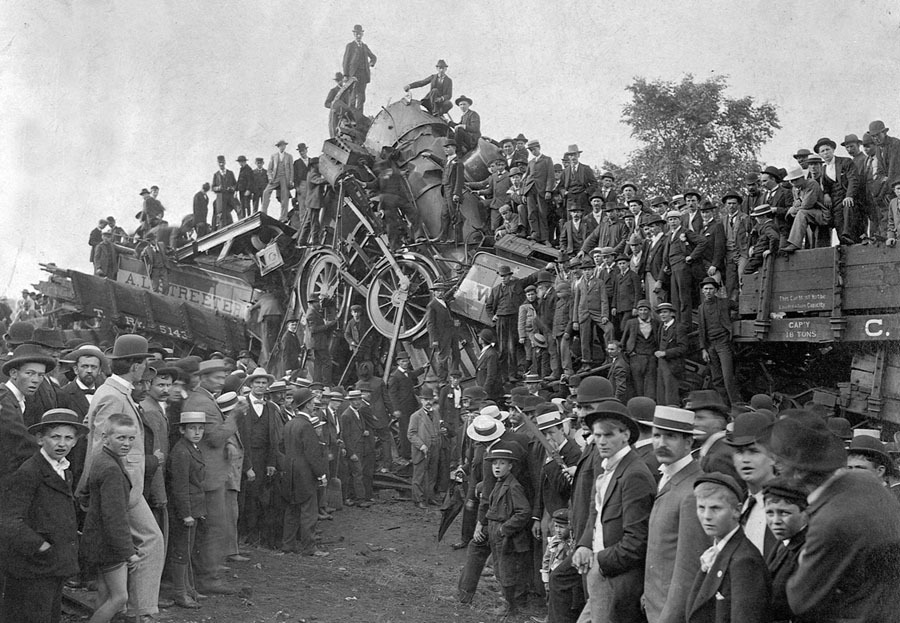
15 September, 1896, Texas. Two locomotives on a dedicated track are deliberately sent to collide with each other as a publicity stunt; unexpected boiler explosions in both trains killed two onlookers and injured others.
On September 15, 1896, thousands gathered in Crush, Texas—a temporary town created solely for a publicity stunt organized by the Missouri-Kansas-Texas Railroad. The plan was bold and unprecedented: crash two full-sized steam locomotives head-on at high speed for spectacle. Promoted as safe and thrilling entertainment, the event drew an estimated 40,000 people, lured by free admission and the promise of a once-in-a-lifetime collision.
The two locomotives, painted in contrasting colors, charged toward each other on a specially built track. At impact, the crowd roared. But moments later, both boilers exploded violently, sending metal debris flying into the audience. Two people were killed, including a young photographer, and at least six others were seriously injured.
Though intended as a celebration of railroading and corporate flair, the Crash at Crush ended in tragedy. The stunt did cement itself in history, however, as one of the earliest and most disastrous examples of public spectacle gone wrong.

On September 15, 1896, thousands gathered in Crush, Texas—a temporary town created solely for a publicity stunt organized by the Missouri-Kansas-Texas Railroad. The plan was bold and unprecedented: crash two full-sized steam locomotives head-on at high speed for spectacle. Promoted as safe and thrilling entertainment, the event drew an estimated 40,000 people, lured by free admission and the promise of a once-in-a-lifetime collision.
The two locomotives, painted in contrasting colors, charged toward each other on a specially built track. At impact, the crowd roared. But moments later, both boilers exploded violently, sending metal debris flying into the audience. Two people were killed, including a young photographer, and at least six others were seriously injured.
Though intended as a celebration of railroading and corporate flair, the Crash at Crush ended in tragedy. The stunt did cement itself in history, however, as one of the earliest and most disastrous examples of public spectacle gone wrong.
Posted on 8/9/25 at 9:34 pm to Shanegolang

This post was edited on 8/9/25 at 9:40 pm
Posted on 8/9/25 at 10:01 pm to Kafka
Robert Mitchum with inmates in jail while serving 60 days for marijuana possession, 1949


Posted on 8/9/25 at 10:04 pm to Kafka

Posted on 8/10/25 at 3:03 pm to Kafka

Posted on 8/10/25 at 11:26 pm to Kafka

Posted on 8/11/25 at 10:55 am to Kafka
Posted on 8/11/25 at 10:59 am to nes2010
Posted on 8/11/25 at 11:05 am to nes2010
Race organizers try to prevent Katherine Switzer from participating in the Boston Marathon, becoming the first woman to finish the marathon, 1967.

Posted on 8/12/25 at 6:27 pm to nes2010


Posted on 8/12/25 at 7:38 pm to Kafka
quote:
There is nothing lie a dogs love
What is that character's name?
Posted on 8/12/25 at 7:41 pm to BHM
quote:
What is that character's name?
Posted on 8/12/25 at 8:01 pm to Kafka
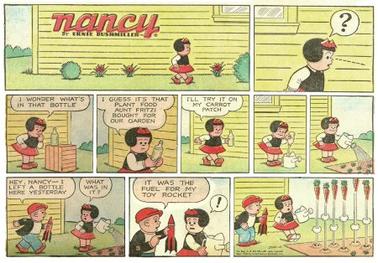
“Ernie Bushmiller” would have been a more impressive and interesting literary name than “Kafka”.
A Bushmilleresque comment, n'est-ce pas?
A Bushmilleresque comment, n'est-ce pas?
Posted on 8/12/25 at 9:02 pm to soccerfüt

Posted on 8/12/25 at 10:18 pm to sqerty
quote:


 Page 1118 of 1282


Popular
Back to top
 Follow TigerDroppings for LSU Football News