




- My Forums
- Tiger Rant
- LSU Recruiting
- SEC Rant
- Saints Talk
- Pelicans Talk
- More Sports Board
- Fantasy Sports
- Golf Board
- Soccer Board
- O-T Lounge
- Tech Board
- Home/Garden Board
- Outdoor Board
- Health/Fitness Board
- Movie/TV Board
- Book Board
- Music Board
- Political Talk
- Money Talk
- Fark Board
- Gaming Board
- Travel Board
- Food/Drink Board
- Ticket Exchange
- TD Help Board
Customize My Forums- View All Forums
- Show Left Links
- Topic Sort Options
- Trending Topics
- Recent Topics
- Active Topics
Started By
Message
re: How much hp does it take to roast the tires?
Posted on 10/20/16 at 9:06 am to Cooter Davenport

Posted on 10/20/16 at 9:06 am to Cooter Davenport
quote:
Nah, it has nothing to do with the weight. Actually the weight would help it stay in place and burn out.
What the frick kind of stupid did I just read? I thought Aggie had a good engineering program.
Based off your logic, the people hat put weight in their truck beds for winter driving and wet weather diving must really be fricking up.
 0
0


Posted on 10/20/16 at 9:06 am to mdomingue
quote:
Incorrect, more weight, more force required.
To go fast, yes, but not to burn out. You are thinking of it all wrong. You burn out standing still. The more weight, the easier it is to stand still.
quote:
Why would that make a difference unless you were on a soft surface where you might dig down (like a dirt surface). I've had way more trouble keeping traction on the lighter rear end of a small pickup than I ever did on a full sized one with more HP and torque.
For the same reason that standing on the brakes makes it easier to peel out. Also for the same reason that you will peel out if you are chained to an immovable object. Peeling out is a function of your wheels moving around faster than the actual car is moving forward. Obviously if it is SO insanely heavy that the wheels can't even move it will do nothing, but given that the power is sufficient the heavier the vehicle the easier the burnout because the harder it is for the vehicle's speed to catch up to the speed of the wheels.
quote:
This would indeed be the most likely limiting factor for most modern vehicles on dry pavement.
Yes, any time someone says "vehicle x won't even peel out" about a modern vehicle what is mostly happening is torque management. Not even traction control. TM happens instantly, pre-traction control. You can't even TRIGGER traction control because the engine is retarding itself and the power is very low.
Posted on 10/20/16 at 9:08 am to Cooter Davenport
quote:
Peeling out is a function of your wheels moving around faster than the actual car is moving forward.
No, it's a function of overcoming the force of friction between the tire and the pavement.
Posted on 10/20/16 at 9:13 am to TheCaterpillar
This reminds me of one of the greatest hood rat things I've ever seen.
When our HS football team played at Northeast HS, their team would run out onto the field through smoke created by their fans burning out the tires on crotch rockets in the parking lot.
When our HS football team played at Northeast HS, their team would run out onto the field through smoke created by their fans burning out the tires on crotch rockets in the parking lot.
Posted on 10/20/16 at 9:16 am to Cooter Davenport
You want weight to hold you in place, but you don't want it over the tires.


Posted on 10/20/16 at 9:19 am to Gaston
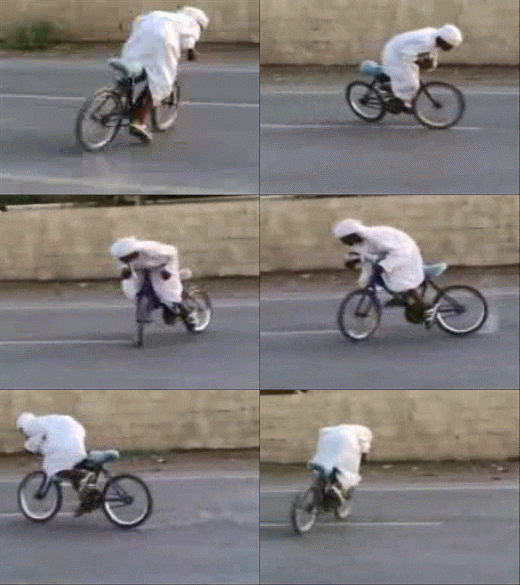
I could do it on my bicycle pretty easily
Posted on 10/20/16 at 9:23 am to Spaceman Spiff
Posted on 10/20/16 at 9:34 am to Gaston

Posted on 10/20/16 at 9:39 am to Scooba
quote:
It doesn't take horsepower, it takes torque.
You would think a physics wizard would know that.


Posted on 10/20/16 at 9:43 am to TigerstuckinMS

Posted on 10/20/16 at 9:49 am to LNCHBOX
quote:
No, it's a function of overcoming the force of friction between the tire and the pavement.
It is if we assume that the pavement is concrete of asphalt in good condition and the tires are good.
Posted on 10/20/16 at 9:57 am to Cooter Davenport
quote:
It is if we assume that the pavement is concrete of asphalt in good condition and the tires are good.
No, it is always a function of overcoming friction between the tires, regardless of condition, and pavement, regardless of condition.

Posted on 10/20/16 at 10:16 am to Scooba
quote:All the torque in the world won't spin the tires if it's not doing the work fast enough.
It doesn't take horsepower, it takes torque.

Posted on 10/20/16 at 10:17 am to Cooter Davenport
quote:quote:
Incorrect, more weight, more force required.
To go fast, yes, but not to burn out. You are thinking of it all wrong. You burn out standing still. The more weight, the easier it is to stand still.
Nope, to burn out you have to overcome friction at the driven wheels. Normal force on the tires (this will be the force generated by gravity, in other words weight) times the coefficient of friction is equal to the amount of force required to overcome friction. Therefore, the heavier the vehicle, the more force required to burn out.
quote:
For the same reason that standing on the brakes makes it easier to peel out.
Wrong again, standing on the brakes adds another level of friction to overcome. The passive wheel provide very little resistance to movement, since the coefficient of friction on the wheel bearings is much lower than on the tire surface, when free to rotate. When the brakes are applied, you now have to overcome the sliding friction of the front wheels to move the vehicle forward, increasing the likely hood the driver wheels will spin.
quote:
Also for the same reason that you will peel out if you are chained to an immovable object
Well, that is completely different because you're adding more force into the equation.
quote:
Peeling out is a function of your wheels moving around faster than the actual car is moving forward.
Well, it is true that that is what is happening but the wheels spin because excessive force is applied causing the force due to sliding friction at the tire to be overcome.
quote:
Obviously if it is SO insanely heavy that the wheels can't even move it will do nothing,
Think about what you are saying, if you can apply enough weight to make the wheels impossible to move, you are effectively saying that a heavy enough vehicle weight will make it impossible to burn out given a finite amount of power.
Trust me, I'm right about this, you are not.
Posted on 10/20/16 at 10:19 am to Gaston
Take off the traction control and my 2012 6.7L diesel powered F-250 will light them up from a dead stop. Can be hell to drive when the roads are wet.
400hp and 800 ft-lbs torque stock
Pickups will burn the tires easier in general due to the lighter weight on the rear axle when unloaded.
400hp and 800 ft-lbs torque stock
Pickups will burn the tires easier in general due to the lighter weight on the rear axle when unloaded.
Posted on 10/20/16 at 10:23 am to Cooter Davenport
quote:
Cooter Davenport
quote:
You are thinking of it all wrong.
Posted on 10/20/16 at 10:31 am to Scooba
quote:
It doesn't take horsepower, it takes torque.
The two are kind of related.
HP = Torque x RPM ÷ 5252
Torque = HP X 5252 ÷ RPM
Given enough horsepower you can provide the torque to the wheels via the power train with either multiplication or reduction of torque due to your gear ratios.
Posted on 10/20/16 at 11:09 am to mdomingue
quote:is right on everythinging here.
mdomingue
There are at least 6 or 8 variables.
More weight absolutely leads to better traction. Why do racecars produce such heavy downforce? This is automobile 101.


Posted on 10/20/16 at 1:29 pm to Cooter Davenport
I've tried it on quick takeoffs but you can feel the delay on hitting the gas and when the engine decides it wants to spin up. Why I said heavy is there's at least 600LB extra equipment inside the car, if that weight makes a difference. Driving it felt a lot more nimble when it was bare bones.

Posted on 10/20/16 at 1:48 pm to Gaston
What jeans will you be wearing when you "roast" said tires?

 Page 3 of 4

Popular
Back to top
 Follow TigerDroppings for LSU Football News