- My Forums
- Tiger Rant
- LSU Score Board
- LSU Recruiting
- SEC Rant
- SEC Score Board
- Saints Talk
- Pelicans Talk
- More Sports Board
- Fantasy Sports
- Golf Board
- Soccer Board
- O-T Lounge
- Tech Board
- Home/Garden Board
- Outdoor Board
- Health/Fitness Board
- Movie/TV Board
- Book Board
- Music Board
- Political Talk
- Money Talk
- Fark Board
- Gaming Board
- Travel Board
- Food/Drink Board
- Ticket Exchange
- TD Help Board
Customize My Forums- View All Forums
- Topic Sort Options
- Trending Topics
- Recent Topics
- Active Topics

Korkstand
| Favorite team: | LSU  |
| Location: | |
| Biography: | |
| Interests: | |
| Occupation: | |
| Number of Posts: | 29134 |
| Registered on: | 11/17/2003 |
| Online Status: | Not Online |
Recent Posts
Message
re: Kansas man is fighting ALPR cameras in Wichita court
Posted by Korkstand on 7/31/26 at 7:28 pm to brass2mouth
quote:
I’m confused.
That's clear
quote:
You’re ok with the government tracking you when you’re walking around your neighborhood, but not when you’re driving?
Not ok with it at all without cause. We can use cameras for protection without taking the giant leap to tracking everyone at all times, and without making that data searchable without a warrant.
quote:
What case are you referring to? Carpenter? Because that pertains to cell phones.
Not you driving on a public road.
There are several cases but yes that is the main one. It pertains to cell phones because that was essentially the only way to track everyone all the time. Now we have a new way to do that. Are you being obtuse intentionally?

 0
0
re: Kansas man is fighting ALPR cameras in Wichita court
Posted by Korkstand on 7/31/26 at 5:13 pm to brass2mouth
quote:Whether this is "completely legal" is up for debate.
What I would/wouldn’t have a problem with vs what is completely legal are two different things.
People are confusing what they have a problem with as being illegal, when it’s not.
quote:Yes, no problem whatsoever with protecting private and public property. That's not what this is about.
I’m not a huge fan of the “surveillance state” but if you haven’t noticed you’re recorded nearly anytime you walk outside either by Real Time Crime Camera (think the flashing blue/red lights you see in NOLA/BR and various other areas), an LPR, or your neighbor’s camera and it’s all 100% legal.
quote:It has also ruled that gathering long-term location data constitutes a search which requires a warrant.
USSC has rules several times that your license plate on your vehicle on a public roadway is not private information and police can query your plate simple by seeing you on the roadway.
Querying a plate is not a problem. The attaching of mountains of location data to that plate, and providing it to law enforcement on a whim, is the problem.
quote:As with weapons or really any tool, there are legit good uses and bad ones. I don't think people have a problem with the technology so much as they have a problem with how it's being used and how it looks like they're prepping to go further in that bad direction.
Yall won’t butch when a family member is a victim of a violent crime and a LPR camera catches the Perp. A LPR helped find a neighbor with dementia who drove and got lost. Found her 40 miles away 20 minutes after being reported missing.
re: Kansas man is fighting ALPR cameras in Wichita court
Posted by Korkstand on 7/31/26 at 2:38 pm to brass2mouth
quote:quote:It’s not.
Being observed, photographed, or filmed while out in public is a far cry from your whereabouts being known to the government at all times, with searchable history stored forever.
It's the difference between people driving by to observe your home, or even staking out your home, vs. installing a camera permanently pointed at your home. You wouldn't have a problem with the latter?
re: Kansas man is fighting ALPR cameras in Wichita court
Posted by Korkstand on 7/31/26 at 1:33 pm to HoustonGumbeauxGuy
quote:
Did you read your agreement with Apple?
Did you read your agreement with the government?
re: Kansas man is fighting ALPR cameras in Wichita court
Posted by Korkstand on 7/31/26 at 12:02 pm to HoustonGumbeauxGuy
quote:Being observed, photographed, or filmed while out in public is a far cry from your whereabouts being known to the government at all times, with searchable history stored forever. If your stance is "anything goes" once you step outside your home, then what goes on inside your home can for the most part be deduced. The aggregate of where you go and who you are with, at almost all times and over years, can reveal deeply personal shite. Your religious and political views, your health, your finances, your network of acquaintances, and on and on.
It is my understanding that if you’re in a public space, you forfeit all expectations of privacy
There is an enormous difference between *an* instance of you being out in public being known, and *every* instance of you being out in public being known, recorded, aggregated, and analyzed.
quote:It's always DNS but when it's not it's your wifi.
Issue is almost WiFi
quote:I'm all for citizens using cameras to protect their own property, and to voluntarily share it with their neighbors and law enforcement to help combat crime. And I think most people agree with that. The problem people have is with government doing it.
Crime has decreased in our neighborhood because of the cameras.
re: Flock rolls out new toys far beyond license plate readers
Posted by Korkstand on 7/29/26 at 2:13 pm to StonewallJack
quote:Mass surveillance is how they start finding "criminals" who haven't done anything wrong. It has already started due to these cameras and it will get much worse.
Have no fear unless you are breaking the law!
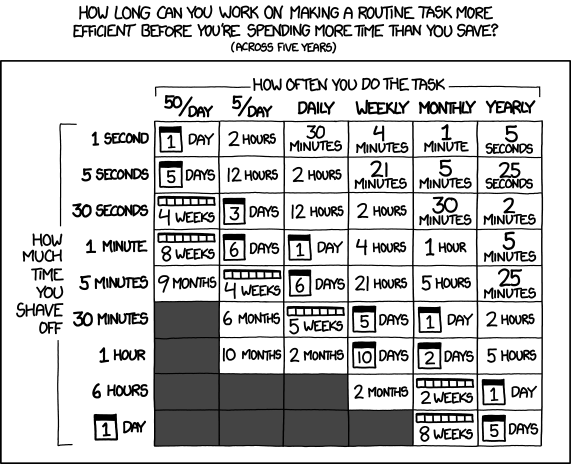
I don't think I can help without having the actual file for testing. Sorry.
But if I did have the file I would still use AI to write a script to dump the sheets to sqlite and write queries. Because I just know I would come back next year and have some kind of issue with the excel sheets. :lol:
My response to your exact question is I would feed the file to AI and have it write formulas for what you want, then verify.
But to really solve your problem, which as I understand it is
But to really solve your problem, which as I understand it is
quote:I would put this data in a database and write queries. AI can plop out a pretty frontend for it too if you want.
save a ton of time
re: Amazing the difference an attic vent makes...
Posted by Korkstand on 7/28/26 at 4:27 pm to Hangover Haven
quote:Looked into radiant barriers?
Other than spry foam, any better ideas keeping your attic cooler?
re: The Unitree Super Athlete As2-W - Your Autonomous Everyday Side-Follow
Posted by Korkstand on 7/24/26 at 2:08 pm to AaronDeTiger
quote:I asked AI if it was AI.
I had to google to see if that was actually real.
Turns out the thing is real, and the marketing videos are even *mostly* real but obviously very edited and perfectly staged.
re: Official LLM discussion thread
Posted by Korkstand on 7/23/26 at 4:57 pm to bluebarracuda
I tried to roughly estimate 24/7 always-on with a couple hours of active LLM use per day. If you're idling at 50 watts that'll burn 438kWh/year which is probably $50 minimum anywhere. Maybe you can tune idle consumption lower than that.
re: Official LLM discussion thread
Posted by Korkstand on 7/23/26 at 2:58 pm to AaronDeTiger
quote:And the power.quote:Minus the hardware.
It's free
My math says a modest machine and modest usage would cost ~$100/year to run at 15 cents/kwh.
quote:Most of the same benefits of running anything locally. Same cons as well.
Novice here…what is the benefit of running an LLM locally? What does it achieve versus accessing LLM through the cloud?
Mostly boils down to data ownership and control.
Honestly this is a question I'd send to a cloud LLM. :lol:
quote:Most people don't even know that they can log in to their router and configure it. Setting up a VPN and dealing with those potential issues in addition to the BI app is several steps too far. Again, the process with an NVR is install app, point camera at QR code, done.
What port forwarding?
Most home routers have VPN servers already on them. You press an enable button and give it a password. Done for setup. You install the VPN app on a phone and connect.
quote:How many steps are required to make Windows keep running? With an NVR appliance as long as the power is on it's running. Any steps beyond that are too many.
As far the computer, as long as it is turned on Blue Iris will run. You don't have to remain logged in.
And the update process. NVR updates are one click in the app to update the NVR software and the underlying OS/firmware. And if your camera brands match the NVR it will update their firmware too. How's that process with BI?
quote:Every single NVR on the market will work with Dahua cameras.
What commercial NVR will work with generic Chinese cameras?
I'm not trying to knock Blue Iris (though I do question the choice to keep it Windows-only). I'm just saying when someone asks for plug and play it's way down my list.
quote:
Blue iris is software. Install it on a windows pc.
The cameras are POE. Get a POE dumb switch and plug the cameras in with an Ethernet cable.
There no coding to be done. May have to do a bit of config, but the most of that is knowing the camera ip addresses. You'll want to set up the cameras with static ip addresses. Pretty much all home routers support setting static ip addresses for devices.
Start a chatgpt convo and tell it what you equipment you have. It will give you a pretty decent guide for setting everything up.
Most people don't want to deal with all that, including getting Windows to behave like an always-on appliance and port forwarding on your firewall which isn't all that secure, when the alternative is plug the cameras into an NVR and scan a QR code in the app.
re: What is the right abstraction for context-centric work?
Posted by Korkstand on 7/22/26 at 11:12 am to GetMeOutOfHere
quote:quote:
I’m not sure that kind of liability filtering can be replaced by machines but also our obsession with liability is why western society is getting rapidly leapfrogged
The most underreported issue in tech today, imo.
No one wants to just do things, everyone wants to cover their arse, because that's what we've incentivized: saying why you can't or shouldn't do something.
Interesting points from both of you. I'll just say that CYA, liability, risk management, and responsibility are part of what allows any society to function at all, but I'll leave it to others to debate whether Western society has become so focused on them that they're now holding us back.
What I'll focus on is how these same themes keep appearing in my software development work. The more I build with AI, the more I feel like they're all converging into a different way of thinking about software.
Almost everything we do involves uncertainty. We make assumptions, gather evidence, weigh tradeoffs, and make decisions based on logic, experience, incentives, and sometimes just intuition. Even who has the authority to make a decision can itself be uncertain. Regardless of how much we automate, there eventually comes a point where a real human owns the outcome.
Naturally, we like taking credit for positive outcomes and dislike taking blame for negative ones. The goal, of course, is to avoid negative outcomes altogether.
Lately I've become fixated on how software represents uncertainty. Take something as simple as a task manager with a binary "done" checkbox. Reality isn't binary. Sometimes a task is mostly done. Sometimes the original task becomes irrelevant because a different solution unexpectedly solves the same problem. Sometimes someone takes an action that nobody anticipated, yet it advances the desired outcome better than the original plan.
Those details matter, but most software throws them away. We compress a messy reality into a checkbox, a status field, or a dropdown, and with it we lose information that could have helped us understand what actually happened, why it happened, what evidence supported the decision, what alternatives existed at the time, and ultimately how to make better decisions in the future.
That's just one simple example. I keep finding the same pattern everywhere. We force reality into rigid schemas because computers have traditionally been deterministic. Our software reflects that mindset.
Reality, however, is uncertain from top to bottom.
One thing AI has given me is the freedom to rapidly experiment with UI and UX. The more I do, the less I think the interface should primarily be about manipulating software. Instead, I keep coming back to the idea that the machine should preserve uncertainty rather than erase it, then present that uncertainty in a way that's actually useful to the human making the next decision.
Given what I'm trying to accomplish right now, show me everything I need to know—and only what I need to know—to confidently make the next decision that I will ultimately own.
That has me wondering if AI changes the purpose of the interface itself. As AI takes over more execution, the UI becomes less about operating software and more about enabling collaboration between humans and AI. It's the protocol through which judgment, evidence, uncertainty, and responsibility flow between us.
If that's true, then humans become the bottleneck—not because we're slow, but because we remain responsible. The challenge isn't simply building better AI. It's building the highest-bandwidth interface possible for human judgment.
And just like that GitHub launches Copilot Canvases that let you collaborate with agents via a canvas. I really think these kinds of shared visual workspaces will be the way forward. Then once we incorporate gestures it could be close to a VR experience without the headgear. The sci-fi movie big interactive smart white(transparent)board UI/UX might not be too far off.
It might not be exactly like Minority Report or Iron Man, but it's looking more and more to me that we need a richer and higher-bandwidth way to work with AI, and collaborative visual workspaces look like a good way to achieve that.
Maybe now I'm just looking for the right vocabulary to discuss the development of the class of software that will be built to take full advantage of this interaction model?
It might not be exactly like Minority Report or Iron Man, but it's looking more and more to me that we need a richer and higher-bandwidth way to work with AI, and collaborative visual workspaces look like a good way to achieve that.
Maybe now I'm just looking for the right vocabulary to discuss the development of the class of software that will be built to take full advantage of this interaction model?
I'll summarize my current position and understanding like this:
As automation increases, the work that's left for humans is disproportionately about uncertainty/ambiguity, judgment, and ownership (of decisions not things). The interface should optimize for those tasks, and as of now I don't know how that should look or work, or how to even think and talk about it.
I guess I should do some reading on HCI theory.
As automation increases, the work that's left for humans is disproportionately about uncertainty/ambiguity, judgment, and ownership (of decisions not things). The interface should optimize for those tasks, and as of now I don't know how that should look or work, or how to even think and talk about it.
I guess I should do some reading on HCI theory.
Popular

 54
54