




- My Forums
- Tiger Rant
- LSU Recruiting
- SEC Rant
- Saints Talk
- Pelicans Talk
- More Sports Board
- Fantasy Sports
- Golf Board
- Soccer Board
- O-T Lounge
- Tech Board
- Home/Garden Board
- Outdoor Board
- Health/Fitness Board
- Movie/TV Board
- Book Board
- Music Board
- Political Talk
- Money Talk
- Fark Board
- Gaming Board
- Travel Board
- Food/Drink Board
- Ticket Exchange
- TD Help Board
Customize My Forums- View All Forums
- Show Left Links
- Topic Sort Options
- Trending Topics
- Recent Topics
- Active Topics
Started By
Message
 1
1


Posted on 11/21/25 at 9:53 am to 4cubbies
quote:


Posted on 11/21/25 at 10:15 am to PeleofAnalytics
quote:
There are CPI calculators that can tell you what it is. You can not trust it if you want but it says100k in Jan 2020 is 126k today.
I know those are out there and I also know they are usually pretty full of shite.
The items in the basket and their relative weighting create the issue. For example, the impact of the cost of gas or groceries are not the same for a $65k earner as a $150k earner but they are treated the same on the calculator.
Posted on 11/21/25 at 10:45 am to Mid Iowa Tiger
quote:
I know those are out there and I also know they are usually pretty full of shite.
The items in the basket and their relative weighting create the issue. For example, the impact of the cost of gas or groceries are not the same for a $65k earner as a $150k earner but they are treated the same on the calculator.
So what is the detailed math you use to come up with your own comparison of 100k salary on Jan 2020 to today?
Posted on 11/21/25 at 11:32 am to NC_Tigah
People screaming about the “wealth gap” always ignore the only thing that actually matters: the lifestyle gap. And that has never been smaller than it is today.
2,000 Years Ago (Rome):
Rich lived in villas with servants, education, imported food, and political power.
Poor lived in crowded insulae (tenements), constant fire risk, limited protein, chronic hunger, no schooling, and no mobility.
The gap was enormous.
1,200 Years Ago (Medieval):
Rich had castles, horses, stored food, some security and primitive medicine.
Poor had mud huts, famine, plague, dirty water, and zero literacy.
Another massive gap.
700 Years Ago:
Rich had meat, books, education, warm homes, and travel by horse.
Poor were malnourished, uneducated, and rarely traveled beyond a few miles.
Completely different worlds.
200 Years Ago:
Rich had carriages, large homes, private doctors (mostly ineffective), and better diets.
Poor lived in unsafe housing, had high child mortality, and no medical care.
The gap was still enormous.
100 Years Ago:
Rich had early cars, electricity, refrigeration, and private hospital rooms.
Poor had outhouses, coal smoke, overcrowding, and food insecurity.
The gap remained large.
50 Years Ago:
Rich had multiple TVs, luxury cars, private schools, and early computers.
Poor had basic cars, one TV, limited travel, and limited healthcare access.
The gap was shrinking but still there.
Today:
Rich and poor alike have cars safer than past luxury models, AC, clean water, sewage systems, refrigeration, year-round food, smartphones, the same internet, streaming entertainment, modern medicine, MRIs, anesthesia, antibiotics, air travel, electricity, and paved roads.
The rich get nicer versions, but the functional lifestyle is nearly identical. This level of equality has never existed in human history.
Caveat:
The real divide today isn’t rich vs. poor individuals. It’s developed regions vs. undeveloped regions. Some nations built rule of law, stable institutions, innovation, and economic freedom. Others didn’t. That’s where the true gaps remain.
And one thing hasn’t changed across all 2,000 years: tyranny is the historical norm. Most of the world, then and now, lives under corrupt or authoritarian systems. The divide between free and unfree societies explains far more about human inequality than the wealth-gap talking point ever will.
2,000 Years Ago (Rome):
Rich lived in villas with servants, education, imported food, and political power.
Poor lived in crowded insulae (tenements), constant fire risk, limited protein, chronic hunger, no schooling, and no mobility.
The gap was enormous.
1,200 Years Ago (Medieval):
Rich had castles, horses, stored food, some security and primitive medicine.
Poor had mud huts, famine, plague, dirty water, and zero literacy.
Another massive gap.
700 Years Ago:
Rich had meat, books, education, warm homes, and travel by horse.
Poor were malnourished, uneducated, and rarely traveled beyond a few miles.
Completely different worlds.
200 Years Ago:
Rich had carriages, large homes, private doctors (mostly ineffective), and better diets.
Poor lived in unsafe housing, had high child mortality, and no medical care.
The gap was still enormous.
100 Years Ago:
Rich had early cars, electricity, refrigeration, and private hospital rooms.
Poor had outhouses, coal smoke, overcrowding, and food insecurity.
The gap remained large.
50 Years Ago:
Rich had multiple TVs, luxury cars, private schools, and early computers.
Poor had basic cars, one TV, limited travel, and limited healthcare access.
The gap was shrinking but still there.
Today:
Rich and poor alike have cars safer than past luxury models, AC, clean water, sewage systems, refrigeration, year-round food, smartphones, the same internet, streaming entertainment, modern medicine, MRIs, anesthesia, antibiotics, air travel, electricity, and paved roads.
The rich get nicer versions, but the functional lifestyle is nearly identical. This level of equality has never existed in human history.
Caveat:
The real divide today isn’t rich vs. poor individuals. It’s developed regions vs. undeveloped regions. Some nations built rule of law, stable institutions, innovation, and economic freedom. Others didn’t. That’s where the true gaps remain.
And one thing hasn’t changed across all 2,000 years: tyranny is the historical norm. Most of the world, then and now, lives under corrupt or authoritarian systems. The divide between free and unfree societies explains far more about human inequality than the wealth-gap talking point ever will.
Posted on 11/21/25 at 11:47 am to Mid Iowa Tiger
quote:Correct.
cost of gas or groceries are not the same for a $65k earner as a $150k earner but they are treated the same on the calculator
It's why our dependence-inducing public assistance programs, which will eventually lead to fiscal dominance and spiraling inflation, are a cruel disservice to the very folks they claim to help.
But economic reality here remains very different than perception.
Reality is that US lifestyle across the economic spectrum significantly outstrips that of the rest of the world. The question is "Why do the American people not realize that?"
For Marxim to root, the Proletariat must be convinced of Bourgeoisie economic evils targeting the common man.
A rising tide lifts all boats. But if one is a fishing boat, and the other a freighter, the freighter gets more of a "benefit" from the equal rise. Egalitarian progressivism would solve that problem by draining the port.
Posted on 11/22/25 at 6:04 am to dickkellog
quote:
that's the great thing about money. it's freedom from want and fear
You've never studied the history of any major civilization obviously


Posted on 11/22/25 at 6:06 am to RollTide4547
Gaucho dabbed all over two of you in this thread
Posted on 11/22/25 at 6:21 am to Mid Iowa Tiger
quote:
I’d say around $175k is like $100k pre-covid.
That’s a damn good comparison. I’ve been around the 200k mark for about 7 years, 150k the five years before that, I’ve got fewer bills now than I did pre-COVID and I had more money laying around in 2019. As a matter of fact, I took 3 vacations from April 19 to April 2020, paid cash for all of them, one being Disney, and put in a pool that year too.

Posted on 11/22/25 at 9:39 am to NC_Tigah
Would you mind explaining those charts more for those of us who lack economic expertise?

Posted on 11/22/25 at 12:08 pm to 4cubbies
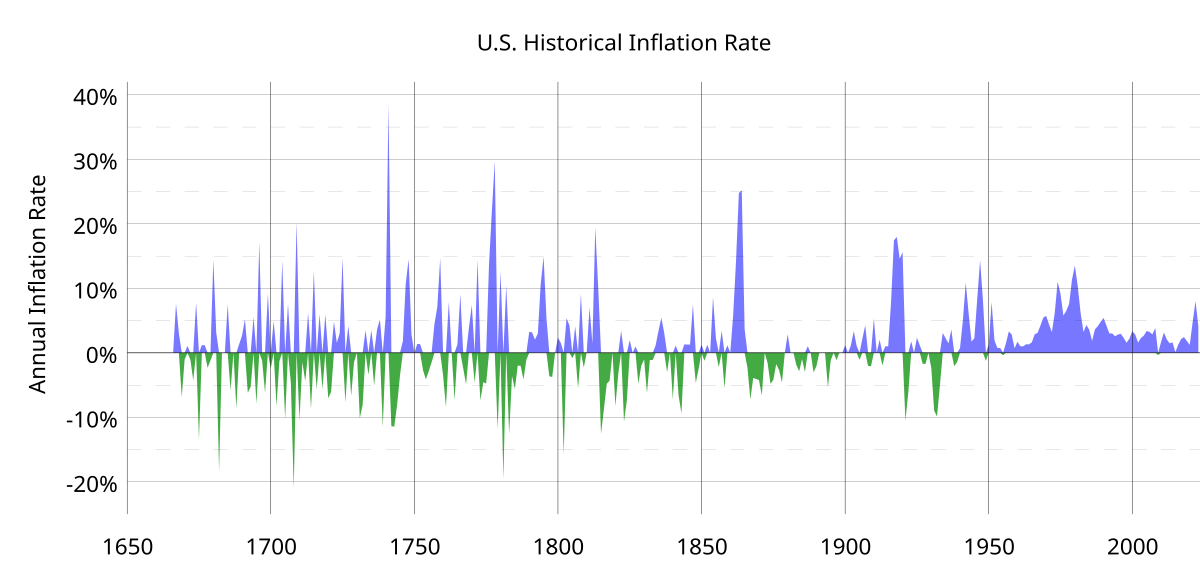
quote:In basic terms, modern international economies date to the late-18th, early 19th century (industrial age, surmounted geographic barriers, etc). The portion of your chart predating that period is less important in today's terms d/t premodern nuances.
Would you mind explaining those charts more for those of us who lack economic expertise?
By the 19th century, international trade currency was backed by either silver or gold. In rough terms, $20 = 1 oz Gold throughout the entire 19th and early 20th century. Meaning, the amount of currency in circulation matched the amount of gold in reserves. In an industrializing country with a growing population, fixed reserves were inherently deflationary.
Let's presume that in 1800 100 workers generated 100 work-units(wu) for $100 (5ozGold), so workers were paid $1/wu
Hypothetically, by 1820 the working population increased 20%, and d/t industrialization, worker productivity increased 80%.
So at that point there are 120 workers producing 1.8 wu/worker for a total output of 216wu. However, the amount of gold in reserve has not changed. It is still $100. So instead of being paid the $1/wu as in 1800, in 1820 the pay drops to 46¢/wu.
Though the price of goods and services across the economy would have broadly tracked the same trend, you can imagine the psychological impact of continually being paid less for the same work.
Four gold rushes eased that somewhat.
There was one 19th century exception. During the Civil War, the Union government couldn’t fund military spending through taxes or gold-backed borrowing alone. So they issued unbacked paper currency (greenbacks). Inflation skyrocketed.
In 1934, FDR, devalued the dollar to $35/oz Gold. Bretton Woods transitioned international non-dollar currencies to fiat. That pretty much correlated to no more Gold standard deflation though the dollar did remain tethered to gold at $35/oz, and thus became the world reserve. In 1970, Nixon cut the USD-gold tie, converting the USD to fiat. The result has been persistent inflation since..
Posted on 11/22/25 at 5:23 pm to NC_Tigah
quote:
Though the price of goods and services across the economy would have broadly tracked the same trend, you can imagine the psychological impact of continually being paid less for the same work.
Thanks for spelling this out for me. This never occurred to me before. This justifies inflation in more palatable terms.
Posted on 11/23/25 at 4:54 am to 4cubbies
quote:
This never occurred to me before. This justifies inflation in more palatable terms.

It also exemplifies why Gold-Standard tariff policy was so critical.
Trade imbalance (Imports > Exports) meant shedding gold to foreign countries. That in turn would drive further domestic deflationary pressure.
Though our fiat system fogs the effects of current imbalances (consumption > production), there are economic effects nonetheless.
Dollars shed overseas => money printed in compensation => more dollars in circulation => inflation.
This post was edited on 11/23/25 at 4:55 am
Posted on 11/23/25 at 5:12 am to el Gaucho
bullshite
Posted on 11/23/25 at 5:35 am to theballguy
Can never work in this country to the extent they want????
We became the most stable county when the wealthy were taxed at 91% once they hit 200,000$. This is just a frickin fact, and I think that's too high myself, but the country was in a much better position. Period. That's non debatable.
It's down to 21% dawg, and a lot of the wealthy use loopholes and go YEARS without paying anything.
You are crazy as hell if you think that raising it to something like 65% would not change the economy. You don't believe that shite lol. They could also raise the starting number to 1 million and it would still make a hell of a difference.
Do y'all actually study anything before speaking on it or are the numbers that track taxing also a left wing hoax to y'all?
We became the most stable county when the wealthy were taxed at 91% once they hit 200,000$. This is just a frickin fact, and I think that's too high myself, but the country was in a much better position. Period. That's non debatable.
It's down to 21% dawg, and a lot of the wealthy use loopholes and go YEARS without paying anything.
You are crazy as hell if you think that raising it to something like 65% would not change the economy. You don't believe that shite lol. They could also raise the starting number to 1 million and it would still make a hell of a difference.
Do y'all actually study anything before speaking on it or are the numbers that track taxing also a left wing hoax to y'all?
This post was edited on 11/23/25 at 5:37 am

Posted on 11/23/25 at 6:00 am to HighStatus
quote:
We became the most stable county when the wealthy were taxed at 91% once they hit 200,000$. This is just a frickin fact,
Are you talking about the stable period that had us fighting two world wars sandwiched between a decade long depression followed by racial strife, protests, assassinations, and the capped off by Vietnam, stagflation, the oil crisis and Jimmy Carter?
Is that the stable period you mean? Is that a frickin fact? Did you learn this at an HBCU?
Posted on 11/23/25 at 7:15 am to HighStatus
quote:Well dawg, you did the emotional rant.
We became the most stable county when the wealthy were taxed at 91% once they hit 200,000$. This is just a frickin fact, and I think that's too high myself, but the country was in a much better position. Period. That's non debatable.
It's down to 21% dawg, and a lot of the wealthy use loopholes and go YEARS without paying anything.
You are crazy as hell if you think that raising it to something like 65% would not change the economy. You don't believe that shite lol. They could also raise the starting number to 1 million and it would still make a hell of a difference.
Do y'all actually study anything before speaking on it or are the numbers that track taxing also a left wing hoax to y'all?
Now the question is, "If we went back to the "91%" tax law,
would YOU be willing to pay YOUR fair share?"
Before you jump to answer that, let's do the actual FACTS.
(1) Obviously, the top bracket is 37%, not 21%.
(2) In the old brackets, the 91% kicked in at the equivalent of $2.5M in today's money, affecting around 1 in 1500 households. Our current top bracket clocks in at $625.
(3) There were huge loopholes in the "91%" tax law reducing the effective rate to ~40%
and finally ...
(4) The share of taxes the Top 1% paid under the "91%" code was roughly 30%. Now It's >40%. The share the Top 10% paid was ~55%. Now it's 72%.
Here's a breakdown of the tax burden in the 1950s:
Top 1%: Paid around 30% of federal income taxes
Top 5%: Paid around 45% of federal income taxes
Top 10%: Paid around 55% of federal income taxes
Bottom 50%: Paid around 15% of federal income taxes
For comparison, here's the 2025 tax burden:
Top 1%: Paid 40.4% of federal income taxes
Top 5%: Paid 61% of federal income taxes
Top 10%: Paid 72% of federal income taxes
Bottom 50%: Paid 3% of federal income taxes
---
So getting back to the question,
"If we went back to the "91%" tax law,
would YOU be willing to pay YOUR fair share, Dawg?"
Because by those standards, I'm overpaying bigtime right now.
This post was edited on 11/23/25 at 7:16 am
Posted on 11/23/25 at 7:36 am to HighStatus
quote:
We became the most stable county when the wealthy were taxed at 91% once they hit 200,000$.
You are wanting SOMEBODY ELSE to pay 91%.
frick you
Posted on 11/23/25 at 8:05 am to RohanGonzales
quote:He'd better be careful what he asks for, as pointed out earlier, he just might get it .... forced to actually pay his "fair share."
You are wanting SOMEBODY ELSE to pay 91%.

 Page 3 of 4

Popular
Back to top
 Follow TigerDroppings for LSU Football News