




- My Forums
- Tiger Rant
- LSU Recruiting
- SEC Rant
- Saints Talk
- Pelicans Talk
- More Sports Board
- Fantasy Sports
- Golf Board
- Soccer Board
- O-T Lounge
- Tech Board
- Home/Garden Board
- Outdoor Board
- Health/Fitness Board
- Movie/TV Board
- Book Board
- Music Board
- Political Talk
- Money Talk
- Fark Board
- Gaming Board
- Travel Board
- Food/Drink Board
- Ticket Exchange
- TD Help Board
Customize My Forums- View All Forums
- Show Left Links
- Topic Sort Options
- Trending Topics
- Recent Topics
- Active Topics
Started By
Message
re: Electricians - why are high-voltage power lines always exposed?
Posted on 1/14/19 at 7:30 pm to TDsngumbo

Posted on 1/14/19 at 7:30 pm to TDsngumbo
EE checking in. Long winded but thorough.
Ampacity (amperage capacity) of jacketed conductors is lower than bare conductors in free air since the jacket serves as both a thermal and an electrical insulator.
Because the conductors are supported over their entire length by insulators, insulating them mid span normally serves no purpose whatsoever. An exception to that is in densely populated areas and circuits with a high burden of foliage and wildlife.
In those instances, coated primary conductors (aka tree wire) are an option. Coated is a loaded term as it is a thermoset designed to provide a degree of protection against faults from transient incidental contact. It is not insulation that would be meant for permanently installed construction.
Insulated cable meant for underground and raceway installations on circuits greater than 5kV is a compound construction with a central primary conductor and a concentric ground made of foil or braided strand.
When this type of cable is connected (terminated), the ends are fitted with kits designed to dissipate coronal discharge. There is no practical means of tapping this cable mid span which makes it essentially useless for overhead primary service.
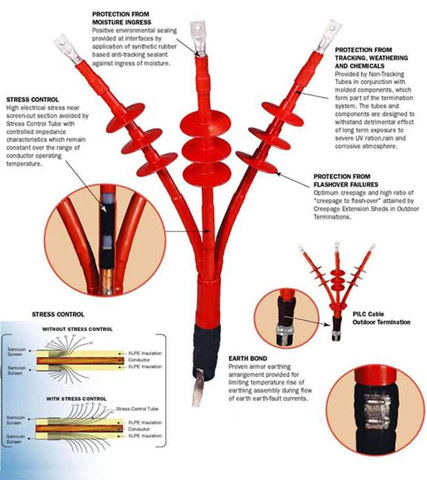
Ampacity (amperage capacity) of jacketed conductors is lower than bare conductors in free air since the jacket serves as both a thermal and an electrical insulator.
Because the conductors are supported over their entire length by insulators, insulating them mid span normally serves no purpose whatsoever. An exception to that is in densely populated areas and circuits with a high burden of foliage and wildlife.
In those instances, coated primary conductors (aka tree wire) are an option. Coated is a loaded term as it is a thermoset designed to provide a degree of protection against faults from transient incidental contact. It is not insulation that would be meant for permanently installed construction.
Insulated cable meant for underground and raceway installations on circuits greater than 5kV is a compound construction with a central primary conductor and a concentric ground made of foil or braided strand.
When this type of cable is connected (terminated), the ends are fitted with kits designed to dissipate coronal discharge. There is no practical means of tapping this cable mid span which makes it essentially useless for overhead primary service.
 1
1

Posted on 1/14/19 at 7:36 pm to Croozin2
I worked on a project in New Jersey where we installed a new underground 230kv line that was oil insulated and the were pump houses....I also worked for Entetgy Services when they were in Kenner for short time
Posted on 1/14/19 at 7:43 pm to MississippiLSUfan
quote:
Are hot air balloons grounded? Cause I’ve seen some bad shite happen when those hit power lines.
Many years ago I saw the hot air balloons advertising for the newly opened McInnis Peterson Chevrolet I-12 at Airline come in contact with the powerlines on Airline in front of the Dominique stockyard and the balloon caught fire, shot up like a rocket with 2 people on board, then when enough of the balloon was destroyed the basket fell to the ground on the railroad tracks beside the stockyard.
Posted on 1/14/19 at 7:56 pm to dillpickleLSU
Still have PILC (paper insulated lead covered) conductors in spots including an underground crossing of the Intracoastal in the most fricked up spot imaginable.
I know because a buddy called about 6 months ago asking "Do y'all have any old lead jacketed cable in service?" I replied "shite no, why?"
He said they called him in a panic looking for a 4/0 3 phase splice kit, the one they had in their warehouse in a crate marked "DO NOT THROW AWAY UNDER PENALTY OF DEATH" had been thrown away.
I know because a buddy called about 6 months ago asking "Do y'all have any old lead jacketed cable in service?" I replied "shite no, why?"
He said they called him in a panic looking for a 4/0 3 phase splice kit, the one they had in their warehouse in a crate marked "DO NOT THROW AWAY UNDER PENALTY OF DEATH" had been thrown away.
This post was edited on 1/14/19 at 7:58 pm

Posted on 1/14/19 at 7:56 pm to reverendotis
In addition to what you posted, to sufficiently support insulated 3 phase high voltage cable, they would needed to be lashed to a messenger. This also drives up the cost of installation and increases time of repair after an incident
Posted on 1/14/19 at 8:33 pm to TDsngumbo
High voltage power lines are at extreme voltage levels due to huge losses ( I squared-R losses) . Insulating these lines at these extreme voltages is cost prohibited. Think about the Miles these line travel . Under ground Distribution is possible but it is very expensive . There is also a difference between long distance HV transmission lines and relatively short distance Distribution lines . Go study some EE.


Posted on 1/15/19 at 5:25 am to dillpickleLSU
You learn something new every day. Guess it depends on application. 
Posted on 1/15/19 at 5:27 am to Croozin2
Yes I specifically remember that job because the pump house manufacturer took forever to get us the specs so we couldn't get the foundation plans finalized and permitted. Our construction manager installed the foundation without a permit and told the county he wasnt sorry and would have done it again, lol
Posted on 1/15/19 at 5:30 am to dillpickleLSU
Also, there are very few guys who can splice this stuff. We were watching them and they asked that we do not take pictures or record them. Apparently they get paid a lot.
Posted on 1/15/19 at 7:54 am to TDsngumbo
Damn, electricity. You complicated.
Posted on 1/15/19 at 8:00 am to TDsngumbo
Expensive and heavy.

Posted on 1/15/19 at 8:16 am to CarRamrod
quote:
the guys that repair the cross country lines
Frick that... nope. I wonder how many of those guys die.

 Page 3 of 3


Popular
Back to top
 Follow TigerDroppings for LSU Football News