




 9
9



- My Forums
- Tiger Rant
- LSU Recruiting
- SEC Rant
- Saints Talk
- Pelicans Talk
- More Sports Board
- Fantasy Sports
- Golf Board
- Soccer Board
- O-T Lounge
- Tech Board
- Home/Garden Board
- Outdoor Board
- Health/Fitness Board
- Movie/TV Board
- Book Board
- Music Board
- Political Talk
- Money Talk
- Fark Board
- Gaming Board
- Travel Board
- Food/Drink Board
- Ticket Exchange
- TD Help Board
Customize My Forums- View All Forums
- Show Left Links
- Topic Sort Options
- Trending Topics
- Recent Topics
- Active Topics
Started By
Message
Thoughts on floating LVP in kitchen?
Posted on 8/17/26 at 2:02 pm
Posted on 8/17/26 at 2:02 pm
Making some last decisions for our kitchen remodel.
Hardwoods were our original choice, but they're so expensive and we don't want the hassle of dealing with the polyurethane.
Our next option was LVP. There's a slight dip where out kitchen meets the breakfast area, which was part of an addition on the home.
The contractor said to use floating LVP. It won't go under the cabinets, but they'll use quarter round to hide any issues up against the cabinet base.
I just read some comments saying to never use floating LVP because they will inevitably buckle.
Hardwoods were our original choice, but they're so expensive and we don't want the hassle of dealing with the polyurethane.
Our next option was LVP. There's a slight dip where out kitchen meets the breakfast area, which was part of an addition on the home.
The contractor said to use floating LVP. It won't go under the cabinets, but they'll use quarter round to hide any issues up against the cabinet base.
I just read some comments saying to never use floating LVP because they will inevitably buckle.
Posted on 8/17/26 at 2:19 pm to StringedInstruments
You can glue it down, but nothing wrong if you use a thick, quality product with a good interlock system.
I installed one in a basement, it was cheap and the interlock wasn’t consistent, I swear the planks were banana shaped, however the client who is a friend of mine said it’s still holding up.
I installed one in a basement, it was cheap and the interlock wasn’t consistent, I swear the planks were banana shaped, however the client who is a friend of mine said it’s still holding up.
Posted on 8/17/26 at 2:25 pm to dillpickleLSU
The only issue with glue down is ensuring the slab is flat and level. This takes a good bit of floor patch, especially if there was a flooring finish previously installed.
My issue with a floating LVT is the sound of footsteps if the underlayment is not thick enough.
My issue with a floating LVT is the sound of footsteps if the underlayment is not thick enough.
Posted on 8/17/26 at 3:07 pm to 4LSU2
Yeah you need good underlayment and the thick planks like 21mm or thicker
This post was edited on 8/17/26 at 3:07 pm
Posted on 8/17/26 at 5:25 pm to StringedInstruments
I HATE the way floating LVP feels on floors. No way would I use it in an area that is constantly walked on all day
Posted on 8/17/26 at 6:44 pm to StringedInstruments
go with ceramic tile brah. Don’t put a plastic floor down in your kitchen
Posted on 8/17/26 at 8:08 pm to StringedInstruments
quote:
I just read some comments saying to never use floating LVP because they will inevitably buckle.
Yup. Will never do it again. Put it in after Ida and the locking grooves cracked in all the high traffic areas, and the floor buckled for no reason other than what I can see being humidity changes throughout the year. Put the most expensive underlayment I could get also.
Posted on 8/17/26 at 8:31 pm to StringedInstruments
I’m currently laying Banf Gray Hickory 22mm LVP in a 20x15 playroom in my basement. I like it. Good luck with your kitchen! 
Posted on 8/17/26 at 10:50 pm to StringedInstruments
Gotta go with grand on this one I assume you’re spending quite a bit on your kitchen remodel, don’t fumble at the goal line with your flooring choice. Go with ceramic, or better yet - porcelain. If your contractor balks, get a new contractor.
Posted on 8/18/26 at 9:47 am to StringedInstruments
I had major interior house reno 4 years ago. Entire house flooring (previously wood floors, ceramic tile, carpet) was replaced, all floating LVP, with exception of bathrooms (new ceramic tile). House is slab on grade (built in 1993). I worked with interior decorator - she recommended it - and had used it in other projects, including in high end homes. Apparently LVP became much more popular in my area after a major flooding event in 2016 and 1000s had to replace flooring in their houses. I had my doubts, but in the end I decide to go with the LVP.
Though I don’t disagree with comments made by others discouraging its use, 4 years in I’m happy with it and I have had no issues - and that includes the heavily trafficked kitchen. I have received a number of complements on it. How well it will hold up for the next 4, 6, 8, ….years i haven’t a clue. I would suspect the quality of the LVP chosen and the quality & attention to detail of the install plays a major role in how well it will hold up.
One thing I do know, if installed as a floating product and not glued, and I know you don’t want to hear this, it would be a piece of cake to remove and replace if you had issues with it or you ultimately didn’t like it.
One additional anecdote, I live in a reasonably high-end subdivision and I wondered if using LVP might be an issue if and when I sell the house. All I can say is every nearby neighbor I’ve had who sold their house, the new buyer ripped out and replaced 100% of the existing flooring and installed new flooring regardless of what flooring was in the house or its age. This is happening next door to me right now as I type this. So now I’m of the opinion, install you like or can afford; a potential buyer is likely to replace existing flooring anyway…..
ETA: If it helps, this is the LVP I installed in my house.
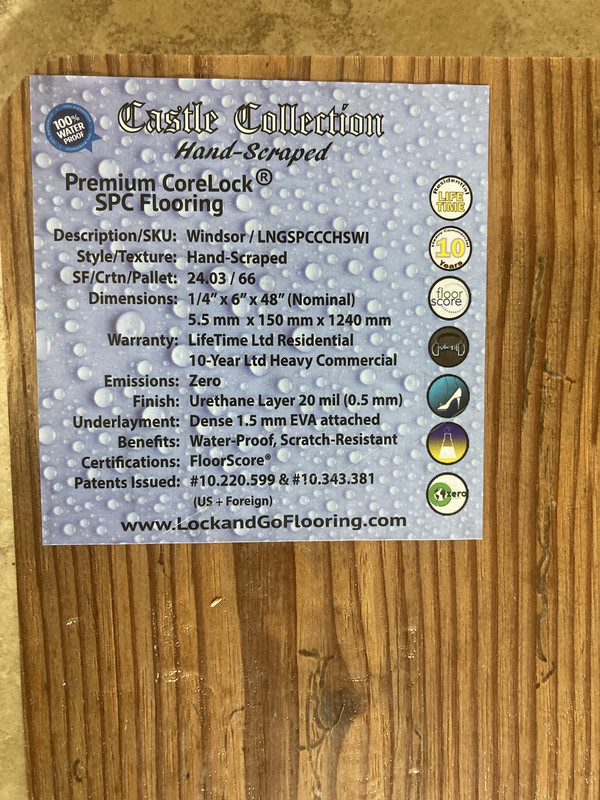
Though I don’t disagree with comments made by others discouraging its use, 4 years in I’m happy with it and I have had no issues - and that includes the heavily trafficked kitchen. I have received a number of complements on it. How well it will hold up for the next 4, 6, 8, ….years i haven’t a clue. I would suspect the quality of the LVP chosen and the quality & attention to detail of the install plays a major role in how well it will hold up.
One thing I do know, if installed as a floating product and not glued, and I know you don’t want to hear this, it would be a piece of cake to remove and replace if you had issues with it or you ultimately didn’t like it.
One additional anecdote, I live in a reasonably high-end subdivision and I wondered if using LVP might be an issue if and when I sell the house. All I can say is every nearby neighbor I’ve had who sold their house, the new buyer ripped out and replaced 100% of the existing flooring and installed new flooring regardless of what flooring was in the house or its age. This is happening next door to me right now as I type this. So now I’m of the opinion, install you like or can afford; a potential buyer is likely to replace existing flooring anyway…..
ETA: If it helps, this is the LVP I installed in my house.
This post was edited on 8/18/26 at 2:36 pm
Posted on 8/18/26 at 9:53 am to StringedInstruments
Hardwood is not that expensive,
Posted on 8/18/26 at 12:51 pm to StringedInstruments
the two biggest things with LVP are
1) quality product that is thick AND has a thick wear layer, i.e. I went with cali bamboo for my last install, it has a 22mill wear layer.
2) an install that pays attention to detail. it is very easy to install and have the click/lock system be 90% in but that really comes into play a few years in when there is a lot of movement and expansion/contraction. all of those joints where it is not fully in, will start to separate and come apart.
The cali bamboo I installed myself looked perfect and just like I installed it over 3 years later.
The new build we bought with an unknown LVP is showing tons of separations 3 years in, and the top layer is peeling off in a few small areas and I'm sure because the install was shitty and I assume the wear layer is not thick.
I am not saying you have to go with that brand, but make sure you have a great installer and do your research on the brand
1) quality product that is thick AND has a thick wear layer, i.e. I went with cali bamboo for my last install, it has a 22mill wear layer.
2) an install that pays attention to detail. it is very easy to install and have the click/lock system be 90% in but that really comes into play a few years in when there is a lot of movement and expansion/contraction. all of those joints where it is not fully in, will start to separate and come apart.
The cali bamboo I installed myself looked perfect and just like I installed it over 3 years later.
The new build we bought with an unknown LVP is showing tons of separations 3 years in, and the top layer is peeling off in a few small areas and I'm sure because the install was shitty and I assume the wear layer is not thick.
I am not saying you have to go with that brand, but make sure you have a great installer and do your research on the brand
Posted on 8/18/26 at 2:19 pm to TheBoo
quote:
Yup. Will never do it again. Put it in after Ida and the locking grooves cracked in all the high traffic areas, and the floor buckled for no reason other than what I can see being humidity changes throughout the year. Put the most expensive underlayment I could get also.
We had the same exact thing happen to us with our LVP. The stupid proprietary locking mechanism on the brand we chose is breaking all over in the highly trafficked areas.
I miss the slide locking engineered hardwood / laminate that we had pre-Ida.

 Page 1 of 1




Popular

Back to top
 Follow TigerDroppings for LSU Football News