




- My Forums
- Tiger Rant
- LSU Recruiting
- SEC Rant
- Saints Talk
- Pelicans Talk
- More Sports Board
- Fantasy Sports
- Golf Board
- Soccer Board
- O-T Lounge
- Tech Board
- Home/Garden Board
- Outdoor Board
- Health/Fitness Board
- Movie/TV Board
- Book Board
- Music Board
- Political Talk
- Money Talk
- Fark Board
- Gaming Board
- Travel Board
- Food/Drink Board
- Ticket Exchange
- TD Help Board
Customize My Forums- View All Forums
- Show Left Links
- Topic Sort Options
- Trending Topics
- Recent Topics
- Active Topics
Started By
Message
How long do you simmer your broth?
Posted on 7/10/25 at 7:19 pm

Posted on 7/10/25 at 7:19 pm
I pulled out a couple of chicken/turkey carcasses and some frozen veggie trimmings today while I was home for lunch. Filled my 10qt pot with water, a head of garlic, a couple of bay leaves, peppercorns and a lemon. I brought it to a low boil, then put in in the oven set to 205 since I had to go back to work. When I got home at 4:00, I put it on the stove at a low boil to reduce a little. My plan is to cook until 8 or 9, then cool and strain. What’s your normal broth routine?
 7
7


Posted on 7/10/25 at 8:06 pm to LSUGUMBO
About 2.5-3 hours slow simmer when I make a broth from a fresh hen.
This post was edited on 7/10/25 at 8:07 pm


Posted on 7/10/25 at 9:14 pm to Professor Dawghair
For shrimp stock, don't go longer than 30 minutes. For other meats, as long as is convenient to you.


Posted on 7/10/25 at 9:24 pm to LSUGUMBO
12-24 hours if I have time.
Posted on 7/10/25 at 9:53 pm to LSUGUMBO
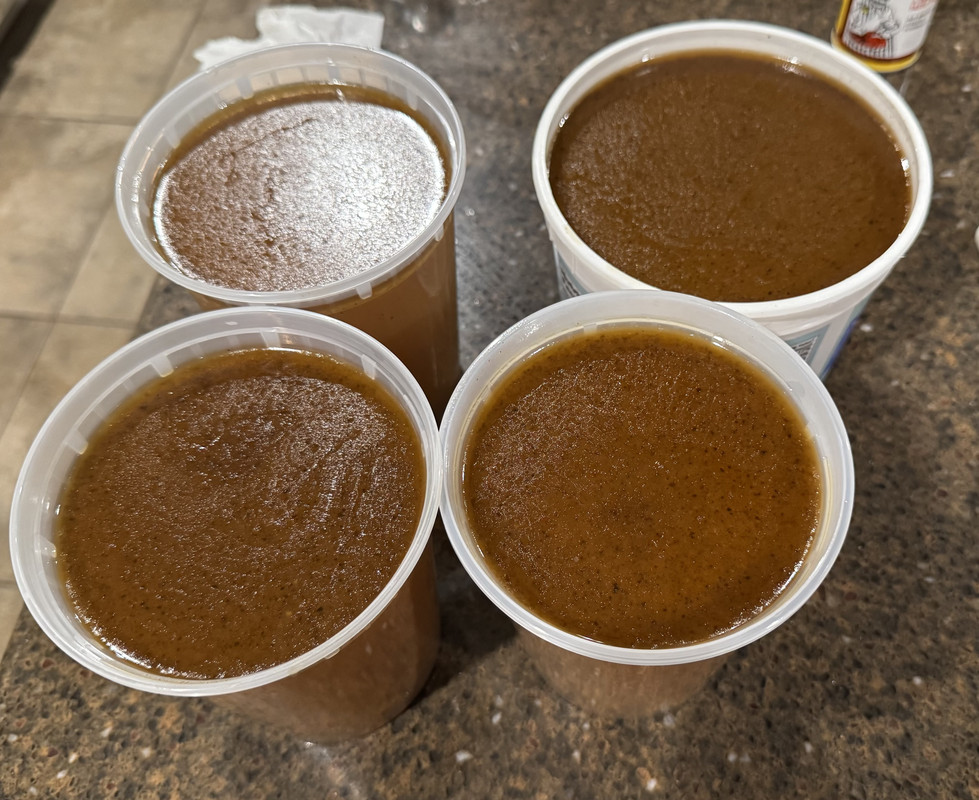
6 qts of rich broth from 5 chickens and a smoked turkey. About 8 hours cooking and 90 minutes cooling/straining. Tastes delicious!
Posted on 7/11/25 at 8:17 am to LSUGUMBO
For meat stocks------chicken, turkey, pork, beef, etc. I will cook it low and slow for up to 24 hours and by the time it's done it will be very richly flavored. This is more a stock and even an aspic in many cases and they are more flavorful than a basic broth.
I let it cool down and put it in my fridge in a stainless steel bowl and let that chill overnight. The next day it will have a layer of congealed fat across the top and I remove that. What is under that is a gel, not a fluid liquid and it is packed with flavor. I will bag that up in Zip-Lock bags and freeze for later use.
I always use carrots, onions, celery, garlic, bay leaves and various dry and wet seasonings to start my meat stocks.
For seafood stocks, like already mentioned, they are much faster to cook and I add no vegetables to those stocks, just the shells, fish carcasses, etc. and cook no longer than 45 minutes.
I let it cool down and put it in my fridge in a stainless steel bowl and let that chill overnight. The next day it will have a layer of congealed fat across the top and I remove that. What is under that is a gel, not a fluid liquid and it is packed with flavor. I will bag that up in Zip-Lock bags and freeze for later use.
I always use carrots, onions, celery, garlic, bay leaves and various dry and wet seasonings to start my meat stocks.
For seafood stocks, like already mentioned, they are much faster to cook and I add no vegetables to those stocks, just the shells, fish carcasses, etc. and cook no longer than 45 minutes.

Posted on 7/11/25 at 1:10 pm to LSUGUMBO
At some point, there has to be diminishing returns, right? If you simmer it for 4 hours vs 8 hours, how much of a difference will there be?
For crawfish, I usually only simmer the heads for an hour ish.
For chicken or turkey carcass - at least an hour. But I don't think I've ever gone over two hours. I'll have to try going longer if I have the time.
For crawfish, I usually only simmer the heads for an hour ish.
For chicken or turkey carcass - at least an hour. But I don't think I've ever gone over two hours. I'll have to try going longer if I have the time.
Posted on 7/11/25 at 1:32 pm to SUB
quote:
At some point, there has to be diminishing returns, right? If you simmer it for 4 hours vs 8 hours, how much of a difference will there be?
This is probably true, I'm just not 100% sure when the bones release all the collagen that makes a broth/stock taste so good and give it such great texture. Many restaurants make 24 hour broths for soups like pho. I do think you get all you're going to get out of the vegetables after just a couple of hours
This is the AI generated answer from Google
quote:
AI Overview
Chicken stock should simmer for at least 3-4 hours for a good flavor and up to 8 hours or longer for a more concentrated and rich stock. Some recipes suggest simmering for a full day (24 hours) or even longer, especially for a more gelatinous stock.
Here's a more detailed breakdown:
Minimum:
For a basic chicken stock with decent flavor, aim for at least 3-4 hours.
Better flavor:
6-8 hours of simmering will extract more flavor from the bones and connective tissue.
Maximum flavor and gelatin:
Simmering for 12 hours or more will produce a very rich and gelatinous stock.
Consider the cooking method:
Pressure cookers can significantly reduce the simmering time, while a slow cooker may require longer simmering times.
Important factors to consider:
Type of bones:
Raw bones will require longer simmering than cooked bones (like from a rotisserie chicken).
Desired result:
If you want a light, clear stock, shorter simmering times are better. For a richer, more intense flavor, simmer longer.
Skimming:
Regularly skim off any foam or impurities that rise to the surface during simmering.
Keep it covered:
Keep the pot covered during simmering, topping up with water if needed to keep the bones submerged.
Strain thoroughly:
Once simmering is complete, strain the stock through a fine-mesh sieve or cheesecloth-lined strainer to remove solids.

Posted on 7/11/25 at 1:39 pm to LSUGUMBO
I thought about putting the question into a chatbot too! 
That's an interesting answer. I never thought about the pressure cooker...that seems interesting. I'd like to know if anyone here has tried that method.
That's an interesting answer. I never thought about the pressure cooker...that seems interesting. I'd like to know if anyone here has tried that method.
Posted on 7/11/25 at 5:34 pm to LSUGUMBO
From Grok
For chicken stock, simmer bones and vegetables for **6 to 8 hours** on low heat. This allows the collagen in the bones to break down into gelatin, giving the stock a rich flavor and body. Skim foam and impurities periodically, and avoid boiling to keep the stock clear. If using a pressure cooker, 1 to 2 hours is sufficient. For a lighter stock, 3 to 4 hours can work, but longer simmering enhances depth.
Simmering chicken stock beyond 8 hours can enhance flavor to a point, but there are diminishing returns and potential drawbacks. Here's a breakdown:
- **Up to 12-24 hours**: Extended simmering can extract more collagen, minerals, and depth from the bones, resulting in a richer, more intense flavor and thicker texture due to increased gelatin. Many professional chefs simmer stocks for 12-18 hours for maximum flavor, especially for bone-heavy stocks.
- **Beyond 24 hours**: The flavor may not improve significantly and can sometimes become overly intense, bitter, or "off" due to over-extraction of certain compounds from bones or vegetables. Vegetables, in particular, can break down too much, making the stock cloudy or imparting a stale taste.
**Tips for longer simmering**:
- Monitor water levels and top off with hot water to prevent the stock from reducing too much or burning.
- Skim regularly to remove impurities.
- If vegetables start to disintegrate (after 6-8 hours), consider removing them and adding fresh ones to avoid bitterness.
- Taste periodically to ensure the flavor remains balanced.
Is it beneficial to simmer longer
For home cooking, **8-12 hours** is typically the sweet spot for a flavorful, well-rounded chicken stock. If you go longer, keep it under 24 hours and taste-test to ensure quality.
For chicken stock, simmer bones and vegetables for **6 to 8 hours** on low heat. This allows the collagen in the bones to break down into gelatin, giving the stock a rich flavor and body. Skim foam and impurities periodically, and avoid boiling to keep the stock clear. If using a pressure cooker, 1 to 2 hours is sufficient. For a lighter stock, 3 to 4 hours can work, but longer simmering enhances depth.
Simmering chicken stock beyond 8 hours can enhance flavor to a point, but there are diminishing returns and potential drawbacks. Here's a breakdown:
- **Up to 12-24 hours**: Extended simmering can extract more collagen, minerals, and depth from the bones, resulting in a richer, more intense flavor and thicker texture due to increased gelatin. Many professional chefs simmer stocks for 12-18 hours for maximum flavor, especially for bone-heavy stocks.
- **Beyond 24 hours**: The flavor may not improve significantly and can sometimes become overly intense, bitter, or "off" due to over-extraction of certain compounds from bones or vegetables. Vegetables, in particular, can break down too much, making the stock cloudy or imparting a stale taste.
**Tips for longer simmering**:
- Monitor water levels and top off with hot water to prevent the stock from reducing too much or burning.
- Skim regularly to remove impurities.
- If vegetables start to disintegrate (after 6-8 hours), consider removing them and adding fresh ones to avoid bitterness.
- Taste periodically to ensure the flavor remains balanced.
Is it beneficial to simmer longer
For home cooking, **8-12 hours** is typically the sweet spot for a flavorful, well-rounded chicken stock. If you go longer, keep it under 24 hours and taste-test to ensure quality.


Posted on 7/11/25 at 6:22 pm to Tomcat
I use an 8 qt pressure cooker at 15 psig. Boiling point at 15 psig is 250 F vs 212 F at atmos pressure. Cooking time decreases by half for every 18 deg F temp increase above 212 F. I cook under pressure for 2 hours (+ 1 hr to decompress), which is equivalent to about 8 hrs at atmos pressure. I use bones. skin, jal pepper, celery, carrots, onions, etc..
Cool, strain, and refrigerate. I freeze excess stock in qt freezer bags. Works and tastes great.
This post was edited on 7/13/25 at 2:26 am

Posted on 7/12/25 at 8:08 am to LSUGUMBO
We process about 40-50 birds a year for ourselves. Wife takes and freezes the carcasses.
When we do cook our chicken we save the bones, roast the saved carcasses, then put in a large instant pot for 4-6 hrs with onions, carrots, the usual.
It’s an immaculate stock.
When we do cook our chicken we save the bones, roast the saved carcasses, then put in a large instant pot for 4-6 hrs with onions, carrots, the usual.
It’s an immaculate stock.
Posted on 7/12/25 at 8:30 am to Junky
quote:
We process about 40-50 birds a year for ourselves
quote:
It’s an immaculate stock.
So, are these your basic "yard birds" you keep for eggs and meat purposes?
If so, I've processed a few in my lifetime too and I love the flavor of the meat they produce. It is redder in color and packs more flavor with being leaner and the breast meat is so much different with the breast bone being way more pronounced with the meat being much smaller.
Last month one of my sister in laws asked me to take the last rooster she had since her laying hens were killed off by predators. I took it home and processed it and made a gumbo out of it and it was delicious. The meat had to be cooked a bit longer due to the roosters age and the fact it was a basic yard bird.
Posted on 7/12/25 at 8:59 pm to gumbo2176
quote:
So, are these your basic "yard birds" you keep for eggs and meat purposes?
We have egg layers. Typically we do about 20 broilers in the early spring, when the temperature outside is just warm enough, then another 20 that we butcher around thanksgiving. I move them to fresh grass daily. It’s not a lot of work.
The meat is unbelievably better, richer, more flavorful.

Posted on 7/12/25 at 10:15 pm to SUB
I almost exclusively use a pressure cooker for making my stocks. I freeze my bones n veggie trimmings and when I have enough I pull em out and fill water till it tops all the flavorings. I don't have a set time but usually 30min to a couple hours at most. Will give you rich gelatinous stock. Max pressure and usually a natural release unless I'm in a hurry or something.
Posted on 7/13/25 at 8:48 am to LSshoe
Same with the pressure cooker, but I often default to large crockpot overnight + next workday. Stock is always gelatinous and perfect.

 Page 1 of 1


Back to top
 Follow TigerDroppings for LSU Football News