


- My Forums
- Tiger Rant
- LSU Recruiting
- SEC Rant
- Saints Talk
- Pelicans Talk
- More Sports Board
- Coaching Changes
- Fantasy Sports
- Golf Board
- Soccer Board
- O-T Lounge
- Tech Board
- Home/Garden Board
- Outdoor Board
- Health/Fitness Board
- Movie/TV Board
- Book Board
- Music Board
- Political Talk
- Money Talk
- Fark Board
- Gaming Board
- Travel Board
- Food/Drink Board
- Ticket Exchange
- TD Help Board
Customize My Forums- View All Forums
- Show Left Links
- Topic Sort Options
- Trending Topics
- Recent Topics
- Active Topics
Started By
Message
TulaneLSU’s 10 pictures of the NOLA Metro Cheesesteak Poorboy
Posted on 1/4/20 at 10:37 am
Posted on 1/4/20 at 10:37 am
Dear Friends,
I require three things from food. First, it must sustain me. Second, it must taste good. Third, and perhaps most important, it must tell a good story. This triune posture makes dining a fully immersive event -- food should feed the body, the spirit, and the mind. Today, I share with the the TulaneLSU NOLA Metro Cheesesteak Poorboy, a name I am working to trademark with my bartering barrister, buttocksinclarse.
First, we start with the base of all poorboys: New Orleans French bread. Perhaps as challenging as the age old question of Strawberry rhubarb or blackberry confiture jelly at La Madeleine’s, toasted or cold muffuletta, or Augustine or Thomas is Leidenheimer or Reising’s? Now I am aware that Leidenheimer bought out Reising’s Sunrise. But even under its new ownership, Reising’s tastes different from Leidenheimer. It’s chew can be almost gum like at times, and on a full length poorboy can quickly cause the experience to go from pleasurable to painful, as the jaw and teeth struggle to tear through the flour which is very high in gluten and extremely low in fat. I always considered Reising’s to be Leidenheimer minus any fat.

Just like I always do at La Madeleine’s, I decided on getting both to experiment. In this step, we remember the German and French influence on New Orleans. The French first brought French bread to this colony in the 1700s. The Germans mastered the New Orleans French bread in the late 1800s.
The next step is choosing the right beef. I’ve heard it said that a cheesesteak is not a cheesesteak unless it’s made from ribeye. That’s a lie. It doesn’t matter what steak you use, so long as it is beef. You can’t put a tuna steak on bread with cheese and call it a cheesesteak. Not in my world, at least. One of our family’s friends, Wolfgang Puck, told me something like this: “TulaneLSU, if you ever want to make good beef, use Snake River Farms American Wagyu. It has the marbling of Japanese Wagyu and the rich flavor of American beef.”

The steak recalls the Metro area’s once thriving beef industry. As coastal erosion and urban sprawl increased, the pasturelands disappeared. My grandfather once told me of a childhood memory of chasing turkeys on a family friend’s farm. We were fishing The Pen down in Lafitte at the time. Grandfather said, “TulaneLSU, right on this very spot in my lifetime was solid ground. Cows grazed here; now otters (his vision had gone -- they were nutria) play and trout swarm. Don’t take anything in this life for granted. The very ground you walk on is not promised. But as for the love and faithfulness of our God, those things are forever.”


New Orleans does not have a significant cheese history. Creole cream cheese, of which I am not very fond, has a mildly interesting history. It never became very popular, though, because it simply doesn’t taste that good. Of all the cheeses available to us, it is far down the list. I would never put Creole cream cheese on a cheesesteak poorboy. But if I did, I would get the Gold Seal Creamery version of it at Dorignac’s.
Here I have freshly shredded Tillamook pepperjack. Although it is derived from Monterey Jack, a discovery or invention, depending on your worldview, of the Franciscans of Monterey, California 300 years ago, it makes me think of County Kerry, Ireland. Tillamook Creamery was founded by a Scotsman, Peter Duncan McIntosh, so there’s no real connection, other than the one that floats in my mind, with the New Orleans Irish who came in droves in the mid to late 1800s and were used to build the city. Proud Orleans Irish are quick to tell you, sometimes ad nauseum, about how their great great grandfather helped dig the New Basin Canal. They’ll tell you how the Irish had it worse than enslaved Africans before them, to which I always roll my eyes.
As one American philosopher has said, “When America opened the floodgates and let all of us Irish in, what do you think they were doing that for? Because they were trying to save us from poverty? No, they did it because they needed us. They needed us to build their cities, dig their subways and it made them richer. The Carnegies, the Rockefellers: they needed the worker bees. Then there we were. But some all us didn't want to swarm around the hive and lose who we were. We wanted to stay Irish and preserve the things that meant something to us: honor and family, and loyalty.”
I also purchased some beautiful provolone from Sam’s. Provolone is the superior cheese for cheesesteaks, in my opinion. It reminds us of the beautiful Italians who have had perhaps the greatest influence of all new immigrants to the city. The Italians changed the landscape of New Orleans food, introducing pasta, pizza, muffulettas, and St. Joseph’s Day altars. Creole Italian food is arguably the greatest American contribution to the world’s menu, although it currently is wildly underappreciated.

I require three things from food. First, it must sustain me. Second, it must taste good. Third, and perhaps most important, it must tell a good story. This triune posture makes dining a fully immersive event -- food should feed the body, the spirit, and the mind. Today, I share with the the TulaneLSU NOLA Metro Cheesesteak Poorboy, a name I am working to trademark with my bartering barrister, buttocksinclarse.
First, we start with the base of all poorboys: New Orleans French bread. Perhaps as challenging as the age old question of Strawberry rhubarb or blackberry confiture jelly at La Madeleine’s, toasted or cold muffuletta, or Augustine or Thomas is Leidenheimer or Reising’s? Now I am aware that Leidenheimer bought out Reising’s Sunrise. But even under its new ownership, Reising’s tastes different from Leidenheimer. It’s chew can be almost gum like at times, and on a full length poorboy can quickly cause the experience to go from pleasurable to painful, as the jaw and teeth struggle to tear through the flour which is very high in gluten and extremely low in fat. I always considered Reising’s to be Leidenheimer minus any fat.
Just like I always do at La Madeleine’s, I decided on getting both to experiment. In this step, we remember the German and French influence on New Orleans. The French first brought French bread to this colony in the 1700s. The Germans mastered the New Orleans French bread in the late 1800s.
The next step is choosing the right beef. I’ve heard it said that a cheesesteak is not a cheesesteak unless it’s made from ribeye. That’s a lie. It doesn’t matter what steak you use, so long as it is beef. You can’t put a tuna steak on bread with cheese and call it a cheesesteak. Not in my world, at least. One of our family’s friends, Wolfgang Puck, told me something like this: “TulaneLSU, if you ever want to make good beef, use Snake River Farms American Wagyu. It has the marbling of Japanese Wagyu and the rich flavor of American beef.”
The steak recalls the Metro area’s once thriving beef industry. As coastal erosion and urban sprawl increased, the pasturelands disappeared. My grandfather once told me of a childhood memory of chasing turkeys on a family friend’s farm. We were fishing The Pen down in Lafitte at the time. Grandfather said, “TulaneLSU, right on this very spot in my lifetime was solid ground. Cows grazed here; now otters (his vision had gone -- they were nutria) play and trout swarm. Don’t take anything in this life for granted. The very ground you walk on is not promised. But as for the love and faithfulness of our God, those things are forever.”
New Orleans does not have a significant cheese history. Creole cream cheese, of which I am not very fond, has a mildly interesting history. It never became very popular, though, because it simply doesn’t taste that good. Of all the cheeses available to us, it is far down the list. I would never put Creole cream cheese on a cheesesteak poorboy. But if I did, I would get the Gold Seal Creamery version of it at Dorignac’s.
Here I have freshly shredded Tillamook pepperjack. Although it is derived from Monterey Jack, a discovery or invention, depending on your worldview, of the Franciscans of Monterey, California 300 years ago, it makes me think of County Kerry, Ireland. Tillamook Creamery was founded by a Scotsman, Peter Duncan McIntosh, so there’s no real connection, other than the one that floats in my mind, with the New Orleans Irish who came in droves in the mid to late 1800s and were used to build the city. Proud Orleans Irish are quick to tell you, sometimes ad nauseum, about how their great great grandfather helped dig the New Basin Canal. They’ll tell you how the Irish had it worse than enslaved Africans before them, to which I always roll my eyes.
As one American philosopher has said, “When America opened the floodgates and let all of us Irish in, what do you think they were doing that for? Because they were trying to save us from poverty? No, they did it because they needed us. They needed us to build their cities, dig their subways and it made them richer. The Carnegies, the Rockefellers: they needed the worker bees. Then there we were. But some all us didn't want to swarm around the hive and lose who we were. We wanted to stay Irish and preserve the things that meant something to us: honor and family, and loyalty.”
I also purchased some beautiful provolone from Sam’s. Provolone is the superior cheese for cheesesteaks, in my opinion. It reminds us of the beautiful Italians who have had perhaps the greatest influence of all new immigrants to the city. The Italians changed the landscape of New Orleans food, introducing pasta, pizza, muffulettas, and St. Joseph’s Day altars. Creole Italian food is arguably the greatest American contribution to the world’s menu, although it currently is wildly underappreciated.
This post was edited on 1/4/20 at 10:41 am
 4
4

Posted on 1/4/20 at 10:37 am to TulaneLSU
At the dawn of 1800, America and French Louisiana was transitioning from a colonial outpost to a new and independent nation. When the French sold its Louisiana possessions to the Americans in 1803, it heralded a new age for the city of New Orleans. Wilderness North Carolinians and Kentuckians heard of the great financial opportunities afforded by the banking and slave mecca of the South. And come they did, establishing the Garden District and Uptown, which before the post-Katrina Yankee immigration, were culturally the only parts of New Orleans that resembled the Deep South. The onions of my cheesesteak represent this lily white immigratio and culture, which hardly exists today.

When Marcus Garvey established the Universal Negro Improvement Association a century ago, he understood the need for symbols. Symbols are powerful and help individuals and groups with their identity. He admired Ethiopia, for it had, at that time, never fallen under European hegemony, one of the few places in Africa with that claim. So he borrowed the colors of the Ethiopian flag -- red, green and yellow -- for the movement’s colors. And today, these three beautiful colors together are seen as a sign of African pride and solidarity.
Within a decade of New Orleans’ founding, the French were importing Africans as chattel slaves. New Orleans’ history of black residents is much more than that of slavery, of course. The city had many free blacks throughout its history, owing, at least, in part to the less rigid racial system of the French, which tolerated clandestine interracial relationships, which produced interracial children. This in turn birthed the American Civil Rights Movement. New Orleans’ history of fighting for justice is unparalleled by any other American city. A.P. Tureaud, Homer Plessy, and many other New Orleanians who rose up against tyranny remind us that the movement was far more than Martin Luther King.
Perhaps New Orleans’ most famous worldwide export, jazz, is also a product of the black influence in New Orleans. Truthfully, I really do not enjoy jazz except for a few Mardi Gras pieces. We would be here for the next few days if I listed all the beautiful contributions black people have made to our great city. Here are my green, yellow, and red sweet peppers to remind us of the black influence in the city.

I chopped my NY strip steaks into fine pieces beforehand, as I do not have a flat griddle, which would be perfect for this sort of cooking. I did not want to injure my knife or pan by cutting in the pan.
 [/url]
For NOLA Metro cheesesteaks, I grill to a well done temperature. I’m not sure why; it’s just what I’ve always done. I cook all parts separate, just as all the constituent cultures of New Orleans arrived. But in the flat pan of New Orleans, all are blended together to bring a beautiful, unified whole.

My friends, I present to you, the product 300 years of cultures interlaced and braided together, the NOLA Metro Cheesesteak Poorboy:
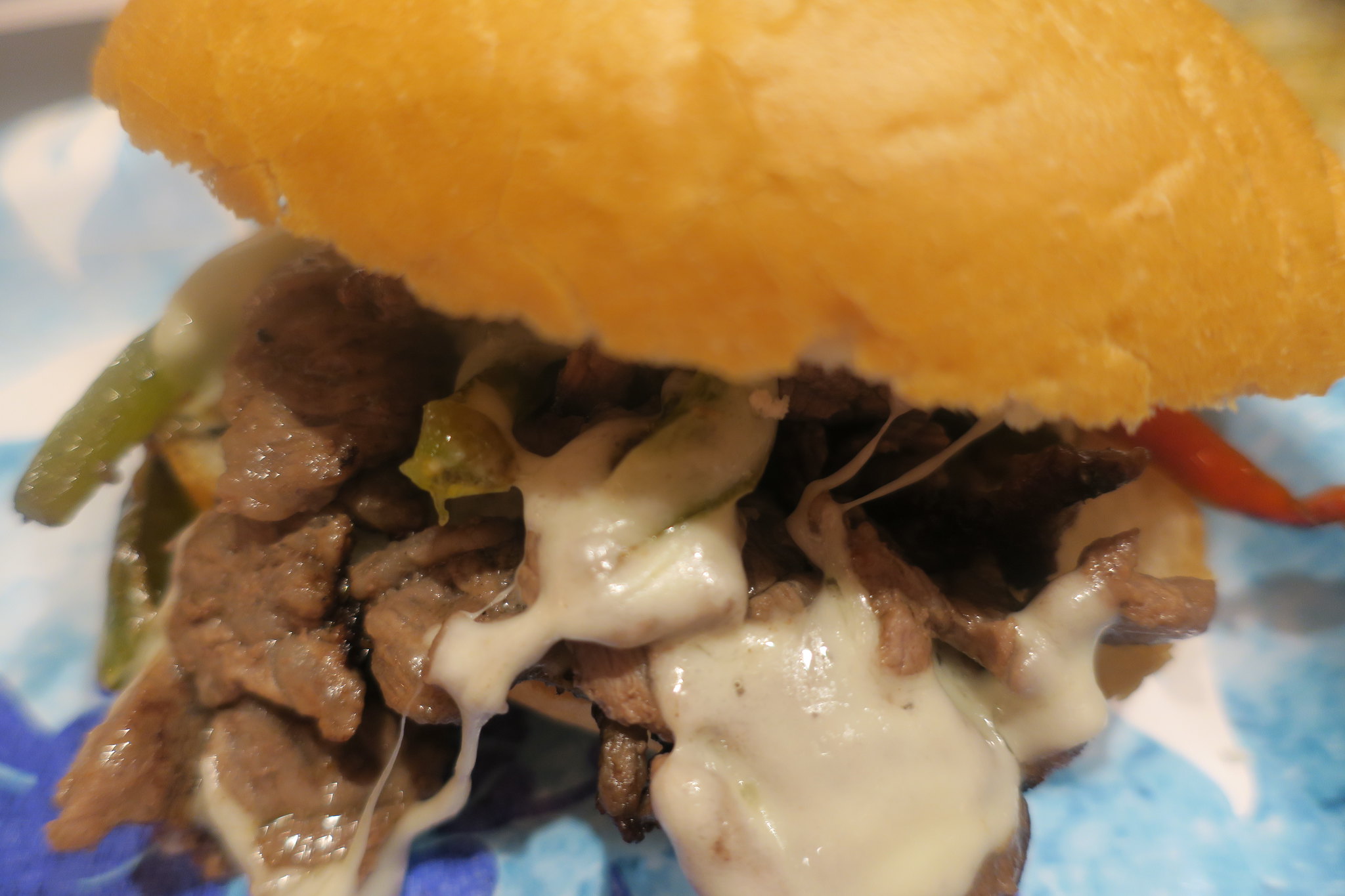
May your day be filled with that which gives you sustenance, strength, satisfaction, and sanctity.
Love,
TulaneLSU
When Marcus Garvey established the Universal Negro Improvement Association a century ago, he understood the need for symbols. Symbols are powerful and help individuals and groups with their identity. He admired Ethiopia, for it had, at that time, never fallen under European hegemony, one of the few places in Africa with that claim. So he borrowed the colors of the Ethiopian flag -- red, green and yellow -- for the movement’s colors. And today, these three beautiful colors together are seen as a sign of African pride and solidarity.
Within a decade of New Orleans’ founding, the French were importing Africans as chattel slaves. New Orleans’ history of black residents is much more than that of slavery, of course. The city had many free blacks throughout its history, owing, at least, in part to the less rigid racial system of the French, which tolerated clandestine interracial relationships, which produced interracial children. This in turn birthed the American Civil Rights Movement. New Orleans’ history of fighting for justice is unparalleled by any other American city. A.P. Tureaud, Homer Plessy, and many other New Orleanians who rose up against tyranny remind us that the movement was far more than Martin Luther King.
Perhaps New Orleans’ most famous worldwide export, jazz, is also a product of the black influence in New Orleans. Truthfully, I really do not enjoy jazz except for a few Mardi Gras pieces. We would be here for the next few days if I listed all the beautiful contributions black people have made to our great city. Here are my green, yellow, and red sweet peppers to remind us of the black influence in the city.
I chopped my NY strip steaks into fine pieces beforehand, as I do not have a flat griddle, which would be perfect for this sort of cooking. I did not want to injure my knife or pan by cutting in the pan.
[/url] For NOLA Metro cheesesteaks, I grill to a well done temperature. I’m not sure why; it’s just what I’ve always done. I cook all parts separate, just as all the constituent cultures of New Orleans arrived. But in the flat pan of New Orleans, all are blended together to bring a beautiful, unified whole.
My friends, I present to you, the product 300 years of cultures interlaced and braided together, the NOLA Metro Cheesesteak Poorboy:
May your day be filled with that which gives you sustenance, strength, satisfaction, and sanctity.
Love,
TulaneLSU
This post was edited on 1/4/20 at 10:39 am

Posted on 1/4/20 at 10:39 am to TulaneLSU
Is that a George Foreman grill? 

Posted on 1/4/20 at 10:43 am to TulaneLSU
quote:
Love,
TulaneLSU

Posted on 1/4/20 at 10:43 am to KosmoCramer
It's All-Clad stainless steel from Williams Sonoma.

Posted on 1/4/20 at 10:49 am to TulaneLSU
quote:
from Williams Sonoma.
I thought you were poor?


Posted on 1/4/20 at 10:56 am to TulaneLSU
Not your finest work
Posted on 1/4/20 at 11:09 am to TulaneLSU
quote:
the NOLA Metro Cheesesteak Poorboy


Posted on 1/4/20 at 11:10 am to TulaneLSU
quote:
buttocksinclarse.



Posted on 1/4/20 at 11:23 am to TulaneLSU
You are a treasure.


Posted on 1/4/20 at 11:28 am to Caplewood
quote:
Not your finest work
Usually what happens when you’re dumb schtick has jumped the shark and the material that was meant to be funny isn’t.
Posted on 1/4/20 at 11:39 am to Paul Allen
Could have been the Top 5 cheesesteaks in the city.
Posted on 1/4/20 at 11:42 am to Paul Allen
quote:
Usually what happens when you’re dumb schtick has jumped the shark and the material that was meant to be funny isn’t.
The schtick has never been funny to begin. I'd love to meet the idiot that actually reads all his threads.
Posted on 1/4/20 at 11:50 am to Paul Allen
Tom, don’t you have a lousy show to prepare for?
Posted on 1/4/20 at 12:02 pm to OldHickory
Call right now, you’ll get right in.
Posted on 1/4/20 at 12:56 pm to TulaneLSU
Unbelievable.
IWEI
IWEI


Posted on 1/4/20 at 1:30 pm to TulaneLSU
Looks like you shite between a roll.


Posted on 1/4/20 at 1:36 pm to TulaneLSU
quote:
One of our family’s friends, Wolfgang Puck
Posted on 1/4/20 at 1:47 pm to Cosmo
You are an atrocious attention whore
You used SRF waygu on some shite homemade pepper laden “cheesesteak”?
I hope you get hit by an oversized load truck
You used SRF waygu on some shite homemade pepper laden “cheesesteak”?
I hope you get hit by an oversized load truck
Posted on 1/4/20 at 1:47 pm to TulaneLSU
Downvote does using non-stick. Cmon...

 Page 1 of 2

Popular
Back to top
 Follow TigerDroppings for LSU Football News