




- My Forums
- Tiger Rant
- LSU Recruiting
- SEC Rant
- Saints Talk
- Pelicans Talk
- More Sports Board
- Fantasy Sports
- Golf Board
- Soccer Board
- O-T Lounge
- Tech Board
- Home/Garden Board
- Outdoor Board
- Health/Fitness Board
- Movie/TV Board
- Book Board
- Music Board
- Political Talk
- Money Talk
- Fark Board
- Gaming Board
- Travel Board
- Food/Drink Board
- Ticket Exchange
- TD Help Board
Customize My Forums- View All Forums
- Show Left Links
- Topic Sort Options
- Trending Topics
- Recent Topics
- Active Topics
Started By
Message
re: A podcast for those interested in the etymology of the English language and History
Posted on 7/17/19 at 10:37 pm to fr33manator


Posted on 7/17/19 at 10:37 pm to fr33manator
fricking hell, there’s over 150 hours of that shite already 
 2
2


Posted on 7/17/19 at 10:43 pm to soccerfüt
what bump? I only started it an hour ago. We speak these words but few comprehend the journey they have taken. Their roots. Latin, Norse, Germanic, French...
They’ve been truncated and transformed and twisted.
You know the Monty Python bit about Kuh-nig-its?
That was closer to the original pronunciation than our current knight.
And in the Norman period they were called chevaliers, from the French cheval for horse.
Posted on 7/17/19 at 10:44 pm to Joshjrn
quote:
fricking hell, there’s over 150 hours of that shite already
And worth every minute. I listen to it while in my truck and to go to sleep
Posted on 7/17/19 at 10:46 pm to fr33manator
My commute is only about 15 minutes, so I imagine that would be too choppy. I have a flight in a couple of weeks, so I’ll give it a go then.
Posted on 7/17/19 at 10:50 pm to Joshjrn
I’ve listened to a dozen episodes multiple times. It’s amazing what you pick up in bits and pieces.
For example... you know steak tartare?
The mongols invaded and reached Europe in the...1400s if I recall my Carlin. They would take cuts of meat and place them under their saddles while they rode, and the up and down motion and pressure would pulverize these cuts into almost a paste.
Europeans called the mongols Tartars...and so this method of pulverized meat with spices became... Steak tartare
Just stuff like this really tickles my pickle
For example... you know steak tartare?
The mongols invaded and reached Europe in the...1400s if I recall my Carlin. They would take cuts of meat and place them under their saddles while they rode, and the up and down motion and pressure would pulverize these cuts into almost a paste.
Europeans called the mongols Tartars...and so this method of pulverized meat with spices became... Steak tartare
Just stuff like this really tickles my pickle
Posted on 7/17/19 at 10:52 pm to fr33manator
quote:
150 hours
Listening to the intro now. There goes the next two+ weeks of productivity.
Posted on 7/17/19 at 11:21 pm to DoctorTechnical
Listening just now, I learned where the tradition of smashing a bottle on the bow of a new ship came from.
Originally, Vikings would strap a slave or prisoner to the keel of a new ship as sacrifice to the gods as it set out, for good fortune.
The keel would crush the sacrifice as it plunged into the sea and stain the keel with their blood. Over time, red wine was poured onto the keel as a substitute, and eventually the tradition was replaced with simply a bottle being smashed against the hull.
Fascinating
Originally, Vikings would strap a slave or prisoner to the keel of a new ship as sacrifice to the gods as it set out, for good fortune.
The keel would crush the sacrifice as it plunged into the sea and stain the keel with their blood. Over time, red wine was poured onto the keel as a substitute, and eventually the tradition was replaced with simply a bottle being smashed against the hull.
Fascinating

Posted on 7/17/19 at 11:24 pm to Dandy Lion
Indo-European (IE) is the root language of almost all European languages as well as Sanskrit, Iranian, and some other lesser known languages. Some of the languages spoken in modern India are IE.
The original root language was spoken by the proto Indo-Europeans who lived in southwest Russia about 6,000 years ago. 19th century scholars called these people "Aryans" which fell out of favor after WWII (for obvious reasons).
The IE or "Aryan" grave sites have been excavated and their DNA sequenced. They were tall, robust, dark haired and dark eyed. They were not blonde as most people assumed they would be. (It seems blonde hair is native to "Old Europe" before the "Aryan" invasions).
In any case, this group invaded Europe starting in the late neolithic and ushered in the bronze age (circa 4,000 B.C.) The Indo-Europeans pretty much wiped out the native European males but kept the females alive for "marriage." (We know this because native Euro male lineages all but died out). They introduced the horse and chariot and certain forms of bronze weaponry. They subsisted off of pastoralism (cattle herds and the like) while the native Europeans were farmers. They brought milk to Europe and the lactose tolerance gene with them.
We know that they later left Europe and went back East onto the Steppe lands and south into west Asia. They dominated Kazakhstan for centuries. Some made it all the way to the Chinese desert.
Around 1500 B.C. a group of these people went south into India and took over the crumbling empire down there. The Sanskrit language was brought with them and the Rig Vedas were written by them.
It was in the 1600's when British colonial scholars in India began noticing that Sanskrit had a ton of similarities with ancient Greek and Latin. They studied it further and came to the conclusion that all European languages were derived from Sanskrit (this is false - Sanskrit is a branch, but not a direct ancestor).
There are two branches of IE languages: Centum and Satem. Most of the western European languages are centum while the easterly languages are satem.
English itself is a Germanic language. Germanic is believed to have developed during the Nordic bronze age in Scandinavia (1700-500 BC). But ultimately it was derived from Indo-European just as were all languages (except Hungarian, Basque and Finnish).
Galiec/Celtic languages are also IE and related closely with the Italic languages (linguists call it "Italo-Celtic"). Great Britain was utterly ravished by the IE peoples as they made it into western Europe. They replaced about 90% of the gene pool of the Isles in 400 years. That means a lot of killing (and probably disease spreading) went on. Since both males and females seem to have been wiped out equally, there is a good chance disease was responsible (the plague is a possibility). If it were genocide, most likely they would have kept some of the women around as "wives" as they did in central Europe.
How do we know this about Britian? Because modern British males are about 80% R1b, but this lineage is not found in any male's bones that predate the IE (Bell Beaker) invasions. This means the R1b males dominated either through genocide or disease.
Anyway, this is a fascinating rabbit hole.
The original root language was spoken by the proto Indo-Europeans who lived in southwest Russia about 6,000 years ago. 19th century scholars called these people "Aryans" which fell out of favor after WWII (for obvious reasons).
The IE or "Aryan" grave sites have been excavated and their DNA sequenced. They were tall, robust, dark haired and dark eyed. They were not blonde as most people assumed they would be. (It seems blonde hair is native to "Old Europe" before the "Aryan" invasions).
In any case, this group invaded Europe starting in the late neolithic and ushered in the bronze age (circa 4,000 B.C.) The Indo-Europeans pretty much wiped out the native European males but kept the females alive for "marriage." (We know this because native Euro male lineages all but died out). They introduced the horse and chariot and certain forms of bronze weaponry. They subsisted off of pastoralism (cattle herds and the like) while the native Europeans were farmers. They brought milk to Europe and the lactose tolerance gene with them.
We know that they later left Europe and went back East onto the Steppe lands and south into west Asia. They dominated Kazakhstan for centuries. Some made it all the way to the Chinese desert.
Around 1500 B.C. a group of these people went south into India and took over the crumbling empire down there. The Sanskrit language was brought with them and the Rig Vedas were written by them.
It was in the 1600's when British colonial scholars in India began noticing that Sanskrit had a ton of similarities with ancient Greek and Latin. They studied it further and came to the conclusion that all European languages were derived from Sanskrit (this is false - Sanskrit is a branch, but not a direct ancestor).
There are two branches of IE languages: Centum and Satem. Most of the western European languages are centum while the easterly languages are satem.
English itself is a Germanic language. Germanic is believed to have developed during the Nordic bronze age in Scandinavia (1700-500 BC). But ultimately it was derived from Indo-European just as were all languages (except Hungarian, Basque and Finnish).
Galiec/Celtic languages are also IE and related closely with the Italic languages (linguists call it "Italo-Celtic"). Great Britain was utterly ravished by the IE peoples as they made it into western Europe. They replaced about 90% of the gene pool of the Isles in 400 years. That means a lot of killing (and probably disease spreading) went on. Since both males and females seem to have been wiped out equally, there is a good chance disease was responsible (the plague is a possibility). If it were genocide, most likely they would have kept some of the women around as "wives" as they did in central Europe.
How do we know this about Britian? Because modern British males are about 80% R1b, but this lineage is not found in any male's bones that predate the IE (Bell Beaker) invasions. This means the R1b males dominated either through genocide or disease.
Anyway, this is a fascinating rabbit hole.

Posted on 7/17/19 at 11:55 pm to AUstar
That doesn’t surprise me. I’m not tied to the blonde haired, blue eyed Aryan myth. Conquerors have risen out the steppes from Time immemorial. Tartars, huns, mongols. Slavic mythology is steeped with them.
They did what conquering tribes always did. Raped and slaughtered and pillaged. And left their genes and traces of their language behind. And in time this gave rise to the Germanic and Nordic barbarians. Who did the same.
It’s fascinating stuff. We stand on the shoulders and speak the language of rapers and reavers. I look at it all with the long eye of Odin. The modern mores matter not to me. Our tale is one of blood and devestation, plague and plunder.
And our language reflects that. I would expect No different.
They did what conquering tribes always did. Raped and slaughtered and pillaged. And left their genes and traces of their language behind. And in time this gave rise to the Germanic and Nordic barbarians. Who did the same.
It’s fascinating stuff. We stand on the shoulders and speak the language of rapers and reavers. I look at it all with the long eye of Odin. The modern mores matter not to me. Our tale is one of blood and devestation, plague and plunder.
And our language reflects that. I would expect No different.
Posted on 7/18/19 at 8:40 am to Joshjrn
I just learned this morning that the word quoth
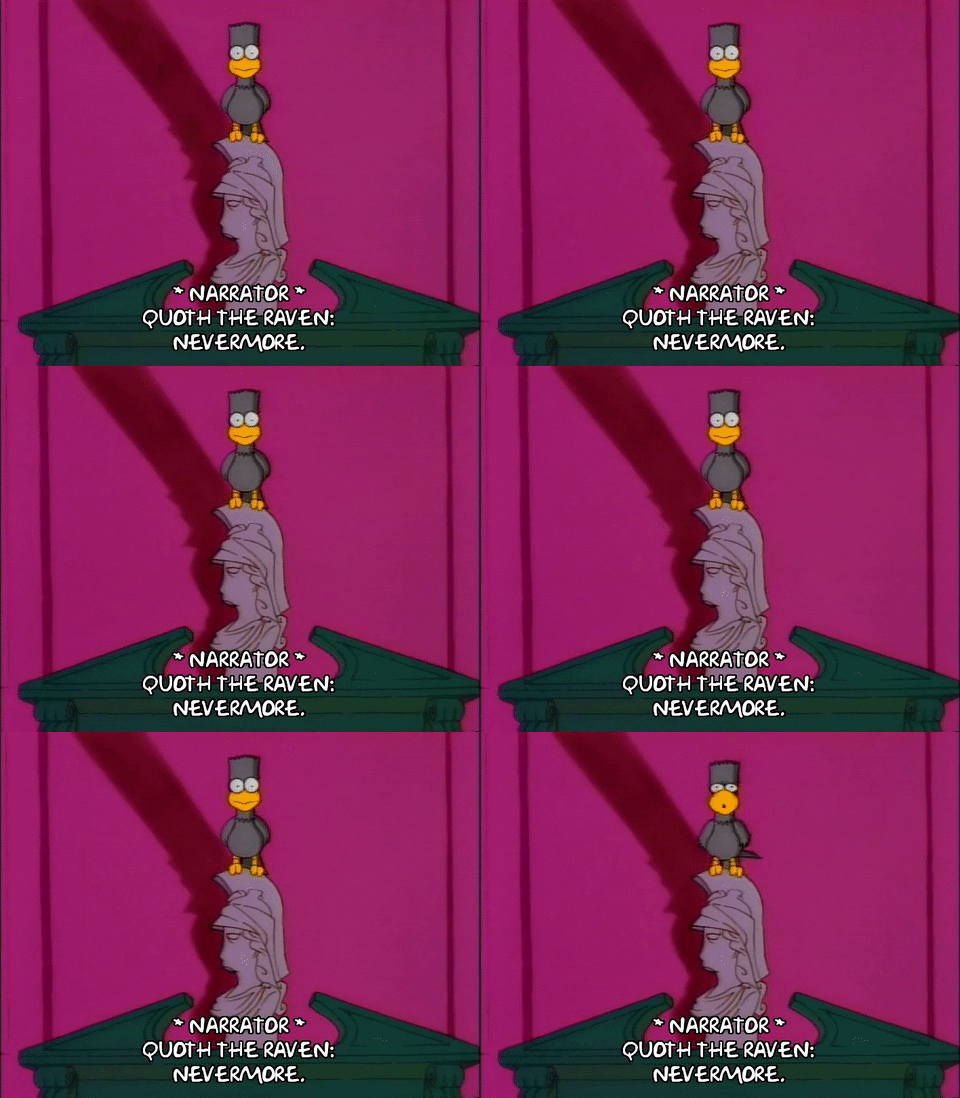
And the word quote have completely different roots and didn’t even have similar meaning until recently.
Quote comes from the Latin Quota. Quoth is from Norse.
Never would have thought that
And the word quote have completely different roots and didn’t even have similar meaning until recently.
Quote comes from the Latin Quota. Quoth is from Norse.
Never would have thought that
Posted on 7/18/19 at 1:36 pm to Dandy Lion
quote:
Dandy Lion
quote:Which is normal.
I was just being a dick.


Posted on 7/18/19 at 1:48 pm to fr33manator
I just started the first episode today thanks to this thread. I never enjoyed English class growing up, but this is very interesting.
Posted on 8/26/19 at 2:22 pm to DestrehanTiger
Great new episode on the Canterbury tales out now.
Very interesting
Very interesting
Posted on 8/26/19 at 5:54 pm to fr33manator
I have barely been able to listen to three episodes, yet. It's great, though
Posted on 10/10/19 at 11:13 pm to RedPop4
THere’s an awesome new one on the history of vulgar Language. Very interesting

Posted on 10/11/19 at 6:45 am to fr33manator
Thank you for the bump, you muthafricking goddam a-hole cocklick.
Apropos now?
Apropos now?
This post was edited on 10/11/19 at 6:46 am
Posted on 10/11/19 at 7:01 am to fr33manator
You got me thinking. I got a degree in English in 1991 and the ONLY course I can remember enjoying is Milton. It was taught by a very short lady whose name I cannot recall, sadly. She was fantastic! Does anyone remember her?

 Page 2 of 2


Popular
Back to top
 Follow TigerDroppings for LSU Football News