




- My Forums
- Tiger Rant
- LSU Recruiting
- SEC Rant
- Saints Talk
- Pelicans Talk
- More Sports Board
- Fantasy Sports
- Golf Board
- Soccer Board
- O-T Lounge
- Tech Board
- Home/Garden Board
- Outdoor Board
- Health/Fitness Board
- Movie/TV Board
- Book Board
- Music Board
- Political Talk
- Money Talk
- Fark Board
- Gaming Board
- Travel Board
- Food/Drink Board
- Ticket Exchange
- TD Help Board
Customize My Forums- View All Forums
- Show Left Links
- Topic Sort Options
- Trending Topics
- Recent Topics
- Active Topics
Started By
Message
Houston area breweries announce merger in 'new normal' of craft beer
Posted on 7/16/24 at 8:21 am

Posted on 7/16/24 at 8:21 am
quote:
The last calendar year has seen various changes within the Houston area beer community. Popular breweries such as Buffalo Bayou and Humble's Ingenious closed, as did Urban South's area brewhouse and taproom and newbies Black Page and CounterCommon. Brands with big ambitions made their move, too. In short, there's a sense that the industry is shrinking, or at least consolidating, possibly into something leaner.
More proof of that was revealed Friday when three Houston area breweries announced a merger. 11 Below Brewing Company, in northwest Houston by the Willowbrook Mall; B-52 Brewing in Conroe; and Fortress BeerWorks in Spring will join together their operations with changes taking place in the near future.
"We'll spare you the corporate-speak BS that mergers usually come with, but we're pretty stoked about what we'll be able to do together in this new normal of the craft beer industry here in Houston," read the announcement shared on the social media platforms of all three breweries Friday.
11 Below's announcement mentioned that the brewery would be "merging operations" with B-52 and Fortress, while both B-52 and Fortress only mentioned 11 Below in their announcements. This suggests that 11 Below will be absorbing B-52 and Fortress, though this has not yet been confirmed. Chron has reached out to 11 Below for more details.
Of the three, 11 Below has the most brand recognition in the Houston area, distributing their canned products in H-E-B and other retailers. The brewery is best known for core beers such as 7 Iron, Hipster Sauce and Oso Bueno, plus limited-release favorite Negative Space, an imperial chocolate milk stout.
B-52, which brothers Brent and Chad Daniel opened in 2014, was a darling of the Houston area beer scene years ago, pumping out limited-release beers that brought devoted fans to its sprawling Conroe brewery. Chad died in 2018 in a motorcycle accident, and Brent put B-52 on the market in 2022. Fortress, which opened in 2019 with four friends at the helm, purchased B-52 in November of that year. Fortress serves a variety of beer at its inviting taproom, even pouring some B-52 favorites since buying them out.
In the announcement, the breweries promise that customers will be able to find beer from all three producers at each other's taprooms. It's uncertain exactly what the merger will entail, but recent Houston area brewing consolidation measures may serve as an example. In 2022, the East End's Equal Parts Brewing bought longtime favorite Brash Brewing; since, Brash has maintained its brand and taproom location. Last year, Elder Son in the Heights took over Southern Yankee's brewery and taproom on FM1960; in the deal, Elder Son took on Southern Yankee's recipes and promised to make beer for Southern Yankee's restaurant and tap in Montrose.
LINK
 3
3


Posted on 7/16/24 at 8:42 am to ragincajun03
I've never understood how they all make it
so many breweries and distilleries all fighting for same market
I remember when Abita was the only one of it's kind
breweries are like sushi places these days, on several corners and in strip malls
so many breweries and distilleries all fighting for same market
I remember when Abita was the only one of it's kind
breweries are like sushi places these days, on several corners and in strip malls
Posted on 7/16/24 at 8:43 am to ragincajun03
quote:
We'll spare you the corporate-speak BS that mergers usually come with, but we're pretty stoked
This is gold.
I wonder if this is how they report to the SEC? Haha!


Posted on 7/16/24 at 8:50 am to nicholastiger
Craft beer is so 2014

Posted on 7/16/24 at 9:12 am to ragincajun03
the craft beer bubble popped a few years ago
this was inevitable
this was inevitable


Posted on 7/16/24 at 9:13 am to nicholastiger
quote:
breweries are like sushi places these days, on several corners and in strip malls
and very few are worth the trouble


Posted on 7/16/24 at 10:24 am to nicholastiger
quote:
I've never understood how they all make it
so many breweries and distilleries all fighting for same market
They aren't anymore. Breweries reached a peak saturation point pre-covid. It was starting to scale back to a healthy equilibrium then covid came and killed many breweries. While many that opened just to take advantage of the peak market probably needed to go, covid coupled with inflation started killing the rest. Then, to top it off, America's drinking habits changed. Young people aren't drinking as much anymore, and if they are drinking, it's a low calorie seltzer.
So you have 4 factors at play:
1) An oversaturated market destined to retract to a healthy level.
2) Covid policies that directly attacked breweries and other small businesses.
3) Inflation which is killing small businesses trying to survive through covid.
4) And millennials not drinking beer anymore.
Posted on 7/16/24 at 11:27 am to BugAC
quote:
And millennials not drinking beer anymore
Any information or link on this? Not saying you’re wrong, but would like to see some data on this.


Posted on 7/16/24 at 12:01 pm to BugAC
quote:
Then, to top it off, America's drinking habits changed. Young people aren't drinking as much anymore, and if they are drinking, it's a low calorie seltzer.
Athletic Brewing Company (NA beer) just recently got a $800M valuation and huge $50M equity investment - so it's seltzers, craft cocktails, and fake beer that is hurting the scene.
Posted on 7/16/24 at 12:24 pm to Billy Mays
Podcasts I listen to are running NA beer ads nonstop for the last 2-3 months. It's not a product I've dipped into, but it's growing substantially based on advertising spend.
And mocktail menus are getting to be nearly as big as cocktail menus
And mocktail menus are getting to be nearly as big as cocktail menus
This post was edited on 7/16/24 at 1:51 pm
Posted on 7/16/24 at 12:28 pm to Paul Allen
quote:
Any information or link on this? Not saying you’re wrong, but would like to see some data on this.
Nothing off hand. I'm sure if i searched i could find it. Most of it comes from talking with brewers, listening to podcasts, reading articles online and in magazines about the industry.
The beervana podcast has a lot of information about the economics of beer. I'm sure some of it is on his website too.
LINK
Lots of links to industry talks. You can peruse quite a few that paint the picture. Is there any one topic you are curious about? I can see if i can find an article for you on it. The one below is a recent one.
LINK
quote:
We’ve seen this in every sector of the beer industry: mature businesses or the people that run them have spent years or decades riding waves of good and bad times and they’ve decided it’s time to “move on.” Michael Kiser didn’t quite use that language, but Bob Pease did, as have many who have been making similar announcements these days.
These are big announcements. The beer industry is in a moment of transition, and when important institutions like Good Beer Hunting and the Brewers Association make big changes, that transition hastens.
quote:
At the time, the craft segment was 11% of beer overall (up sharply from 7.8% a year earlier), with a decade of sustained growth. But despite the growing visibility of craft beer, the past decade was notably slim on growth. Today, the craft segment is just 13%, well below the goal, and flat or declining. Barrelage has increased, from 15.6 million in 2014 to 23.4 million last year, and any industry would be happy to notch 50% growth over a decade.
Yet most of that growth happened in the first five years and has actually declined by 3 million barrels since 2019. Last month, I posted the graph above, which illustrates the problem. These difficulties are hardly unique to the US and reflect global trends in the drinks industry: declining consumption, fragmentation across alcohol categories, the rise of imports in the US, among others. And then there was Covid. The Brewers Association was swept along, and it’s hard to see how Pease or anyone at the BA could have helped quiet the turbulence.
quote:
During these past ten years, the definition of what constituted a “craft brewery” has become so blurred and confusing no one really seems to know anymore—and smaller breweries have felt increasingly marginalized in an organization that includes Monster, Tilray, and even Boston Beer.
Another good link
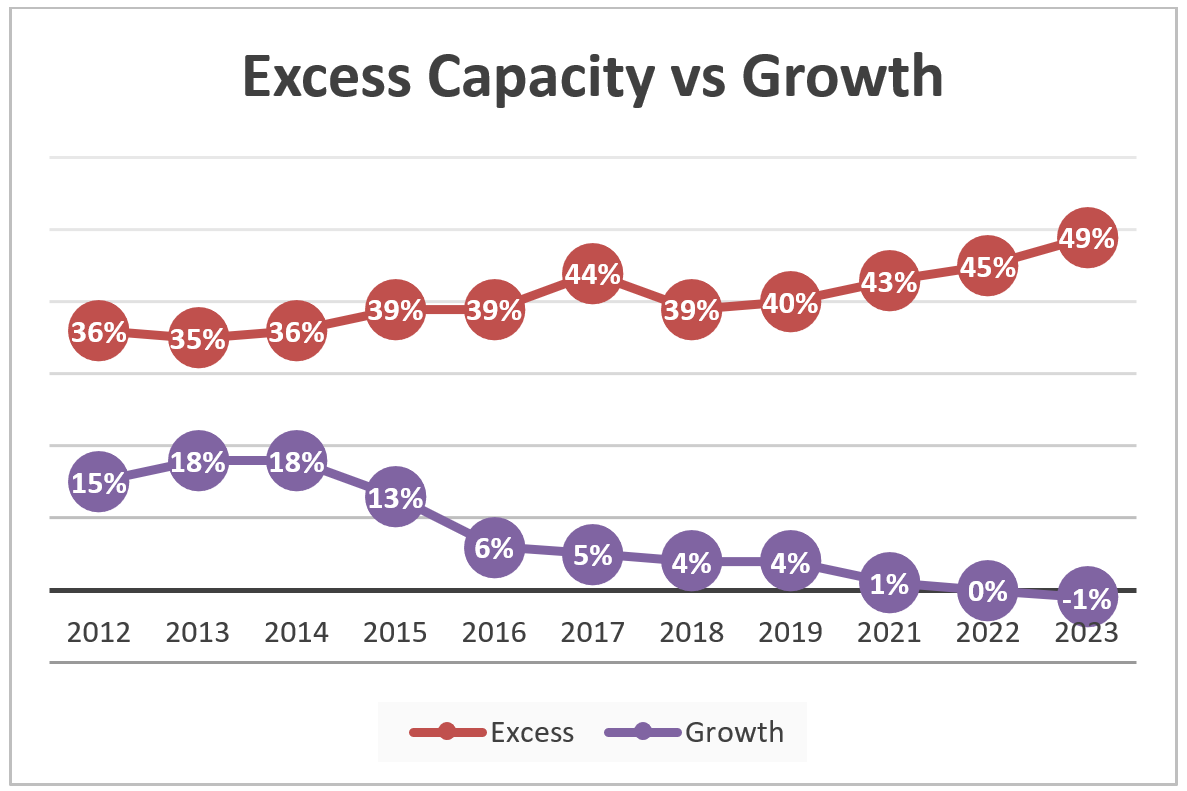
Excess Capacity
quote:
A while back, I saw a statistic in an article I’ve now lost track of. It mentioned how much excess capacity exists in the beer industry. That is, the amount of beer that could be brewed given the time and space within breweries, but isn’t: the days the mash tun is idle, the number of tanks sitting empty. Excess capacity is bad. Brewing is a capital-intensive industry with narrow margins. Breweries do not want to buy, or worse, finance expensive equipment that just sits around. They don’t want to pay leases on space they’re not using. They don’t want to pay staff who have no beer to make.
quote:
American breweries are currently at about half their capacity. That’s not good! But it’s actually worse that in looks because growth has been dead flat for three years. Were the industry growing, it would need headspace, so to speak, for future expansion. Here’s Bart:
“When you’re growing rapidly, excess capacity is a good thing so you can keep up with that growth. Athletic has a lot of excess capacity right now with the purchase of that former Ballast Point facility, but no one thinks that’s an issue. So the ratio in the mid-2010s was different because brewers were rapidly growing into it. As I pointed out in 2015, the 2012 and 2014 ratios look the same, but 2014 production was actually bigger than 2012 total capacity.
“So you need to understand the capacity number in the context of its time. If we were growing 18% again right now, even 51% might not be that bad (at 18% you’d use up all that excess capacity in 4 years), but at static or negative growth, it’s a lot worse, because it represents investments that aren’t being utilized.”
This post was edited on 7/16/24 at 12:39 pm


Posted on 7/16/24 at 3:49 pm to GrammarKnotsi
I don't know about ya'll but I still like and welcome breweries. Of course with the saturation, the poorly-developed ones tend to die off, but a good brewery is the US equivalent of a community pub.
They're easy gathering places for neighbors and families, and the decent ones here that offer communal spaces do very well. I think it's threading the needle to gain market share and make a fortune or broadly expand, but I imagine good ones with good leadership still have plenty of potential as lifestyle businesses.
They're easy gathering places for neighbors and families, and the decent ones here that offer communal spaces do very well. I think it's threading the needle to gain market share and make a fortune or broadly expand, but I imagine good ones with good leadership still have plenty of potential as lifestyle businesses.

Posted on 7/16/24 at 4:16 pm to Pettifogger
The successful breweries in Houston tend to have embraced being neighborhood bars - trivia, bingo, run clubs, comedy shows, etc. Suburban no frills breweries in warehouses aren’t going to make it these days.
This post was edited on 7/16/24 at 4:17 pm

 Page 1 of 1


Popular
Back to top
 Follow TigerDroppings for LSU Football News