




- My Forums
- Tiger Rant
- LSU Recruiting
- SEC Rant
- Saints Talk
- Pelicans Talk
- More Sports Board
- Fantasy Sports
- Golf Board
- Soccer Board
- O-T Lounge
- Tech Board
- Home/Garden Board
- Outdoor Board
- Health/Fitness Board
- Movie/TV Board
- Book Board
- Music Board
- Political Talk
- Money Talk
- Fark Board
- Gaming Board
- Travel Board
- Food/Drink Board
- Ticket Exchange
- TD Help Board
Customize My Forums- View All Forums
- Show Left Links
- Topic Sort Options
- Trending Topics
- Recent Topics
- Active Topics
Started By
Message

The Two Envelopes Problem (A Monty Hall Problem Variant)
Posted on 5/12/21 at 5:53 pm
Posted on 5/12/21 at 5:53 pm
Wikipedia
quote:
The problem typically is introduced by formulating a hypothetical challenge of the following type:
You are given two indistinguishable envelopes, each containing money. One contains twice as much as the other. You may pick one envelope and keep the money it contains. Having chosen an envelope at will, but before inspecting it, you are given the chance to switch envelopes. Should you switch?
It seems obvious that there is no point in switching envelopes as the situation is symmetric. However, because you stand to gain twice as much money if you switch while risking only a loss of half of what you currently have, it is possible to argue that it is more beneficial to switch
 13
13


Posted on 5/12/21 at 5:54 pm to UndercoverBryologist
it depends

Posted on 5/12/21 at 5:55 pm to UndercoverBryologist
You should've started with a question the OT is intellectually capable of answering.
"Which block is blue?" is a good one.
"Which block is blue?" is a good one.
This post was edited on 5/12/21 at 5:56 pm

Posted on 5/12/21 at 5:55 pm to UndercoverBryologist
I’ll take both.
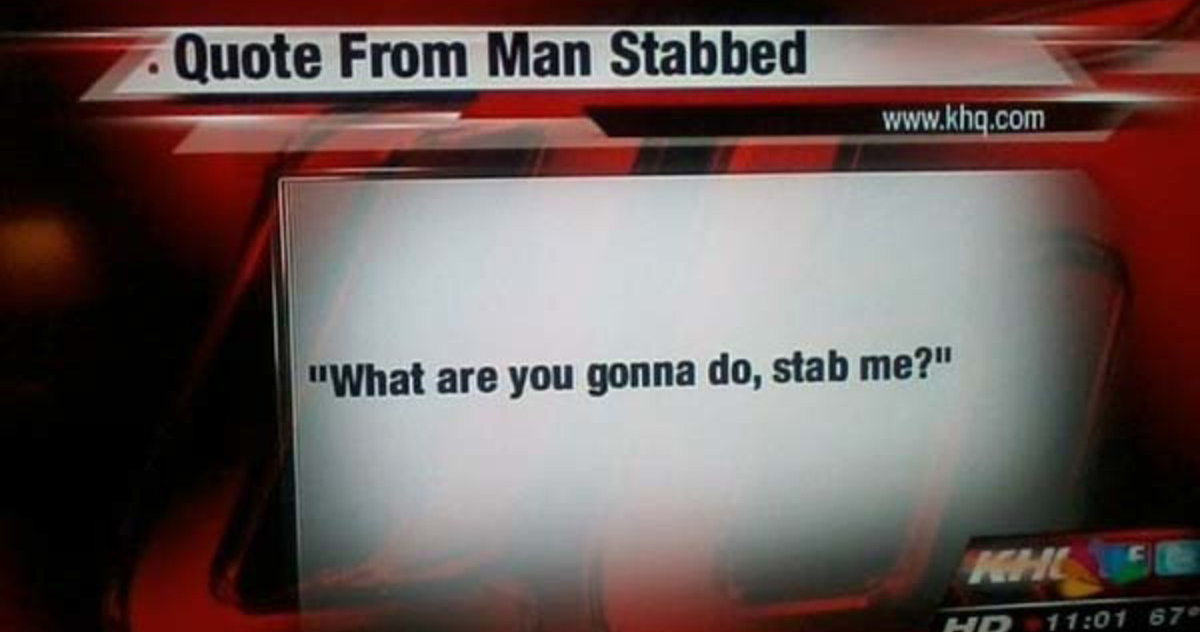
What are they gonna do, stab me?
What are they gonna do, stab me?

Posted on 5/12/21 at 5:56 pm to UndercoverBryologist
Doesn't seem to really work with 2. You aren't altering percentages.
You are risking the same dollar amount of money in either case.
Also - fromWikipedia:
You are risking the same dollar amount of money in either case.
Also - fromWikipedia:
quote:
The puzzle: The puzzle is to find the flaw in the very compelling line of reasoning above. This includes determining exactly why and under what conditions that step is not correct, in order to be sure not to make this mistake in a more complicated situation where the misstep may not be so obvious. In short, the problem is to solve the paradox. Thus, in particular, the puzzle is not solved by the very simple task of finding another way to calculate the probabilities that does not lead to a contradiction.


Posted on 5/12/21 at 5:56 pm to fr33manator
quote:
What are they gonna do, stab me?
Posted on 5/12/21 at 5:57 pm to UndercoverBryologist
It depends on how much is in the envelope I open. If it is $100? I'd probably open the second envelope. If that one has only $50, the loss of $50 won't affect my life that much. If the first envelope I open has $2MM, then I will probably stand down.
Posted on 5/12/21 at 5:57 pm to UndercoverBryologist
quote:
However, because you stand to gain twice as much money if you switch while risking only a loss of half of what you currently have, it is possible to argue that it is more beneficial to switch
Why doesn't this apply again, causing you to switch back to the original envelope?
Posted on 5/12/21 at 5:57 pm to OldmanBeasley


Posted on 5/12/21 at 5:57 pm to UndercoverBryologist
quote:
However, because you stand to gain twice as much money if you switch while risking only a loss of half of what you currently have, it is possible to argue that it is more beneficial to switch
What a retarded premise. It's 50/50 either way, you can pick once or switch. Odds don't change.

Posted on 5/12/21 at 5:58 pm to Displaced
OP didn't quote it correctly at all fwiw. The conclusion that switching is always beneficial would lead to a person constantly switching their envelope back and forth - indicating a paradox.
Following quote is the actual problem from the link.
Following quote is the actual problem from the link.
quote:
Problem
Basic setup: You are given two indistinguishable envelopes, each of which contains a positive sum of money. One envelope contains twice as much as the other. You may pick one envelope and keep whatever amount it contains. You pick one envelope at random but before you open it you are given the chance to take the other envelope instead.
The switching argument: Now suppose you reason as follows:
I denote by A the amount in my selected envelope.
The probability that A is the smaller amount is 1/2, and that it is the larger amount is also 1/2.
The other envelope may contain either 2A or A/2.
If A is the smaller amount, then the other envelope contains 2A.
If A is the larger amount, then the other envelope contains A/2.
Thus the other envelope contains 2A with probability 1/2 and A/2 with probability 1/2.
So the expected value of the money in the other envelope is:
(1/2)(2A)+(1/2)(A/2) = (5/4)A
This is greater than A so, on average, I gain by swapping.
After the switch, I can denote that content by B and reason in exactly the same manner as above.
I will conclude that the most rational thing to do is to swap back again.
To be rational, I will thus end up swapping envelopes indefinitely.
As it seems more rational to open just any envelope than to swap indefinitely, we have a contradiction.
The puzzle: The puzzle is to find the flaw in the very compelling line of reasoning above. This includes determining exactly why and under what conditions that step is not correct, in order to be sure not to make this mistake in a more complicated situation where the misstep may not be so obvious. In short, the problem is to solve the paradox. Thus, in particular, the puzzle is not solved by the very simple task of finding another way to calculate the probabilities that does not lead to a contradiction.
This post was edited on 5/12/21 at 6:01 pm


Posted on 5/12/21 at 5:58 pm to UndercoverBryologist
This is just dumb and trying to sound smart
Yeah, or...I could lose twice as much
Yeah if you just want to pretend to be smart.
Both envelopes have money, one has more money. Pick which you want.
-i want envelope 1!
You sure? You can change your mind if you want.
-ok fine I'll take 2!
Great choice you're a math genius
Thats silly
quote:
because you stand to gain twice as much money if you switch
Yeah, or...I could lose twice as much
quote:
is possible to argue that it is more beneficial to switch
Yeah if you just want to pretend to be smart.
Both envelopes have money, one has more money. Pick which you want.
-i want envelope 1!
You sure? You can change your mind if you want.
-ok fine I'll take 2!
Great choice you're a math genius
Thats silly
Posted on 5/12/21 at 6:00 pm to Sneaky__Sally
quote:
OP didn't quote it correctly at all fwiw:
Well, I quoted the opening paragraph to the Wikipedia article just to tease the premise, in the hopes that people would enjoy figuring it out for themselves.


Posted on 5/12/21 at 6:01 pm to UndercoverBryologist
Posted on 5/12/21 at 6:01 pm to UndercoverBryologist
But you didn't quote the actual problem proposed - which is to find the flaw in their expected value reasoning.
Posted on 5/12/21 at 6:03 pm to Sneaky__Sally
quote:
The probability that A is the smaller amount is 1/2, and that it is the larger amount is also 1/2.
The other envelope may contain either 2A or A/2.
If A is the smaller amount, then the other envelope contains 2A.
If A is the larger amount, then the other envelope contains A/2.
Thus the other envelope contains 2A with probability 1/2 and A/2 with probability 1/2.
So it's 50/50 either way, got it.
quote:
So the expected value of the money in the other envelope is:
(1/2)(2A)+(1/2)(A/2) = (5/4)A
This is greater than A so, on average, I gain by swapping.

What? It's literally a 50/50 chance which has more.
quote:
After the switch, I can denote that content by B and reason in exactly the same manner as above.
I will conclude that the most rational thing to do is to swap back again.
To be rational, I will thus end up swapping envelopes indefinitely.
This is dumb as frick! There is *literally* no way to mathematically figure out which envelope has more. Just pick one and take your free money ffs

Posted on 5/12/21 at 6:03 pm to SouthernStyled
quote:It does. Which is why the whole exercise is BS, even the 3 option question.
Why doesn't this apply again, causing you to switch back to the original envelope?
Posted on 5/12/21 at 6:04 pm to WG_Dawg
Right but the problem is to prove / find the flaw in their expected value formula.
Posted on 5/12/21 at 6:05 pm to Sneaky__Sally
quote:
But you didn't quote the actual problem proposed - which is to find the flaw in their expected value reasoning.
I suspect it has something to do with the fact that they say one envelope has twice as much money as the other then when they start calculating their EV, they say 'if you picked the bigger envelope, you have A and the other has A/2, but if you pick the smaller envelope, you have A and the other has 2A'. That statement and 'one envelope has twice as much money as the other' don't jive. They're using 2 different definitions of 'A' depending on which envelope you pick first but carrying out the calculations as if the definition of A is invariant with respect to which envelope you pick first.
I'm on the OT, though. What the frick do I know?
This post was edited on 5/12/21 at 6:26 pm
Posted on 5/12/21 at 6:08 pm to Sneaky__Sally
quote:
the problem is to prove / find the flaw in their expected value formula.
The flaw is it's illogical and made up. Forget money and just pick any 2 things. One envelope has red paper inside and one has blue. Or one has a pencil and one has pen. Whatever. It is not possible in any way whatsoever given that information to mathematically figure out which is in which envelope.

 Page 1 of 3

Popular
Back to top
 Follow TigerDroppings for LSU Football News