




 6
6






- My Forums
- Tiger Rant
- LSU Score Board
- LSU Recruiting
- SEC Rant
- SEC Score Board
- Saints Talk
- Pelicans Talk
- More Sports Board
- Fantasy Sports
- Golf Board
- Soccer Board
- O-T Lounge
- Tech Board
- Home/Garden Board
- Outdoor Board
- Health/Fitness Board
- Movie/TV Board
- Book Board
- Music Board
- Political Talk
- Money Talk
- Fark Board
- Gaming Board
- Travel Board
- Food/Drink Board
- Ticket Exchange
- TD Help Board
Customize My Forums- View All Forums
- Show Left Links
- Topic Sort Options
- Trending Topics
- Recent Topics
- Active Topics
Started By
Message
How to properly wire boat in regards to house and starting batteries
Posted on 7/16/26 at 7:24 am
Posted on 7/16/26 at 7:24 am
I’m working on rewiring my boat as I work on replacing some things. Anyone know a good place online or can you give advice on how to wire an offshore boat in regards to what goes to each battery?
I have 2 starting batteries and a house. But I don’t think it’s any different than just a starting battery and one house battery? I know some things like bilge pumps are direct wired to the house?
I have 2 starting batteries and a house. But I don’t think it’s any different than just a starting battery and one house battery? I know some things like bilge pumps are direct wired to the house?
Posted on 7/16/26 at 7:48 am to baldona
It really gets complicated when you get to the switches and gauges.
Just make sure to have some master on /off switches.
Just make sure to have some master on /off switches.
Posted on 7/16/26 at 8:10 am to baldona
If you're looking for a good reference, check out Blue Sea Systems
Lots of good information and examples of electrical and subsystem design. That said, I would always recommend consulting a certified marine electrical professional, especially since you mentioned this is for an offshore boat.
Lots of good information and examples of electrical and subsystem design. That said, I would always recommend consulting a certified marine electrical professional, especially since you mentioned this is for an offshore boat.
Posted on 7/16/26 at 8:30 am to baldona
ABYC E10
The answer is it depends. How's the shore power wired? Charges everything or just house bank?
Usually critical loads like bilge pumps go on the cranking batteries and non critical go on house.
Eta: my general advice is start completely over. Most boats were wired by drunk thumbless idiots and are downright dangerous.
The answer is it depends. How's the shore power wired? Charges everything or just house bank?
Usually critical loads like bilge pumps go on the cranking batteries and non critical go on house.
Eta: my general advice is start completely over. Most boats were wired by drunk thumbless idiots and are downright dangerous.
This post was edited on 7/16/26 at 8:32 am
Posted on 7/16/26 at 10:25 am to DownshiftAndFloorIt
quote:
Eta: my general advice is start completely over. Most boats were wired by drunk thumbless idiots and are downright dangerous.
Basically my plan this fall. I was working on my stereo and bilge pumps and now I just want to redo it all or at least clean it up. Its a 15 year old boat with at least 3 owners and I'm sure that they were as knowledgeable as me.
Everything is currently "working". I'm just trying to replace some things and while I do that clean it all up.
Posted on 7/16/26 at 10:58 am to Novastar
quote:
If you're looking for a good reference, check out Blue Sea Systems
Thank you. I'm going to buy a couple of their Fuse blocks and that's where some of these questions are coming from
Posted on 7/16/26 at 10:59 am to baldona
Just be logical about it. Things that can cause the boat to sink, lose propulsion, or lose steering = important. Wire those to the cranking batteries, and make sure the engines or shore power are always charging the cranking batteries.
Basically everything else is extra and goes on the house bank. You need to do some other things like a load study and make sure you have sufficient amperage available. The main things are dont sink, don't lose propulsion, and dont lose steering. Second to that are dont lose the VHF and dont lose nav and anchor lights. Third is dont lose the ability to navigate.
Eta: and read ABYC E11. I misspoke earlier. E10 is batteries, E11 is AC and DC electrical systems. Their documents are meant to be simple to understand and they are fantastic guides for exactly what you are doing. I wouldnt use them for a classed crew boat but for a private boat, highly recommend getting very familiar with E11.
Basically everything else is extra and goes on the house bank. You need to do some other things like a load study and make sure you have sufficient amperage available. The main things are dont sink, don't lose propulsion, and dont lose steering. Second to that are dont lose the VHF and dont lose nav and anchor lights. Third is dont lose the ability to navigate.
Eta: and read ABYC E11. I misspoke earlier. E10 is batteries, E11 is AC and DC electrical systems. Their documents are meant to be simple to understand and they are fantastic guides for exactly what you are doing. I wouldnt use them for a classed crew boat but for a private boat, highly recommend getting very familiar with E11.
This post was edited on 7/16/26 at 11:02 am
Posted on 7/16/26 at 12:51 pm to baldona
If it means getting back to the hill its on the starting battery. If it is something you can live with until you get back to the hill it can go on anything but the starting battery. If you have fancy electronics and a fancy trolling motor they won't get along together on the same bank of batteries.
Boat Wire USA, Brunswick, Georgia, is a great source for marine wiring questions and products. Used to be a small company, I think they have been bought out but they will still answer questions.
Boat Wire USA, Brunswick, Georgia, is a great source for marine wiring questions and products. Used to be a small company, I think they have been bought out but they will still answer questions.
Posted on 7/16/26 at 3:29 pm to AwgustaDawg
quote:
If it means getting back to the hill its on the starting battery.
Here's my question though, I'm pretty sure (and maybe wrong) that my house is being charge off one of my motors. That's some of the wiring I'm looking at more closely. Each of my batteries has an on/off switch.
This is just a center console. But since I have 2 starting and one house, I mentioned off shore because I wasn't sure if bass boats were wired a little more loosely as getting back to the hill is generally not as much of a major concern.
I'm also curious with all these new advances in battery tech, if just keeping a cheap/ small lithium for starting a motor isn't the worst idea and simplifying some of the other wiring?
Posted on 7/16/26 at 5:02 pm to baldona
quote:
Most boats were wired by drunk thumbless idiots and are downright dangerous.
Wish I could upvote this 1000000 times lol.
OP - I’ll try to dig up one of my wiring diagrams tomorrow for a twin engine boat. I typically do them with start batteries only powering motors and house battery powering everything else. Only exception being electronic steering. That typically goes to starting batteries. One could argue to put bilge pumps on start batteries, but I’d rather not have electronics vs not being able to start engine if pump sticks on and kills battery. Definitely wire them on the battery side and not the switch side though. You want the to have 24hr power.
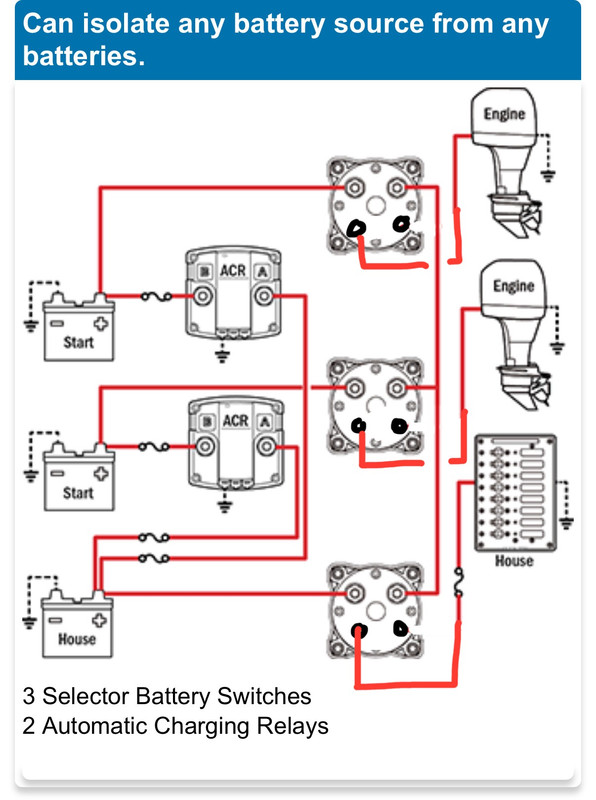
I use Blue Sea dual circuit On/Off/Combine switches for each battery. I Jump the “extra” circuit of each switch to the other switches, so that you can emergency combine any battery to any of the other ones (diagram will help explain this). Basically any switch in combine is jumped to any other switch in combine.
I put on board charger leads directly to battery. ACR/VSR between each start battery and house (Port-> House & Stbd -> House). Can do this either at the battery itself or at the battery side of each switch. I like to put my ACRs on the battery side so you can use a 2 bank charger and it will charge all 3 batteries. I’ve heard people argue not to do this for various reasons, but I’ve rigged nearly every boat I’ve touched this way and none of them have had issues with on board charger. Alternatively if you have a 3 bank charger just wire ACRs on the switched side. Either way will work.
If can probably answer any other questions you have

Also, if you find yourself needing any new panels or anything I can probably help you out too. I CNC all my own panels and have been getting pretty good at it. Always looking for an excuse to cut something else. Pretty sure I have some extra starboard, luxxematte, acrylic, etc laying around here somewhere as well.
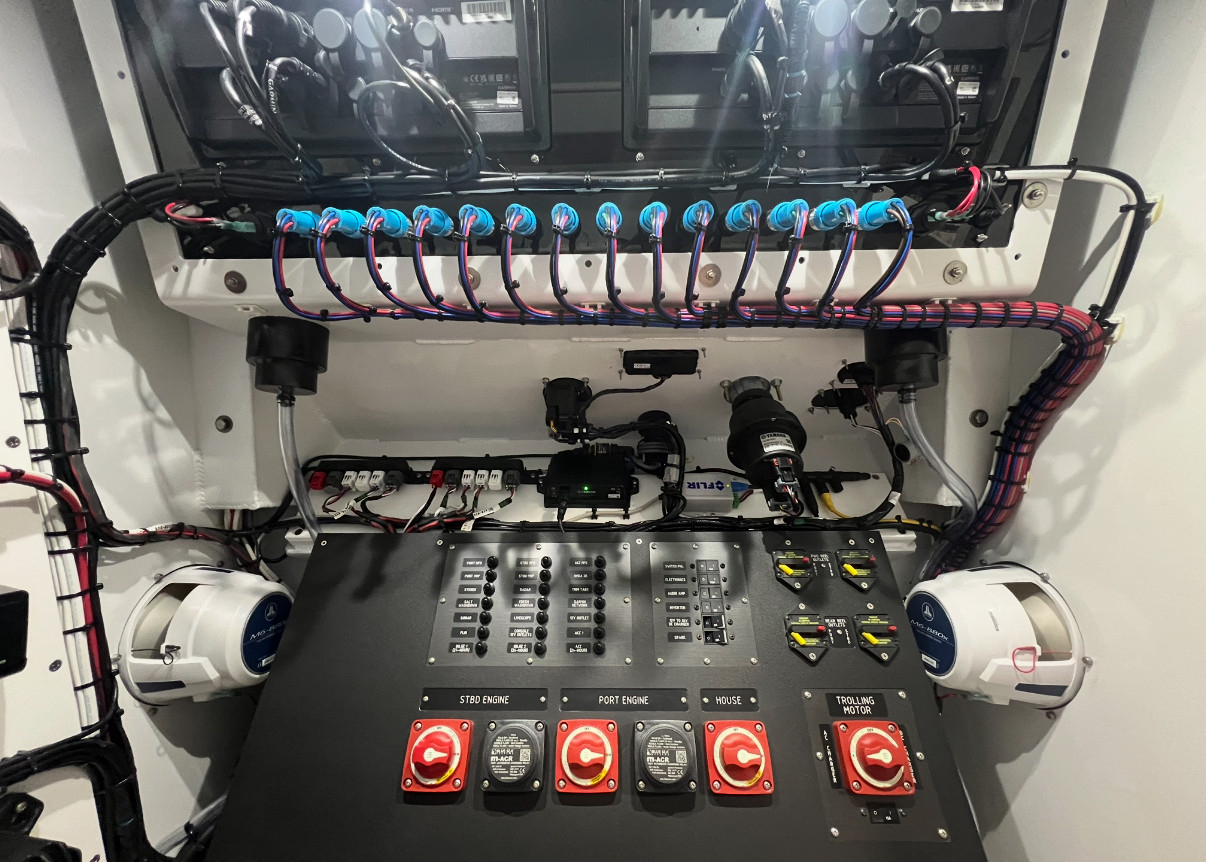
This is one I made for an American Aluminum I rigged out. It’s on a hinge so you can open it to access all the wiring behind it.
This post was edited on 7/16/26 at 5:05 pm
Posted on 7/16/26 at 5:12 pm to baldona
quote:
This is just a center console. But since I have 2 starting and one house, I mentioned off shore because I wasn't sure if bass boats were wired a little more loosely as getting back to the hill is generally not as much of a major concern.
You’re not wrong. It seems most bass boats and smaller boats take a slightly different approach. Atleast from what I’ve seen from MFR.
quote:
I'm also curious with all these new advances in battery tech, if just keeping a cheap/ small lithium for starting a motor isn't the worst idea and simplifying some of the other wiring?
Are you talking about basically using a lithium as a reserve/jump pack? Or using lithium to replace your starting batteries?
With 2 engines there isn’t really a need to have the “jump pack” setup. If one is low, just combine with other engine/battery. At most I’d just carry one of those portable jump packs instead of a built in one.
If you’re talking about replacing with lithium, that is a different situation. There was a post on here a few weeks ago about that. You can go read that to see how I feel about it
This post was edited on 7/16/26 at 5:14 pm
Posted on 7/16/26 at 5:27 pm to Combaro01
quote:
Consult a marine electrician
He is currently doing that.
Posted on 7/16/26 at 5:38 pm to CP3
quote:
With 2 engines there isn’t really a need to have the “jump pack” setup. If one is low, just combine with other engine/battery. At most I’d just carry one of those portable jump packs instead of a built in one.
If you’re talking about replacing with lithium, that is a different situation. There was a post on here a few weeks ago about that. You can go read that to see how I feel about it
Ha yeah. I'm not talking about replacing the starter with a lithium.
What I meant was it seems like some of this wiring is overdone to prevent a starting battery from failing. Guys are spending $1000 to run off of other batteries to prevent a starter from failing, making systems exponentially more complicated.
When all you really need to do is have a back up to jump.
Yeah I can jump off one of my others too certainly.
Posted on 7/16/26 at 5:40 pm to Combaro01
quote:
Consult a marine electrician or specialized forums; wiring mistakes can be dangerous.
A.) This stuff isn't THAT complicated. In fact, most of it is very simple. Positive and negative and maybe a switch and fuse. Its just positive and negative and a switch and a fuse, 30 times.
B.) The marine electrician isn't going to be on the boat with me 40 miles offshore. I'm mostly trying to learn it so I also know how to diagnose issues
Posted on 7/16/26 at 5:44 pm to baldona
Ah gotcha. I mean if you want to keep it super simple, I guess you could just use regular on/off switches for each battery/load. And charge house battery using aux lead from engine or ACRs.
But for like $200 more (3 dual circuit switches), you could do it like I described and have built in “redundancy” that just requires turning a knob. If you’re replacing switches anyway, it’s not really an added cost.
But for like $200 more (3 dual circuit switches), you could do it like I described and have built in “redundancy” that just requires turning a knob. If you’re replacing switches anyway, it’s not really an added cost.
Posted on 7/16/26 at 5:47 pm to CP3
This is the setup I was describing. Pict is rough markup I had on my phone, so not the best quality. When switch is “on” the top terminals are connected to the bottom terminals. But the left set of posts and right set of posts are separate circuits.
When in combine, the switch basically has all 4 posts tied together
Basically right side posts in picture are only used when in combine.
When in combine, the switch basically has all 4 posts tied together
Basically right side posts in picture are only used when in combine.
This post was edited on 7/16/26 at 5:48 pm
Posted on 7/17/26 at 4:59 am to baldona
quote:
Basically my plan this fall. I was working on my stereo and bilge pumps and now I just want to redo it all or at least clean it up. Its a 15 year old boat with at least 3 owners and I'm sure that they were as knowledgeable as me.
I did my stereo and some of the wiring on my new boat in 2022. I am not sure what kind of system you are doing baldona but there are some pretty tight rules with wiring amps. Meaning wire size, distance from amp to circuit breaker and what not. If you are doing multiple amps, I would suggest a amp board where you can lay things out on a bench and get the wiring done correctly. Consider the amp board as one thing and have it wired to your power from there. Including all the circuit breakers and connectors. It makes it much easier.
I have a bay boat but like someone said, it does get kind of confusing with all the different circuits and fuse panels I have and which battery they go to. Absolutely make a schematic.
For me , that sounds like a fun project. Good luck
Posted on 7/17/26 at 8:05 am to baldona
I’ve rewired several boats. Blue Seas is a tremendous resource. Use on/off switches for your house and starter and a VSR to combine/charge. BEP makes the one I use it’s a cluster of two on/off switches and the VSR. Get your wire from best boat wire, tinned marine wire. You’ll need a shitpile of heatshrink connectors, heatshrink tubing in red and black, a good pair of crimpers, a big bag of zip ties, and a tolerance for wasting wire…never ever ever cut your wire until you have neatly and safely routed it to where it’s going and secured it in place, then cut it and terminate it
it’s really not that hard to do a decent job, it mostly depends on access or lack thereof and a little forethought
it’s really not that hard to do a decent job, it mostly depends on access or lack thereof and a little forethought
Posted on 7/17/26 at 9:57 am to CP3
the champion is still in grand isle waiting for CP3 to rewire her

 Page 1 of 2



Popular

Back to top
 Follow TigerDroppings for LSU Football News