




- My Forums
- Tiger Rant
- LSU Recruiting
- SEC Rant
- Saints Talk
- Pelicans Talk
- More Sports Board
- Fantasy Sports
- Golf Board
- Soccer Board
- O-T Lounge
- Tech Board
- Home/Garden Board
- Outdoor Board
- Health/Fitness Board
- Movie/TV Board
- Book Board
- Music Board
- Political Talk
- Money Talk
- Fark Board
- Gaming Board
- Travel Board
- Food/Drink Board
- Ticket Exchange
- TD Help Board
Customize My Forums- View All Forums
- Show Left Links
- Topic Sort Options
- Trending Topics
- Recent Topics
- Active Topics
Started By
Message
re: James Webb space telescope reaches final destination 1 million miles from earth
Posted on 1/24/22 at 9:44 pm to When in Rome
Posted on 1/24/22 at 9:44 pm to When in Rome
Why did it have to orbit around the sun
 2
2


Posted on 1/24/22 at 10:20 pm to xxTIMMYxx
Shut up about the Sun.
SHUT UP ABOUT THE SUN

SHUT UP ABOUT THE SUN

Posted on 1/24/22 at 10:25 pm to xxTIMMYxx
quote:
Why did it have to orbit around the sun
Because the earth orbits around the sun and it’s at a Lagrange point which is a gravitationally stable spot. Think of it as just tracking the Earths orbit instead of it orbiting the Sun (although that’s what it’s doing).

Posted on 1/24/22 at 10:35 pm to LCA131
Asking the brains of the OT, how does it see backwards in time? I know it has something to do with the speed of light not reaching us and such, but I don't understand how it picks up the light if it hasn't reached us yet? frick I don't know but would love to
This post was edited on 1/24/22 at 10:36 pm


Posted on 1/24/22 at 11:38 pm to vuvuzela
quote:We see a thing because light from the thing is observed. For example, you see your monitor because light from the monitor is observed by your eyes. Your monitor is close so the light from the monitor reaches your eyes almost instantaneously.
Asking the brains of the OT, how does it see backwards in time?
A "light year" is the distance light travels in one year. It's about 6 trillion miles.
Proxima Centauri (a star) is about 4 1/4 light years away from Earth. That's about 25 trillion miles. When you see Proxima Centauri, you are seeing light that came from Proxima Centauri. That light travelled about 25 trillion miles from Proxima Centauri to your eye. It took that light about 4 1/4 years to travel from Proxima Centauri to your eye. A proton that leaves Proxima Centauri today will not arrive at your eye until about 4 1/4 years in the future.
The Proxima Centauri light you are seeing today departed from Proxima Centauri about 4 1/4 years ago. If you saw Proxima Centauri explode in a supernova today, the light by which you observed that supernova would have departed from Proxima Centauri about 4 1/4 years ago. In other words, Proxima Centauri would have exploded around October 2017, but people on Earth would have seen it for the first time in January 2022.
Accordingly, you are seeing a supernova that occurred 4 1/4 years ago. You are seeing backward in time.
The farther from Earth an object is, the longer it takes for light from it to be observed on Earth. Light from a Virgo star that is one million light years from earth takes one million years to travel to Earth.
Accordingly, if you observed a Virgo star pulsing today, those pulses actually occurred one million years ago, and the light from those pulses took one million years to travel from the Virgo star to Earth for you to observe it. You are seeing pulses that occurred one million years ago. You are seeing backward in time.
Again, the farther from Earth an object is, the longer it takes for light from it to be observed on Earth, and the further back in time you are seeing. You are seeing backward in time.
If one could see far enough, it is possible to see back in time to the beginning of the Universe.
Posted on 1/25/22 at 12:45 am to When in Rome
Impossible. I was told there is a lid on flat Earth that we can't fly out of

Posted on 1/25/22 at 8:18 am to When in Rome
This is a cool post for the math nerds out there:
Twitter

quote:
Around 2 p.m. ET today, JWST will enter the L2 halo orbit, with a 4m 58s MCC-2 thruster burn using 2.3 kg fuel, dV = 1.5 m/s.
Here is my guess of JWST's trajectory before and after the burn.

JWST is in an elliptical orbit around earth, nearing it farthest point and has slowed down to 0.2020 km/s. JWST is high above the ecliptic plane to the right as seen from earth. The MCC-2 burn will steer it a bit towards the L2 point on its way down and back as shown above.
2/
Note that the halo orbit is ellipse-like, 1.6mil km wide and 0.8mil km tall, tilted so that the bottom is closer to earth. The center of the ellipse lies above the ecliptic and closer to earth than L2.
The above trajectory is based on this diagram at jwst-docs.stsci.edu/

Please feel free to point out any mistakes or inaccuracies in the above analysis. It is simplistic no doubt.
It is possible that the words "above" and "below" in the first diagram should be interchanged, i.e., JWST is below the ecliptic plane at this point. The diagram from the jwst.stsci site may be illustrative and not the actual JWST orbit.
Here is the L2 halo orbit of the Herschel Space Observatory. Very similar to JWST. The spacecraft traveled up and right from earth and then maneuvered down and left into the halo orbit, very similar to tweet 1.
Size = 1500k x 800k km, period = 178 days.
herschel.esac.esa.int
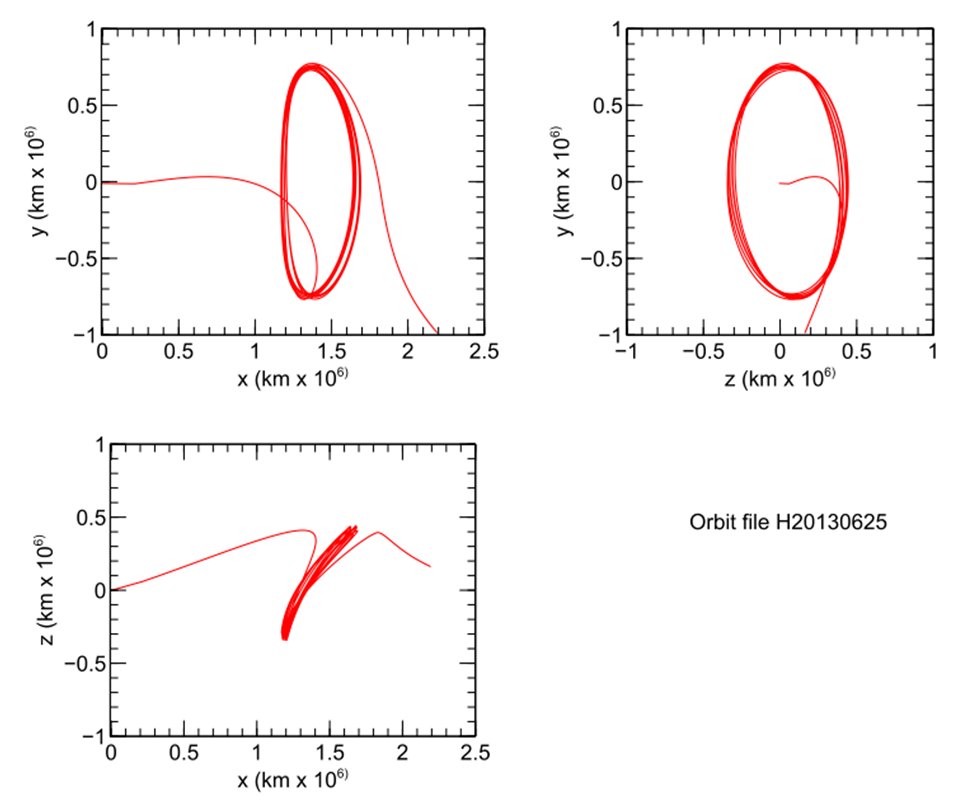
The Herschel Space Observatory was retired in 2013, when it ran out of its liquid Helium coolant. Herschel was moved out of L2 into a heliocentric orbit where it would not encounter Earth for several 100 years.


Posted on 1/25/22 at 8:28 am to When in Rome
But can it see footprints on the moon?
Posted on 1/25/22 at 8:37 am to HubbaBubba


Posted on 1/25/22 at 8:39 am to When in Rome
quote:
The world’s biggest, most powerful space telescope
I guess they wanted to be conservative.

Posted on 1/25/22 at 8:43 am to When in Rome
I will not take any Michael Collins slander on this board.
Posted on 1/25/22 at 8:47 am to BlackCoffeeKid
 but it's funny.
Seriously, without him we wouldn't have this photo:


Posted on 1/25/22 at 8:52 am to When in Rome
For a long time I didn't realize that one of the astronauts always stayed back while 2 of them got to walk on the moon. I was like damn, imagine being the dude who has to say "well I mean i didn't WALK on the moon but i was there"
Posted on 1/25/22 at 8:59 am to Ingeniero
quote:Looking at this picture, you can tell who got to walk on the moon and who didn't
I was like damn, imagine being the dude who has to say "well I mean i didn't WALK on the moon but i was there"

Sorry @BCK
Posted on 1/25/22 at 9:08 am to When in Rome
quote:
without him we wouldn't have this photo:
I did admittedly laugh a bit
I want to say Collins lost another camera to space due to an open hatch during a space walk. Said he had his best pictures on that camera and it's a shame it floated out of the cabin.
"In August 1966, Sweden got its first satellite: a Hasselblad super-wide camera. Astronaut Michael Collins lost hold of it during a spacewalk."
Lost Hasselblad Camera
This post was edited on 1/25/22 at 9:11 am
Posted on 1/25/22 at 9:10 am to BlackCoffeeKid
quote:
Said he had his best pictures on that camera and it's a shame it floated out of the cabin.

Posted on 1/25/22 at 9:13 am to When in Rome
MOAR INFOGRAPHICS
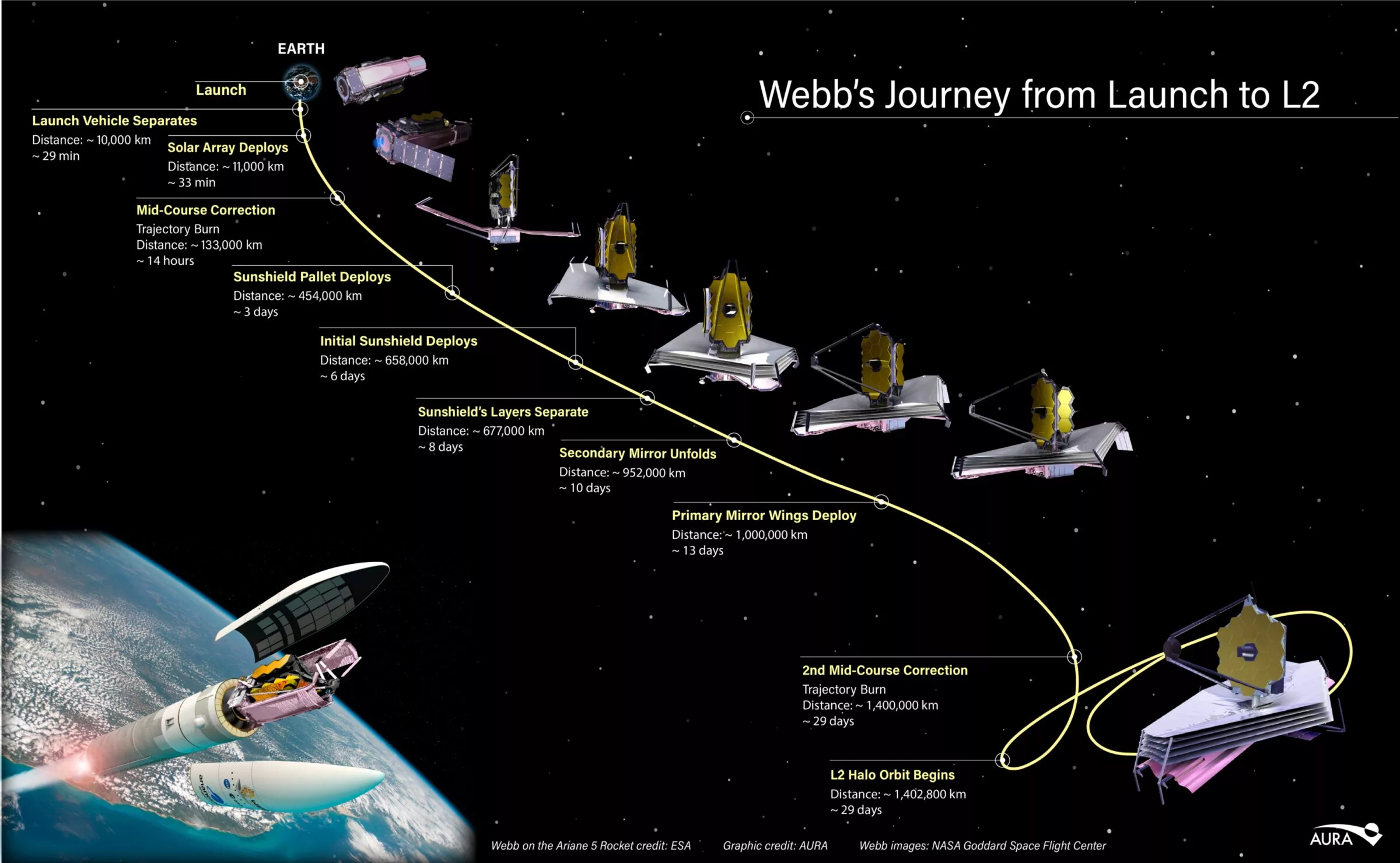
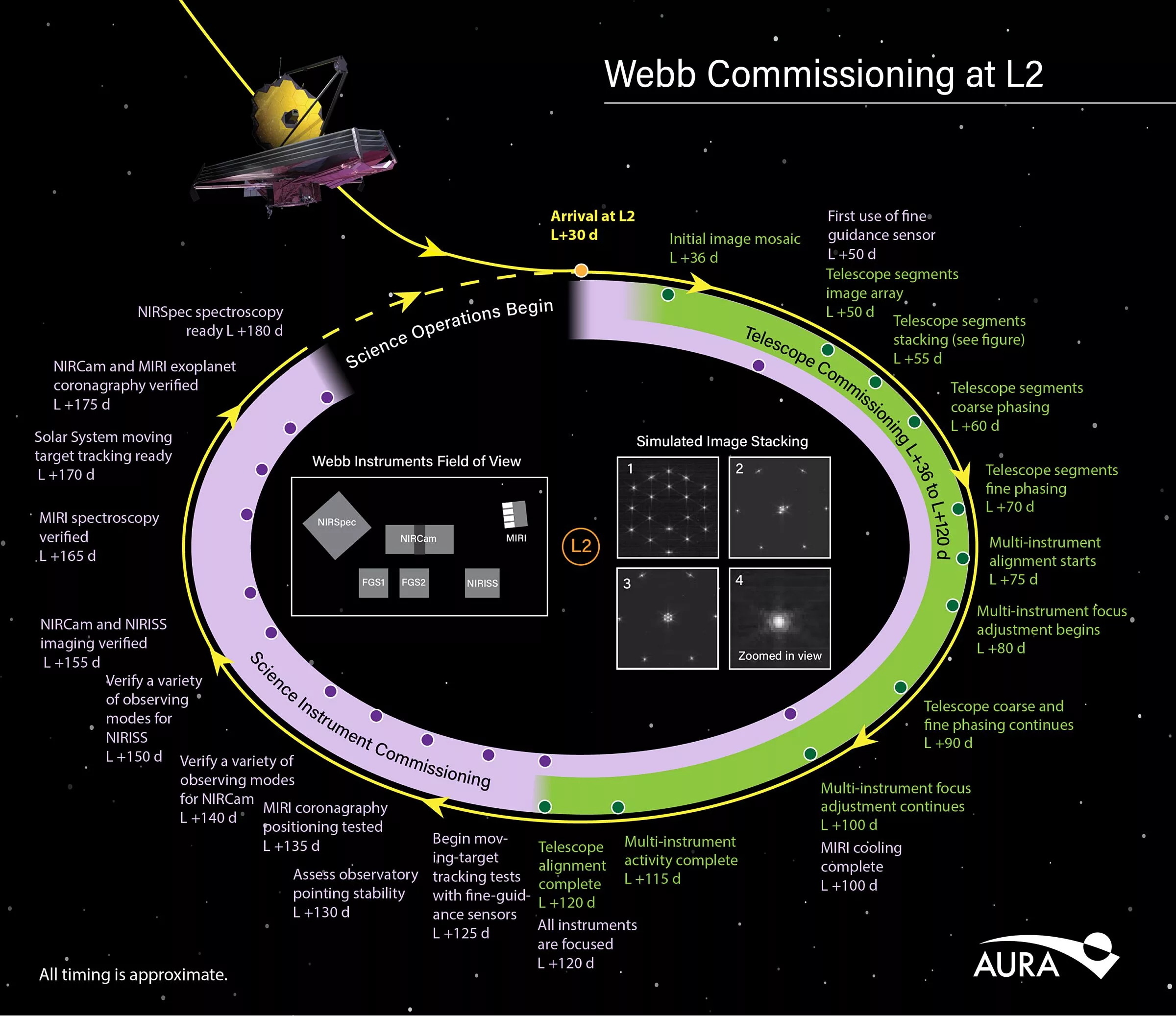
quote:
JWST'S JOURNEY TO L2 JWST’s journey from launch to the Sun-Earth L2 point will be filled with a steady stream of spacecraft activities, from unfurling the sunshield (starting 3 days after launch) to unfolding the telescope mirror (13 days after launch).Image: AURA / S. Lifson
quote:Planetary.org
JWST COMMISSIONING After JWST arrives at L2, its first trip around the L2 “halo orbit” will be jam-packed with work for the JWST team. The telescope commissioning (green) ensures that all 18 segments of the main mirror are aligned and will bring the telescope to perfect focus. The insets on the right show an example of image stacking: moving the segments so that a star’s image from each segment is brought into alignment; the final image is zoomed in to show that all 18 images are correctly stacked. Throughout the telescope commissioning, the science instruments are cooling down and preparing for their own detailed check-outs (purple). The inset on the left shows their relative positions on the sky; the inset box is roughly 20 x 10 arcminutes on a side (for reference, the full moon is about 30 arcminutes across). All dates in this diagram are approximate, and the activities noted represent only a tiny fraction of the commissioning work being done.Image: AURA / S. Lifson
Posted on 1/25/22 at 9:47 am to When in Rome
I feel sorry for all the moms having to wash y'all's jizz out of your pants.
At least take them up to the laundry room instead of piled in the corner of the basement.
At least take them up to the laundry room instead of piled in the corner of the basement.
Posted on 1/25/22 at 10:36 am to Comic_Tiger


 Page 3 of 3


Popular
Back to top
 Follow TigerDroppings for LSU Football News