




- My Forums
- Tiger Rant
- LSU Recruiting
- SEC Rant
- Saints Talk
- Pelicans Talk
- More Sports Board
- Fantasy Sports
- Golf Board
- Soccer Board
- O-T Lounge
- Tech Board
- Home/Garden Board
- Outdoor Board
- Health/Fitness Board
- Movie/TV Board
- Book Board
- Music Board
- Political Talk
- Money Talk
- Fark Board
- Gaming Board
- Travel Board
- Food/Drink Board
- Ticket Exchange
- TD Help Board
Customize My Forums- View All Forums
- Show Left Links
- Topic Sort Options
- Trending Topics
- Recent Topics
- Active Topics
Started By
Message
re: Louisiana Tropical Fruit Gardening - Experiences and Updates
Posted on 3/4/25 at 8:38 am to Buddy the Tiger

Posted on 3/4/25 at 8:38 am to Buddy the Tiger
quote:
Do you have any recommendations on where to get the good soil?
Yes but this is going to take a fairly lengthy explanation. Will update this post today when I have time.
UPDATE
OK I'm going to give you the short answer and then the long answer. This pertains ONLY to soil for fruit trees that will live permanently in containers. I believe the best pre-made soil on the market is Gary's Best Top Pot from Laguna Hills Nursery in California. You can buy it on Amazon now and it is wildly expensive to ship. $35/per cubic foot. You can also purchase the ingredients in bulk and make it yourself. The makeup is as follows:
35% peat
30% pumice
20% perlite
10% sand
5% biochar
I'll explain why this is the best later. This YouTube video will explain most of it:
LINK
Second choice would be Promix with lots of perlite or something you make yourself without any bark in it. Here is a link to the Promix website. You want one of the high porosity ones.
LINK
I do not recommend any big box soil but if I had no other choice, I'd use the Miracle Gro cactus/citrus/palm mix in the yellow bag and I would add a significant amount of perlite to it. Like, a lot of perlite. I've done it in the past and if you're really careful about winter watering and add new soil every couple of years it can work. See the next post about what happens when you use this stuff as soil.
This post was edited on 3/4/25 at 2:52 pm
 2
2

Posted on 3/4/25 at 2:39 pm to Tigerlaff
So why Gary's or a custom mineral forward mix? Because it breathes and doesn't break down. They tell you that drainage is important but no one ever explains why. Roots need oxygen, moisture (not water), and nutrients in that order. The more water retention your soil has, the more likely you are to suffocate and rot your roots.
The horticultural industry and academia are wrong about this. You do not want a "rich" soil full of compost unless your only goal is to grow vegetables in a single season and then discard the soil and plant. Roots do not "eat" nutritious soil. They eat glucose made by the leaves and they absorb, using ambient moisture, nutrients in the soil. In nature, the dead leaves, animals, etc. are on the surface of the soil, not deep down. Below that layer of detritus is either sand, silt, clay, or a mix of the same. Go get a shovel and dig in your yard. Unless you live in the rainforest, you'll hit sand/silt/clay less than a foot down and usually less than 6 inches down. You want your nutritious organics on top of your soil, not mixed throughout.
So why is this principle so important? Because every last bag of soil at your local big box store and even at your speciality nursery is going to be made primarily from "recycled forest products." 50 years ago the horticultural industry figured out that they could bag the wood waste by-products of the timber industry and call it "soil." It was plentiful. It was cheap and in some cases free. It was light and reduced freight costs. Most importantly, it worked! But only for about 9 months on average. It holds moisture well and the bark chunks are usually large enough to provide good aeration for the roots. It works just long enough to start a seed or cutting, ship it from a wholesaler to a vendor, sell it to a customer, and take it home to grow. After about a year, plants start to decline despite no change in the fertilizing or watering habits. This is because all that bark and sawdust is decomposing into finer and finer particles and sinking to the bottom of the pot where they become an anaerobic sludge. The chemical process of decomposition consumes oxygen. Here is a picture of that from one of my old citrus pots:
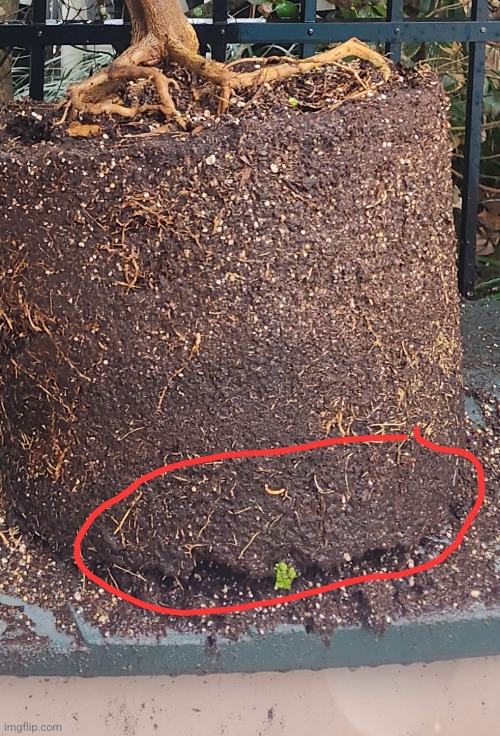
That bottom layer was not allowing water to drain and it stunk from the rotting wood. This was the very early stage of this and I ended up cutting the bottom third off of that entire root ball. The particles are so fine that they do not breathe and water stays stuck to it. Roots cannot get the oxygen they need and they get attacked by bacteria and fungi while they are weak. Root rot begins and unless you change out the soil and prune the dead roots the plant is likely to die.
But how are we supposed to retain moisture and give plants nutrition if we can't use these rich organic soils? Well, we need our nutrients to come from either fertilizer or compost on the top layer of the pot or from a liquid fertilizer. I use a top layer of compost with osmocote and water with fish emulsion every so often. But we still need something organic that will hold moisture and give the soil structure. There are a few ways to do this:
1) use about 1/3 peat in your mineral based potting mix. Yes, peat is organic but it decomposes extremely slowly. It has already been dead for thousands of years at the bottom of a lake and it is not going to rot away the same way a fresh wood chip will. It is a great consistency, light weight, and holds moisture (not water) extremely well.
2) grow your plant in fired clay pellets. This is hands down the best and most expensive medium to use. It absorbs water and stays moist, it holds on to nutrients that wash over it, and it breathes extremely well. Roots love it. This is what the high end marijuana growers use for crops that need the best care possible. It is not really feasible for most people or for our container fruit project.
3) use about 1/3 coconut coir in your mineral based mix. Coir serves the exact same role as peat, with the only difference being cost and state of decay. Coir is cheaper than peat and it has not been dead long. Because of that, the cells are still full of plant tannins that can hurt certain plants growing in it. I simply don't see a major advantage that coir has over peat.
4) use about 1/3 rice hulls in your mineral based mix. Rice hulls are almost pure silica and basically don't decompose. They provide excellent and permanent structure, aeration, and drainage to your soil. They do not hold moisture well and you will have to water a ton.
For 90% of people reading this, the answer is to make your own soil with a mix of peat, perlite, and sand. 1/3 of each would be fine. The pumice and biochar are nice but usually expensive and the pumice is heavy and hard to find. A great pumice substitute is coarse decomposed granite from your big box store. I use Gary's because I'm a nutcase and can afford it and I want the best for my permanent pots but it is definitely not necessary or cost conscious.
CONCLUSION: you are better off growing your plants in pots of pure sand and using a liquid fertilizer than you are with a bagged potting soil containing wood waste. Build your soil out of permanent minerals and let the nutrients wash down to the roots from above.
The horticultural industry and academia are wrong about this. You do not want a "rich" soil full of compost unless your only goal is to grow vegetables in a single season and then discard the soil and plant. Roots do not "eat" nutritious soil. They eat glucose made by the leaves and they absorb, using ambient moisture, nutrients in the soil. In nature, the dead leaves, animals, etc. are on the surface of the soil, not deep down. Below that layer of detritus is either sand, silt, clay, or a mix of the same. Go get a shovel and dig in your yard. Unless you live in the rainforest, you'll hit sand/silt/clay less than a foot down and usually less than 6 inches down. You want your nutritious organics on top of your soil, not mixed throughout.
So why is this principle so important? Because every last bag of soil at your local big box store and even at your speciality nursery is going to be made primarily from "recycled forest products." 50 years ago the horticultural industry figured out that they could bag the wood waste by-products of the timber industry and call it "soil." It was plentiful. It was cheap and in some cases free. It was light and reduced freight costs. Most importantly, it worked! But only for about 9 months on average. It holds moisture well and the bark chunks are usually large enough to provide good aeration for the roots. It works just long enough to start a seed or cutting, ship it from a wholesaler to a vendor, sell it to a customer, and take it home to grow. After about a year, plants start to decline despite no change in the fertilizing or watering habits. This is because all that bark and sawdust is decomposing into finer and finer particles and sinking to the bottom of the pot where they become an anaerobic sludge. The chemical process of decomposition consumes oxygen. Here is a picture of that from one of my old citrus pots:
That bottom layer was not allowing water to drain and it stunk from the rotting wood. This was the very early stage of this and I ended up cutting the bottom third off of that entire root ball. The particles are so fine that they do not breathe and water stays stuck to it. Roots cannot get the oxygen they need and they get attacked by bacteria and fungi while they are weak. Root rot begins and unless you change out the soil and prune the dead roots the plant is likely to die.
But how are we supposed to retain moisture and give plants nutrition if we can't use these rich organic soils? Well, we need our nutrients to come from either fertilizer or compost on the top layer of the pot or from a liquid fertilizer. I use a top layer of compost with osmocote and water with fish emulsion every so often. But we still need something organic that will hold moisture and give the soil structure. There are a few ways to do this:
1) use about 1/3 peat in your mineral based potting mix. Yes, peat is organic but it decomposes extremely slowly. It has already been dead for thousands of years at the bottom of a lake and it is not going to rot away the same way a fresh wood chip will. It is a great consistency, light weight, and holds moisture (not water) extremely well.
2) grow your plant in fired clay pellets. This is hands down the best and most expensive medium to use. It absorbs water and stays moist, it holds on to nutrients that wash over it, and it breathes extremely well. Roots love it. This is what the high end marijuana growers use for crops that need the best care possible. It is not really feasible for most people or for our container fruit project.
3) use about 1/3 coconut coir in your mineral based mix. Coir serves the exact same role as peat, with the only difference being cost and state of decay. Coir is cheaper than peat and it has not been dead long. Because of that, the cells are still full of plant tannins that can hurt certain plants growing in it. I simply don't see a major advantage that coir has over peat.
4) use about 1/3 rice hulls in your mineral based mix. Rice hulls are almost pure silica and basically don't decompose. They provide excellent and permanent structure, aeration, and drainage to your soil. They do not hold moisture well and you will have to water a ton.
For 90% of people reading this, the answer is to make your own soil with a mix of peat, perlite, and sand. 1/3 of each would be fine. The pumice and biochar are nice but usually expensive and the pumice is heavy and hard to find. A great pumice substitute is coarse decomposed granite from your big box store. I use Gary's because I'm a nutcase and can afford it and I want the best for my permanent pots but it is definitely not necessary or cost conscious.
CONCLUSION: you are better off growing your plants in pots of pure sand and using a liquid fertilizer than you are with a bagged potting soil containing wood waste. Build your soil out of permanent minerals and let the nutrients wash down to the roots from above.
This post was edited on 3/4/25 at 3:51 pm

Posted on 3/5/25 at 10:07 am to Tigerlaff
I've ordered a few trees over the last couple days that will probably arrive next week. My office is a refurbished building where the loading dock garage doors were converted to windows. I think I am going to put a few things in the office. I have a south facing and east facing window.
I did order a Spanish lime and a few varieties of guava.
I did order a Spanish lime and a few varieties of guava.
Posted on 3/5/25 at 11:16 am to TimeOutdoors
quote:
I did order a Spanish lime and a few varieties of guava.
Hell yeah. Which guavas did you go with? Probably the easiest container tropical fruit for beginners.
Post pics when you get your stuff in. You may want to do some pruning to encourage the right kind of growth. Guava wants to be a multi-trunked bush like a mini crepe myrtle. You have to choose a central leader stem and turn that into the trunk via pruning if you want it to be a "tree." Much much easier if you start early.
Can't wait to see how that Spanish Lime turns out. Nobody ever got delicious tropical fruits in Louisiana without pushing the envelope to see what is possible.
This post was edited on 3/5/25 at 11:32 am
Posted on 3/5/25 at 1:02 pm to Tigerlaff
What size is your pop-up greenhouse? Mine was 6x8 but it was still frozen to the ground when I left Alaska so I had to donate it to the next tenant. I remember them being hard to find sometimes, so I am going to pick one up soon while they are in stock. I think 8x8 should be sufficient and not too much of a challenge to heat during the winter.
Items Ordered:
Tamarindus Indica Tamarind
Red Lady Papaya
Mai Dward Mango
Large Supreme Ruby Guava
Grafted Spanish Lime
Items Ordered:
Tamarindus Indica Tamarind
Red Lady Papaya
Mai Dward Mango
Large Supreme Ruby Guava
Grafted Spanish Lime
This post was edited on 3/5/25 at 2:05 pm

Posted on 3/5/25 at 2:48 pm to Tigerlaff
Nurse them through about 5 winters and you may get to keep them. Good luck.
Posted on 3/5/25 at 3:19 pm to TimeOutdoors
Mine is 8x8. It's the eagle peak heavy duty one and it is amazing. Much higher quality and toughness than I was expecting. The metal is all powder coated and stainless and the joints are strong.
Good lineup. You can get that red lady to fruit in a large pot. Better would be to put it in the ground next to a southern facing wall and cover it for freezes.
The only one of those that I'm well versed on is the ruby supreme so let me know if you need any help.
If anyone wants to see ornamentals let me know but I figured the fruit would be more interesting.
Good lineup. You can get that red lady to fruit in a large pot. Better would be to put it in the ground next to a southern facing wall and cover it for freezes.
The only one of those that I'm well versed on is the ruby supreme so let me know if you need any help.
If anyone wants to see ornamentals let me know but I figured the fruit would be more interesting.
This post was edited on 3/5/25 at 11:06 pm
Posted on 3/5/25 at 3:21 pm to TigerSprings
Yeah the geffner and emperor are new to me but my bottom lows with greenhouse are upper 40s and my average lows for January and February are in the 60s. Above 60F is warm enough for good cellular respiration for everything but like coconuts and durian. Lychee and atemoya are both subtropical with the former needing about 150 chill hours to bloom and the latter being semi deciduous and dropping leaves each winter. And the really sensitive stuff does great in my grow room at 78F and 75% humidity.
This post was edited on 3/5/25 at 3:33 pm

Posted on 3/5/25 at 4:08 pm to Tigerlaff
have you gotten to eaten any of the ice cream banana's?
I was looking into getting that one a few months ago and never pulled the trigger.
I was looking into getting that one a few months ago and never pulled the trigger.

Posted on 3/5/25 at 4:15 pm to Tigerlaff
I have a Wurtz avocado in a pot from last year and Glenn Mango I just ordered.
Those will go w/ my Lisbon lemon and Persian lime.
Here's to hoping!
Those will go w/ my Lisbon lemon and Persian lime.
Here's to hoping!

Posted on 3/5/25 at 5:50 pm to TeddyPadillac
quote:
have you gotten to eaten any of the ice cream banana's?
I was looking into getting that one a few months ago and never pulled the trigger.
Not from my trees yet, but I have eaten them from other trees. The biggest difference is texture. It's like a dense custard. The flavor is awesome. Sweeter than a Cavendish with vanilla notes.
The plant itself is an absolute tank. When temps start dropping into the low 50s my Cavendish type bananas start yellowing and can't metabolize well. The namwah keeps trucking until about 28 or 29 before I start seeing damage. And if the freeze doesn't last long or you wrap it to protect it will shrug it right off. Here are some pics of mine while protected.
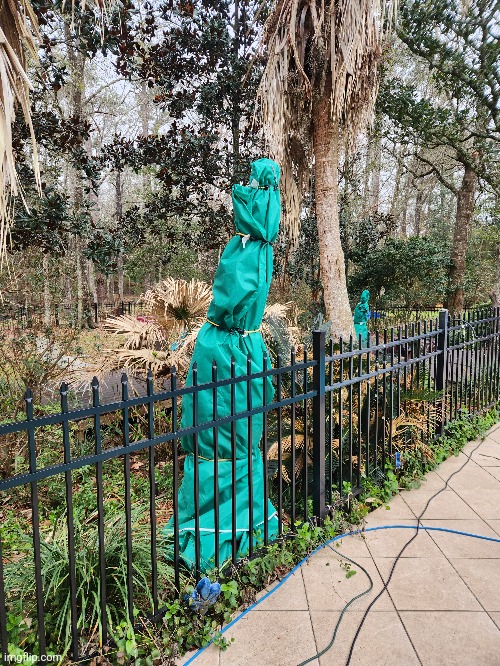
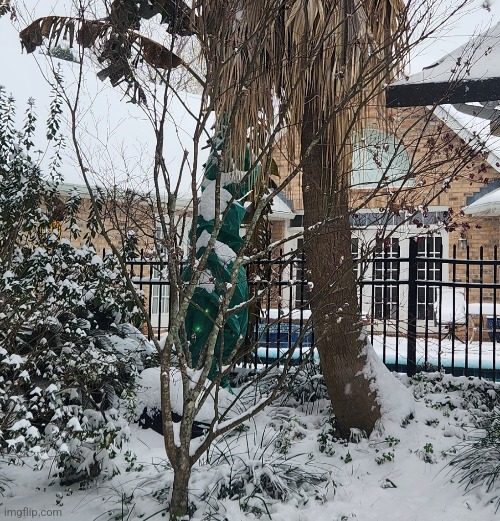
If you don't protect during deep long freezes it will die to the ground and come back in the spring, but not fruit. You have to get a stalk through one winter to fruit.
If fruit is your main goal get the dwarf namwah. The regular namwah/ice cream is tall and you will need a ladder to harvest.
This post was edited on 3/5/25 at 6:33 pm
Posted on 3/5/25 at 6:35 pm to Neauxla
quote:
I have a Wurtz avocado in a pot from last year and Glenn Mango I just ordered
So I don't have avocados but I know someone who does and he says the key is to be able to water them frequently but have all the water drain away immediately. More than any other tree, they are somehow water hogs and very sensitive to wet roots. It's all about sandy soil.
Posted on 3/5/25 at 7:37 pm to Tigerlaff
quote:
So I don't have avocados but I know someone who does and he says the key is to be able to water them frequently but have all the water drain away immediately. More than any other tree, they are somehow water hogs and very sensitive to wet roots. It's all about sandy soil.
Good to know!
This post was edited on 3/5/25 at 9:07 pm
Posted on 3/5/25 at 9:07 pm to Tigerlaff
Any recommendations on mangoes?
Posted on 3/5/25 at 10:22 pm to Neauxla
I will be getting my first mango at the end of this month. If you are growing in a container, Pickering is probably your best bet IMO. Do all the research about care in advance. It's not a beginner tree or a learn as you go thing if you do not live in zone 10 or above. You will need a very porous soil with lots of sand, at least a 25gal pot for decent fruiting, and will need to control for both powdery mildew and anthracnose during the flowering and fruit set stages by spraying with copper and sulfur. Their natural habitat is actually quite low in humidity and has lots of drying wind, so the muggy gulf south in summer is very likely to cause fungal issues. If you let it fruit before it is large and thick enough, you risk breaking limbs and stunting the tree's growth.
wiltznucs who has already posted in this thread is going to be much more knowledgeable than me about this as he has many mangos in cultivation in central Florida.
wiltznucs who has already posted in this thread is going to be much more knowledgeable than me about this as he has many mangos in cultivation in central Florida.
This post was edited on 3/5/25 at 10:34 pm


Posted on 3/6/25 at 9:20 am to Neauxla
quote:
Any recommendations on mangoes?
Where are you? Want to grow in a pot or in the ground?
The big consideration for mangoes is that they cannot tolerate freezing weather. Brief exposure to freezing temperatures is one thing, prolonged exposure of even several hours or more can and often does kill the trees.
There are some naturally dwarf and semi-dwarf varieties which have proven to be successful when grown in pots. With the understanding that you will likely have to move into a larger pot every year or two. I think we’ll see more varieties in the future as growers experiment with using alternative dwarf type rootstocks which will limit the trees growth.
If being honest, I’ve never seen a potted one that was as productive as the same tree variety planted in the ground. That said; nothing is better than a fresh home grown mango even if it is somewhat fewer than from a tree planted in the ground.
Most people are unaware that virtually all mangoes sold in the United States are imported. Per USDA guidelines, the fruit has to be boiled for over an hour in order to ensure there is no disease.
So what you end up with is a mango that was picked prematurely to allow it to ripen on its way to the US. Plus it’s also been cooked.
If in Zone 9 or higher and plan on putting it in the ground plus you can protect it from freezing then your options are wide open. It’s really a matter of finding the mango flavor profile you like. There’s a huge range from traditional fruity commercial mango, spicy resiny Indian mango, classic Thai honey mango, citrusy Indo-Chinese, etc.
For dwarf/semi-dwarf that responds well to being in pots the Pickering is very popular. Classic flavor with some coconut undertones. Very resistant to disease and naturally vigorous. It produces even when neglected.
Others well suited to pots are Dwarf Hawaiian, Julie and Nam Doc Mai #4. I’d throw Sweet Tart and Angie into that mix too.
Edit…
Just saw that you had already purchased Glenn. That’s a great choice and very popular for being classic flavor and quite productive; but, it won’t respond well to being in a pot long term. It’s a medium to large tree that can probably be kept to 10-15 feet tall with regular pruning. Left to its own devices it can get very large. Within a few years that tree will want to be in a 65 gallon pot or in the ground.
For young trees in their first year or two, I go heavy on the nitrogen. It really helps to promote root growth as well as vegetative growth and additional limbs. Tipping is a pruning practice where you trim back the newest growth once or twice per year to promote additional shoots/limbs. I try to cut mine back about 20% every year. Usually immediately after harvesting the last fruit on the tree.
I typically will not allow my mango trees to hold fruit until they are about 4 feet tall and 4 feet wide. This is often their second or even third year. Mango growing is all about delayed gratification. If you allow a young tree to hold fruit in its first or second year it really sets it’s overall growth back. Fruit production just takes a lot out of them. So on the young ones I pluck the baby mangoes off once they reach the size of a pea. Once the fruit is all gone, I prune it back and let the tree continue to develop new growth through the summer and fall.
Otherwise, my regimen basically looks like this. I use a citrus type fertilizer 8-4-8 in the months of April, July and October. There are those that recommend using a zero nitrogen high potassium fertilizer in the winter to help promote fruit growth. In the winter months, once panicles begin forming I regularly spray with wettable sulfur. As a natural fungicide, it does a great job preventing powdery mildew.
Once the weather warms up I transition to copper fungicide if I should see issues of anthracnose, scab or black spot. Neem oil based sprays do a great job keeping insects away. Once they get established, the trees are pretty hardy. Many people have old trees that produces lots of fruit and give them absolutely no maintenance.
This post was edited on 3/6/25 at 2:59 pm
Posted on 3/6/25 at 12:21 pm to wiltznucs

Posted on 3/6/25 at 12:28 pm to wiltznucs
So I cancelled my Glenn and ordered a Pickering based upon Tigerlaff recommendation. I want to add another dwarf or semidwarf in the fruity/citrusy profile . I am gonna keep them in pots for now and may end up planting later once I move. (currently house hunting).
I am in New Orleans.
Posted on 3/6/25 at 12:31 pm to Neauxla
Do all these citrus trees self pollinate?
It doesnt' say anythign about it when I'm looking them up on sites like Everglades.
I know when I was looking at apple and cherry trees it was specific about needing another tree for pollinating.
It doesnt' say anythign about it when I'm looking them up on sites like Everglades.
I know when I was looking at apple and cherry trees it was specific about needing another tree for pollinating.
Posted on 3/6/25 at 12:39 pm to TeddyPadillac
Yes, any citrus you buy will be self pollinating. However, as is true with just about all fruits, trees that are cross pollinated with other citrus may produce more, larger, and better quality fruits. Definitely not necessary.
Also, I'd try to buy my citrus in LA. Interstate shipping of citrus is a huge mess because of laws to contain the citrus greening virus. Florida is totally infested and I would not buy any citrus tree from Florida. Check out Four Winds out of California if you are looking for something uncommon.
Also, I'd try to buy my citrus in LA. Interstate shipping of citrus is a huge mess because of laws to contain the citrus greening virus. Florida is totally infested and I would not buy any citrus tree from Florida. Check out Four Winds out of California if you are looking for something uncommon.
This post was edited on 3/6/25 at 12:43 pm

 Page 3 of 110

Popular
Back to top
 Follow TigerDroppings for LSU Football News