




 1
1






- My Forums
- Tiger Rant
- LSU Recruiting
- SEC Rant
- Saints Talk
- Pelicans Talk
- More Sports Board
- Fantasy Sports
- Golf Board
- Soccer Board
- O-T Lounge
- Tech Board
- Home/Garden Board
- Outdoor Board
- Health/Fitness Board
- Movie/TV Board
- Book Board
- Music Board
- Political Talk
- Money Talk
- Fark Board
- Gaming Board
- Travel Board
- Food/Drink Board
- Ticket Exchange
- TD Help Board
Customize My Forums- View All Forums
- Show Left Links
- Topic Sort Options
- Trending Topics
- Recent Topics
- Active Topics
Started By
Message
re: Louisiana Tropical Fruit Gardening - Experiences and Updates
Posted on 5/8/25 at 7:50 pm to Tigerlaff
Posted on 5/8/25 at 7:50 pm to Tigerlaff
5/8/25 (post #2) - Key/Mexican Lime (Citrus aurantifolia)
The key lime / Mexican lime is the oldest tropical I have. It has been growing strong for 6 years, 4 and a half of those in this same 20 Gallon pot. I have refreshed the soil twice and root pruned once. Like all citrus, it needs an acidic fast-draining soil. The tree has a very convenient shrubby habit that keeps it small and it does great in pots. I get probably 200-250 limes per year. The key lime is the most cold sensitive citrus on earth and absolutely will not tolerate cold weather. They are only hardy in central/south Florida. It won't die before 32F but it can absolutely get sick, catch a pathogen, and then die with prolonged exposure to weather in the 30s and even 40s. This one goes inside of my climate controlled grow room, usually in late November or early December, with big lights and a humidifier. No matter how much you you mimic a hospitable environment, it always protests being inside and will usually drop about a third of its foliage over the 60-70 days it is indoors. However, limes (and lemons) will also fruit year round unlike oranges provided that the temperature and light is sufficient. This means I always get a winter flowering and fruit set indoors. Key limes are wonderful because you can harvest them for a huge portion of the year. The schedule looks like this:
Midsummer: the winter crop is still green, but large enough to harvest and use. These are my first limes of the season and always some of the most satisfying because of their 6 month absence.
August: the few remaining winter limes are now ripening to a bright yellow and are harvested.
October: the main spring crop begins to ripen and harvesting starts. These are the best limes of the year because they get the most outdoor exposure while developing. I always wait until totally ripe.
November - December/January: the last of the spring crop is harvested indoors and the winter crop is setting.
March - The spring bloom and fruit set begins.
There are 2 cultivars commonly seen on the market: regular and thornless. Speaking from experience and the anecdotes of others, the thornless one is not as vigorous, does not produce as well, and can eventually develop thorns anyway. Just get the thorny one. You get used to it.
The pests you see are the common citrus ones: leaf miner in summer and aphids in spring. The leaf miners bother my key lime less than any other citrus I've ever grown with Meyer lemon being by far the worst. Neem oil, spinosad, and pyrethrin rotated regularly will take care of all of them.
The tree is a heavy feeder and needs fertilizer. The gold standard for potted citrus is Super Thrive Foliage Pro once per week with watering and Osmocote granular time release 3-4 times per year. I also do a foliar feed but I can't say it's ever been necessary.
I use these limes on everything. They are much more aromatic and flavorful than store bought Persian limes. Fish tacos, guacamole, asian stir fry, key lime pie, etc. But the very best and highest use of the key lime IMHO is the greatest cocktail known to man: the 'Ti Punch. This drink could merit its own post, but it consists of unaged rhum agricole (rum made from sugarcane juice instead of molasses), half or a whole key lime squeezed of its juice and the shell dropped into the glass, ice (optional), and brown sugar simple syrup mixed to taste.
Tree difficulty: 3/5
About 6 feet tall.

Some of the winter crop.

Ripe limes.

The biggest key lime ever harvested.

'Ti Punch

The key lime / Mexican lime is the oldest tropical I have. It has been growing strong for 6 years, 4 and a half of those in this same 20 Gallon pot. I have refreshed the soil twice and root pruned once. Like all citrus, it needs an acidic fast-draining soil. The tree has a very convenient shrubby habit that keeps it small and it does great in pots. I get probably 200-250 limes per year. The key lime is the most cold sensitive citrus on earth and absolutely will not tolerate cold weather. They are only hardy in central/south Florida. It won't die before 32F but it can absolutely get sick, catch a pathogen, and then die with prolonged exposure to weather in the 30s and even 40s. This one goes inside of my climate controlled grow room, usually in late November or early December, with big lights and a humidifier. No matter how much you you mimic a hospitable environment, it always protests being inside and will usually drop about a third of its foliage over the 60-70 days it is indoors. However, limes (and lemons) will also fruit year round unlike oranges provided that the temperature and light is sufficient. This means I always get a winter flowering and fruit set indoors. Key limes are wonderful because you can harvest them for a huge portion of the year. The schedule looks like this:
Midsummer: the winter crop is still green, but large enough to harvest and use. These are my first limes of the season and always some of the most satisfying because of their 6 month absence.
August: the few remaining winter limes are now ripening to a bright yellow and are harvested.
October: the main spring crop begins to ripen and harvesting starts. These are the best limes of the year because they get the most outdoor exposure while developing. I always wait until totally ripe.
November - December/January: the last of the spring crop is harvested indoors and the winter crop is setting.
March - The spring bloom and fruit set begins.
There are 2 cultivars commonly seen on the market: regular and thornless. Speaking from experience and the anecdotes of others, the thornless one is not as vigorous, does not produce as well, and can eventually develop thorns anyway. Just get the thorny one. You get used to it.
The pests you see are the common citrus ones: leaf miner in summer and aphids in spring. The leaf miners bother my key lime less than any other citrus I've ever grown with Meyer lemon being by far the worst. Neem oil, spinosad, and pyrethrin rotated regularly will take care of all of them.
The tree is a heavy feeder and needs fertilizer. The gold standard for potted citrus is Super Thrive Foliage Pro once per week with watering and Osmocote granular time release 3-4 times per year. I also do a foliar feed but I can't say it's ever been necessary.
I use these limes on everything. They are much more aromatic and flavorful than store bought Persian limes. Fish tacos, guacamole, asian stir fry, key lime pie, etc. But the very best and highest use of the key lime IMHO is the greatest cocktail known to man: the 'Ti Punch. This drink could merit its own post, but it consists of unaged rhum agricole (rum made from sugarcane juice instead of molasses), half or a whole key lime squeezed of its juice and the shell dropped into the glass, ice (optional), and brown sugar simple syrup mixed to taste.
Tree difficulty: 3/5
About 6 feet tall.
Some of the winter crop.
Ripe limes.
The biggest key lime ever harvested.
'Ti Punch
This post was edited on 5/9/25 at 3:52 pm
Posted on 5/9/25 at 8:55 am to Tigerlaff
05/09/25 (post #3) - Meiwa Kumquat (Citrus crassifolia)
I only started growing the Meiwa kumquat back in October 2024, and unfortunately I have learned a lot about them the hard way. I selected a great looking healthy tree from the nursery and planted it in one of the few spots in my yard that gets half day morning sun. I had never heard of Gary Matsuoka and did not know anything about the scourge of bark chips and compost for root health, so I planted it with the nursery root ball full of bark and amended the hole with manure compost and called it a day. This was the eighth citrus I had grown and considered myself well-versed in it.
My first mistake was obviously leaving the bark chips in the rootball and planting with compost in the hole, but my second mistake was assuming that the Meiwa would behave like my Nagami kumquat (vigorous, fast-growing, impervious to pests/cold/stress, prolific). As it turns out, guys in the nursery trade will tell you that Meiwa is NOT a vigorous grower, needs more sun than Nagami, and is significantly less cold hardy, especially when young. In fact the only thing it seems to share with Nagami is a penchant for zinc deficiency.
So the tree did not grow at all, but the fruit ripened over the winter and they were the best kumquats I've ever had. Amazing. Extremely sweet and citrusy with only a hint of tropical tartness. It tastes like someone made candy out of a Nagami kumquat. After protecting it through the January snowpocalypse, I harvested the last fruit and eagerly awaited a spring flush and flowering. It didn't happen. Instead it did nothing at all, which I took for root development. Then leaves started yellowing one by one from the bottom up and falling. Then tiny new growth buds would form and then abort. It did not put on a single new leaf. Worse, the area I planted it in began to sink and started holding much more water than a citrus wants in the clay soil. I diagnosed this as the main reason for the decline.
By this time I knew about the detrimental effect of decaying organic matter to root health, so on 04/05/25 I took took the opportunity to dig it up, hose blast all the bark out of the root ball, and replanted it in the same spot on a one foot high mound of very sandy soil amended with perlite. The drainage and soil issues were solved. I have had huge success with literally every other tree doing this, including multiple citrus varieties, and I fully expected a dramatic turnaround like the 25 other times I've done this.
The Meiwa responded by going into shock and dropping 90% of its leaves. For the last 5 weeks it has done next to nothing and small growth buds are barely forming. It also has two flowers brought on by stress that will never set fruit.
Honestly, the jury is still out on this tree. I have no idea if it will ultimately recover. It is possible that half day sun simply isn't enough and that anything (growth, recovery, fruiting, etc.) with this tree is just very slow. I hope to update this post later this summer with a success story, but the fruit was so good that I bought a second tree to grow in a pot so that I can more tightly control the soil and light conditions. Based on my experience, it looks like it will recover but I've never seen anything this slow before.
This was obviously a case of hubris and I would have done things differently if I had known about this tree's particular growth habit versus the Nagami.
Tree difficulty: 3.5/5
Planting October 2024. Lots of fruit.

Ripe fruit.

Snowpocalypse.

Ready to harvest.
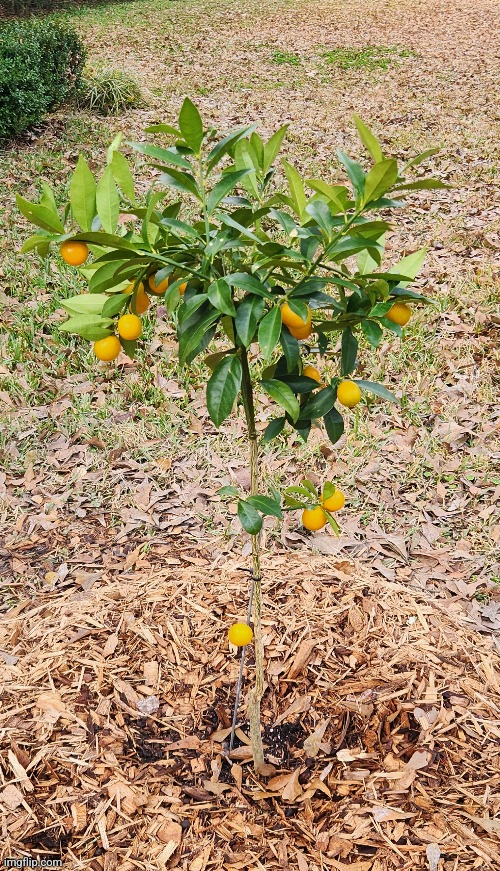
Bare rooting and replanting April 2025. Roots are healthy.


Status today.

Update 5/20/25: VICTORY!

Update 5/28/25: yeah we're good.

I only started growing the Meiwa kumquat back in October 2024, and unfortunately I have learned a lot about them the hard way. I selected a great looking healthy tree from the nursery and planted it in one of the few spots in my yard that gets half day morning sun. I had never heard of Gary Matsuoka and did not know anything about the scourge of bark chips and compost for root health, so I planted it with the nursery root ball full of bark and amended the hole with manure compost and called it a day. This was the eighth citrus I had grown and considered myself well-versed in it.
My first mistake was obviously leaving the bark chips in the rootball and planting with compost in the hole, but my second mistake was assuming that the Meiwa would behave like my Nagami kumquat (vigorous, fast-growing, impervious to pests/cold/stress, prolific). As it turns out, guys in the nursery trade will tell you that Meiwa is NOT a vigorous grower, needs more sun than Nagami, and is significantly less cold hardy, especially when young. In fact the only thing it seems to share with Nagami is a penchant for zinc deficiency.
So the tree did not grow at all, but the fruit ripened over the winter and they were the best kumquats I've ever had. Amazing. Extremely sweet and citrusy with only a hint of tropical tartness. It tastes like someone made candy out of a Nagami kumquat. After protecting it through the January snowpocalypse, I harvested the last fruit and eagerly awaited a spring flush and flowering. It didn't happen. Instead it did nothing at all, which I took for root development. Then leaves started yellowing one by one from the bottom up and falling. Then tiny new growth buds would form and then abort. It did not put on a single new leaf. Worse, the area I planted it in began to sink and started holding much more water than a citrus wants in the clay soil. I diagnosed this as the main reason for the decline.
By this time I knew about the detrimental effect of decaying organic matter to root health, so on 04/05/25 I took took the opportunity to dig it up, hose blast all the bark out of the root ball, and replanted it in the same spot on a one foot high mound of very sandy soil amended with perlite. The drainage and soil issues were solved. I have had huge success with literally every other tree doing this, including multiple citrus varieties, and I fully expected a dramatic turnaround like the 25 other times I've done this.
The Meiwa responded by going into shock and dropping 90% of its leaves. For the last 5 weeks it has done next to nothing and small growth buds are barely forming. It also has two flowers brought on by stress that will never set fruit.
Honestly, the jury is still out on this tree. I have no idea if it will ultimately recover. It is possible that half day sun simply isn't enough and that anything (growth, recovery, fruiting, etc.) with this tree is just very slow. I hope to update this post later this summer with a success story, but the fruit was so good that I bought a second tree to grow in a pot so that I can more tightly control the soil and light conditions. Based on my experience, it looks like it will recover but I've never seen anything this slow before.
This was obviously a case of hubris and I would have done things differently if I had known about this tree's particular growth habit versus the Nagami.
Tree difficulty: 3.5/5
Planting October 2024. Lots of fruit.
Ripe fruit.
Snowpocalypse.
Ready to harvest.
Bare rooting and replanting April 2025. Roots are healthy.
Status today.
Update 5/20/25: VICTORY!
Update 5/28/25: yeah we're good.
This post was edited on 5/28/25 at 8:28 pm
Posted on 5/11/25 at 1:42 pm to Tigerlaff
Great thread. I find myself checking it daily.
I'm in Zone 8a primarily, so some/much of this I can't grow but I can still glean good info from this thread. Like how poor a growing medium Miracle Grow "soil" seems to be. I had no idea. So many thanks.
I'm a novice fruit grower. I have four in-ground rabbiteye blueberry bushes, two container Owari Satsumas, One container Celeste Fig, and two container Wonderful Pomegranates.
I'm in Zone 8a primarily, so some/much of this I can't grow but I can still glean good info from this thread. Like how poor a growing medium Miracle Grow "soil" seems to be. I had no idea. So many thanks.
I'm a novice fruit grower. I have four in-ground rabbiteye blueberry bushes, two container Owari Satsumas, One container Celeste Fig, and two container Wonderful Pomegranates.
This post was edited on 5/11/25 at 1:44 pm
Posted on 5/11/25 at 6:41 pm to TerraForma
Thanks man. One of my main goals was to give people shortcuts to not make the same mistakes I did. If you're in zone 8 let me spit some knowledge at you about things you can grow that are not your typical local fare:
Bananas: Musa basjoo if you don't care about fruit. If you do, Dwarf Orinoco.
Feijoa/pineapple guava: any cultivar, provided it is either self fertile or you buy two different varieties to cross pollinate.
Loquat: multiple varieties hardy to zone 7. Will need to protect flowers and fruit below 28F.
Bananas: Musa basjoo if you don't care about fruit. If you do, Dwarf Orinoco.
Feijoa/pineapple guava: any cultivar, provided it is either self fertile or you buy two different varieties to cross pollinate.
Loquat: multiple varieties hardy to zone 7. Will need to protect flowers and fruit below 28F.
Posted on 5/12/25 at 10:56 am to Tigerlaff
I had a similar experience to you with a satsuma and grapefruit tree. Bad soil, too deep, wet. It’s been struggling for 6 years. lol. I pulled the grapefruit up about a month ago and planted on a berm..it has recovered well! I didn’t move the satsuma at the time bc it was looking good and flushing new growth. Big mistake, it has now started to look chlorotic, no blooms ..no vigor. I but the bullet yesterday and pulled it up as well, raised it on a berm of sand and river silt about 16” above grade..later in the season that I would have liked to do this.
Waiting game to see if it rebounds or gets replaced! It was going to die either way, so maybe it makes it!
I have definitely found in our clay heavy soil that planting most things on a berm makes more sense than not! We can always water, you can’t help dirt drain as easily!
Waiting game to see if it rebounds or gets replaced! It was going to die either way, so maybe it makes it!
I have definitely found in our clay heavy soil that planting most things on a berm makes more sense than not! We can always water, you can’t help dirt drain as easily!
Posted on 5/12/25 at 12:24 pm to DickTater
Yeah, every bit of that checks out. Glad you saved the grapefruit. Much easier to replace a satsuma. My kumquat is still just... existing. Not flushing growth but not dropping more leaves or losing color.
One good rule of thumb to remember is that trees dropping all their leaves is almost never a dire situation. They do it as a defense mechanism. But if you see leaves discoloring and wilting while they hang on the tree, then it's time to worry.
One good rule of thumb to remember is that trees dropping all their leaves is almost never a dire situation. They do it as a defense mechanism. But if you see leaves discoloring and wilting while they hang on the tree, then it's time to worry.
This post was edited on 5/12/25 at 12:28 pm
Posted on 5/12/25 at 3:16 pm to Tigerlaff
quote:This is good to know.
One good rule of thumb to remember is that trees dropping all their leaves is almost never a dire situation. They do it as a defense mechanism. But if you see leaves discoloring and wilting while they hang on the tree, then it's time to worry.
Posted on 5/12/25 at 4:48 pm to Tigerlaff


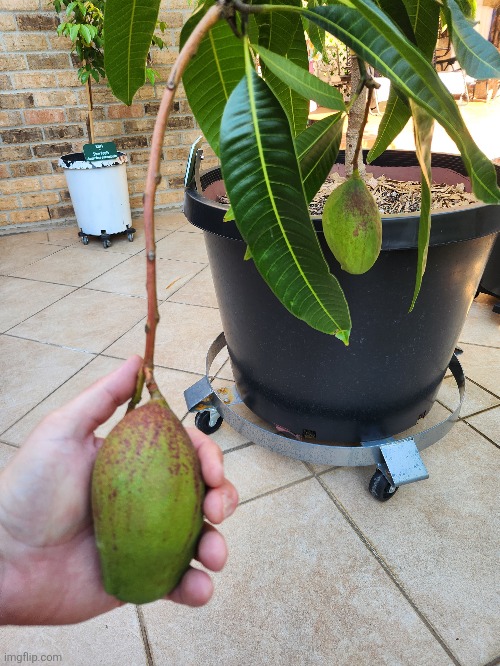
Some motivation for those who joined the Pickering mango team. I’m guessing we’re 4-6 weeks out. Maybe less…
Planted as a 7 gallon tree a little more than a year ago.
Posted on 5/12/25 at 5:40 pm to wiltznucs
Right there with you boss.
This post was edited on 5/13/25 at 5:26 pm
Posted on 5/12/25 at 6:05 pm to Tigerlaff
05/12/2025 (post #4) - Jamaican Cherry Tree / Strawberry Tree (Muntingia calabura)
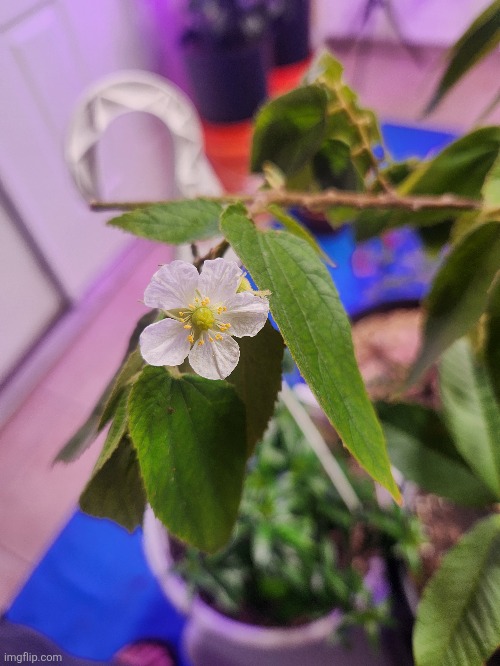
The Jamaican Cherry is the fastest growing woody plant I have ever grown. Only bamboo (a grass) or bananas (an herb) would surpass the insanely aggressive growth rate of this tree. I got it in February and have cut it back twice. If grown in the ground in the right climate, it can grow 20 feet in the first year. It is also called the Strawberry Tree for it's flowers, which look exactly like strawberry flowers.
This tree will not survive freezes and hates cold weather. It drinks a ton of water as a result of the growth rate. Videos on YouTube prove that this tree can be dwarfed by container growing and severe pruning before putting away for the winter.
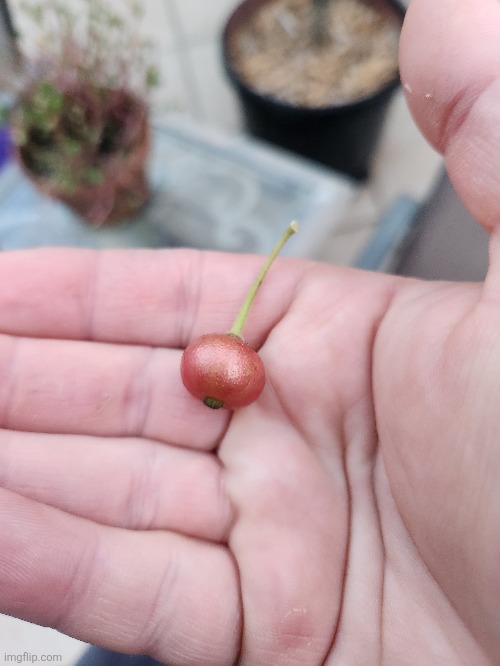
The fruit is a small cherry-like ball that turns red upon ripening. On the front end, it tastes exactly like cotton candy. On the back end, it tastes exactly like buttered popcorn. It is a weird and delightful eating experience and it fruits prolifically and constantly. I am able to pick at least a couple every day from my small tree and it is very early in the growing season.
Tree difficulty: 2/5.
Tree arrival on 02/15/25. That's a 15g pot.
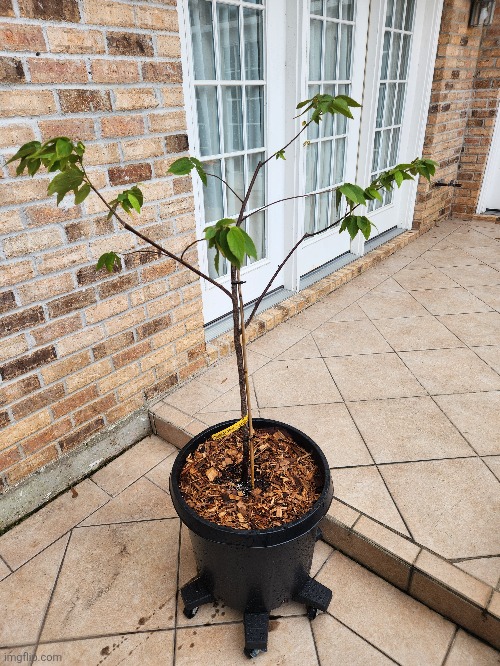
Tree today 05/12/25.
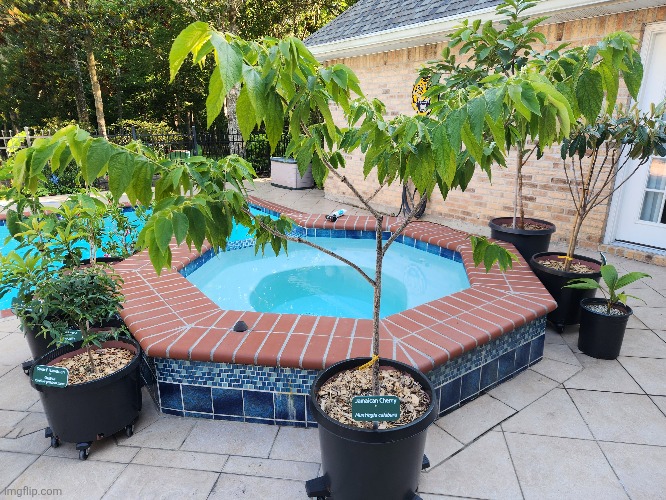
Flower
Fruit
The Jamaican Cherry is the fastest growing woody plant I have ever grown. Only bamboo (a grass) or bananas (an herb) would surpass the insanely aggressive growth rate of this tree. I got it in February and have cut it back twice. If grown in the ground in the right climate, it can grow 20 feet in the first year. It is also called the Strawberry Tree for it's flowers, which look exactly like strawberry flowers.
This tree will not survive freezes and hates cold weather. It drinks a ton of water as a result of the growth rate. Videos on YouTube prove that this tree can be dwarfed by container growing and severe pruning before putting away for the winter.
The fruit is a small cherry-like ball that turns red upon ripening. On the front end, it tastes exactly like cotton candy. On the back end, it tastes exactly like buttered popcorn. It is a weird and delightful eating experience and it fruits prolifically and constantly. I am able to pick at least a couple every day from my small tree and it is very early in the growing season.
Tree difficulty: 2/5.
Tree arrival on 02/15/25. That's a 15g pot.
Tree today 05/12/25.
Flower
Fruit
This post was edited on 5/13/25 at 5:25 pm
Posted on 5/12/25 at 8:06 pm to wiltznucs
Jealous! My lil tree is probably 12” tall 
Posted on 5/12/25 at 8:33 pm to Neauxla
quote:
Jealous! My lil tree is probably 12” tall
If it’s any consolation; odds are you got the best option. It’s been a wacky year for us in terms of weather; but, Pickering has been the winner in my grove. Even among some more mature trees. 15+ mango varieties and the little Pickering smoked the competition. Hang in there!
Posted on 5/13/25 at 11:23 am to wiltznucs
quote:at least my Nam Doc Mai #4 is growing. It's had 2 growth spurts. My pickering just grew a ton of flowers which I pinched off, but no new branches or leaves.
If it’s any consolation; odds are you got the best option. It’s been a wacky year for us in terms of weather; but, Pickering has been the winner in my grove. Even among some more mature trees. 15+ mango varieties and the little Pickering smoked the competition. Hang in there!
Got them around the same time and size.
Posted on 5/15/25 at 10:09 am to Neauxla
Got a chance to try white sapote from Lara Farms today. Got 5lbs of them. This is the Redlands variety. I have a small Suebelle tree that is not old enough to bear fruit yet.
The taste and texture is like sweet vanilla custard with slight citrus undertones. The tree is a relative of citrus so I suppose that makes sense. The skin is bitter but also highly aromatic and somehow enjoyable (at least for a bite or two).
This is an incredibly good tasting fruit and I can definitely say we do not have anything analogous in Louisiana. The only drawback is the relatively high seed to fruit ratio. Otherwise, an elite fruit for me.


The taste and texture is like sweet vanilla custard with slight citrus undertones. The tree is a relative of citrus so I suppose that makes sense. The skin is bitter but also highly aromatic and somehow enjoyable (at least for a bite or two).
This is an incredibly good tasting fruit and I can definitely say we do not have anything analogous in Louisiana. The only drawback is the relatively high seed to fruit ratio. Otherwise, an elite fruit for me.
Posted on 5/15/25 at 10:35 am to Tigerlaff
quote:cold hardy in the ground without too much hassle?
white sapote
Posted on 5/15/25 at 10:44 am to cgrand
quote:
cold hardy in the ground
Possibly. From my research, it appears to be about as cold hardy as a Meyer lemon. This means it will absolutely need protection every winter, but I do have a large 6 year old Meyer lemon in my yard. The white sapote seems to be much more cold hardy than you would suspect and I can personally attest that the Meyer lemon is NOT as cold hardy as commonly advertised.
quote:
without too much hassle?
There's the rub. It wants to be a huge tree and will try to grow too large for you to protect. It is possible in large pots to restrict the roots and dwarf the tree's growth significantly, which is what I'm doing. I honestly don't know if you could prune it enough to keep protectable and also get a decent fruit set.
This post was edited on 5/15/25 at 10:46 am
Posted on 5/15/25 at 2:44 pm to Tigerlaff
Definitely some Sapote fans out there. I’ve not tried the White Sapote. Have tried the Black Sapote though. Didn’t really blow my skirt up; but, it has its fans too.
Posted on 5/15/25 at 4:28 pm to Tigerlaff

Dwarf Hawaiian Mangoes are coming along. Looks like they’ll be a bit smaller than usual this year. I’m actually surprised to have got any. It bloomed unusually early and had all male flowers the first time around. So no fruit set whatsoever.
This fruit is from the second bloom after the new year. It’s actually setting a third bloom currently. So a mix of emerging panicles and developing fruit all at the same time on the same tree.
Posted on 5/15/25 at 4:45 pm to wiltznucs
how can you tell the difference between male and female flowers?
Posted on 5/15/25 at 6:11 pm to Neauxla

 Page 20 of 155



Popular

Back to top
 Follow TigerDroppings for LSU Football News