




- My Forums
- Tiger Rant
- LSU Recruiting
- SEC Rant
- Saints Talk
- Pelicans Talk
- More Sports Board
- Fantasy Sports
- Golf Board
- Soccer Board
- O-T Lounge
- Tech Board
- Home/Garden Board
- Outdoor Board
- Health/Fitness Board
- Movie/TV Board
- Book Board
- Music Board
- Political Talk
- Money Talk
- Fark Board
- Gaming Board
- Travel Board
- Food/Drink Board
- Ticket Exchange
- TD Help Board
Customize My Forums- View All Forums
- Show Left Links
- Topic Sort Options
- Trending Topics
- Recent Topics
- Active Topics
Started By
Message
re: Homebrewing Thread: Volume II
Posted on 7/7/20 at 8:39 am to BottomlandBrew

Posted on 7/7/20 at 8:39 am to BottomlandBrew
quote:
Won't help with flavor. Will help with aroma. I'd suggest the next batch doing a 15 minute addition for flavoring. You really need some boil to get those hop flavor compounds bound to the beer. For some reason a lot of the NEIPA recipes have gotten away from flavor hop additions and instead prefer massive late additions.
You could even add hops in the mash. I don't remember exactly the verbiage, but in Janish's book The New IPA, there was a study performed at one of the Japanese breweries that showed hops introduced in the mash increases the hop compounds found in the finished beer.
That being said, i doubt that means anything in the homebrewing world. If this were a brulosophy study, then the results would be like every single other brulosophy experiment.
 1
1



Posted on 7/7/20 at 9:09 am to BugAC
Any idea why the hop flavor and aroma disappeared after a month? I thought I went over kill on the amount of hops.


Posted on 7/7/20 at 9:25 am to BigPerm30
It's just what happens with hops. It fades with time, and you can have some pretty steep dropoffs if the majority of your hops are aroma. More isn't always better. You hit a point where adding more hops is doing nothing but soaking up excess beer.
Posted on 7/7/20 at 9:42 am to BigPerm30
quote:
Any idea why the hop flavor and aroma disappeared after a month? I thought I went over kill on the amount of hops.
Don't know. The only time that happens to me is when i have issues with my transfer. After about a month the hop aroma fades, and then in another month or so it starts turning brown.
Posted on 7/7/20 at 10:21 am to BugAC
Thanks. I guess I need to start making smaller batches or drinking faster.

Posted on 7/8/20 at 10:23 am to BigPerm30
Those of you with experience brewing saisons. Any tips for my first?
Finally got my 2.5 gal keg for smaller batch brews. Think I am going to fill it with a saison while its warm and I can ferment at 80-90 degrees. I have read about open fermentations, do y'all do that? Any yeast recs? Do some strains have bacteria or things that will produce some tartness?
Finally got my 2.5 gal keg for smaller batch brews. Think I am going to fill it with a saison while its warm and I can ferment at 80-90 degrees. I have read about open fermentations, do y'all do that? Any yeast recs? Do some strains have bacteria or things that will produce some tartness?

Posted on 7/8/20 at 10:47 am to GeauxPack81
quote:
Those of you with experience brewing saisons. Any tips for my first?
My favorite grain bill for saisons is
81% pilsner malt
10% white wheat
5% flaked oats
3% acid malt
My favorite hop for this beer has always been Mosaic. I normally use Wyeast 3711. I mash low, 148 degrees. This grain bill was one that Great Raft used for one of their Born in a Barn beers.
Posted on 7/8/20 at 1:21 pm to GeauxPack81
quote:
Those of you with experience brewing saisons. Any tips for my first?
If you want to look at Saison Dupont as the archetype, then keep it simple for the grain bill. They use 100 Belgian pilsner, but they also do a linear step mash, so you might want to add a few ounces of melanoidin malt to give it that little extra something if you don't want to commit to the step mash. I do a hochkurz mash with a rest at 147 and 162.
Mash on the lower end if doing a single infusion. 147-149 for 90 minutes.
You want a long than normal boil. The past few years I've moved to a 120 minute boil. If you look at Saison Dupont, it's a lot more golden than a 100% pilsner malt bill would normally be, and some of this is from a longer boil.
EKG and Styrian Golding are the prototypical Dupont hops, but you can go with most classic European styles. I like Northern Brewer, Saaz, or Hallertau.
3724 and 565 are supposedly the Dupont strains, but there's some debate on whether Dupont is actually a blend and 565 and 3724 are two different parts of the blend. You want to start them in the 60's for the first 24 hours of active fermentation to bring out the fruitier esters, then crank it up to 80 or more to get the spicier phenols. If you start hot you'll end up with a lot of pepper with little fruit. You'll see some chatter baout it stalling around 1.020, but just pitch a big starter and keep it warm to finish and you'll get to terminal gravity without stalling.
3711 is an option, but it's not all that great flavor wise. It'll ferment water, but you sacrifice some flavor for ease. Given the choice I will go with 3724 and 565, but I've used 3711 many times and will use it again.
There are some blended strains out there with brett or bacteria. Yeast Bay has their farmhouse blend that has lacto with a saison strain, and White Labs has 670 which is saison blended with classic Brett B. The yeast bay strain is a quick turnaround. The 670 is a commitment, but holy hit is it funky and awesome.
Posted on 7/8/20 at 1:39 pm to GeauxPack81
quote:
Those of you with experience brewing saisons. Any tips for my first?
Finally got my 2.5 gal keg for smaller batch brews. Think I am going to fill it with a saison while its warm and I can ferment at 80-90 degrees. I have read about open fermentations, do y'all do that? Any yeast recs? Do some strains have bacteria or things that will produce some tartness?
I probably brew saisons more than any other style, but they are the base for most of my sour beers.
A few things:
1) I don't ferment my saisons in the 80s/90s. It is possible, but all of my saisons are in the mid-high 70s. Keep in mind, though, my saisons are almost exclusively mixed fermentation as well.
2) I do not do open fermentations...yet. Problem with open fermentation is that our climate (Louisiana) is rarely suited for it. Meaning, you'll likely get some nasty critters in your beer if you open ferment. Open fermentation is best done when its at or below freezing. I may try it this winter if we get some predictably cold weather, but it's not often that happens. A quick way of getting some of those microbes from open air fermentation, is making a starter and putting a cheese cloth over one end to keep out insects, and put near an area you think may have good fermentation potential, such as garden/fruits/etc...
3) Yeast recs are all over the place. If you want dry and peppery, then Wyeast3711 French Saison is your man. It will ferment water, if you let it. Highly attenuative. I like Belgian Saison strains. Not quite as peppery as French. The only problem, is they tend to stall frequently, and take a while to finish up. However, with mixed ferm saisons where i'm using some brettanomyces, this really isnt' much of an issue.
4) Some brett strains produce lactic acid. If you're more curious about mixed fermentation/brett fermentation go to the milk the funk wiki page. They have tons of good information for mixed ferm beers. I have a saison fermenting right now with 3 or 4 brett packs (multiple strains per pack) in hopes of getting some brett acidity. If i get none, then i'll blend a small amount of a mixed ferm sour to get the acidity i want.
LINK
Now if you want some acidity, go to bootleg biology's website and order The Mad Fermentationist Blend. It's a saison blend with saison sach yeast, brett yeast, and LAB (lactic acid bacteria). Depending on your recipe design and time allowed to ferment, it can produce anything from mild to moderate sourness. More hops/IBU's equals more restrained acidity in the mixed ferm world. Some LAB's (lactobacillus, pediococcus) are very hop intolerant, so much so that 5 IBU's could be enough to prohibit acidity. However, through my experience, you can bump that up to 12-15 IBU's and still have acidity shine through. My mixed ferms sit for a year or more before bottling, and my mildly hopped sours (5ish range) were VERY acidic.
I've been playing around more with light acidity. Blending is the most predictable way of getting what i want out of mixed ferm. I used to blend 50/50 or 75/25 sour/new beer. Now i'm more blending 20/80 sour/clean beer. I'm about to go to a model of keeping a stock of more acidic beers, and blending with brett/sach fermentations from now on. Sour beer is fun, but it's a long learning curve.
This post was edited on 7/8/20 at 1:44 pm
Posted on 7/8/20 at 1:55 pm to BugAC
And in regards to mixed fermentations, there is additional variables to account for. Your pitching method could also determine how much brett character is produced.
Pitching altogether - tends to lead to less bretty flavors per the research. In layman's terms, brett eats the esters produced by saccharomyces, along with the unfermented sugars from a sach fermentation. If pitched together, it becomes a race of who is eating the sugars both strains wants, first, which tends to lead to a more neutral brett profile.
Staggered Pitch - such as pitching sach first, let it ferment out, then pitch the brett (AND LABS if introducing bacteria to acidify). As stated above, the Brett is on cleanup duty, and with that, tends to produce more of your funky brett flavors.
Under Pitching - There are also studies out that show that underpitching brett (low cell count) leads to stronger brett aromas/flavors.
Bottle Conditioning - and then, after all of this, you can bottle condition with Brett. I used to either bottle condition my sours with either brett or a wine/champagne yeast. However, now, i strictly bottle condition with Brett. Not only does it lead to more amplified brett notes, but the beer tends to evolve in the bottle. My mixed ferm beers will taste different from 2 months to 6 months to 1 year in teh bottle. It's really fun not knowing how the beer will change. I've made a particularly extremely funky brett beer before, almost to where i couldn't drink it 3-4 months after bottled. Tasted like burnt wires/plastic. After 8 months in the bottle, it went from super funky, to pleasantly fruity, with that mild bubblegum/leather flavors of classic bretts.
Pitching altogether - tends to lead to less bretty flavors per the research. In layman's terms, brett eats the esters produced by saccharomyces, along with the unfermented sugars from a sach fermentation. If pitched together, it becomes a race of who is eating the sugars both strains wants, first, which tends to lead to a more neutral brett profile.
Staggered Pitch - such as pitching sach first, let it ferment out, then pitch the brett (AND LABS if introducing bacteria to acidify). As stated above, the Brett is on cleanup duty, and with that, tends to produce more of your funky brett flavors.
Under Pitching - There are also studies out that show that underpitching brett (low cell count) leads to stronger brett aromas/flavors.
Bottle Conditioning - and then, after all of this, you can bottle condition with Brett. I used to either bottle condition my sours with either brett or a wine/champagne yeast. However, now, i strictly bottle condition with Brett. Not only does it lead to more amplified brett notes, but the beer tends to evolve in the bottle. My mixed ferm beers will taste different from 2 months to 6 months to 1 year in teh bottle. It's really fun not knowing how the beer will change. I've made a particularly extremely funky brett beer before, almost to where i couldn't drink it 3-4 months after bottled. Tasted like burnt wires/plastic. After 8 months in the bottle, it went from super funky, to pleasantly fruity, with that mild bubblegum/leather flavors of classic bretts.

Posted on 7/8/20 at 2:56 pm to BugAC
Someone was asking about Hazy IPA's and some tips on them eariler, i don't remember who. But i mentioned adding hops to the mash.
Listening to Scott Janish on The Full Pint Podcast, and he states the reason for adding hops in the mash, is that there are metals within the grains that speeds up oxygen absorption. Hops counteract this, but by adding some hops to the mash, you neutralize these metals in the grains.
He also talks about using malted oats or golden naked oats as opposed to flaked oats. I've been using malted oats recently. The reasoning, is that oats is also high in manganese which is highly oxygen absorbent.
ETA: I'm also reading right now that Idaho-7 has outstanding hot side hopping contributions to the overall hop flavor of the beer. LINK
Listening to Scott Janish on The Full Pint Podcast, and he states the reason for adding hops in the mash, is that there are metals within the grains that speeds up oxygen absorption. Hops counteract this, but by adding some hops to the mash, you neutralize these metals in the grains.
He also talks about using malted oats or golden naked oats as opposed to flaked oats. I've been using malted oats recently. The reasoning, is that oats is also high in manganese which is highly oxygen absorbent.
ETA: I'm also reading right now that Idaho-7 has outstanding hot side hopping contributions to the overall hop flavor of the beer. LINK
This post was edited on 7/8/20 at 3:15 pm

Posted on 7/8/20 at 3:08 pm to BugAC
i bought his new book.......still only about 1 page and a half in.
Posted on 7/8/20 at 3:15 pm to CarRamrod
quote:
i bought his new book.......still only about 1 page and a half in.
It's not an easy read. It's very technical and scientific. But he does a great job of summarizing the chapters at the end.
Posted on 7/8/20 at 3:18 pm to BugAC
 i get the technicality of it..... it is the 2 year old and 6 week old that is hooding my back.
Posted on 7/8/20 at 3:20 pm to CarRamrod
quote:
i get the technicality of it..... it is the 2 year old and 6 week old that is hooding my back.
Don't know why that would be a distraction...
Posted on 7/8/20 at 3:20 pm to BugAC
quote:
The temperature of the whirlpool is another factor to experiment with to encourage monoterpene alcohols to find their way into the fermenter. Takako Inui, a Specialist in the Beer Development Department at Suntory Beer Ltd., Japan showed that late hopping at 185°F (85°C) retained slightly more measured linalool compared to late hopping warmer at 203°F (95°C) or cooler at 167°F (75°C). 4 Because of the research (as well as intentionally trying to have less bitterness from significant whirlpool additions) at Sapwood we are generally targeting a whirlpool temperature around 180°F (82°C).
I was also talking about this in terms of whirlpooling. I think a poster was getting back into brewing again and was inquiring on any new info out there.
Posted on 7/8/20 at 3:27 pm to BugAC
quote:
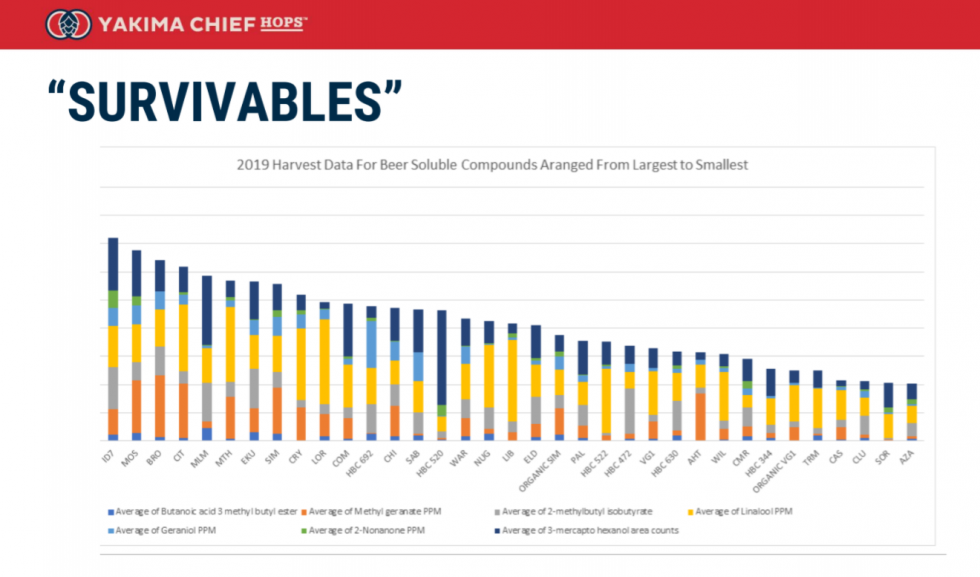
Finally, this brings us to the most recent research in this area from Yakima Chief Hops. If we know what compounds are likely the most important to hot-side flavor, why not test which hops have the highest combination of all these compounds? This is exactly what Yakima Chief did and coined these compounds as “survivables.” I like it!
Below are the results of Yakima Chief’s study12 (and one of the more exciting hop charts I’ve seen in a while). Testing hops for a combination of monoterpene alcohols (linalool and geraniol), thiols (3MH), and hop-derived ester (2MIB), you can see why I was likely so bullish on Idaho 7! Idaho 7 leads the pack when it comes to having the most of these survivable compounds and why it’s likely such a great hot-side hop. Not far behind are Mosaic, Bravo, Citra, and Millennium, Mount Hood, Euaknot, and Simcoe. Yakima Chief is using the research to put together a blend of Cryo called TRI-2304CR, that will be a blend of hops that are loaded with these survivables! You can check out the full presentation on their webinars website.
quote:
Conclusion
Hopefully, this post helps inspire some new experimentation when it comes to packing in as much hot-side hop flavor as possible into your beers!
Below is a list of the hops that came up in the research that may be great to play with in the whirlpool. Because hot-side flavor is so complex, it makes sense to try and blend these varieties to push as much sensory explosion as possible! I’m curious to hear which hop, or combination of hops, you have the most luck with to push pre-dry-hop flavor.
Idaho 7
Bravo
Brewers Gold
Centennial
Citra
Columbus
Ekuanot
Mosaic
Simcoe
Southern Cross
Pacific Jade
Vic Secret
Polaris
Huell Melon
Millennium
Mount Hood
quote:
Key Points
Sampling your beer pre-dry hop is one of the best ways to determine how well your hot-side hops performed. I try to make this a habit.
Monoterpene alcohols like linalool and geraniol are consistently mentioned as key components of determining hop flavor intensity. To push hop-derived monoterpene alcohols in beer, lowering the temperature of the whirlpool to 185°F (85°C) may be worth exploring.
Hop-derived esters help to give beer fruity apple and apricot-like flavors and are likely retained at higher concentrations when added to the whirlpool.
Hop-derived fatty acids can impact the flavor and aroma of beer through the esterification processes (which have low thresholds) and synergy. Specifically, the acids can amplify the sensory experience of monoterpene alcohols.
Slightly aging your hops (especially Bravo and Apollo) and using them in a blend with other great hot-side hops may be a good way to build in hot-side flavor complexity.
Hop-derived thiols have low sensory thresholds, but can contribute to hop fruity hop flavor synergistically and on their own.
The thiol 3MH (grapefruit-like) can increase during the boil, but 4MMP is likely retained in higher concentrations during cooler whirlpool conditions.
Hops high in a combination of all these “survivables” may be some of the best to experiment with in the whirlpool.
Posted on 7/8/20 at 4:02 pm to BottomlandBrew
Thanks for all the help everyone. Probably just stick to 3711 for now then. Seems easiest. I'll get my feet wet with one soon, and really try more experimentation next summer.
Posted on 7/8/20 at 5:28 pm to BugAC
What's that quoted from?
This post was edited on 7/8/20 at 5:28 pm
Posted on 7/8/20 at 5:29 pm to CarRamrod
quote:
What's that quoted from?
The link I posted above. Scottjanish.com

 Page 225 of 281

Popular
Back to top
 Follow TigerDroppings for LSU Football News