




- My Forums
- Tiger Rant
- LSU Recruiting
- SEC Rant
- Saints Talk
- Pelicans Talk
- More Sports Board
- Fantasy Sports
- Golf Board
- Soccer Board
- O-T Lounge
- Tech Board
- Home/Garden Board
- Outdoor Board
- Health/Fitness Board
- Movie/TV Board
- Book Board
- Music Board
- Political Talk
- Money Talk
- Fark Board
- Gaming Board
- Travel Board
- Food/Drink Board
- Ticket Exchange
- TD Help Board
Customize My Forums- View All Forums
- Show Left Links
- Topic Sort Options
- Trending Topics
- Recent Topics
- Active Topics
Started By
Message

The Great Game: America’s Long & Disastrous Foreign Policy Agenda In The Middle East:
Posted on 12/8/24 at 5:13 pm

Posted on 12/8/24 at 5:13 pm
Iran looks to be the biggest loser in the latest turmoil to rock the Middle East. Yet tragically, Iran’s current Revolutionary State is in many ways a reaction and lasting legacy of past American interventionism in the region. How so?
Recommended reading: America's Great Game: The CIA's Secret Arabists and the Shaping of the Modern Middle East by Hugh Wilford.
This book of deep history focuses primarily on three CIA agents and their regime change efforts in three countries after WWII: Syria, Egypt and Iran. The key figure that emerges in this narrative is Kermit “Kim” Roosevelt — grandson of Theodore. Roosevelt was recruited into the newly created Central Intelligence Agency to head the Office of Policy Coordination, the espionage and counter-intelligence branch of the CIA.
A rather complicated chess game of competing powers in the newly formed CIA emerges — the Zionists vs. the anti-Zionists. And what a wicked game it was. Wilford illustrates how these agent provocateurs were very short sighted in their schemes and largely viewed the indigenous populations of the Middle Eastern nations as simple pawns in a larger chess game between the Great Powers.
These CIA wunderkinds with blue-blood pedigrees viewed the nation states in the post-colonial era as blank slates to be shaped at will by their supposed knowledge and intellect. Yet rather than fundamentally transform power relations in the Middle East to pro-American sentiment as promised, this spy clique of the Eastern Establishment inculcated a residual and generational resentment toward American meddling in the region that is still evident today.
Along with Roosevelt, Miles Copeland — a Birmingham Alabama native and the father of the famed rock musician Stewart — is another CIA spook who was instrumental in shaping the Middle Eastern landscape after the end of WWII. Copeland helped orchestrate the first CIA military coup in the region: a 1949 bloodless putsch in Syria. The CIA installed Husni al-Za’im, a former Kurdish officer in the Ottoman Army.
Kim Roosevelt, along with assistance from his cousin Archibald Roosevelt, in turn masterminded the 1953 Iranian coup d'état which toppled nationalist prime minister Mohammed Mosaddeqh after Mosaddeqh nationalized the petroleum industry in Iran.
Archibald Roosevelt in turn orchestrated a second 1956 regime change operation in Syria after a violent counter-coup displaced the al-Za’im regime. This second regime change operation in Syria and the ensuing instability ultimately helped push Syria closer to the USSR.
This was a repeated pattern. The CIA’s initial backing of Egyptian General Mohamed Naguib — and his young protege General Gamal Abdel Nasser — likewise backfired when Nasser ousted his elder benefactor, turned his back on the West and nationalized the Suez Canal.
As a tweak to the West, Nasser also opened diplomatic channels to the Soviet Union and supported the creation of a socialist pan-Arabic State. And of course, we all know the results of the festering resentment over the installation of the Shah that ultimately resulted in the Iranian revolution.
Whether it was braggadocio, naïveté or misplaced idealism, the failures of these nation building efforts shaped the modern Middle East that we know today. Sadly, this “game” continues anew. The same doublespeak and false promises spew forth from the mouths of these Masters of the Universe types in our corrupt national security apparatus.
Perhaps it was possible at one time to posit that the chaos and violent fury released upon the region after the Iraq War was an unforeseen contingency. Yet we have now seen a succession of four Middle Eastern nations — Iraq, Libya, Yemen and now Syria — engulfed in violence and human catastrophe after US, NATO and Western military intervention. And now these Masters of the Universe want a war with Iran?
Not coincidentally, each of these repeated military interventions have been followed by a staggering refugee wave headed for Europe. Yet in the name of pluralism, Western nations are sternly lectured by many of these same ruling elites that it must open their borders to a deluge of immigrants whose values are wholly alien to pluralistic societies and must instead welcome these immigrants though many have demonstrated violent antagonism toward free societies?
At this late stage, naïveté can’t be blamed for these repeated failures. It is indeed sheer madness to claim the situation in the Middle East is all an unforeseen accident. The pattern is established and is crystal clear for anyone who doesn’t regurgitate Deep State talking points. The minute details and the exact coordination of the plan becomes irrelevant when the larger pattern is so clear: chaos — the more violent the better — is the goal of these repeated regime change operations.
We can’t change the past. But must we be doomed to repeat it? Endlessly on a loop?
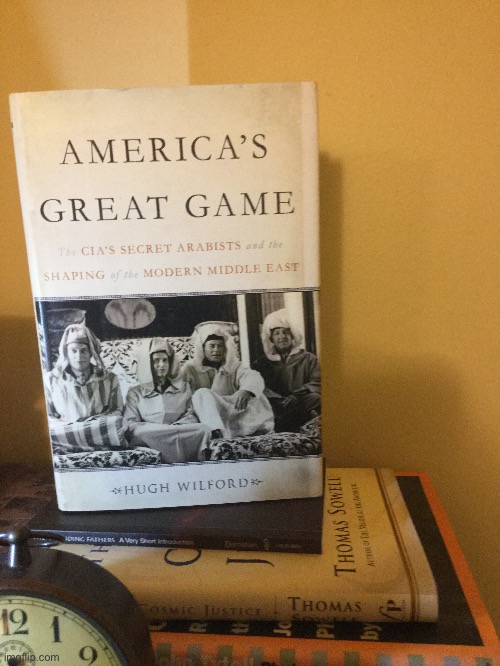
Recommended reading: America's Great Game: The CIA's Secret Arabists and the Shaping of the Modern Middle East by Hugh Wilford.
This book of deep history focuses primarily on three CIA agents and their regime change efforts in three countries after WWII: Syria, Egypt and Iran. The key figure that emerges in this narrative is Kermit “Kim” Roosevelt — grandson of Theodore. Roosevelt was recruited into the newly created Central Intelligence Agency to head the Office of Policy Coordination, the espionage and counter-intelligence branch of the CIA.
A rather complicated chess game of competing powers in the newly formed CIA emerges — the Zionists vs. the anti-Zionists. And what a wicked game it was. Wilford illustrates how these agent provocateurs were very short sighted in their schemes and largely viewed the indigenous populations of the Middle Eastern nations as simple pawns in a larger chess game between the Great Powers.
These CIA wunderkinds with blue-blood pedigrees viewed the nation states in the post-colonial era as blank slates to be shaped at will by their supposed knowledge and intellect. Yet rather than fundamentally transform power relations in the Middle East to pro-American sentiment as promised, this spy clique of the Eastern Establishment inculcated a residual and generational resentment toward American meddling in the region that is still evident today.
Along with Roosevelt, Miles Copeland — a Birmingham Alabama native and the father of the famed rock musician Stewart — is another CIA spook who was instrumental in shaping the Middle Eastern landscape after the end of WWII. Copeland helped orchestrate the first CIA military coup in the region: a 1949 bloodless putsch in Syria. The CIA installed Husni al-Za’im, a former Kurdish officer in the Ottoman Army.
Kim Roosevelt, along with assistance from his cousin Archibald Roosevelt, in turn masterminded the 1953 Iranian coup d'état which toppled nationalist prime minister Mohammed Mosaddeqh after Mosaddeqh nationalized the petroleum industry in Iran.
Archibald Roosevelt in turn orchestrated a second 1956 regime change operation in Syria after a violent counter-coup displaced the al-Za’im regime. This second regime change operation in Syria and the ensuing instability ultimately helped push Syria closer to the USSR.
This was a repeated pattern. The CIA’s initial backing of Egyptian General Mohamed Naguib — and his young protege General Gamal Abdel Nasser — likewise backfired when Nasser ousted his elder benefactor, turned his back on the West and nationalized the Suez Canal.
As a tweak to the West, Nasser also opened diplomatic channels to the Soviet Union and supported the creation of a socialist pan-Arabic State. And of course, we all know the results of the festering resentment over the installation of the Shah that ultimately resulted in the Iranian revolution.
Whether it was braggadocio, naïveté or misplaced idealism, the failures of these nation building efforts shaped the modern Middle East that we know today. Sadly, this “game” continues anew. The same doublespeak and false promises spew forth from the mouths of these Masters of the Universe types in our corrupt national security apparatus.
Perhaps it was possible at one time to posit that the chaos and violent fury released upon the region after the Iraq War was an unforeseen contingency. Yet we have now seen a succession of four Middle Eastern nations — Iraq, Libya, Yemen and now Syria — engulfed in violence and human catastrophe after US, NATO and Western military intervention. And now these Masters of the Universe want a war with Iran?
Not coincidentally, each of these repeated military interventions have been followed by a staggering refugee wave headed for Europe. Yet in the name of pluralism, Western nations are sternly lectured by many of these same ruling elites that it must open their borders to a deluge of immigrants whose values are wholly alien to pluralistic societies and must instead welcome these immigrants though many have demonstrated violent antagonism toward free societies?
At this late stage, naïveté can’t be blamed for these repeated failures. It is indeed sheer madness to claim the situation in the Middle East is all an unforeseen accident. The pattern is established and is crystal clear for anyone who doesn’t regurgitate Deep State talking points. The minute details and the exact coordination of the plan becomes irrelevant when the larger pattern is so clear: chaos — the more violent the better — is the goal of these repeated regime change operations.
We can’t change the past. But must we be doomed to repeat it? Endlessly on a loop?
This post was edited on 12/8/24 at 9:34 pm
 2
2


Posted on 12/8/24 at 7:23 pm to Toomer Deplorable
British Intelligence was hip-deep in that Iranian coup, yet the CIA always gets the blame
Posted on 12/8/24 at 9:13 pm to FightinTigersDammit
quote:
British Intelligence was hip-deep in that Iranian coup,
BRITISH PETROLEUM (then known as the Anglo-Iranian Oil Company) was hip-deep in that Iranian coup…
FIFY!

But it most certainly is true that protecting British oil investments was the primary purpose of the 1953 Iranian coup.
Kermit Roosevelt was the primary instigator tasked with that mission, code name Operation Ajax.
When early intelligence reports indicated the coup was failing after loyalists to Prime Minister Muhammad Mossadegh offered stiff resistance, Roosevelt disregarded a cable from HQ CIA telling him to abort the mission and proceeded with the coup just the same.
This post was edited on 12/8/24 at 9:29 pm
Posted on 12/9/24 at 6:37 am to Toomer Deplorable

 Page 1 of 1


Popular
Back to top
 Follow TigerDroppings for LSU Football News