




 1
1









- My Forums
- Tiger Rant
- LSU Recruiting
- SEC Rant
- Saints Talk
- Pelicans Talk
- More Sports Board
- Fantasy Sports
- Golf Board
- Soccer Board
- O-T Lounge
- Tech Board
- Home/Garden Board
- Outdoor Board
- Health/Fitness Board
- Movie/TV Board
- Book Board
- Music Board
- Political Talk
- Money Talk
- Fark Board
- Gaming Board
- Travel Board
- Food/Drink Board
- Ticket Exchange
- TD Help Board
Customize My Forums- View All Forums
- Show Left Links
- Topic Sort Options
- Trending Topics
- Recent Topics
- Active Topics
Started By
Message
re: Evangelicals turning on Catholics all of a sudden.
Posted on 4/16/26 at 1:50 pm to madmaxvol
Posted on 4/16/26 at 1:50 pm to madmaxvol
The 1054 split wasn’t Rome “starting something new.” Both East and West already existed as the same apostolic Church with bishops, sacraments, and succession going back to the apostles. The split was over authority and doctrine within that already existing structure.
The Reformation is fundamentally different. It wasn’t a dispute within the same sacramental and apostolic framework that stayed intact. It rejected core elements of that framework outright. That’s why you get multiple, conflicting confessions afterward.
Also, calling it “Apostolic Catholic” vs “Roman Catholic” doesn’t solve anything. Rome can actually point to continuous bishops, councils, and teaching authority from the beginning. Where is that continuity structurally in Protestantism prior to the 1500s?
You can say “we separated,” but separated from what? If the answer is a visible, historical Church with defined authority, then you’re still depending on that Church for your origin while denying its authority.
The Reformation is fundamentally different. It wasn’t a dispute within the same sacramental and apostolic framework that stayed intact. It rejected core elements of that framework outright. That’s why you get multiple, conflicting confessions afterward.
Also, calling it “Apostolic Catholic” vs “Roman Catholic” doesn’t solve anything. Rome can actually point to continuous bishops, councils, and teaching authority from the beginning. Where is that continuity structurally in Protestantism prior to the 1500s?
You can say “we separated,” but separated from what? If the answer is a visible, historical Church with defined authority, then you’re still depending on that Church for your origin while denying its authority.
Posted on 4/16/26 at 2:33 pm to METAL
quote:
Trogo and phagein absolutely mean two different things.
The problem with building up these semantic domains without support is that they don’t really stand up.
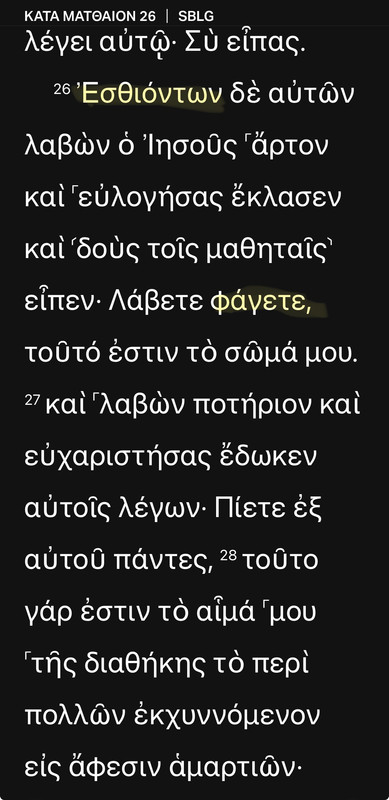
In the SBLG text below, Jesus is addressing the disciples with the First Eucharist in Matthaion 26 and the theopneustos Scripture uses esthio and phagein for “eat.” And when Jesus addresses the issue of Judas’ betrayal, he uses trogo. Which means “eat.” And the passage regarding Noah in the Gospels also uses trogo to simply mean “eat.” “Eating and drinking and giving in marriage…”
Posted on 4/16/26 at 3:16 pm to The Baker
Pope Leo causing so much confusion. I like most of what he is doing, but he's taking on the Francis scope of poor timing and never enough clarification and never looking at the other side. He's playing "parent" to the West and trying to guide there, without actually doing anything about other cultures except minor extensions of friendliness - but never holding them accountable.
Like Francis, it feels like he is trying to "balance the scales," and that never works because no one cares about nuance.
I actually have no problem with:
1. The Pope being pro-Open Borders. He SHOULD be. And we SHOULD allow people to seek refuge - in a perfect world. And it's fine to have the counter balance, but from a policy perspective it doesn't work. So we should strive to invite others, help, etc., but there are realistic and justifiable limits for a PLETHORA of reasons that Pope should at least point to the difficulty of managing a more welcome atmosphere in this world.
For him to say "All are welcome," is perfectly defendable. But how that surfaces from a church level to a state level to a national level - there are requirements.
Ideally - we don't live in that world nor CAN humans live in that world, of course we'd want it to be that way. But that's a much more theological discussion.
The Pope should ALSO say all violence opens the door for evil. It doesn't matter about good intentions, it does.
But realistically on the ground it doesn't work.
He makes the same mistake as Francis - He's pointing to some claims that from a theological perspective are plenty valid, but from a real world perspective just don't work.
We should have the goals, but we are nowhere close to that yet. And will most likely never be.
Like Francis, it feels like he is trying to "balance the scales," and that never works because no one cares about nuance.
I actually have no problem with:
1. The Pope being pro-Open Borders. He SHOULD be. And we SHOULD allow people to seek refuge - in a perfect world. And it's fine to have the counter balance, but from a policy perspective it doesn't work. So we should strive to invite others, help, etc., but there are realistic and justifiable limits for a PLETHORA of reasons that Pope should at least point to the difficulty of managing a more welcome atmosphere in this world.
For him to say "All are welcome," is perfectly defendable. But how that surfaces from a church level to a state level to a national level - there are requirements.
Ideally - we don't live in that world nor CAN humans live in that world, of course we'd want it to be that way. But that's a much more theological discussion.
The Pope should ALSO say all violence opens the door for evil. It doesn't matter about good intentions, it does.
But realistically on the ground it doesn't work.
He makes the same mistake as Francis - He's pointing to some claims that from a theological perspective are plenty valid, but from a real world perspective just don't work.
We should have the goals, but we are nowhere close to that yet. And will most likely never be.
Posted on 4/16/26 at 3:27 pm to the808bass
Yes, trogo can be used in a general sense for “eat,” but that actually strengthens the point, not weakens it.
If John wanted to soften the teaching after the crowd pushed back, he had already been using phagein. He could have stayed there or clarified metaphorically. Instead, he switches to trogo right when the dispute intensifies. So the question isn’t “can trogo mean eat?” It’s why switch verbs at all in the middle of a controversy if nothing is changing?
It’s the whole pattern:
-The crowd takes Him literally
- He does not correct them
- He repeats it more forcefully
- He ties it directly to eternal life
- People leave
- He lets them go
That is not how Jesus handles misunderstandings elsewhere. If anything, John 6 reads like a deliberate escalation, not a clarification.
If John wanted to soften the teaching after the crowd pushed back, he had already been using phagein. He could have stayed there or clarified metaphorically. Instead, he switches to trogo right when the dispute intensifies. So the question isn’t “can trogo mean eat?” It’s why switch verbs at all in the middle of a controversy if nothing is changing?
It’s the whole pattern:
-The crowd takes Him literally
- He does not correct them
- He repeats it more forcefully
- He ties it directly to eternal life
- People leave
- He lets them go
That is not how Jesus handles misunderstandings elsewhere. If anything, John 6 reads like a deliberate escalation, not a clarification.
Posted on 4/16/26 at 8:47 pm to METAL
quote:
So… during my 15 year hiatus from the Catholic Church there was a solid few years where I subscribed to the same logic you do today. I’m not pretending to be anywhere near as well-versed on other agent cultures as you are, but I do have a working knowledge. A lot of the same things you are covering right now among many other things, let me to an agnostic lifestyle.
I think I have a lot of knowledge personally, and don’t consider myself agnostic. If you didn’t get as far as being positive the myth - the man - the legend Jesus Christ did not exist as a historical person, then you didn’t get as far as me.
quote:
I think you’re connecting dots that look interesting on the surface, but most of those parallels don’t hold up under actual linguistic or historical scrutiny. Similar consonants across unrelated languages isn’t evidence of shared origin, it’s coincidence unless you can show a real transmission path. Hebrew, Egyptian, and Sanskrit develop in different language families with their own internal rules. A-T-N, Amun/Amen, or B-R-H-M parallels sound compelling until you actually study how those languages work.
Sure you can find scholarly works defending your position but so can I. Aten/Adon is the best and easiest to think about. They are equivalent consonants - literally the same exact word in Egyptian (and Akkadian) and Israelite/Canaanite. In both languages in cities 200 miles apart (cultic center of Aten worship in Amarna and cultic center of Yahweh/Adon worship in Jerusalem) they both referred to “the one true God” who created the universe. The Egyptians symbolized Aten as the sun. In Psalm 27, Isaiah 60, and 1 John 1, Adonai is called “my light”, “everlasting light”, and “the light”. In Ezekiel 43, the “glory of God” enters the temple from the east. The temple faced east, so that the sunrise would shine light into the temple. In Egyptian texts, Aten is described as the source of all light and life. In Israelite texts, Adonai is described as the source of all light and life. Everything I said is true. You don’t have to believe they are related in any way but one must acknowledge the striking similarities within two neighboring religious cults, and acknowledge that for many centuries before the Bronze Age collapse, Egypt ruled the land that was to become Israel and Judah.
quote:
Scholars have looked hard at those Homeric parallel claims and they’re widely considered weak.
Homeric works was the dominant way Greek speaking people learned to read and write. Every single educated Greek speaking literate person would have known Homeric myths like the back of their hand. Some scholars (I would call them hacks) might consider the links weak, but the scholarly works I read have convinced me.
Jesus was with his companions in the sea. A storm occurs, and the hero masters the sea. I meant Odysseus. But where Odysseus struggles and needs help from a sea goddess to calm the storm, Jesus remains calm and simply calms the storm himself. Every Greek speaking Jew would’ve read “Mark” and thought of Odysseus at sea and how Jesus was a better hero than the great Greek hero.
quote:
On morality, saying there’s no objective morality doesn’t really match how you’re reasoning. You’re still making truth claims about what’s more plausible, what counts as good evidence, and what people ought to believe. That already assumes some kind of standard beyond preference. Otherwise it’s all just opinion, including your own argument.
It’s all opinions, and where there is consensus of opinions, society holds us accountable. And even if “the Bible” was divinely inspired, we can’t consider it an objective standard because there is no objectivity contained within it. Should we offer our firstborn sons on the eighth day as a burnt offering to Yahweh, or does Yahweh want us to ransom our children by offering a goat or sheep in his place? Yahweh says he never commanded child sacrifice, but he also brags that he commanded child sacrifice.
quote:
Once you actually dig into the history, language, and context, most of those parallels start to fall apart.
You couldn’t be more wrong, but we’ll have to agree to disagree.

Posted on 4/16/26 at 10:06 pm to Squirrelmeister
I fell further than that. I outright rejected God and denied Christ all together. Maybe I wasn’t as far as you are but I was close.
Anyway… Aten/Adon isn’t “literally the same word.” They come from different language families with different roots and rules. Consonant overlap isn’t evidence of identity unless you can show a transmission path, not just geographic proximity. Otherwise you could link half the ancient world the same way. Same with the “light” theme. Calling God “light” is about as universal as it gets. That’s not borrowing, that’s basic religious language across cultures.
With the Homer example, the parallel you gave actually hurts your case. In the Odyssey, Odysseus needs help from a goddess. In the Gospels, Jesus commands the sea by His own authority. That’s not imitation, that’s a deliberate contrast. And more importantly, the Gospels are rooted in a Jewish worldview that explicitly rejects pagan myth, not borrows from it.
For historicity, that’s just not where serious scholarship is. You can argue about who Jesus was, but the claim that He didn’t exist at all is a fringe position. Even skeptical historians don’t take that route.
Morality is where I think your argument is the weakest. Maybe you’re just answering my poorly worded points so I’ll try again. You say it’s all opinion and consensus, but that reduces morality to whatever the majority or the powerful decide. That’s not morality, that’s sociology. If consensus shifts, does something like slavery, genocide, or abusing children suddenly become “good”? You don’t actually live like that’s true.
You’re also still making moral judgments. You call some views better, some arguments stronger, some scholars unreliable. By what standard? If it’s all opinion, then your critique has no more weight than the position you’re criticizing. More importantly, you’re borrowing categories you can’t ground. Concepts like truth, reason, evidence, and moral obligation only make sense if there’s something objective behind them. Otherwise you’re just describing preferences and calling them arguments.
And on the child sacrifice point, that’s a misunderstanding of the text. The Old Testament consistently condemns child sacrifice. The “firstborn” language is about dedication and redemption, not literal killing. That’s how it’s interpreted within the text itself.
None of this is meant to be a shot at you personally by the way. Just strongly disagree with your beliefs and arguments.
Anyway… Aten/Adon isn’t “literally the same word.” They come from different language families with different roots and rules. Consonant overlap isn’t evidence of identity unless you can show a transmission path, not just geographic proximity. Otherwise you could link half the ancient world the same way. Same with the “light” theme. Calling God “light” is about as universal as it gets. That’s not borrowing, that’s basic religious language across cultures.
With the Homer example, the parallel you gave actually hurts your case. In the Odyssey, Odysseus needs help from a goddess. In the Gospels, Jesus commands the sea by His own authority. That’s not imitation, that’s a deliberate contrast. And more importantly, the Gospels are rooted in a Jewish worldview that explicitly rejects pagan myth, not borrows from it.
For historicity, that’s just not where serious scholarship is. You can argue about who Jesus was, but the claim that He didn’t exist at all is a fringe position. Even skeptical historians don’t take that route.
Morality is where I think your argument is the weakest. Maybe you’re just answering my poorly worded points so I’ll try again. You say it’s all opinion and consensus, but that reduces morality to whatever the majority or the powerful decide. That’s not morality, that’s sociology. If consensus shifts, does something like slavery, genocide, or abusing children suddenly become “good”? You don’t actually live like that’s true.
You’re also still making moral judgments. You call some views better, some arguments stronger, some scholars unreliable. By what standard? If it’s all opinion, then your critique has no more weight than the position you’re criticizing. More importantly, you’re borrowing categories you can’t ground. Concepts like truth, reason, evidence, and moral obligation only make sense if there’s something objective behind them. Otherwise you’re just describing preferences and calling them arguments.
And on the child sacrifice point, that’s a misunderstanding of the text. The Old Testament consistently condemns child sacrifice. The “firstborn” language is about dedication and redemption, not literal killing. That’s how it’s interpreted within the text itself.
None of this is meant to be a shot at you personally by the way. Just strongly disagree with your beliefs and arguments.
Posted on 4/16/26 at 10:12 pm to FooManChoo
quote:
Jesus is clearly not speaking about His literal flesh and blood, but He is speaking of belief in Him (faith).
You allege he is speaking of belief in him, but it doesn’t say that. “Jesus” says truly on those who eat his flesh have everlasting life, and his flesh is true food. He could have said his body is allegorical food. He didn’t. You say he is “clearly” not speaking of his literal flesh, but to the majority of Christians on this planet it’s clear to them the wafer is Jesus’ literal body. I find it funny you can point out the allegory and parables sometimes but you believe in a literal 6 day creation and talking snakes and talking donkeys.
quote:
Is Jesus a literal door (John 10:7,9)? Is He a literal shepherd in terms of occupation (John 10:11, 14)? Is He providing literal light to the world right now (John 8:12; 9:5)? Is He a literal vine and a plant rather than the God-man (John 15:1, 5)? Is He a literal rock or cornerstone (Matthew 21:42)? Is He the literal temple where Jews worship (John 2:19-21)?
Is James the literal brother of Jesus? Are the 500 witnesses Jesus appeared to all his literal biological brothers? Be consistent.

quote:
I could go on, but the point is that Jesus frequently used metaphorical language to describe His mission and what benefits His people receive through Him.
Yet “Jesus” in Mark 4 tells you that the whole work is a parable.
quote:
I could exegete the passage, including how Jesus spoke of eating His flesh in contrast to the miracle of the multiplying bread that the people wanted more of from earlier in the chapter
You simply don’t know the history. The story of Jesus, in this particular concept eating of Jesus’ flesh, is an allegorical recreation of the Yom Kippur festival, where two identical goats (Iesous Barabbas and Iesous Kristos) are chosen on a gamble, and one is set free while the other is eaten by the priests as a sacrifice of their Lord. The priests would eat the heart of the sacrificed goat raw with wine and vinegar. The body of the Lord - later called Kyriou - the same name used of Jesus - was true food. It was the flesh of a literal animal that was a stand in for their patron deity.
Do y’all talk about it at your Calvinist heretical church that Barabbas’ name was Jesus? Do y’all realize the criminal released by Pontius Pilate was named “Jesus, son of the Father”?
Read the first gospel - Mark 5:10-12. The author is talking about you. You are the outsider. For you, you will eat up these parables and allegories and believe those stories are historical. The insiders - not you - knew that all that shite was made up and that only they knew the inner secret meanings (of the celestial Jesus who was not a historical person on earth).
Posted on 4/16/26 at 10:36 pm to METAL
quote:
With the Homer example, the parallel you gave actually hurts your case. In the Odyssey, Odysseus needs help from a goddess. In the Gospels, Jesus commands the sea by His own authority. That’s not imitation, that’s a deliberate contrast.
Why are you repeating what I already told you as if you are telling me something new? But it is imitation but also contrast. It’s retelling the story with Jesus as Odysseus but Jesus is a better version. He could calm the storm. He didn’t need divine help. I thought I explained it like that anyway. Maybe I wasn’t clear.
quote:
And more importantly, the Gospels are rooted in a Jewish worldview that explicitly rejects pagan myth, not borrows from it.
What is “Jewish”? The Sadducees rejected a lot of Zoroastrian influence - the devil, eternal punishment in fire, the resurrection of the dead and coming judgement. The Pharisees and Essenes embraced that Zoroastrian paganism. The concept of the soul (as separate from the body), going to heaven after death, resurrection of the dead, end of the world and final judgement, Christmas trees and Jesus’ birthday and giving presents, Easter bunnies and eggs, praying to Mary and the Saints - all pagan.
quote:
For historicity, that’s just not where serious scholarship is. You can argue about who Jesus was, but the claim that He didn’t exist at all is a fringe position. Even skeptical historians don’t take that route.
More and more serious scholars are serious Jesus-mythicists. I predict in 20 years, the dominant position of scholars will be that Jesus was a complete myth. Just a couple hundred years ago the consensus was Adam and Eve were the first humans. Now, scholars have the courage to admit and acknowledge Adam and Eve are not possible, and that Abraham and Moses are fictive characters.
quote:
The “firstborn” language is about dedication and redemption, not literal killing.
So just as with the sheep and the goats and cattle firstborn, after 8 days with the mother, they are to give the firstborn of animals and humans to the Lord. Implicit is that after 8 days the animal or baby will no longer be with its mother.
Have you seen this verse of Ezekiel 20?
quote:
25Moreover, I gave them statutes that were not good and rules by which they could not have life, 26and I defiled them through their very gifts in their offering up all their firstborn, that I might devastate them. I did it that they might know that I am the LORD.
Yahweh admits to commanding child sacrifice. How then can you argue that he didn’t command child sacrifice? Don’t stoop to the level of Foo.
quote:
None of this is meant to be a shot at you personally by the way. Just strongly disagree with your beliefs and arguments.
Same
Posted on 4/17/26 at 7:58 am to Squirrelmeister
I restated it to highlight the clear differences. Imagine some isolated tribe, cut off from the world, that lives on some body of water. In sure they would make up similar stories. However… You’re mixing categories and reading texts in isolation, which is why this keeps going sideways.
What you’re describing with Homer… (“imitation + contrast”) still needs a literary dependence. Where’s the evidence Mark is consciously reworking Homer, rather than recording an event in a culture where seas, storms, and boats are common realities? Similar scene does not mean shared source. And again, the key difference matters… Odysseus survives with help; Jesus commands nature. That’s not just “better storytelling,” that’s a fundamentally different claim about identity.
As far as “Jewish borrowing,” Second Temple Judaism wasn’t passively absorbing paganism. The Pharisees didn’t get resurrection from Zoroastrianism out of nowhere; you already have it developing within the Hebrew Scriptures (Daniel 12, Isaiah 26, etc.). Jews in exile encountered other ideas, sure, but they filtered them through a strongly monotheistic framework that rejected pagan metaphysics. Lumping Christmas trees and the resurrection into the same “pagan bucket” just flattens everything into “looks similar, therefore same origin.”
On historicity, you’re predicting a future consensus because the present one doesn’t support your position. That’s not an argument, it’s speculation. Right now, the overwhelming majority of historians, religious and secular, affirm Jesus existed. Mythicism isn’t growing because evidence is shifting; it’s mostly online momentum.
I’m surprised you think that about Ezekiel 20. You’re reading that like it’s a straightforward command, when the whole chapter is a judgment oracle. God is recounting Israel’s rebellion and essentially saying, “You wanted to follow pagan practices? I gave you over to them.” That’s consistent with how Scripture speaks elsewhere (Romans 1 uses the same concept… God “gave them up”). It’s not God instituting child sacrifice, it’s God handing them over to the consequences of idolatry they were already choosing.
That interpretation is also forced by the rest of the Bible:
-God explicitly forbids child sacrifice (Deut 12:31, 18:10)
- He calls it something that “never entered His mind” (Jer 7:31)
- The “firstborn” laws are paired with redemption, not killing (Exodus 13, Numbers 18)
So you’ve got two options:
1: Read Ezekiel 20 in context with the entire biblical witness (judgment language, divine abandonment)
or
2: Isolate one passage and force it to contradict everything else.
You chose #2…
And stepping back, you keep building arguments on surface parallels and then treating them like explanatory causes. But similarities don’t explain origins. You need mechanism, transmission, and coherence across the whole dataset. Right now, you’ve got interesting connections, not a compelling case.
What you’re describing with Homer… (“imitation + contrast”) still needs a literary dependence. Where’s the evidence Mark is consciously reworking Homer, rather than recording an event in a culture where seas, storms, and boats are common realities? Similar scene does not mean shared source. And again, the key difference matters… Odysseus survives with help; Jesus commands nature. That’s not just “better storytelling,” that’s a fundamentally different claim about identity.
As far as “Jewish borrowing,” Second Temple Judaism wasn’t passively absorbing paganism. The Pharisees didn’t get resurrection from Zoroastrianism out of nowhere; you already have it developing within the Hebrew Scriptures (Daniel 12, Isaiah 26, etc.). Jews in exile encountered other ideas, sure, but they filtered them through a strongly monotheistic framework that rejected pagan metaphysics. Lumping Christmas trees and the resurrection into the same “pagan bucket” just flattens everything into “looks similar, therefore same origin.”
On historicity, you’re predicting a future consensus because the present one doesn’t support your position. That’s not an argument, it’s speculation. Right now, the overwhelming majority of historians, religious and secular, affirm Jesus existed. Mythicism isn’t growing because evidence is shifting; it’s mostly online momentum.
I’m surprised you think that about Ezekiel 20. You’re reading that like it’s a straightforward command, when the whole chapter is a judgment oracle. God is recounting Israel’s rebellion and essentially saying, “You wanted to follow pagan practices? I gave you over to them.” That’s consistent with how Scripture speaks elsewhere (Romans 1 uses the same concept… God “gave them up”). It’s not God instituting child sacrifice, it’s God handing them over to the consequences of idolatry they were already choosing.
That interpretation is also forced by the rest of the Bible:
-God explicitly forbids child sacrifice (Deut 12:31, 18:10)
- He calls it something that “never entered His mind” (Jer 7:31)
- The “firstborn” laws are paired with redemption, not killing (Exodus 13, Numbers 18)
So you’ve got two options:
1: Read Ezekiel 20 in context with the entire biblical witness (judgment language, divine abandonment)
or
2: Isolate one passage and force it to contradict everything else.
You chose #2…
And stepping back, you keep building arguments on surface parallels and then treating them like explanatory causes. But similarities don’t explain origins. You need mechanism, transmission, and coherence across the whole dataset. Right now, you’ve got interesting connections, not a compelling case.
Posted on 4/17/26 at 8:18 am to METAL
quote:
The 1054 split wasn’t Rome “starting something new.” Both East and West already existed as the same apostolic Church with bishops, sacraments, and succession going back to the apostles. The split was over authority and doctrine within that already existing structure.
The "Great Schism of 1054" split over theological differences between the East and the West. In particular was the position on Papal Primacy.
quote:
The Reformation is fundamentally different. It wasn’t a dispute within the same sacramental and apostolic framework that stayed intact. It rejected core elements of that framework outright. That’s why you get multiple, conflicting confessions afterward.
The Roman Catholic Church's drifting away from the concepts of: sola scriptura, sola fide, sola gratia, sola Christus and soli deo gloria, was absolutely different. A failed attempt to bring the church back to the teachings of the early church fell on deaf ears, and ultimately led to the Protestant Reformation.
The big sticking point is sola fide. Catholics may point to James 2:24, and Protestants will point to examples like Luke 23:43, Matthew 9:6, Romans 4:2-9, 1 Corinthians 6:9-11 or Philippians 3:8-12 as support for heir perspectives.
quote:
Rome can actually point to continuous bishops, councils, and teaching authority from the beginning. Where is that continuity structurally in Protestantism prior to the 1500s?
The Protestant churches derived from the Roman Catholic Church prior to the 1500's...but split off after they recognized practices like indulgences, were not scriptural and were elements of false theology...consequently, the Catholic Reformation also took place because it was recognized internally that they had drifted away from their original theological practices and doctrine, and this resulted in a change to reaffirm/realign their apologetics.
As for teaching authority...Matthew 23:9 "And call no man your father on earth, for you have one Father, who is in heaven". The title "Pope is derived from the Greek "Pappas" meaning father.
Posted on 4/17/26 at 8:23 am to The Baker
Works based religions of any label traps people in religious bondage. Rather than repent and believe God's word, these types defend the doctrine of demons that blinds people from the light of God's glorious gospel.
That would apply to Catholics or Protestants or Orthodox or whoever that add anything to God's plan to save mankind through faith in his Son.
If you are working your way to heaven you need to repent today and believe on the Lord Jesus Christ for everlasting life and the forgiveness of sins. He died for us all and he only wants you to believe he did that for you and trust him alone.
That would apply to Catholics or Protestants or Orthodox or whoever that add anything to God's plan to save mankind through faith in his Son.
If you are working your way to heaven you need to repent today and believe on the Lord Jesus Christ for everlasting life and the forgiveness of sins. He died for us all and he only wants you to believe he did that for you and trust him alone.
Posted on 4/17/26 at 9:27 am to madmaxvol
You say Rome “drifted” from sola scriptura, sola fide, etc., but those aren’t the standard the early Church used. That’s the point. You’re judging the first 1500 years of Christianity by a 16th century framework that didn’t exist before the 1500s.
Show me where the early Church teaches sola scriptura as you define it. Not just quoting Scripture, but Scripture alone as the sole infallible authority over and against a binding Church. You won’t find it. What you do find is bishops, councils, apostolic succession, and authoritative interpretation.
Same with sola fide. James 2:24 literally says “a man is justified by works and not by faith alone.” The early Church doesn’t read Paul the way the Reformers later did. That tension you’re pointing out isn’t Catholics vs Protestants, it’s Protestantism trying to harmonize itself against the broader witness of Scripture and the early Church.
As far as continuity, you basically conceded the point… You said Protestants “derived from” the Catholic Church and then broke off. Correct…. So structurally, historically, and sacramentally, the continuity runs through the Catholic Church. Protestants don’t have a continuous line of bishops, councils, and sacramental life going back to the apostles. They have a break and a reset.
This is a surface level argument on indulgences…. Abuse of a practice isn’t the same as invention of a doctrine. The Church reformed abuses, yes, but that’s very different from saying the entire framework was false from the beginning.
On Matthew 23:9, you’re taking it way too literally. If “call no man father” is absolute, then Paul calling himself a spiritual father (1 Corinthians 4:15) is a contradiction. Clearly it’s about not usurping God’s ultimate authority, not banning the word “father.” Otherwise you’d also have to stop calling your biological dad “father.”
At the end of the day, the difference is this… You’re arguing the Church fell into error for 1500 years until the Reformers recovered the truth. Catholicism is arguing Christ actually kept His promise to preserve His Church, and that the same visible, sacramental, apostolic Church continued through history, even with sinful members and the need for reform.
One of those requires a total collapse and restoration… The other requires continuity with purification… Which one actually fits the historical record better?
Show me where the early Church teaches sola scriptura as you define it. Not just quoting Scripture, but Scripture alone as the sole infallible authority over and against a binding Church. You won’t find it. What you do find is bishops, councils, apostolic succession, and authoritative interpretation.
Same with sola fide. James 2:24 literally says “a man is justified by works and not by faith alone.” The early Church doesn’t read Paul the way the Reformers later did. That tension you’re pointing out isn’t Catholics vs Protestants, it’s Protestantism trying to harmonize itself against the broader witness of Scripture and the early Church.
As far as continuity, you basically conceded the point… You said Protestants “derived from” the Catholic Church and then broke off. Correct…. So structurally, historically, and sacramentally, the continuity runs through the Catholic Church. Protestants don’t have a continuous line of bishops, councils, and sacramental life going back to the apostles. They have a break and a reset.
This is a surface level argument on indulgences…. Abuse of a practice isn’t the same as invention of a doctrine. The Church reformed abuses, yes, but that’s very different from saying the entire framework was false from the beginning.
On Matthew 23:9, you’re taking it way too literally. If “call no man father” is absolute, then Paul calling himself a spiritual father (1 Corinthians 4:15) is a contradiction. Clearly it’s about not usurping God’s ultimate authority, not banning the word “father.” Otherwise you’d also have to stop calling your biological dad “father.”
At the end of the day, the difference is this… You’re arguing the Church fell into error for 1500 years until the Reformers recovered the truth. Catholicism is arguing Christ actually kept His promise to preserve His Church, and that the same visible, sacramental, apostolic Church continued through history, even with sinful members and the need for reform.
One of those requires a total collapse and restoration… The other requires continuity with purification… Which one actually fits the historical record better?
Posted on 4/17/26 at 11:25 am to METAL
quote:
You say Rome “drifted” from sola scriptura, sola fide, etc., but those aren’t the standard the early Church used. That’s the point. You’re judging the first 1500 years of Christianity by a 16th century framework that didn’t exist before the 1500s.
Show me where the early Church teaches sola scriptura as you define it. Not just quoting Scripture, but Scripture alone as the sole infallible authority over and against a binding Church. You won’t find it. What you do find is bishops, councils, apostolic succession, and authoritative interpretation.
It was around 397 when St. Augustine wrote, "the things that are plainly laid down in Scripture are to be found all matters that concern faith and the manner of life". Much more recently, in the 1300s, John Wycliffe both pointed out that the authority for the Christian is the scriptures, rather than the Pope. Thus...sola scriptura appears to have been present in the church, and embraced by a Bishop and Priest quite a while before the 1500s.
quote:
This is a surface level argument on indulgences…. Abuse of a practice isn’t the same as invention of a doctrine. The Church reformed abuses, yes, but that’s very different from saying the entire framework was false from the beginning.
By accepting the Bible as the norma normans non normata, the Church would actually ensure that their traditions and dogmas are anchored in the God-Breathed text of Scripture. Otherwise, they may go do crazy non-biblical things like start selling indulgences and encourage veneration of relics. They've done it before...what's to keep them from doing it again?
quote:
On Matthew 23:9, you’re taking it way too literally. If “call no man father” is absolute, then Paul calling himself a spiritual father (1 Corinthians 4:15) is a contradiction. Clearly it’s about not usurping God’s ultimate authority, not banning the word “father.” Otherwise you’d also have to stop calling your biological dad “father.”
Jesus was talking to the Pharisees about the honorary titles and status they would place on themselves. It is a warning not to elevate human authority to a divine level. In chapter 23, we are warned not to call anyone rabbi, father or teacher if that title diminishes our faith or dependence on God. What I call my earthly father has no impact on my dependence on my creator.
quote:
At the end of the day, the difference is this… You’re arguing the Church fell into error for 1500 years until the Reformers recovered the truth. Catholicism is arguing Christ actually kept His promise to preserve His Church, and that the same visible, sacramental, apostolic Church continued through history, even with sinful members and the need for reform.
One of those requires a total collapse and restoration… The other requires continuity with purification… Which one actually fits the historical record better?
I do not believe that all church practices were erroneous for 1500 years. I do believe that the church added things during that period that eventually were woven into doctrine, even though there was no scriptural connection.
The continuity of the church is through Christ...Sola Christus. Through that, the Protestant Reformation actually WAS continuity with purification. Ecclesia reformata, semper reformanda secundum verbum Dei. Reformation is not a "license to change for change sake", it is a dedicated effort to return to biblical faithfulness when areas of non-biblical doctrine are recognized.
ETA...ultimately, it comes down to this. If my Catholic Brothers and Sisters believe in the Holy Trinity, and put their faith in God, and believe their salvation comes through Christ's Birth, Death and Resurrection...then everything else is doctrinal semantics.
This post was edited on 4/17/26 at 11:46 am
Posted on 4/17/26 at 11:50 am to madmaxvol
In reference to Augustine, that quote doesn’t give you sola scriptura. Saying Scripture contains all things necessary for salvation is not the same as saying Scripture is the only infallible authority or that it operates apart from the Church. Augustine also explicitly submits to the authority of the Catholic Church and councils. You’re pulling one line and ignoring the rest of his ecclesiology. Wycliffe in the 1300s actually proves my point, not yours. That’s over a thousand years after the apostles. If sola scriptura only clearly shows up that late, that’s not apostolic continuity, that’s development or innovation.
For “norma normans,” you’re again importing a later framework. The early Church didn’t operate with Scripture versus Tradition as competing authorities. Scripture comes from the Church, is preserved by the Church, and is authoritatively interpreted within the Church. Without that, you don’t even have a fixed canon to appeal to… And your safeguard argument cuts both ways. You’re asking, “what keeps the Church from error?” Fair question. But then what keeps your interpretation from error? Because once you separate Scripture from a binding interpretive authority, you don’t eliminate the problem, you just relocate it to the individual. That’s exactly why you end up with multiple, contradictory doctrines all claiming to be “biblical.”
As far as Matthew 23, you’re agreeing with me in practice, but not following it through. If Christ is warning against elevating human authority to a divine level, then the real question is: did He establish a teaching authority that participates in His authority, or did He leave everyone to self-interpret? The New Testament shows apostles exercising real, binding authority, not just offering suggestions.
Your final point is the main tension area. You say the Church didn’t totally collapse, but also that it added non-biblical doctrines that became binding over time. So where was the Church that preserved the pure faith during that period? Where is the visible, historical continuity of that “reformed” belief before the 1500s? Because “invisible continuity” through correct ideas isn’t how Christianity historically understood the Church. The early Christians pointed to bishops, succession, councils, and sacramental life as the markers of continuity, not just agreement with their interpretation of Scripture.
You’re trying to have it both ways…
Not a total collapse, but also a loss of doctrinal integrity. Continuity, but without a continuous visible structure holding that doctrine.
That tension is exactly what Catholicism resolves.
For “norma normans,” you’re again importing a later framework. The early Church didn’t operate with Scripture versus Tradition as competing authorities. Scripture comes from the Church, is preserved by the Church, and is authoritatively interpreted within the Church. Without that, you don’t even have a fixed canon to appeal to… And your safeguard argument cuts both ways. You’re asking, “what keeps the Church from error?” Fair question. But then what keeps your interpretation from error? Because once you separate Scripture from a binding interpretive authority, you don’t eliminate the problem, you just relocate it to the individual. That’s exactly why you end up with multiple, contradictory doctrines all claiming to be “biblical.”
As far as Matthew 23, you’re agreeing with me in practice, but not following it through. If Christ is warning against elevating human authority to a divine level, then the real question is: did He establish a teaching authority that participates in His authority, or did He leave everyone to self-interpret? The New Testament shows apostles exercising real, binding authority, not just offering suggestions.
Your final point is the main tension area. You say the Church didn’t totally collapse, but also that it added non-biblical doctrines that became binding over time. So where was the Church that preserved the pure faith during that period? Where is the visible, historical continuity of that “reformed” belief before the 1500s? Because “invisible continuity” through correct ideas isn’t how Christianity historically understood the Church. The early Christians pointed to bishops, succession, councils, and sacramental life as the markers of continuity, not just agreement with their interpretation of Scripture.
You’re trying to have it both ways…
Not a total collapse, but also a loss of doctrinal integrity. Continuity, but without a continuous visible structure holding that doctrine.
That tension is exactly what Catholicism resolves.
Posted on 4/17/26 at 10:15 pm to METAL
quote:
What you’re describing with Homer… (“imitation + contrast”) still needs a literary dependence. Where’s the evidence Mark is consciously reworking Homer, rather than recording an event in a culture where seas, storms, and boats are common realities? Similar scene does not mean shared source. And again, the key difference matters… Odysseus survives with help; Jesus commands nature. That’s not just “better storytelling,” that’s a fundamentally different claim about identity.
Odysseus’ own men get turned into pigs. Later, all of Odysseus’ men drown in the sea. Jesus, on the other hand, turns his adversaries into pigs and drowns them in sea. It’s all about parallel stories to Homeric epics but making Jesus reverse the roles or do something way better than the Greek heroes.
quote:
As far as “Jewish borrowing,” Second Temple Judaism wasn’t passively absorbing paganism. The Pharisees didn’t get resurrection from Zoroastrianism out of nowhere
I don’t think it was your intention here but your statement I quoted is absolutely correct. They didn’t get it out of nowhere. Cyrus - the Persian emperor and king of Babylon - called Yahweh’s messiah in Isaiah 45, funded the returning exiles and funded the building of a new temple in Jerusalem. And only the priestly class from Babylon who had lived there multiple generations were allowed to make the rules in their new religious practices and beliefs but were subordinate to Persian agents such as Zerubabbel and Ezra. The funding of the temple came with strings attached - no longer could they have a Jewish messiah. The messiah was now the Persian emperor.
quote:
you already have it developing within the Hebrew Scriptures (Daniel 12
The book of Daniel dates to around 160BC. Persian religious ideas were already slipping into Judaism in the late 6th century BC.
quote:
Jews in exile encountered other ideas, sure, but they filtered them through a strongly monotheistic framework that rejected pagan metaphysics.
We are absolutely certain that even in the 5th century BC, Deuteronomic law didn’t exist, and they worshipped the Canaanite pantheon in the temple in Jerusalem. There wasn’t even a prohibition against other temples and sacrificial sites at the time. The Elephantine papyri preserve this history. The temple authorities in Jerusalem were fine with funding a Jewish temple in Egypt who was openly worshipping Yahweh and Anat (his consort). It wasn’t until the 3rd and 2nd centuries BC that some Jewish sects began to worship Yahweh exclusively. But some didn’t follow suit. Some sects continued to worship the Father, the Spirit (mother), and their favorite son Yahweh (aka the great archangel, the Logos, the firstborn son of the Father). The Christians today preserve the ideas of older Jewish sects than what became the Pharisees and Sadducees. That’s why “Jesus” rebuked them so hard in the mythical gospel stories and why he told them “you do not know the scriptures”. Certainly the temple authorities knew their own scriptures, but they didn’t know or understand or believe the scriptures that the followers of the Jesus cult held to be divinely inspired (like 1 Enoch, jubilees, etc)
quote:
On historicity, you’re predicting a future consensus because the present one doesn’t support your position. That’s not an argument, it’s speculation.
Ok, but it’s based on history. All those characters are fictive. There is established prior probability that the consensus has shifted on Adam and Eve and all the patriarchs as being fictional. If the trend continues, they’ll get to Jesus soon enough.
quote:
Right now, the overwhelming majority of historians, religious and secular, affirm Jesus existed.
Have you seen or heard Bart D Ehrman on the subject? His argument is that the gospels are unreliable and not historical reality, and none of the gospel authors claimed to be eyewitnesses, and we don’t even know who wrote them, and no other early Christian sources (Paul, Clement, authors of Hebrews and James and Jude and 1 Peter and the Didache) even mention one iota of anything about a possible historical Jesus, but come on, man, Jesus must’ve existed!
quote:
I’m surprised you think that about Ezekiel 20. You’re reading that like it’s a straightforward command, when the whole chapter is a judgment oracle. God is recounting Israel’s rebellion and essentially saying, “You wanted to follow pagan practices? I gave you over to them.” That’s consistent with how Scripture speaks elsewhere (Romans 1 uses the same concept… God “gave them up”). It’s not God instituting child sacrifice, it’s God handing them over to the consequences of idolatry they were already choosing. That interpretation is also forced by the rest of the Bible: -God explicitly forbids child sacrifice (Deut 12:31, 18:10) - He calls it something that “never entered His mind” (Jer 7:31)
It never entered his mind, but he bragged about doing it. Come on man! Seriously, do you understand that he says he did it, then denied he ever thought about it. You don’t think that’s a contradiction?
quote:
Right now, you’ve got interesting connections, not a compelling case.
It’s only compelling for those interested in learning. I have a great case. It’s much better than my opposition on the subject, who’s case is “I believe all the stuff in this ancient book is true because I already believe it is true”.

 Page 17 of 17




Popular

Back to top
 Follow TigerDroppings for LSU Football News