




- My Forums
- Tiger Rant
- LSU Recruiting
- SEC Rant
- Saints Talk
- Pelicans Talk
- More Sports Board
- Fantasy Sports
- Golf Board
- Soccer Board
- O-T Lounge
- Tech Board
- Home/Garden Board
- Outdoor Board
- Health/Fitness Board
- Movie/TV Board
- Book Board
- Music Board
- Political Talk
- Money Talk
- Fark Board
- Gaming Board
- Travel Board
- Food/Drink Board
- Ticket Exchange
- TD Help Board
Customize My Forums- View All Forums
- Show Left Links
- Topic Sort Options
- Trending Topics
- Recent Topics
- Active Topics
Started By
Message
re: A very good article on the true meaning of the 14th Amendment
Posted on 1/24/25 at 3:58 pm to SlowFlowPro


Posted on 1/24/25 at 3:58 pm to SlowFlowPro
quote:
quote:
Accordingly, John Elk is more analogous to a Mexican immigrant. He could not become a US citizen by renouncing his tribe any more than a Mexican immigrant could become a US citizen by renouncing Mexico.
Exactly. People in this discussion conflate the parents with the child.
That's where you are wrong again. My great grandparents were off the reservation working as hired farmhands picking cotton and cutting sugar cane in the fields of south Louisiana when my grandfather was born and he wasn't allowed to be a US citizen until 1924. If you premise would hold water then my grandfather would have been given BRC at birth. But he wasn't and that should be the same for illegals as well as foreign migrants workers which is exactly what my great grandparents were considered even though they were actually working on their ancestral lands of their great grandparents. Heck, these illegals are no where near their ancestral lands but are given higher preference than anyone born a native. Seems like the US Government was more racist against Native Americans than Africans and descendants of Africans back in that time period.
 2
2


Posted on 1/24/25 at 4:28 pm to NC_Tigah
quote:
Native Americans were excluded because they were perceived as owing allegiance to their originating nations rather than being fully subject to U.S. jurisdiction. The same would be true of foreign migrants circumventing (i.e., showing no allegiance to) US immigration law.
Yale law professor Peter Schuck and Penn political scientist Rogers M. Smith have made similar arguments. Since the attitude of the framers about the citizenship status of “illegal immigrants” is impossible to discern, Schuck & Smith argue that looking at the citizenship status of Native Americans provides clarity on how Congress should address the issue of birthright citizenship for children born to illegal immigrants.
The Question of Birthright Citizenship….
….
If an unauthorized alien gives birth to a child on American soil, is the child automatically a United States citizen? Americans have long assumed that the answer is yes — that the child is a birthright citizen regardless of the parent's legal status, and that such citizenship is required and guaranteed by the Constitution. But a closer examination of the matter suggests that this answer is actually incorrect, and that birthright citizenship for the children of immigrants here illegally is better understood as a matter for Congress and the American people to resolve.
….
The original Constitution was silent about immigration and the qualifications for citizenship, other than a provision empowering Congress to regulate naturalization. The first mention of national citizenship in the document came in 1868 with the ratification of the 14th Amendment. Its first section — the Citizenship Clause — reads as follows: "All persons born or naturalized in the United States, and subject to the jurisdiction thereof, are citizens of the United States and of the State wherein they reside." The precise meaning of the phrase that we have italicized — "and subject to the jurisdiction thereof" — is at the heart of the debate over whether the U.S.-born children of illegal aliens are automatic birthright citizens.
….
The intention of the 14th Amendment's framers or ratifiers specifically regarding the children of foreigners present in America in violation of U.S. laws is essentially impossible to discern. No framer or ratifier mentioned that topic, so no specific intent is there to be found. Birthright citizenship originated in feudal doctrines of perpetual allegiance that the American revolutionaries rejected in favor of a consensual view that, as the Declaration of Independence put it, governments derive "their just powers from the consent of the governed," and that people are entitled, and perhaps duty-bound, to withdraw their consent from unjust governments. The best way to make sense of the 14th Amendment's Citizenship Clause, therefore, is to attend both to constitutional history (that is, what its framers sought to accomplish by it) and to constitutional theory, or how to make the clause fit most comfortably with general principles of American republicanism, including commitments to popular self-governance, civil solidarity, and inalienable human rights.
….
Broadly speaking, when the Constitution itself does not answer important questions with clarity, decision-making should usually be left to the people's elected representatives in Congress, so long as they do not violate fundamental rights. This properly leaves Congress with the authority to decide the question of birthright citizenship for these children. Does the Citizenship Clause constitute this consent to their birthright citizenship? Again, no one at the time even raised the question, for a single reason: The group did not then exist. Should Congress's failure to alter the status quo by statute or by constitutional amendment support an inference that the American people have consented to this status quo?
….
As we have seen, the framers vested such discretion in Congress with respect to Native Americans, whose presence in the country (which of course long predated that of the framers themselves) was manifestly accepted. This was recognized in the 14th Amendment's own text, a long line of treaties with the tribes, and legislation regulating their citizenship. We doubt the framers would have denied Congress that same policy choice with respect to a group whose very presence in the country — by definition — violates federal law. Basic constitutional protections for this group would certainly have been granted, as in Plyler. But automatic citizenship without public debate and congressional consent would probably not have been.


Posted on 1/24/25 at 4:38 pm to Born to be a Tiger1
quote:
He could not become a US citizen by renouncing his tribe any more than a Mexican immigrant could become a US citizen by renouncing Mexico.
quote:
My great grandparents were off the reservation working as hired farmhands picking cotton and cutting sugar cane in the fields of south Louisiana when my grandfather was born and he wasn't allowed to be a US citizen until 1924. If you premise would hold water then my grandfather would have been given BRC at birth.
You clearly didn't read the part I was agreeing with, because your story agrees with me.
quote:
But he wasn't and that should be the same for illegals as well as foreign migrants workers
Wong Kim Ark makes the distinction between Indians and migrants here (the illegal status wasn't a thing at the time)
Posted on 1/24/25 at 4:40 pm to Toomer Deplorable
quote:
We doubt the framers would have denied Congress that same policy choice with respect to a group whose very presence in the country — by definition — violates federal law. Basic constitutional protections for this group would certainly have been granted, as in Plyler. But automatic citizenship without public debate and congressional consent would probably not have been.
Wong Kim Ark covers this.
quote:
The power of naturalization, vested in congress by the constitution, is a power to confer citizenship, not a power to take it away. 'A naturalized citizen,' said Chief Justice Marshall, 'becomes a member of the society, possessing all the rights of a native citizen, and standing, in the view of the constitution, on the footing of a native. The constitution does not authorize congress to enlarge or abridge those rights. The simple power of the national legislature is to prescribe a uniform rule of naturalization, and the exercise of this power exhausts it, so far as respects the individual. The constitution then takes him up, and, among other rights, extends to him the capacity of suing in the courts of the United States, precisely under the same circumstances under which a native might sue.' Osborn v. Bank, 9 Wheat. 738, 827. Congress having no power to abridge the rights conferred by the constitution upon those who have become naturalized citizens by virtue of acts of congress, a fortiori no act or omission of congress, as to providing for the naturalization of parents or children of a particular race, can affect citizenship acquired as a birthright, by virtue of the constitution itself, without any aid of legislation. The fourteenth amendment, while it leaves the power, where it was before, in congress, to regulate naturalization, has conferred no authority upon congress to restrict the effect of birth, declared by the constitution to constitute a sufficient and complete right to citizenship.
Posted on 1/24/25 at 7:22 pm to SlowFlowPro
Kelli Urbahn is a legal editor for Fox News. She recently said that the senator from Michigan who put the clause "and subject to the jurisdiction thereof" in the 14th Amendment said in speeches he made later that the phrase did not include people that are here illegally.
The majority of the judges on the Supreme Court are originalists. They believe in looking at the intent of the people who penned the Constitution and its amendments. So, hopefully they will settle the issue when it reaches the Supreme Court.
The majority of the judges on the Supreme Court are originalists. They believe in looking at the intent of the people who penned the Constitution and its amendments. So, hopefully they will settle the issue when it reaches the Supreme Court.
Posted on 1/25/25 at 11:21 am to Goforit
quote:
The majority of the judges on the Supreme Court are originalists. They believe in looking at the intent of the people who penned the Constitution and its amendments. So, hopefully they will settle the issue when it reaches the Supreme Court.
As well it should be.
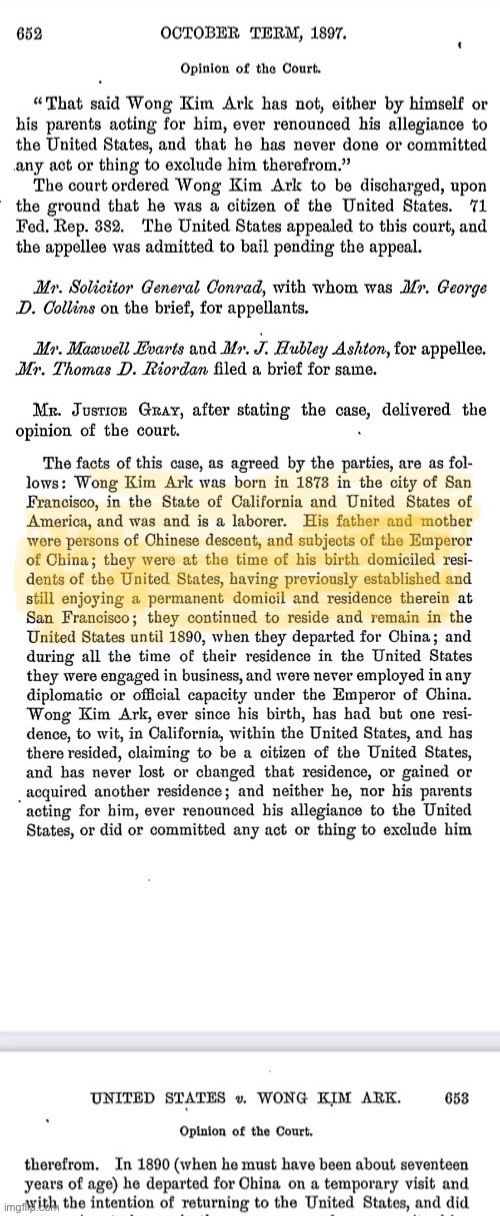
Proponents of birthright citizenship who say that the Wong Kim Ark ruling has settled the issue ignore the fact that Wong’s parents were domiciled residents and thus were in the United States legally.
One Wong does not make a right.
This post was edited on 1/25/25 at 11:22 am

Posted on 1/25/25 at 11:58 am to Goforit
This part is a kill shot to those saying the 14th birthright citizenship applied to all born in the US.
"American Indians and their children did not become citizens until Congress passed the Indian Citizenship Act of 1924. There would have been no need to pass such legislation if the 14th Amendment extended citizenship to every person born in America, no matter what the circumstances of their birth, and no matter who their parents are."
"American Indians and their children did not become citizens until Congress passed the Indian Citizenship Act of 1924. There would have been no need to pass such legislation if the 14th Amendment extended citizenship to every person born in America, no matter what the circumstances of their birth, and no matter who their parents are."
Posted on 1/25/25 at 12:02 pm to Born to be a Tiger1
quote:
Seems like the US Government was more racist against Native Americans than Africans
I think there’s actually an element of respect there

Posted on 1/25/25 at 12:06 pm to SlowFlowPro
quote:
You ignore the context.
The context is somewhat irrelevant to the point. The idea that one judge being so adamant is all you need to judge his conclusion is the point I am skewering.
The Wise Latina was absolutely convinced that overturning Roe was a travesty of justice. It is not a qualification.
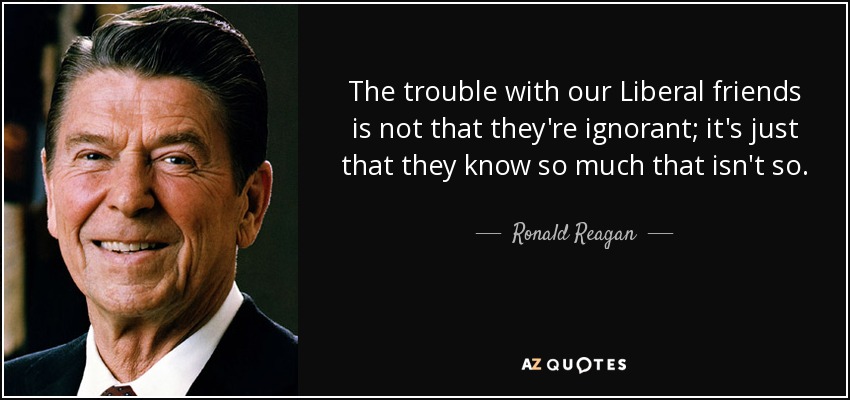
This is a riff on one of Reagan’s most insightful quips.

Posted on 1/25/25 at 12:33 pm to Ag Zwin
We don’t need to guess. Sens. Jacob Howard and Lyman Trumbull, who argued the second “jurisdiction thereof” requirement to the 14th defined it clearly. Both civil and military… subject to its “complete” jurisdiction. Not owing allegiance to anyone else.
Either way, the pure “legal” jurisdiction assumption becomes completely redundant outside the 2 narrow exceptions for diplomats and occupying foreign forces. IE, any human present on US soil is subject to legal jurisdiction outside of the exceptions stated. As you mentioned, Wong deals with the situation before it -children of legal residents. Elks held exception to tribal NAs. Lower courts made some exceptions for babies born in US waters, so further exception precedent exists.
The current way birthright is handled is a long-standing state department error in my view. Not rooted in the case law it claims as its basis.
Either way, the pure “legal” jurisdiction assumption becomes completely redundant outside the 2 narrow exceptions for diplomats and occupying foreign forces. IE, any human present on US soil is subject to legal jurisdiction outside of the exceptions stated. As you mentioned, Wong deals with the situation before it -children of legal residents. Elks held exception to tribal NAs. Lower courts made some exceptions for babies born in US waters, so further exception precedent exists.
The current way birthright is handled is a long-standing state department error in my view. Not rooted in the case law it claims as its basis.

Posted on 1/25/25 at 12:36 pm to Ag Zwin
quote:
The context is somewhat irrelevant to the point.
My point is following idiot John Eastman gets lawyers disbarred and convicted of felonies.
What the judge said is very relevant to that point.
Posted on 1/25/25 at 2:54 pm to SlowFlowPro
quote:
My point is following idiot John Eastman gets lawyers disbarred and convicted of felonies.
There are other voices making the same point.
Seems like one of us is interested in having the issue discussed and reviewed by the ultimate authority, and one of us isn’t.
Posted on 1/25/25 at 3:33 pm to Ag Zwin
quote:
Seems like one of us is interested in having the issue discussed and reviewed by the ultimate authority, and one of us isn’t.
I have discussed this issue at length over the past week.
You just chose the wrong digression to try to make this point.
Posted on 1/25/25 at 3:40 pm to Vacherie Saint
quote:
We don’t need to guess. Sens. Jacob Howard and Lyman Trumbull, who argued the second “jurisdiction thereof” requirement to the 14th defined it clearly.
If it gets to the Supreme Court, we we will see how big of hypocrites Thomas, Gorsuch, and, to an extent, Alito want to be
quote:
The current way birthright is handled is a long-standing state department error in my view. Not rooted in the case law it claims as its basis.
The jurisprudence at the federal appellate level (including USSC) did not stop with Wong Kim Ark. It's been a part of USSC jurisprudence as late as 1982 (Plyler v. Doe), almost 100 years after WKA.
Posted on 1/25/25 at 4:01 pm to SlowFlowPro
quote:
Plyler v. Doe
Has absolutely nothing to do with the definition of citizenship in the 14th.
You are trying too hard. There’s a sound, thought provoking case to be made. And all of this bullshite verbal diarrhea, mental acrobatics, and selective framing you spew on here doesn’t change that.
Posted on 1/25/25 at 4:11 pm to Vacherie Saint
quote:
Has absolutely nothing to do with the definition of citizenship in the 14th.
quote:
As one early commentator noted, given the historical emphasis on geographic territoriality, bounded only, if at all, by principles of sovereignty and allegiance, no plausible distinction with respect to Fourteenth Amendment "jurisdiction" can be drawn between resident aliens whose entry into the United States was lawful, and resident aliens whose entry was unlawful.
Were those words written by the State Department or the Supreme Court?
Posted on 1/25/25 at 4:12 pm to Vacherie Saint
quote:
And all of this bullshite verbal diarrhea, mental acrobatics, and selective framing you spew on here doesn’t change that.
Weird way to describe me posting the text of actual Supreme Court cases

This post was edited on 1/25/25 at 4:12 pm
Posted on 1/25/25 at 5:41 pm to SlowFlowPro
so?
the first sentence since you "failed" to provide your link:
which is exactly what the frick I said. This case leveraged the equal protection clause to allow children who were known to be illegal to attend public school. Their citizenship was never in question, aside from "analogizing" in a footnote how Gray (from Wong) might leverage that logic to address to the citizenship clause - which you happily snipped and copied without linking.
And dont think I didnt notice you completely glossing over the words of the senators who authored and passed the 14th amendment. Very on-brand.
You arent making an argument. You are just arguing.
and still nothing has changed. As shown in your own link, the SCOTUS has not directly ruled on this matter. The standard is, by all objective measures, a long-standing State Department policy, and nothing more.
the first sentence since you "failed" to provide your link:
quote:
Plyler v. Doe and “Jurisdiction”
The Supreme Court has not directly addressed whether the Citizenship Clause necessarily requires U.S. citizenship to be granted to persons born in the United States to unlawfully present aliens. However, it has made pronouncements arguably relevant to that question while addressing other issues. Perhaps most notably, in 1983, the Supreme Court decided Plyler v. Doe, holding that a Texas statute which withheld state funds for the education of children who were not “legally admitted” into the United States
which is exactly what the frick I said. This case leveraged the equal protection clause to allow children who were known to be illegal to attend public school. Their citizenship was never in question, aside from "analogizing" in a footnote how Gray (from Wong) might leverage that logic to address to the citizenship clause - which you happily snipped and copied without linking.
And dont think I didnt notice you completely glossing over the words of the senators who authored and passed the 14th amendment. Very on-brand.
You arent making an argument. You are just arguing.
and still nothing has changed. As shown in your own link, the SCOTUS has not directly ruled on this matter. The standard is, by all objective measures, a long-standing State Department policy, and nothing more.
This post was edited on 1/25/25 at 5:53 pm
Posted on 1/25/25 at 5:43 pm to SlowFlowPro
quote:
Weird way to describe me posting the text of actual Supreme Court cases
You actually posted a quote from a commentator.... speaking on a footnote....unrelated to the ruling.

 Page 7 of 7


Popular
Back to top
 Follow TigerDroppings for LSU Football News