




- My Forums
- Tiger Rant
- LSU Recruiting
- SEC Rant
- Saints Talk
- Pelicans Talk
- More Sports Board
- Fantasy Sports
- Golf Board
- Soccer Board
- O-T Lounge
- Tech Board
- Home/Garden Board
- Outdoor Board
- Health/Fitness Board
- Movie/TV Board
- Book Board
- Music Board
- Political Talk
- Money Talk
- Fark Board
- Gaming Board
- Travel Board
- Food/Drink Board
- Ticket Exchange
- TD Help Board
Customize My Forums- View All Forums
- Show Left Links
- Topic Sort Options
- Trending Topics
- Recent Topics
- Active Topics
Started By
Message

Airmail Navigational Beacons and Concrete Arrows-Most Interesting Thing You’ll Read Today
Posted on 3/30/18 at 10:25 am

Posted on 3/30/18 at 10:25 am
quote:
Scattered across the United States are a network of mysterious concrete arrows. They are often found in remote locations or areas difficult to access. Some will be accompanied by a small shack, a few have a metal tower affixed to their base. Many are in good condition while others have succumbed to nature. The shape and direction of the arrows vary, but it is clear they served the same purpose.
The purpose was important: helping early pilots navigate U.S. transcontinental flights at night.

In a era before radar, pilots used ground-based landmarks for guidance. This solution worked for flight during the day, but grounded pilots at night. Before long, a system of beacons was established across the United States to guide airmail pilots around-the-clock. When radar and radio communications made the beacons obsolete years later, most were torn down or abandoned.
quote:
Beacon Tower System

quote:
Aircraft of the era lacked the advanced electronics for navigation during night flights or through inclement weather. Long before the advent of radio guidance or Instrument Flight Rules (IFR), pilots were limited to visual guidance, using landmarks to chart the route.
Flying at night was out of the question; bad weather and limited flight times meant delivery was limited and still spotty in frequency. The service was indeed faster, but it lacked flexibility and reliability of operations.
By 1924 the Postal Service developed a solution that was effective, if not elegant.

quote:
A system of ground-based navigation beacons extending from New York to San Francisco would help pilots fly across the country at night and ultimately be the world’s first such system.
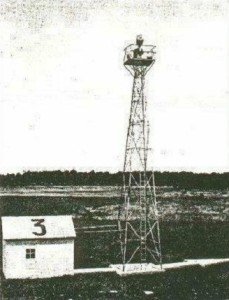
The early iterations of the system used approximately 1,500 airmail beacons, each constructed roughly between 3 and 5 miles apart. The beacons featured a 50-foot tower with rotating lights placed on top of concrete foundations in the shape of giant arrows measuring between 50 and 70 feet long. To increase visibility of the concrete arrows, they were painted bright yellow.
The first towers contained acetylene-gas powered lights which were fed by fuel stored in a shed at the base. At the top of the towers, a rotating beacon with 5,000 candlepower and would flash every ten seconds.
quote:
In clear weather the beacon lights could be seen for 10 miles (16 km). Below the main white beacon, a secondary set of red and green lights would flash a Morse Code letter to identify the beacon to pilots.
To accommodate for emergencies, intermediate landing fields were established every 25 miles along the route. The fields were constructed with rotating incandescent electric lights mounted on 50-foot towers set to sweep six times per minute. These less-common emergency field beacons were visible up to 75 miles away.
The program was an immediate success and continued to expand throughout its operational life. By the end of the first year the airmail service had 18 terminal airfields, 89 emergency airfields, and more than 500 beacon lights in operation.
quote:
But by the 1930s, navigation and radio technology had improved to allow flight without land-based visual guidance. The Low Frequency Radio Range (LFRR) system began to replace older visual-based systems. The airmail beacon program would continue to operate full-scale until 1933, when technology advancements and the higher cost of operation during the Great Depression – finally rendered it obsolete.
quote:
Today
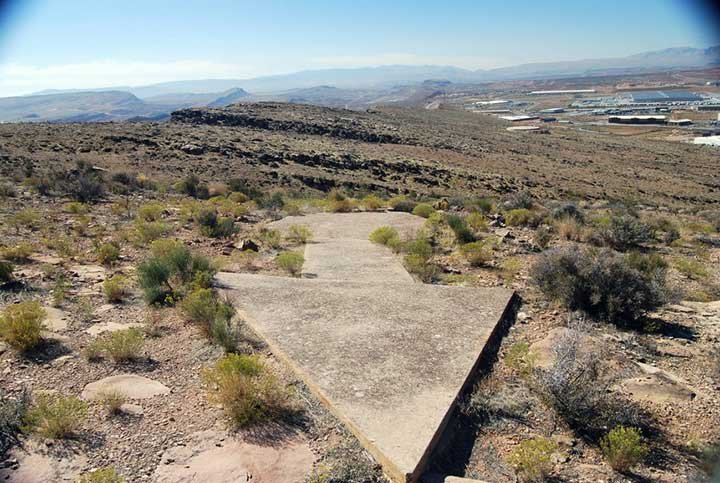


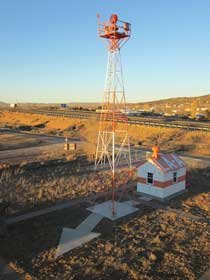
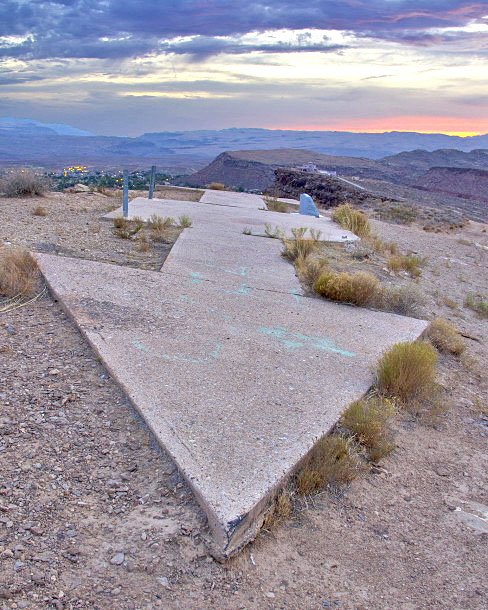

LINK
A lot of these are visible from google maps such as these two...
LINK
LINK
 5
5


Posted on 3/30/18 at 10:31 am to OleWarSkuleAlum
very cool and interesting thanks for posting

Posted on 3/30/18 at 10:31 am to OleWarSkuleAlum
don't let the poliboard see this.
Posted on 3/30/18 at 10:32 am to OleWarSkuleAlum
Interesting reading. Similar concept to the Indian Trail Trees that were used by native Americans to mark paths. I’ve never seen either type of marker in person but would like the opportunity.

Posted on 3/30/18 at 10:34 am to OleWarSkuleAlum
They are to guide the ancient aliens back to earth.

Posted on 3/30/18 at 10:36 am to OleWarSkuleAlum
Big arrows in the desert?
Did you consider that maybe aliens put them there to help find their landing zones?

Did you consider that maybe aliens put them there to help find their landing zones?
Posted on 3/30/18 at 10:36 am to BobABooey
There's a trail near where I live that was used by Indians and later by pioneers. If you know where to look you can still see traces of it. The trees are long since gone though.
Posted on 3/30/18 at 12:07 pm to foshizzle
quote:
Big arrows in the desert?
Did you consider that maybe aliens put them there to help find their landing zones?
During WW2 a lot of these were destroyed to prevent the Japs from using them to navigate.

Posted on 3/30/18 at 1:10 pm to BobABooey
quote:
Similar concept to the Indian Trail Trees that were used by native Americans to mark paths. I’ve never seen either type of marker in person but would like the opportunity.
I've gone fishing in southern Canada and we used trails marked like that to carry our gear to the next lake. Trails have been there hundreds of years

 Page 1 of 1


Popular
Back to top
 Follow TigerDroppings for LSU Football News