




- My Forums
- Tiger Rant
- LSU Recruiting
- SEC Rant
- Saints Talk
- Pelicans Talk
- More Sports Board
- Fantasy Sports
- Golf Board
- Soccer Board
- O-T Lounge
- Tech Board
- Home/Garden Board
- Outdoor Board
- Health/Fitness Board
- Movie/TV Board
- Book Board
- Music Board
- Political Talk
- Money Talk
- Fark Board
- Gaming Board
- Travel Board
- Food/Drink Board
- Ticket Exchange
- TD Help Board
Customize My Forums- View All Forums
- Show Left Links
- Topic Sort Options
- Trending Topics
- Recent Topics
- Active Topics
Started By
Message
Kosher Salt: Diamond
Posted on 4/12/17 at 7:36 am
Posted on 4/12/17 at 7:36 am
I always see and buy the Morton's brand because that's all they ever have. I've been looking for Diamond brand but don't know who carries it. It's supposed to be lighter/volume or flakier.
Anyone know where I should look?
Anyone know where I should look?
 3
3

Posted on 4/12/17 at 7:47 am to tewino
I use and like the Diamond brand. Not sure what you have around you where you are but oddly enough I get mine from Dollar Tree. 

Posted on 4/12/17 at 8:01 am to FromtheVilles
What's the difference? Larger or smaller salt grains?


Posted on 4/12/17 at 8:16 am to tewino
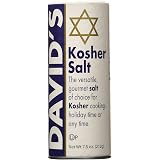
I use David's Kosher salt, you can get it on Amazon.
This post was edited on 4/12/17 at 2:19 pm

Posted on 4/12/17 at 8:42 am to BugAC

This post was edited on 4/12/17 at 10:34 am
Posted on 4/12/17 at 12:52 pm to iAmBatman
I thought it was supposed to be larger lighter grains but I have never been able to find any to evaluate first hand.
Posted on 4/12/17 at 1:39 pm to tewino
Here is a breakdown, excerpted from a NY Times cooking article:
Ordinary table salt is typically made by taking the water out of brine in a series of evaporating pans; its crystals are cubic in shape (remember looking at it through a microscope in science class?). To manufacture its kosher salt, Morton’s runs such salt between rollers, which results in a thin, coarse flake.
By contrast, Diamond Crystal kosher salt is made using a particular open pan evaporating method (the Alberger method, just so you know) which results in handsome hollow pyramid-shaped grains. This hollow structure accounts for the salt’s lightness, and the thin walls of the “pyramids” for its crushability.
So I got out a one-cup measure and a scale, and I weighed similar volumes of Morton’s and Diamond Crystal kosher salts, plus regular table salt, generic coarse sea salt and Malden sea salt from England (included for no reason other than that I think it is the most beautiful of salts). Here’s the outcome, rounded off to the nearest five grams or eighth of an ounce (no, this is not a scientific inquiry):
Morton’s kosher: 250 grams (8 3/4 ounces)
Diamond Crystal kosher: 135 grams (4 3/4 ounces)
Table salt: 300 grams (10 5/8 ounces)
Coarse sea salt: 210 grams (7 3/8 ounces)
Malden sea salt: 120 grams (4 1/4 ounces)
It is the first three figures that we need to pay attention to, because those are the salts we’re most likely to use in our cooking and baking. We learn from them that a tablespoon of Morton’s kosher salt is the equivalent of 1.85 tablespoons of Diamond Crystal — just half a teaspoon shy of 2 tablespoons. We learn that a tablespoon of table salt can be replaced by 2 1/4 tablespoons of Diamond Crystal kosher salt or 1 1/4 tablespoons of Morton’s.
We learn that whenever recipe writers are rash enough to give a precise measurement for salt, they ought to specify what kind they’re talking about.
Ordinary table salt is typically made by taking the water out of brine in a series of evaporating pans; its crystals are cubic in shape (remember looking at it through a microscope in science class?). To manufacture its kosher salt, Morton’s runs such salt between rollers, which results in a thin, coarse flake.
By contrast, Diamond Crystal kosher salt is made using a particular open pan evaporating method (the Alberger method, just so you know) which results in handsome hollow pyramid-shaped grains. This hollow structure accounts for the salt’s lightness, and the thin walls of the “pyramids” for its crushability.
So I got out a one-cup measure and a scale, and I weighed similar volumes of Morton’s and Diamond Crystal kosher salts, plus regular table salt, generic coarse sea salt and Malden sea salt from England (included for no reason other than that I think it is the most beautiful of salts). Here’s the outcome, rounded off to the nearest five grams or eighth of an ounce (no, this is not a scientific inquiry):
Morton’s kosher: 250 grams (8 3/4 ounces)
Diamond Crystal kosher: 135 grams (4 3/4 ounces)
Table salt: 300 grams (10 5/8 ounces)
Coarse sea salt: 210 grams (7 3/8 ounces)
Malden sea salt: 120 grams (4 1/4 ounces)
It is the first three figures that we need to pay attention to, because those are the salts we’re most likely to use in our cooking and baking. We learn from them that a tablespoon of Morton’s kosher salt is the equivalent of 1.85 tablespoons of Diamond Crystal — just half a teaspoon shy of 2 tablespoons. We learn that a tablespoon of table salt can be replaced by 2 1/4 tablespoons of Diamond Crystal kosher salt or 1 1/4 tablespoons of Morton’s.
We learn that whenever recipe writers are rash enough to give a precise measurement for salt, they ought to specify what kind they’re talking about.
This post was edited on 4/12/17 at 3:49 pm
Posted on 4/12/17 at 1:49 pm to tewino
quote:
Anyone know where I should look?
winn dixie

 Page 1 of 1


Popular
Back to top
 Follow TigerDroppings for LSU Football News