




- My Forums
- Tiger Rant
- LSU Recruiting
- SEC Rant
- Saints Talk
- Pelicans Talk
- More Sports Board
- Fantasy Sports
- Golf Board
- Soccer Board
- O-T Lounge
- Tech Board
- Home/Garden Board
- Outdoor Board
- Health/Fitness Board
- Movie/TV Board
- Book Board
- Music Board
- Political Talk
- Money Talk
- Fark Board
- Gaming Board
- Travel Board
- Food/Drink Board
- Ticket Exchange
- TD Help Board
Customize My Forums- View All Forums
- Show Left Links
- Topic Sort Options
- Trending Topics
- Recent Topics
- Active Topics
Started By
Message
Why does Ford use wet belts for their engine oil pumps?
Posted on 12/31/25 at 11:25 am

Posted on 12/31/25 at 11:25 am
More importantly…..why do they place them where it’s impossible to change without tearing down the engine?
This is the bottom end of a 1.5L engine from a Bronco Sport:
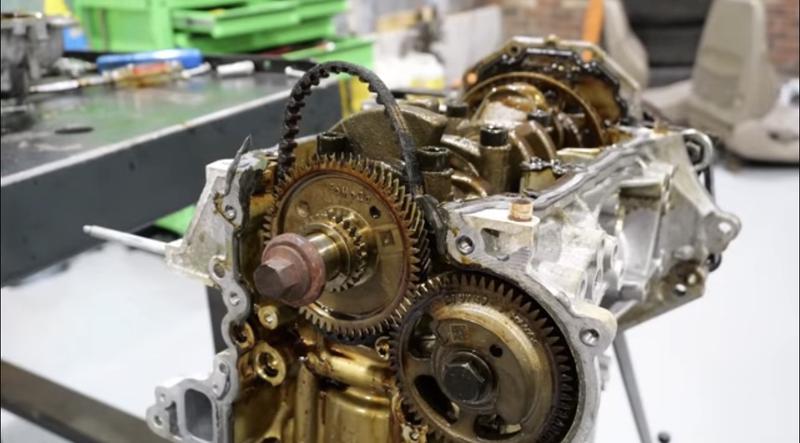
Notice the location of the belt that drives the sump-mounted oil pump. Crankshaft and possibly or the balance shaft has to come out to change the belt (pulleys are pressed on). That’s intense work to replace something that will break down and fail before the rest of the engine.
The 2.7L Ecoboost and 5.0L Coyote in the F-150 have these now to, but at least on those they are at the end of an engine and potentially serviceable. So they can be replaced as a service item when the timing needs to be changed/adjusted before 200k miles.
Or in the case of the GM light duty diesel, you can swap it out if the transmission needs heavy service before 200k miles or if you are already in that area to deal with a rear main seal. Frustrating but serviceable without tearing down the engine.
Feels like if nobody is looking, some of these manufacturers will make the whole engine a wear item though. Like this 1.5L Ford…..no way to service that belt without tearing down the entire bottom end. Which means an engine swap or total rebuild will happen at the oil change belt replacement interval.
Seems like we need to know very detailed engine specs before we buy. No idea how many other carmakers are doing stupid stuff like this without going through their engines or finding a cutaway of that engine.
Is this some kind of weight saving thing? Or is it just cheaper?
This is the bottom end of a 1.5L engine from a Bronco Sport:
Notice the location of the belt that drives the sump-mounted oil pump. Crankshaft and possibly or the balance shaft has to come out to change the belt (pulleys are pressed on). That’s intense work to replace something that will break down and fail before the rest of the engine.
The 2.7L Ecoboost and 5.0L Coyote in the F-150 have these now to, but at least on those they are at the end of an engine and potentially serviceable. So they can be replaced as a service item when the timing needs to be changed/adjusted before 200k miles.
Or in the case of the GM light duty diesel, you can swap it out if the transmission needs heavy service before 200k miles or if you are already in that area to deal with a rear main seal. Frustrating but serviceable without tearing down the engine.
Feels like if nobody is looking, some of these manufacturers will make the whole engine a wear item though. Like this 1.5L Ford…..no way to service that belt without tearing down the entire bottom end. Which means an engine swap or total rebuild will happen at the oil change belt replacement interval.
Seems like we need to know very detailed engine specs before we buy. No idea how many other carmakers are doing stupid stuff like this without going through their engines or finding a cutaway of that engine.
Is this some kind of weight saving thing? Or is it just cheaper?
This post was edited on 12/31/25 at 11:27 am
 14
14


Posted on 12/31/25 at 11:28 am to member12
quote:
1.5L engine
Ridiculous.


Posted on 12/31/25 at 11:28 am to member12
Because the ecoboost is a very complicated engine. Great for mid-size and below vehicles. Laughable for full-size trucks and SUVs.

Posted on 12/31/25 at 11:28 am to member12
I’m going to attempt to live my entire life without owning a 1.5 L Ford-powered anything.
Posted on 12/31/25 at 11:29 am to AUCE05
quote:
Because the ecoboost is a very complicated engine. Great for mid-size and below vehicles. Laughable for full-size trucks and SUVs.
The 3.5L Ecoboost doesn’t have this oil pump belt yet.
The 5.0L and 2.7L motors got them only within the last few years.
Like they are going through decent engines and finding ways to ruin them.


Posted on 12/31/25 at 11:30 am to member12
Because an engineer will crawl over a pile of 100 virgins to frick a mechanic.


Posted on 12/31/25 at 11:31 am to member12
Because they dont build cars to go over 100k miles
They want you to buy a new one before that
They want you to buy a new one before that

Posted on 12/31/25 at 11:33 am to member12
quote:
Like they are going through decent engines and finding ways to ruin them.
It’s call planned obsolescence and it’s a very real thing.
Also they’re chasing a teeny little bit of economy by reducing resistance and mass.

Posted on 12/31/25 at 11:34 am to member12
quote:
1.5L engine
Because you can just flip the lawnmower over to get to it....
Posted on 12/31/25 at 11:39 am to dakarx
Maybe a rebuilt engine is super cheap? They are tiny.

Posted on 12/31/25 at 11:46 am to billjamin
quote:
Also they’re chasing a teeny little bit of economy by reducing resistance and mass.
This and overall size/weight reduction. I've seen some awful designs chosen over good designs and rolled into production over a half inch in length. Pure speculation, but it is entirely possible that the internal belt was redesigned to be able to fit it into a certain model without losing an inch in forward leg room.
Posted on 12/31/25 at 11:47 am to member12
Im and engineer and have had the opportunity to work closely with engineers who design this kind of stuff.
The short answer is Money, noise, vibration, harshness, and CAFE/EPA.
Making an engine that will run, last forever, and be cheap and easy to service is easy. We had that figured out in the 80's, and they got ~ 80% of the fuel economy of many modern engines. A throttle body injected pushrod V6 powered truck could get 16 or 17 mpg and have the entire engine replaced for $1500. Great, we could have stopped there.
When the requirement for the engine became that it must be silent, not vibrate, have a ton of power density, fit in a goofy engine bay and find that last 20% of fuel economy, and not have polutants in the exhaust, you get shite like this.
Oh by the way, it has to be cheap af to make for this ridiculously expensive vehicle because we work for the shareholders. What you have there is the result of companies being ran by accountants and regulations made by retards.
The short answer is Money, noise, vibration, harshness, and CAFE/EPA.
Making an engine that will run, last forever, and be cheap and easy to service is easy. We had that figured out in the 80's, and they got ~ 80% of the fuel economy of many modern engines. A throttle body injected pushrod V6 powered truck could get 16 or 17 mpg and have the entire engine replaced for $1500. Great, we could have stopped there.
When the requirement for the engine became that it must be silent, not vibrate, have a ton of power density, fit in a goofy engine bay and find that last 20% of fuel economy, and not have polutants in the exhaust, you get shite like this.
Oh by the way, it has to be cheap af to make for this ridiculously expensive vehicle because we work for the shareholders. What you have there is the result of companies being ran by accountants and regulations made by retards.

Posted on 12/31/25 at 11:51 am to member12
Had an Explorer with an internal water pump-timing chain driven. Definitely can be costly when it goes.
Definitely built-in obsolescence with maximum collateral damage.
The comment on engineers is dead on.
Definitely built-in obsolescence with maximum collateral damage.
The comment on engineers is dead on.
Posted on 12/31/25 at 11:52 am to DownshiftAndFloorIt
I thought vibration might play a part.
A 92CI 4 cylinder has got to shake like a coin-operated hotel bed.
A 92CI 4 cylinder has got to shake like a coin-operated hotel bed.
Posted on 12/31/25 at 11:53 am to member12
It ain't just Ford!
The GM 3.0L Duramax (LM2/LZ0) uses a unique wet, rubber oil pump drive belt located at the rear of the engine, requiring significant labor (transmission removal) for replacement, typically recommended around 150,000-200,000 miles
The GM 3.0L Duramax (LM2/LZ0) uses a unique wet, rubber oil pump drive belt located at the rear of the engine, requiring significant labor (transmission removal) for replacement, typically recommended around 150,000-200,000 miles
Posted on 12/31/25 at 12:30 pm to N2cars
quote:
thought vibration might play a part.
It plays a huge part. Belts are less noisy than chains or gears and do not transmit torsional vibration.
Its also got to start and stop with minimal vibration or noise 50 bazillion times in stop and go traffic. The design constraints on modern engines are ridiculous.
Posted on 12/31/25 at 12:31 pm to Dog Tree
Lexus exclusively uses timing chains in the current engines in my wheelhouse.
Another reason to buy new or used ones.
Another reason to buy new or used ones.
Posted on 12/31/25 at 12:34 pm to soccerfüt
quote:
Lexus exclusively uses timing chains in the current engines in my wheelhouse.
I don’t think I’ll ever have anything else as a daily unless they quit making the LX or GX.
Posted on 12/31/25 at 12:41 pm to billjamin
quote:
don’t think I’ll ever have anything else as a daily unless they quit making the LX or GX.
The new full sized Toyotas have another engine that I wouldn’t touch.
Posted on 12/31/25 at 12:43 pm to Dog Tree
quote:
The GM 3.0L Duramax (LM2/LZ0) uses a unique wet, rubber oil pump drive belt located at the rear of the engine, requiring significant labor (transmission removal) for replacement, typically recommended around 150,000-200,000 miles
Yeah but at least it can be done without removing the crankshaft. I can’t figure out what Ford was thinking with that little motor.

 Page 1 of 2

Popular
Back to top
 Follow TigerDroppings for LSU Football News