




- My Forums
- Tiger Rant
- LSU Recruiting
- SEC Rant
- Saints Talk
- Pelicans Talk
- More Sports Board
- Fantasy Sports
- Golf Board
- Soccer Board
- O-T Lounge
- Tech Board
- Home/Garden Board
- Outdoor Board
- Health/Fitness Board
- Movie/TV Board
- Book Board
- Music Board
- Political Talk
- Money Talk
- Fark Board
- Gaming Board
- Travel Board
- Food/Drink Board
- Ticket Exchange
- TD Help Board
Customize My Forums- View All Forums
- Show Left Links
- Topic Sort Options
- Trending Topics
- Recent Topics
- Active Topics
Started By
Message
re: But tariffs don’t work….
Posted on 3/25/25 at 11:15 pm to Taxing Authority


Posted on 3/25/25 at 11:15 pm to Taxing Authority
quote:
He gave you math. You didn't refute a single bit of it. It is what it is.
quote:
They WILL cause prices to go up
Math

quote:
Literally in the link.
i mean you could at least make an attempt. Like because of the tariff on Canada current coffee prices are 8.99 a bag but due to the evil orange ALL available coffee will now be 18..99 because of xyz and will stay there till he drops tariffs Yet none of you do ever. You will use Washer and Dryers will go up!! :lol:
 2
2

Posted on 3/25/25 at 11:18 pm to Taxing Authority
quote:
What you're seem to be asking is for someone else to understand it for you. No once can do that.
You mean you aren’t falling for the low rent mortgage broker’s BS?
Weird.


Posted on 3/25/25 at 11:19 pm to SDVTiger
quote:
Yet none of you do ever. You will use Washer and Dryers will go up!!
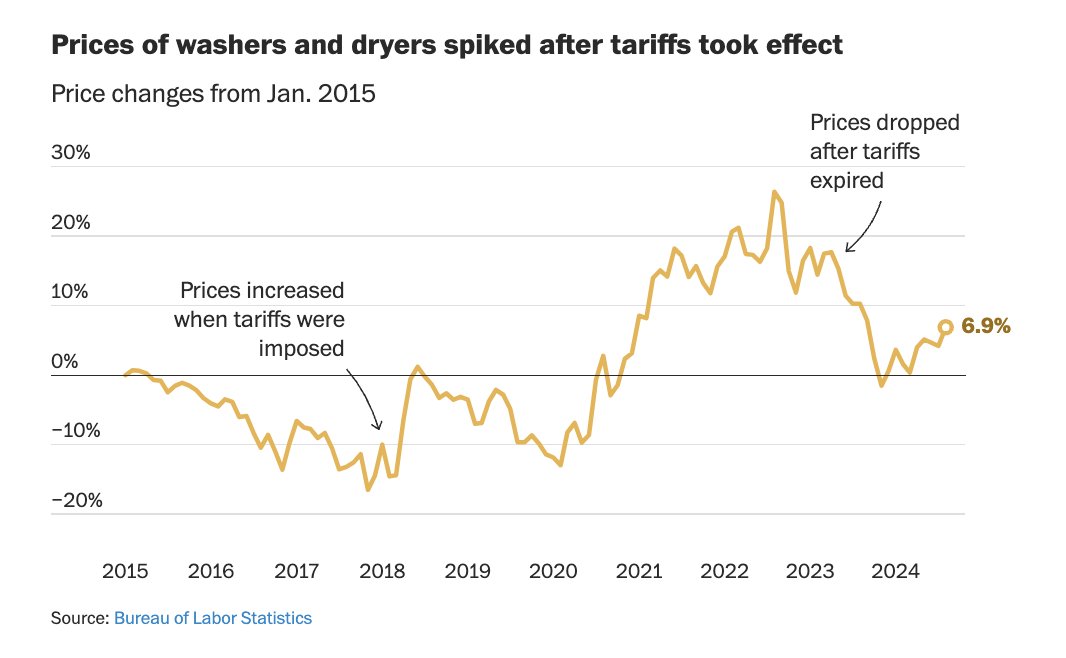
They can't. It's why they never go past the 2018 time frame. The reason is prices of those dropped back down and the eventual increase by the end of 2019 was actually less than all other home appliances.
Posted on 3/25/25 at 11:21 pm to BCreed1
quote:
They can't.
Exactly. They refuse to even try anything other than Washing Machines


Posted on 3/25/25 at 11:22 pm to SDVTiger
quote:You're pretending he didn't show you math. Why should anyone attempt it, when you ignore reality?
i mean you could at least make an attempt.
You're literally a chess-playing pigeon .Posted on 3/25/25 at 11:23 pm to SDVTiger
quote:
They refuse to even try anything other than Washing Machines
They lose the argument on washing machines.
Posted on 3/25/25 at 11:23 pm to BCreed1
quote:
They can't. It's why they never go past the 2018 time frame.
 We've had multiple tariffs since 2018. Biden kept them. Even raised them. Why didn't they work?
 Posted on 3/25/25 at 11:24 pm to BCreed1
quote:
They lose the argument on washing machines.
Muh washing machines. Now do solar, steel, lumber, aluminum, CHIPs, etc. This post was edited on 3/25/25 at 11:25 pm
Posted on 3/25/25 at 11:24 pm to wackatimesthree
quote:
Like he said, they do not work the way y'all think they work.
If we got back all the jobs we "lost" overseas and then doubled it, we'd be talking about maybe 20 million Americans. Out of 340 million. Roughly 6%.
And that's if we double it just for good measure.
If you search for the average factory worker salary in the US, you'll get around $17 an hour. if you search for average manufacturing job salary in the US, you'll get almost $24.50 an hour.
Not sure why the difference (maybe the latter takes management jobs into account and the former doesn't?), but let's use the higher number.
That's a little under $51,000 a year for 20 million people.
That doesn't mean that 20 million people who were unemployed suddenly make $51,000 a year, it probably mostly means that someone who was making $15-$20 an hour is now making $24.50 an hour and the unemployed people are filling in the $15-$20 an hour jobs.
$51,000 a year is going to pay roughly $6,000 in taxes. That IS significantly higher by percentage than when the person was making $18 an hour who will pay maybe $1,500 in federal taxes. The difference being $4,500 times 20 million, which is $90 billion in additional tax revenues.
However, if the average manufacturing worker here makes $24.50, that's four times as much as the average Chinese manufacturing worker makes. Obviously prices have to go up to deal with that.
Let's say prices go up in those industries by 20%. It's probably going to be more than that, but we'll be conservative.
Now, in 2023, we still had almost 13 million manufacturing jobs going in the US and those jobs produced $2.3 Trillion in revenue.
Using that math, an additional 20 million jobs would add another $4.3 Trillion, without accounting for the 20% price increase.
Do the math and those goods costs Americans (all of us, not just 6% of us) over a trillion dollars more than they would have, for a 90 billion dollar offset in federal income taxes.
That's off by almost an order of magnitude.
Now I'm sure that someone could dispute some aspect of what I have said or chime in with, "Wait, you didn't factor in XYZ," but the napkin math is too far off for anything I can reasonably think of to matter.
Bottom line, unless or until someone shows otherwise, when we "get those manufacturing jobs back," America loses. Financially, at least, which is what your claim was based on.
Tariffs will NOT cause anyone's income taxes to go down. They WILL cause prices to go up.
And another reason I know this is that Trump instituted tariffs back in 2018 and we know the effects of them. I don't need a crystal ball. All I have to do is look up the net effect of the 2018 tariffs. We lost. Net jobs, net cost, American producers lost market share, etc. That's a fact.
This post assumes a simply transfer of jobs between sectors, and only focuses on federal income taxes.
Losing local manufacturing jobs affects local economies more than a few hundred or a few thousand workers moving from a ~25 dollar an hour salary to an ~18 dollar salary. How many secondary jobs are tied to these manufacturing jobs (equipment service/part replacement, supply chains, etc.). You're not just talking about strictly manufacturing jobs, but probably probably around 2 or 2.5 other jobs per manufacturing job lost. The above post doesn't properly recognize the punch in the gut local communities ultimately feel when these businesses close up shop and leave the country.
Your focusing on federal income taxes also misses a large piece of the pie as it doesn't take into account payroll taxes, state/local taxes, corporate taxes, and the reducing the strain on some social welfare programs.
There are some other potential societal problems that could be reduced if you increase worker wages from 37k to 51k a year (birth rates, reduced crime rates, mental health, etc.). That's a 35% pay raise, that's quite massive.
quote:
Using that math, an additional 20 million jobs would add another $4.3 Trillion, without accounting for the 20% price increase.
Unless I'm mistaken your angle here, without a price increase, we're paying the same. So whether its 4.3 trillion sent over seas or 4.3 trillion spent at home, it's still 4.3 trillion spent in total.
20% of 4.3 trillion is 860 billion dollars, not over a trillion.
And bear in mind, that 4.3 trillion is now recirculating within our own economy, rather mostly going over seas.
quote:
Now, in 2023, we still had almost 13 million manufacturing jobs going in the US and those jobs produced $2.3 Trillion in revenue.
Using your logic, we need to be promoting the removal of these jobs from our economy. These 13 million jobs are better off overseas, right? After all, we're spending hundreds of billions of dollars more only to get tens of billions more in federal taxes.
This post was edited on 3/25/25 at 11:28 pm


Posted on 3/25/25 at 11:25 pm to BCreed1

Posted on 3/25/25 at 11:29 pm to Taxing Authority
quote:
We've had multiple tariffs since 2018.
We are talking washing machines and dryers. And one of the guys you guys like to tout from a Michigan study is economist Justin Wolfers. And it's here you lose your argument.

But let's pull in 2019.

Posted on 3/25/25 at 11:30 pm to Taxing Authority
quote:
Even raised them. Why didn't they work?
Because of policies.
Posted on 3/25/25 at 11:30 pm to Azkiger
quote:Kinda, yeah. It's like the example I posted a long time ago in this thread. If a worker can produce $300/hr in income, it make no sense to have him work on tasks that can be outsourced for a mere $3/hr.You'll lose $297/hr for every hour. But hey, 'murica first, right? At least we won't be sending those $3/hr overseas!
Using your logic, we need to be promoting the removal of these jobs from our economy.
The alternative to that is to say US workers can't produce value for their higher salary. If that's the case... "tariffs" are nothing but a backdoor way of implementing a minimum wage/corporate welfare.
Posted on 3/25/25 at 11:31 pm to BCreed1
quote:I gave you examples. You ignored them. But I understand why.
We are talking washing machines and dryers.
This post was edited on 3/25/25 at 11:33 pm
Posted on 3/25/25 at 11:32 pm to BCreed1
quote:
Because of policies.
This is where I get dragged down and beaten with experience isn't it? Here goes... why didn't "policies" affect muh washing machines?
This post was edited on 3/25/25 at 11:34 pm
Posted on 3/25/25 at 11:34 pm to Taxing Authority
quote:
I gave you examples. You ignored them.
No, I was talking washing machines and dryers and you interjected yourself into that.
So back to those..... Prices dropped. Other appliances rose well past those 2 appliances. They were not tariff-ed either.
Posted on 3/25/25 at 11:35 pm to BCreed1
quote:
No, I was talking washing machines and dryers and you interjected yourself into that.
I can easily make a case for almost ANYTHING if I get to ignore al the contraveining evidence. This is getting absurd and boring. This post was edited on 3/25/25 at 11:36 pm
Posted on 3/25/25 at 11:35 pm to Taxing Authority
quote:
Kinda, yeah. It's like the example I posted a long time ago in this thread. If a worker can produce $300/hr in income, it make no sense to have him work on tasks that can be outsourced for a mere $3/hr.You'll lose $297/hr for every hour. But hey, 'murica first, right? At least we won't be sending those $3/hr overseas!
Why are you comparing value created (300 an hour) vs hourly salary (3 dollars an hour)?
Also, you're sending a lot more than 3 dollars an hour overseas. Local retailers purchasing foreign goods aren't merely paying hourly wages to have those products placed on their shelf. You're removing what that retailer paid minus whatever transportation costs that are on our own economy's side of the fence back to that country.
Posted on 3/25/25 at 11:35 pm to Taxing Authority
quote:
This is where I get dragged down and beaten with experience isn't it?
Here goes... why didn't "policies" affect muh washing machines?
You can not keep up with what you are talking about. You asked why Biden's tariffs didn't work.
That answer is policies.
Posted on 3/25/25 at 11:36 pm to Taxing Authority
Listen man, if you stop the data in 2019, you'll see that he was on his way to being right 5 years ago.

 Page 19 of 21

Popular
Back to top
 Follow TigerDroppings for LSU Football News