




- My Forums
- Tiger Rant
- LSU Recruiting
- SEC Rant
- Saints Talk
- Pelicans Talk
- More Sports Board
- Coaching Changes
- Fantasy Sports
- Golf Board
- Soccer Board
- O-T Lounge
- Tech Board
- Home/Garden Board
- Outdoor Board
- Health/Fitness Board
- Movie/TV Board
- Book Board
- Music Board
- Political Talk
- Money Talk
- Fark Board
- Gaming Board
- Travel Board
- Food/Drink Board
- Ticket Exchange
- TD Help Board
Customize My Forums- View All Forums
- Show Left Links
- Topic Sort Options
- Trending Topics
- Recent Topics
- Active Topics
Started By
Message
 1
1

Posted on 7/23/24 at 7:31 pm to POTUS2024
Loading Twitter/X Embed...
If tweet fails to load, click here. Chellsie Memmel: "The team dynamic, since Katy through here, I think has just - it's been really great, and I think it's been growing stronger the longer we've been into this trip, and I think it's going to continue building, because they're all here, they all have goals they want to accomplish together and as a team, and that's what's driving them forward."
Posted on 7/23/24 at 7:56 pm to POTUS2024
Instead of embedding the rest of the tweets I'll just copy and paste their comments into this one post. With the first one embedded you can go view the thread by clicking on that embedded tweet if you wish:
Brett McClure: "I think Saint Omer was a great opportunity for them to just spend every single meal together, every practice - they're pushing each other on every single apparatus, every routine, whatever it may be, and then afterwards, being able to sit around and talk strategy or talk about life outside the gym, it was a really good experience. And to be able to spend it with the women's team, I think it brought both of our programs closer together and created Team USA Gymnastics. So, you know, I think we're excited to go out there and showcase what we've been working on."
Chellsie Memmel: "I think they're settling in really well. I mean, it was it was quick, you know, they they got to do the entire [Team USA] Welcome Experience and that, they all really enjoyed. It's Hezly's first Olympic Games so she got to do it for the first time, but the others who were in Tokyo didn't really get this experience, so for them to be able to do that and do it together again, I think they really appreciated it and it was a little bit emotional for some of them."
Brett McClure: "The guys are thrilled to be in the village. You know, Tokyo obviously was a unique experience and Brody kind of passing on some of that information to these guys and Sam [Mikulak] being here who has been a part of three Olympic Games, they were absolutely thrilled to get into the village - couldn't wait to set up their apartment and just having the time of their life, so it's been exciting.
Chellsie Memmel: "I know together as a team, they're all really looking forward to to the competition and it is kind of their redemption tour - four of the five from the previous Olympic Games - so they're excited. They're all coming together for it.
Chellsie Memmel: "They've all made their adjustments already, they can do it fairly quickly. So each day of training looked a little bit better, a little bit tighter on all the skills. So today was our first hard day since we left the Arques training facility and they they looked great."
Brett McClure: "It's not really foreign to them, they're pretty used to it and they enjoy it. They actually like the Gymnova floor a little bit better than the Spieth one at this point in time because it's pretty bouncy, but I think also the adrenaline plays a big role during training right now for the Olympic Games. So they're pretty comfortable."
Chellsie Memmel: "To be here in such a different role, it's been exciting, also stressful. When you're an athlete, you focus on you and your stuff, and do the best you can for yourself and the team and now I'm looking at the big picture so, I'm focused on five athletes, putting together the pieces of the puzzle for the lineup and all of that. So it's a lot more, but it's also really exciting too, to kind of see it in a different way and see it through their eyes as well."
Brett McClure on having fans in the venue: Oh, my gosh, it's going to be so amazing. I think we were really lucky to have a taste of it just a few weeks ago at Olympic Trials, where we had 16,000 people show up for that event. And just the energy that comes out of that, that experience, is incredible. And I believe Bercy is 16,500 capacity, so, pretty similar. And we are so looking forward to it. I mean, Tokyo, it was it was difficult, you know, to be able to look up in the stands and seeing so many empty seats, but obviously understandable given the time. So yeah, we are so excited to go out there in front of a 16,000+ fans."
Chellsie Memmel: "I had a conversation with Cecile already, talking about Team Finals and 'what the expectation on Simone is and if she doesn't feel like it's going to be in her best interest to do all four events that day, is that an option for her?' And I said 'absolutely.' If that's what she needs to continue to be at her best for her team and for herself, then that's what we're going to do, because there are still four other members on our team. So I think for her to just know that she has that option, now whether she takes it or not, it's going to be completely up to her - because we also talked about that, with her at worlds last year and she ultimately decided to all four events during team finals, but I think just for her, knowing that that is a possibility, I think that helps." I imagine some people are going to pounce on this quote.
Brett McClure: "I think this team, has accomplished so much already. The legacy is, in a few words, closing the gap - they close the gap. In Tokyo, we were so far behind in difficulty, we knew we didn't really have a chance..... With it only being three years between Olympic Games, the strategy that we had, was really about LA, to be honest, because we all know gymnastics is a very difficult sport, especially to increase the difficulty. So I think they've already created that legacy. To be able to go out here and compete for a podium. So it's pretty incredible, and I think they are well prepared, and let's see where we finish."
Chellsie Memmel: "I'm also already proud of this team, with everything that they've gone through or seeing teammates get injured at Olympic Trials. I think that I just want them to get to this, to be happy, to be healthy and to be able to be proud of what they accomplished. You know, no matter what the outcome is, I want them to be proud and to be able to look back and say, I'm so glad that I had that experience."
Brett McClure: "I think Saint Omer was a great opportunity for them to just spend every single meal together, every practice - they're pushing each other on every single apparatus, every routine, whatever it may be, and then afterwards, being able to sit around and talk strategy or talk about life outside the gym, it was a really good experience. And to be able to spend it with the women's team, I think it brought both of our programs closer together and created Team USA Gymnastics. So, you know, I think we're excited to go out there and showcase what we've been working on."
Chellsie Memmel: "I think they're settling in really well. I mean, it was it was quick, you know, they they got to do the entire [Team USA] Welcome Experience and that, they all really enjoyed. It's Hezly's first Olympic Games so she got to do it for the first time, but the others who were in Tokyo didn't really get this experience, so for them to be able to do that and do it together again, I think they really appreciated it and it was a little bit emotional for some of them."
Brett McClure: "The guys are thrilled to be in the village. You know, Tokyo obviously was a unique experience and Brody kind of passing on some of that information to these guys and Sam [Mikulak] being here who has been a part of three Olympic Games, they were absolutely thrilled to get into the village - couldn't wait to set up their apartment and just having the time of their life, so it's been exciting.
Chellsie Memmel: "I know together as a team, they're all really looking forward to to the competition and it is kind of their redemption tour - four of the five from the previous Olympic Games - so they're excited. They're all coming together for it.
Chellsie Memmel: "They've all made their adjustments already, they can do it fairly quickly. So each day of training looked a little bit better, a little bit tighter on all the skills. So today was our first hard day since we left the Arques training facility and they they looked great."
Brett McClure: "It's not really foreign to them, they're pretty used to it and they enjoy it. They actually like the Gymnova floor a little bit better than the Spieth one at this point in time because it's pretty bouncy, but I think also the adrenaline plays a big role during training right now for the Olympic Games. So they're pretty comfortable."
Chellsie Memmel: "To be here in such a different role, it's been exciting, also stressful. When you're an athlete, you focus on you and your stuff, and do the best you can for yourself and the team and now I'm looking at the big picture so, I'm focused on five athletes, putting together the pieces of the puzzle for the lineup and all of that. So it's a lot more, but it's also really exciting too, to kind of see it in a different way and see it through their eyes as well."
Brett McClure on having fans in the venue: Oh, my gosh, it's going to be so amazing. I think we were really lucky to have a taste of it just a few weeks ago at Olympic Trials, where we had 16,000 people show up for that event. And just the energy that comes out of that, that experience, is incredible. And I believe Bercy is 16,500 capacity, so, pretty similar. And we are so looking forward to it. I mean, Tokyo, it was it was difficult, you know, to be able to look up in the stands and seeing so many empty seats, but obviously understandable given the time. So yeah, we are so excited to go out there in front of a 16,000+ fans."
Chellsie Memmel: "I had a conversation with Cecile already, talking about Team Finals and 'what the expectation on Simone is and if she doesn't feel like it's going to be in her best interest to do all four events that day, is that an option for her?' And I said 'absolutely.' If that's what she needs to continue to be at her best for her team and for herself, then that's what we're going to do, because there are still four other members on our team. So I think for her to just know that she has that option, now whether she takes it or not, it's going to be completely up to her - because we also talked about that, with her at worlds last year and she ultimately decided to all four events during team finals, but I think just for her, knowing that that is a possibility, I think that helps." I imagine some people are going to pounce on this quote.
Brett McClure: "I think this team, has accomplished so much already. The legacy is, in a few words, closing the gap - they close the gap. In Tokyo, we were so far behind in difficulty, we knew we didn't really have a chance..... With it only being three years between Olympic Games, the strategy that we had, was really about LA, to be honest, because we all know gymnastics is a very difficult sport, especially to increase the difficulty. So I think they've already created that legacy. To be able to go out here and compete for a podium. So it's pretty incredible, and I think they are well prepared, and let's see where we finish."
Chellsie Memmel: "I'm also already proud of this team, with everything that they've gone through or seeing teammates get injured at Olympic Trials. I think that I just want them to get to this, to be happy, to be healthy and to be able to be proud of what they accomplished. You know, no matter what the outcome is, I want them to be proud and to be able to look back and say, I'm so glad that I had that experience."
Posted on 7/24/24 at 3:01 am to POTUS2024
GYMNASTICS AND OLYMPIC GYMNASTICS HISTORY, 1 of 5
Primary Reference for parts 1-3, Smithsonian: LINK
Most of this is copy and paste. Original author from Smithsonian is Meilan Solly.
Part 1: From Ancient History to Coming to America
The sport traces its roots to ancient Greece, where men performed physical exercises in spaces known, fittingly enough, as gymnasiums. The name of the sport itself is derived from the Greek word gymnazein, meaning “to exercise naked.” As alluded to by this definition, most activities, including running, tumbling floor exercises, weight lifting and swimming, were undertaken while unclothed.
The ancient Greeks practiced gymnastics as part of a slate of activities designed to promote physical and mental health. As surgeon and educator David William Cheever wrote for the Atlantic in 1859, “The Athenians wisely held that there could be no health of the mind, unless the body were cared for—and viewed exercise also as a powerful remedial agent in disease.” Different Greek city-states had varying reasons for embracing the sport: In Cheever’s words, the “hardy Spartans, who valued most the qualities of bravery, endurance and self-denial, used the gymnasia only as schools of training for the more sanguinary contests of war.”
Following the decline of Greek civilization and the rise of the Romans, gymnastics evolved “into a more formal sport.” As seen in Sparta, the Romans viewed athletic activity as a means to a martial end. Per Cheever, “The soldier of the early Republic was hence taught gymnastics only as a means of increasing his efficiency.”
Modern gymnastics first emerged during the Enlightenment, when Europe experienced “a shift toward [re]emphasizing physical education and mental education,” says Georgia Cervin, a New Zealand–based sports scholar and the author of Degrees of Difficulty: How Women's Gymnastics Rose to Prominence and Fell from Grace. Many 19th-century gymnastics regimens had nationalist overtones, with the activity falling under a broader “education program for citizens geared [at] having a population that was both healthy and able to serve the country and the military,” Cervin adds.
European immigrants brought gymnastics to the United States in the mid-19th century, establishing offshoots of Turnverein and Sokol clubs in their new country. An American pioneer of the sport was Dudley Allen Sargent, a doctor and educator who taught gymnastics at several U.S. universities between the 1860s and 1910s, in addition to inventing more than 30 different apparatuses for the sport.
Primary Reference for parts 1-3, Smithsonian: LINK
Most of this is copy and paste. Original author from Smithsonian is Meilan Solly.
Part 1: From Ancient History to Coming to America
The sport traces its roots to ancient Greece, where men performed physical exercises in spaces known, fittingly enough, as gymnasiums. The name of the sport itself is derived from the Greek word gymnazein, meaning “to exercise naked.” As alluded to by this definition, most activities, including running, tumbling floor exercises, weight lifting and swimming, were undertaken while unclothed.
The ancient Greeks practiced gymnastics as part of a slate of activities designed to promote physical and mental health. As surgeon and educator David William Cheever wrote for the Atlantic in 1859, “The Athenians wisely held that there could be no health of the mind, unless the body were cared for—and viewed exercise also as a powerful remedial agent in disease.” Different Greek city-states had varying reasons for embracing the sport: In Cheever’s words, the “hardy Spartans, who valued most the qualities of bravery, endurance and self-denial, used the gymnasia only as schools of training for the more sanguinary contests of war.”
Following the decline of Greek civilization and the rise of the Romans, gymnastics evolved “into a more formal sport.” As seen in Sparta, the Romans viewed athletic activity as a means to a martial end. Per Cheever, “The soldier of the early Republic was hence taught gymnastics only as a means of increasing his efficiency.”
Modern gymnastics first emerged during the Enlightenment, when Europe experienced “a shift toward [re]emphasizing physical education and mental education,” says Georgia Cervin, a New Zealand–based sports scholar and the author of Degrees of Difficulty: How Women's Gymnastics Rose to Prominence and Fell from Grace. Many 19th-century gymnastics regimens had nationalist overtones, with the activity falling under a broader “education program for citizens geared [at] having a population that was both healthy and able to serve the country and the military,” Cervin adds.
European immigrants brought gymnastics to the United States in the mid-19th century, establishing offshoots of Turnverein and Sokol clubs in their new country. An American pioneer of the sport was Dudley Allen Sargent, a doctor and educator who taught gymnastics at several U.S. universities between the 1860s and 1910s, in addition to inventing more than 30 different apparatuses for the sport.
Posted on 7/24/24 at 3:03 am to POTUS2024
GYMNASTICS AND OLYMPIC GYMNASTICS HISTORY, 2 of 5
Part 2: Making the Olympics
Gymnastics has a long history on the Olympic program as the sport was introduced to its first Games in 1896, and has been included in every iteration since. Women began competing at the Olympic level at the 1928 Amsterdam Games.
The Bureau of the European Gymnastics Federation—a predecessor to today’s International Gymnastics Federation (FIG)—was established in 1881 as a global governing body for the sport. Fifteen years later, at the first modern Olympic Games, male gymnasts competed in six individual events (horizontal and parallel bars, pommel horse, rings, rope climbing and vault) and two team ones. Germany dominated the field, claiming five gold medals, three silvers and two bronzes.
Prior to 1928, Olympic gymnastics, like its precursor in ancient Greece, was defined rather broadly. In 1900, male gymnasts competed in events more closely associated with track and field today, from pole vaulting to long jumping. Standardization of the sport began with the 1928 Games, though specific events, including floor exercise, were only introduced later. (Interestingly, track and field continued to appear at the World Gymnastics Championships until 1954.)
Women gymnasts participated in demonstration exercises at the Olympics as early as 1906, when the Intercalated Games were held, but were barred from actually competing until the 1928 Olympics. (The FIG, for its part, introduced the men’s World Championships in 1903 and the women’s in 1934.) “No one wanted them to compete, because competition was seen as quite aggressive” and masculine, says Cervin. Jane Rogers, an associate curator at the Smithsonian’s National Museum of American History (NMAH), points out that sports were considered too “strenuous” for women at the time, as men were convinced that their wives’ “reproductive health would just go down the drain if they exercised.”
To allay these concerns, the FIG designed women’s gymnastics “in a way that would showcase femininity” and demonstrate that participating in sports was not just safe for women’s health, but could also be beneficial, says Cervin. “What they’re going to reward [with high scores] align with traditional female values,” she adds: “soft, passive movements” showcasing flexibility, beauty and grace.
(Obviously the sport has evolved but there is a strong contingent that wants to preserve the artistic and feminine components in women's gymnastics. However, the changes in equipment have slanted things toward more athleticism and less artistry over time. For example, early gymnastics on the floor was pretty much a piece of carpet thrown down on a hard surface. Modern floors have springs and they allow for things that were never imagined in the past.)
Part 2: Making the Olympics
Gymnastics has a long history on the Olympic program as the sport was introduced to its first Games in 1896, and has been included in every iteration since. Women began competing at the Olympic level at the 1928 Amsterdam Games.
The Bureau of the European Gymnastics Federation—a predecessor to today’s International Gymnastics Federation (FIG)—was established in 1881 as a global governing body for the sport. Fifteen years later, at the first modern Olympic Games, male gymnasts competed in six individual events (horizontal and parallel bars, pommel horse, rings, rope climbing and vault) and two team ones. Germany dominated the field, claiming five gold medals, three silvers and two bronzes.
Prior to 1928, Olympic gymnastics, like its precursor in ancient Greece, was defined rather broadly. In 1900, male gymnasts competed in events more closely associated with track and field today, from pole vaulting to long jumping. Standardization of the sport began with the 1928 Games, though specific events, including floor exercise, were only introduced later. (Interestingly, track and field continued to appear at the World Gymnastics Championships until 1954.)
Women gymnasts participated in demonstration exercises at the Olympics as early as 1906, when the Intercalated Games were held, but were barred from actually competing until the 1928 Olympics. (The FIG, for its part, introduced the men’s World Championships in 1903 and the women’s in 1934.) “No one wanted them to compete, because competition was seen as quite aggressive” and masculine, says Cervin. Jane Rogers, an associate curator at the Smithsonian’s National Museum of American History (NMAH), points out that sports were considered too “strenuous” for women at the time, as men were convinced that their wives’ “reproductive health would just go down the drain if they exercised.”
To allay these concerns, the FIG designed women’s gymnastics “in a way that would showcase femininity” and demonstrate that participating in sports was not just safe for women’s health, but could also be beneficial, says Cervin. “What they’re going to reward [with high scores] align with traditional female values,” she adds: “soft, passive movements” showcasing flexibility, beauty and grace.
(Obviously the sport has evolved but there is a strong contingent that wants to preserve the artistic and feminine components in women's gymnastics. However, the changes in equipment have slanted things toward more athleticism and less artistry over time. For example, early gymnastics on the floor was pretty much a piece of carpet thrown down on a hard surface. Modern floors have springs and they allow for things that were never imagined in the past.)
Posted on 7/24/24 at 3:05 am to POTUS2024
GYMNASTICS AND OLYMPIC GYMNASTICS HISTORY, 3 of 5
Part 3: A Cold War competition
In the first half of the 20th century, gymnastics proved most popular in continental Europe, where the sport’s modern resurgence had taken place. Though gymnastics experienced a decline in popularity around the mid-1900s, interest soared during the Cold War, when the Olympics emerged as a cultural battleground for nations on both sides of the Iron Curtain.
“The Olympics were seen as a place where the Cold War could be contested,” Cervin explains. “It was a place where, in all sports, the ideologies of communism and capitalism were represented. Winning at a sport was effectively billed as being superior, proving the superiority of that country, from ideology to values.” (nowhere was this felt as much as the 1980 Miracle on Ice. The USSR hockey team was the most dominant dynasty in the history of sport. That program alone would be worthy of its own topic and thread.)
Eastern European athletes established their dominance in the discipline by the 1950s, inspiring Western countries like the U.S. to dedicate more resources to their respective gymnastics programs. The United States Gymnastics Federation—now known as U.S.A. Gymnastics—was formed in 1963 as the American sport’s governing body. Cathy Rigby, a gymnast who later found fame playing Peter Pan in an array of theater and film productions, won the U.S.’ first international title at the 1970 World Championships in Yugoslavia, earning a silver medal on the balance beam.
Soviet gymnast Olga Korbut was arguably the sport’s first global superstar. At the 1972 Munich Games, the diminutive 17-year-old “captured the public imagination with her charismatic and daring performances,” per her official Olympics biography. She was the first woman to perform a backward somersault on the beam in an international competition and received the then-unprecedented score of 9.8 out of 10 for successfully executing a backflip on the uneven bars. (The move, known as the Korbut Flip, is now considered so dangerous that Olympic gymnasts are forbidden from even attempting it.)
(here is her bars routine that made her famous)
“It was amazing,” Korbut later recalled. “One day, I was a nobody, and the next day, I was a star.”
Writing for the Guardian in 2012, journalist Paul Doyle noted that “Korbut broke sporting boundaries by doing something considered unfeasible, almost freakish.” He added, “[W]hat intensified her popularity was that, in another sense, she subverted systems by being utterly normal. Her displays of emotion during competition—her girlish smiles after successful performances, her tears of distress after botched ones, and her warm, natural connection with crowds—exploded the myth fostered by Cold War propaganda that Soviets were a callous, mechanical bunch.”
Part 3: A Cold War competition
In the first half of the 20th century, gymnastics proved most popular in continental Europe, where the sport’s modern resurgence had taken place. Though gymnastics experienced a decline in popularity around the mid-1900s, interest soared during the Cold War, when the Olympics emerged as a cultural battleground for nations on both sides of the Iron Curtain.
“The Olympics were seen as a place where the Cold War could be contested,” Cervin explains. “It was a place where, in all sports, the ideologies of communism and capitalism were represented. Winning at a sport was effectively billed as being superior, proving the superiority of that country, from ideology to values.” (nowhere was this felt as much as the 1980 Miracle on Ice. The USSR hockey team was the most dominant dynasty in the history of sport. That program alone would be worthy of its own topic and thread.)
Eastern European athletes established their dominance in the discipline by the 1950s, inspiring Western countries like the U.S. to dedicate more resources to their respective gymnastics programs. The United States Gymnastics Federation—now known as U.S.A. Gymnastics—was formed in 1963 as the American sport’s governing body. Cathy Rigby, a gymnast who later found fame playing Peter Pan in an array of theater and film productions, won the U.S.’ first international title at the 1970 World Championships in Yugoslavia, earning a silver medal on the balance beam.
Soviet gymnast Olga Korbut was arguably the sport’s first global superstar. At the 1972 Munich Games, the diminutive 17-year-old “captured the public imagination with her charismatic and daring performances,” per her official Olympics biography. She was the first woman to perform a backward somersault on the beam in an international competition and received the then-unprecedented score of 9.8 out of 10 for successfully executing a backflip on the uneven bars. (The move, known as the Korbut Flip, is now considered so dangerous that Olympic gymnasts are forbidden from even attempting it.)
(here is her bars routine that made her famous)
“It was amazing,” Korbut later recalled. “One day, I was a nobody, and the next day, I was a star.”
Writing for the Guardian in 2012, journalist Paul Doyle noted that “Korbut broke sporting boundaries by doing something considered unfeasible, almost freakish.” He added, “[W]hat intensified her popularity was that, in another sense, she subverted systems by being utterly normal. Her displays of emotion during competition—her girlish smiles after successful performances, her tears of distress after botched ones, and her warm, natural connection with crowds—exploded the myth fostered by Cold War propaganda that Soviets were a callous, mechanical bunch.”
Posted on 7/24/24 at 3:14 am to POTUS2024
Personal comment on Part 3 and the Cold War era of the Olympics.
I don't know how other people experienced this era, but I distinctly remembered hearing international athletes and gymnasts saying things like "We knew we didn't need to worry about the Americans." That has always pissed me off.
As a child I knew most female gymnasts tended to be younger and I looked at them as roughly the same age cohort as I was, in that we were both children, though they were older. So when people said they didn't take Americans seriously, I took offense to that as an American and as someone of a similar age group to some of the competitors at the Olympics, or just the overall crop of American kids trying to make it to that level across a multitude of sports. Also, it was not lost on me that we in the US sent our amateurs and college players for basketball, hockey, etc, while other nations routinely had people that were true professionals, a decade older, and so forth. This made the 1992 Dream Team such a delight to watch.
I respect all of the athletes, but these comments have never left me. For me personally, there is no margin of victory big enough, no superiority in the medal count that is good enough. It always felt to me like the rest of the world gave us some credit for having a few good athletes here and there, but overall Americans and American children in particular were chided for many years and thought to be of inferior stock by the rest of the world for a long time and that has never been lost on me.
This is part of the reason why I want to see sport and exercise improved in the US, along with our commitment to international competition. We are a great people with tremendous talent. Now that gymnastics has gotten cranked up, the rest of the world is seeing that.
I don't know how other people experienced this era, but I distinctly remembered hearing international athletes and gymnasts saying things like "We knew we didn't need to worry about the Americans." That has always pissed me off.
As a child I knew most female gymnasts tended to be younger and I looked at them as roughly the same age cohort as I was, in that we were both children, though they were older. So when people said they didn't take Americans seriously, I took offense to that as an American and as someone of a similar age group to some of the competitors at the Olympics, or just the overall crop of American kids trying to make it to that level across a multitude of sports. Also, it was not lost on me that we in the US sent our amateurs and college players for basketball, hockey, etc, while other nations routinely had people that were true professionals, a decade older, and so forth. This made the 1992 Dream Team such a delight to watch.
I respect all of the athletes, but these comments have never left me. For me personally, there is no margin of victory big enough, no superiority in the medal count that is good enough. It always felt to me like the rest of the world gave us some credit for having a few good athletes here and there, but overall Americans and American children in particular were chided for many years and thought to be of inferior stock by the rest of the world for a long time and that has never been lost on me.
This is part of the reason why I want to see sport and exercise improved in the US, along with our commitment to international competition. We are a great people with tremendous talent. Now that gymnastics has gotten cranked up, the rest of the world is seeing that.
Posted on 7/24/24 at 3:19 am to POTUS2024
GYMNASTICS AND OLYMPIC GYMNASTICS HISTORY, 4 of 5
Part 4: Some notable Olympic Games for Gymnastics
These are notes from memory and various sources.
1972 Munich - There were 8 film makers sent to these Games and they each produced something tied to the games, with various themes. I believe the effort was called 'Visions of Eight". Henry Mancini did the music and he came up with music to accompany some video of Lyudmilla Turisheva, who won the All-Around competition in women's gymnastics, despite the massive rise to stardom of Olga Korbut (both from the USSR). Below is Lyudmilla's Theme, from Mancini. Munich is where terrorists attacked and killed some Olympians and this year there are some fears for what might happen in Paris, but I'm hoping there are no issues.
1976 Montreal - The perfect scores were all over the place, from Nadia Comenici and Nelli Kim. There's an interesting documentary about Nelli Kim at these Olympics - it was a very different era. The gymnasts from multiple nations were doing warmups and stretching their legs out in the lawn / field in front of the arena, then waiting by the street at bus stops, while traffic just drove by. We can't imagine this in today's world.
1980 Moscow - In late 1979 the Soviets invaded Afghanistan. The Olympics were all in one year at this time. The Winter Olympics in Lake Placid, NY, starting around Feb 1. President Carter wanted to boycott the Olympics in response to the USSR's invasion. He didn't have time to make the idea palatable for boycotting the Winter Olympics - but he wanted to - and if he'd done so, we would have never gotten the Miracle on Ice. He did boycott the Summer Olympics in Moscow and many US athletes had their athletic dreams stolen from them, as a result.
Does the President have the authority to boycott the Olympics? Not really. Olympians don't work for the US government. However, a President, through the State Department, can revoke passports, making the Olympics a one way trip or an impossible trip, and this effectively grants the power to boycott an Olympics abroad. I don't know what would have happened if Carter decided to boycott the Winter Olympics. I'm guessing impeachment. I think people would have lost their minds.
1984 Los Angeles - In retaliation to a US boycott, the USSR then boycotted the Summer Olympics in LA. Mary Lou Retton at 16, from West Virginia, won the All-Around in her first big international competition. She was being coached by the same coaches that had been with Nadia Comenici in Romania, before they defected to the US. Retton got some perfect 10 scores which put her over the top. The men won the team competition, their first and only gold in the team competition. Bart Connor and Tim Daggett were on that team. You will likely hear Tim Daggett on the NBC broadcast. Bart Connor went on to marry Nadia Comenici. They have a facility, and I believe it's in Oklahoma. Bart is probably considered the primary statesman for US gymnastics.
Part 4: Some notable Olympic Games for Gymnastics
These are notes from memory and various sources.
1972 Munich - There were 8 film makers sent to these Games and they each produced something tied to the games, with various themes. I believe the effort was called 'Visions of Eight". Henry Mancini did the music and he came up with music to accompany some video of Lyudmilla Turisheva, who won the All-Around competition in women's gymnastics, despite the massive rise to stardom of Olga Korbut (both from the USSR). Below is Lyudmilla's Theme, from Mancini. Munich is where terrorists attacked and killed some Olympians and this year there are some fears for what might happen in Paris, but I'm hoping there are no issues.
1976 Montreal - The perfect scores were all over the place, from Nadia Comenici and Nelli Kim. There's an interesting documentary about Nelli Kim at these Olympics - it was a very different era. The gymnasts from multiple nations were doing warmups and stretching their legs out in the lawn / field in front of the arena, then waiting by the street at bus stops, while traffic just drove by. We can't imagine this in today's world.
1980 Moscow - In late 1979 the Soviets invaded Afghanistan. The Olympics were all in one year at this time. The Winter Olympics in Lake Placid, NY, starting around Feb 1. President Carter wanted to boycott the Olympics in response to the USSR's invasion. He didn't have time to make the idea palatable for boycotting the Winter Olympics - but he wanted to - and if he'd done so, we would have never gotten the Miracle on Ice. He did boycott the Summer Olympics in Moscow and many US athletes had their athletic dreams stolen from them, as a result.
Does the President have the authority to boycott the Olympics? Not really. Olympians don't work for the US government. However, a President, through the State Department, can revoke passports, making the Olympics a one way trip or an impossible trip, and this effectively grants the power to boycott an Olympics abroad. I don't know what would have happened if Carter decided to boycott the Winter Olympics. I'm guessing impeachment. I think people would have lost their minds.
1984 Los Angeles - In retaliation to a US boycott, the USSR then boycotted the Summer Olympics in LA. Mary Lou Retton at 16, from West Virginia, won the All-Around in her first big international competition. She was being coached by the same coaches that had been with Nadia Comenici in Romania, before they defected to the US. Retton got some perfect 10 scores which put her over the top. The men won the team competition, their first and only gold in the team competition. Bart Connor and Tim Daggett were on that team. You will likely hear Tim Daggett on the NBC broadcast. Bart Connor went on to marry Nadia Comenici. They have a facility, and I believe it's in Oklahoma. Bart is probably considered the primary statesman for US gymnastics.
Posted on 7/24/24 at 3:32 am to POTUS2024
Continuing...GYMNASTICS AND OLYMPIC GYMNASTICS HISTORY, 4 of 5
Part 4: Some notable Olympic Games for Gymnastics
Sydney 2000 - The Russians and Romanians both had spectacular teams and the Russians were favored to win team gold. But, they all faltered on the beam and this cost them the gold medal. They rebounded and were spectacular on the next event, floor, but it wasn't enough. The Russian girls could be seen taking off their medals after the ceremony - they were not happy. During the women's all-around, with Russian Svetlana Khorkina heavily favored, they set the vault at the wrong height (it's at a different height for men and women) and many gymnasts, including Khorkina, had mishaps. It ruined the competition. Raducan from Romania won the All-Around and then was popped for a banned substance - she had a cold and was given a decongestant or something, and I believe it had a banned substance. She was later cleared but they refused to reset the results and give her the gold medal that she earned. The Romanians had all three podium spots for the all-around. This is not possible now as there is a limit of '2 per country' in these finals. After they announced her doping issue and tried to re-award the medals to the new placings, the three gymnasts in line all refused, stating that Raducan should keep her medal. Silver medal originally went to Romanian, Simona Amanar, and she wanted to refuse the gold and give it to Raducan - but Raducan persuaded her to take it so she could bring it back to Romania.
2004 Athens - This is where the US string of All-Around titles on the women's side started, with Carly Patterson. They have won all of them from the Athens Games forward. The US also won the men's All-Around in Athens, thanks to Paul Hamm.
2008 Beijing - The US won team gold at the World Championships the year prior and were favored to win at the Olympics, but finished with a silver to China, who was on point during the team competition. Chellsie Memmel and Alicia Sacramone were both on that squad and now are senior leaders with USA Gymnastics.
2012 London - American Gabby Douglas won the All-Around in a close competition with Russian, Victoria Komova. Komova lost because of a stumble during her landing on vault. She was a great gymnast but was always prone to a small misstep here and there and it cost her on multiple occasions. She lost out on a World All-Around in a very, very close competition, to American Jorden Wieber, in 2011. American, Aly Raisman, won gold on floor in one of the better floor performances of all time. The best vault of all time (according to many) was done at these Olympics by American, Mykala Maroney. She should have received a perfect score, IMO. There is a good comparison photo out there showing the difference between her vault and one of the men that did the same vault, and she is about 2 feet higher in the air.

2016 Rio - Simone Biles dominated everything. She was 'on the scene' starting in 2013 but the Rio Games were exceedingly dominant. Biles won gold on floor but I thought it was going to be Raisman winning another gold on floor after watching the routines.
2020 Tokyo - Simone Biles dominated again, but for different reasons. The remaining gymnasts on the US team gave what I consider to be the most clutch performance in the history of women's athletics in the US. Simone came down on her first vault and had no idea where she was and abandoned - the remaining members: Grace McCallum, Jordan Chiles, Suni Lee, all had to compete in the remaining events, even though Simone was set to be in each event for the team competition. They had no warning and had to shift in the middle of the team final and they'd lost the team leader and the highest scoring gymnast on the planet, by a wide margin. Those three gymnasts will never get the credit they deserve because they got silver, rather than gold. Suni Lee won the All-Around to keep the US streak going. After going to Auburn to compete in gymnastics there, she developed some kidney issues and for a while didn't know if she would ever be able to do gymnastics again, and now she's back at the Olympics.
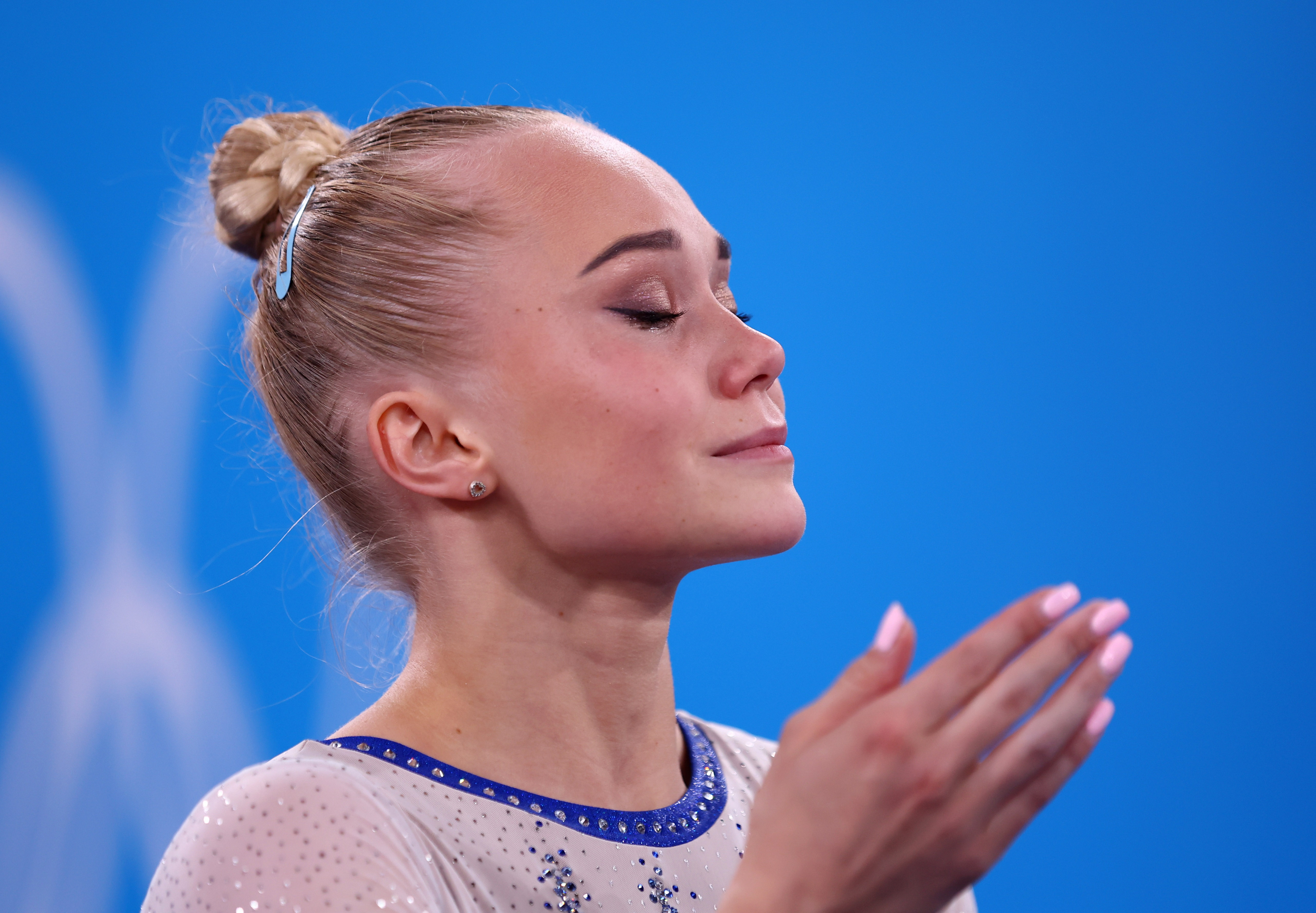
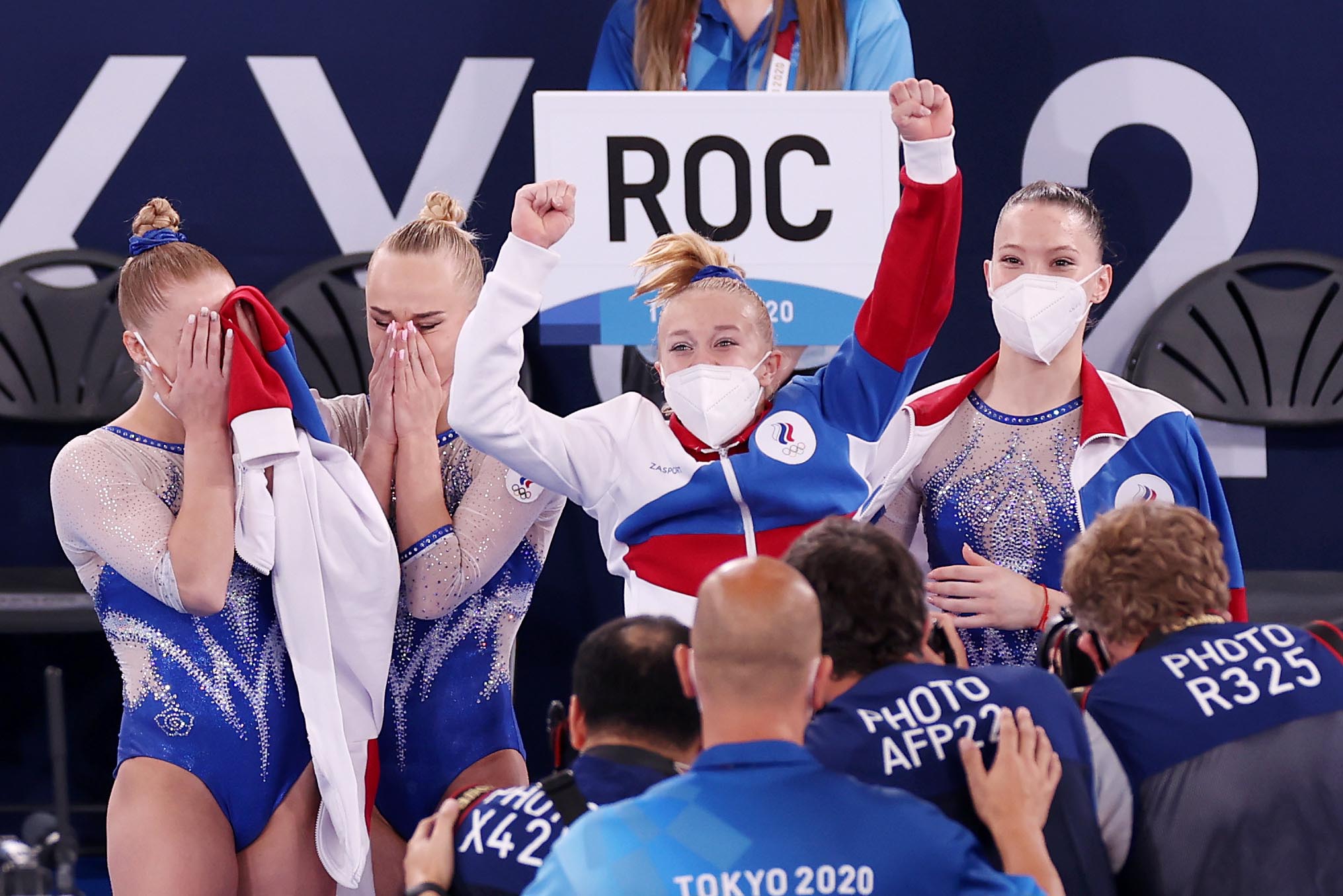
The Russians won the team competition, the first in their history. They were in 2nd place in 2012 and 2016. It was a very big deal for them to win. They were led by Angelina Melnikova, their captain, who wrapped it up for them on floor. She went on to win the World All-Around title about 3 months later. At the Olympics you must turn 16 during the year of the competition. Due to postponement from COVID, the IOC decided to let girls that would turn 16 in 2021 participate in the Tokyo Olympics. This allowed Victoria Listunova to compete for Russia. She is a very good talent and may have been the difference for them to win gold. She is the one with her hands up in the team picture below. Listunova was the baby on that Russian team. I bring this up because perhaps Hezly Rivera will be in that role for the US team in Paris.
Melnikova
Part 4: Some notable Olympic Games for Gymnastics
Sydney 2000 - The Russians and Romanians both had spectacular teams and the Russians were favored to win team gold. But, they all faltered on the beam and this cost them the gold medal. They rebounded and were spectacular on the next event, floor, but it wasn't enough. The Russian girls could be seen taking off their medals after the ceremony - they were not happy. During the women's all-around, with Russian Svetlana Khorkina heavily favored, they set the vault at the wrong height (it's at a different height for men and women) and many gymnasts, including Khorkina, had mishaps. It ruined the competition. Raducan from Romania won the All-Around and then was popped for a banned substance - she had a cold and was given a decongestant or something, and I believe it had a banned substance. She was later cleared but they refused to reset the results and give her the gold medal that she earned. The Romanians had all three podium spots for the all-around. This is not possible now as there is a limit of '2 per country' in these finals. After they announced her doping issue and tried to re-award the medals to the new placings, the three gymnasts in line all refused, stating that Raducan should keep her medal. Silver medal originally went to Romanian, Simona Amanar, and she wanted to refuse the gold and give it to Raducan - but Raducan persuaded her to take it so she could bring it back to Romania.
2004 Athens - This is where the US string of All-Around titles on the women's side started, with Carly Patterson. They have won all of them from the Athens Games forward. The US also won the men's All-Around in Athens, thanks to Paul Hamm.
2008 Beijing - The US won team gold at the World Championships the year prior and were favored to win at the Olympics, but finished with a silver to China, who was on point during the team competition. Chellsie Memmel and Alicia Sacramone were both on that squad and now are senior leaders with USA Gymnastics.
2012 London - American Gabby Douglas won the All-Around in a close competition with Russian, Victoria Komova. Komova lost because of a stumble during her landing on vault. She was a great gymnast but was always prone to a small misstep here and there and it cost her on multiple occasions. She lost out on a World All-Around in a very, very close competition, to American Jorden Wieber, in 2011. American, Aly Raisman, won gold on floor in one of the better floor performances of all time. The best vault of all time (according to many) was done at these Olympics by American, Mykala Maroney. She should have received a perfect score, IMO. There is a good comparison photo out there showing the difference between her vault and one of the men that did the same vault, and she is about 2 feet higher in the air.
2016 Rio - Simone Biles dominated everything. She was 'on the scene' starting in 2013 but the Rio Games were exceedingly dominant. Biles won gold on floor but I thought it was going to be Raisman winning another gold on floor after watching the routines.
2020 Tokyo - Simone Biles dominated again, but for different reasons. The remaining gymnasts on the US team gave what I consider to be the most clutch performance in the history of women's athletics in the US. Simone came down on her first vault and had no idea where she was and abandoned - the remaining members: Grace McCallum, Jordan Chiles, Suni Lee, all had to compete in the remaining events, even though Simone was set to be in each event for the team competition. They had no warning and had to shift in the middle of the team final and they'd lost the team leader and the highest scoring gymnast on the planet, by a wide margin. Those three gymnasts will never get the credit they deserve because they got silver, rather than gold. Suni Lee won the All-Around to keep the US streak going. After going to Auburn to compete in gymnastics there, she developed some kidney issues and for a while didn't know if she would ever be able to do gymnastics again, and now she's back at the Olympics.
The Russians won the team competition, the first in their history. They were in 2nd place in 2012 and 2016. It was a very big deal for them to win. They were led by Angelina Melnikova, their captain, who wrapped it up for them on floor. She went on to win the World All-Around title about 3 months later. At the Olympics you must turn 16 during the year of the competition. Due to postponement from COVID, the IOC decided to let girls that would turn 16 in 2021 participate in the Tokyo Olympics. This allowed Victoria Listunova to compete for Russia. She is a very good talent and may have been the difference for them to win gold. She is the one with her hands up in the team picture below. Listunova was the baby on that Russian team. I bring this up because perhaps Hezly Rivera will be in that role for the US team in Paris.
Melnikova
Posted on 7/24/24 at 3:38 am to POTUS2024
GYMNASTICS AND OLYMPIC GYMNASTICS HISTORY, 5 of 5
Part 5: A few statistics and facts
1928 - 1992
The US won zero team titles. The USSR started sending a women's team in 1952 and won every team title from that moment forward, for each Olympics they entered. They boycotted the 1984 Olympics in LA.
Up until 1984, the US did not have a single Olympic champion in women's gymnastics. In fact, they did not have a single medalist on the women's side for an individual event, until Retton won the all-around. Mary Lou Retton and Julianne McNamara both won gold at those Olympics and the US men won the team gold for the first and only time. The 1984 Summer Olympics were a pretty big deal in the US.
US men had some success in getting gold medals up through 1932. They did not get another until 1984, then another in 1992. They have lagged behind ever since but they are getting better.
1996 - 2000
The US won its first team gold in 1996 but it appeared the rise of US women's gymnastics might be a flash in the pan. They did not have a great showing in 2000. In those two Olympics, the only individual gold medal was Shannon Miller, on beam, 1996.
2004 - 2020
US women have won the team event twice over those 5 Olympics, and produced 10 Olympic champions. The men have produced only one gold medal in this time frame, being Paul Hamm, for the all-around in 2004. Men are getting better and the US women represent the best program on the international stage at the moment.
Part 5: A few statistics and facts
1928 - 1992
The US won zero team titles. The USSR started sending a women's team in 1952 and won every team title from that moment forward, for each Olympics they entered. They boycotted the 1984 Olympics in LA.
Up until 1984, the US did not have a single Olympic champion in women's gymnastics. In fact, they did not have a single medalist on the women's side for an individual event, until Retton won the all-around. Mary Lou Retton and Julianne McNamara both won gold at those Olympics and the US men won the team gold for the first and only time. The 1984 Summer Olympics were a pretty big deal in the US.
US men had some success in getting gold medals up through 1932. They did not get another until 1984, then another in 1992. They have lagged behind ever since but they are getting better.
1996 - 2000
The US won its first team gold in 1996 but it appeared the rise of US women's gymnastics might be a flash in the pan. They did not have a great showing in 2000. In those two Olympics, the only individual gold medal was Shannon Miller, on beam, 1996.
2004 - 2020
US women have won the team event twice over those 5 Olympics, and produced 10 Olympic champions. The men have produced only one gold medal in this time frame, being Paul Hamm, for the all-around in 2004. Men are getting better and the US women represent the best program on the international stage at the moment.

Posted on 7/24/24 at 4:07 am to POTUS2024
Gymnast Spotlight: Oksana Chusovitina
There's a lot of talk about how Simone is 27 and at her 3rd Olympics. She has a long, long way to go to catch up to Chusovitina.

Oksana grew up in the USSR, born in 1975. She represented the USSR (Unified Team) at the 1992 Olympics in Barcelona, in her first of 8 Olympic appearances.
She has 5 skills named after her.
She had a child in 1999 and her son got cancer about 3 years later. She and her family moved to Germany, as there were people there willing to help her get top treatment for her son. She would later get German citizenship and compete for them at the Olympics.
After the dissolution of the USSR, she went where she could find a home, treatment for her son, compete, and ended up going to the Olympics for decades. And here's how it went:
1992 - Unified Team
1996 - Uzbekistan
2000 - Uzbekistan
2004 - Uzbekistan
2008 - Germany (she won a medal at these Olympics, 16 years after her first Olympic appearance)
2012 - Germany
2016 - Uzbekistan
2020 - Uzbekistan
That's 8 trips to the Olympics. She was moving toward qualifying for Paris but had an injury and withdrew. I don't know if she would have made it or not. Her longevity in the sport is something no one has ever come close to matching. I don't think anyone has been able to do half of what she's done.
There's a lot of talk about how Simone is 27 and at her 3rd Olympics. She has a long, long way to go to catch up to Chusovitina.
Oksana grew up in the USSR, born in 1975. She represented the USSR (Unified Team) at the 1992 Olympics in Barcelona, in her first of 8 Olympic appearances.
She has 5 skills named after her.
She had a child in 1999 and her son got cancer about 3 years later. She and her family moved to Germany, as there were people there willing to help her get top treatment for her son. She would later get German citizenship and compete for them at the Olympics.
After the dissolution of the USSR, she went where she could find a home, treatment for her son, compete, and ended up going to the Olympics for decades. And here's how it went:
1992 - Unified Team
1996 - Uzbekistan
2000 - Uzbekistan
2004 - Uzbekistan
2008 - Germany (she won a medal at these Olympics, 16 years after her first Olympic appearance)
2012 - Germany
2016 - Uzbekistan
2020 - Uzbekistan
That's 8 trips to the Olympics. She was moving toward qualifying for Paris but had an injury and withdrew. I don't know if she would have made it or not. Her longevity in the sport is something no one has ever come close to matching. I don't think anyone has been able to do half of what she's done.
Posted on 7/24/24 at 4:46 am to POTUS2024
Men will be doing podium training soon (women tomorrow). I think they are out there as I type this.
This is a breakdown of Brody Malone, two time Olympian and World Champion, by former US Olympian Lance Ringnald.
Ringnald does a lot of these videos - he just started his channel not long ago. His videos are pretty good. He's an Olympian and knows the sport well. He's done reviews of most of the athletes on the US team in Paris right now.
This is a breakdown of Brody Malone, two time Olympian and World Champion, by former US Olympian Lance Ringnald.
Ringnald does a lot of these videos - he just started his channel not long ago. His videos are pretty good. He's an Olympian and knows the sport well. He's done reviews of most of the athletes on the US team in Paris right now.
Posted on 7/24/24 at 8:03 am to POTUS2024
I think the US has had enough achilles issues for quite some time. Hopefully this is nothing more than soreness.
Loading Twitter/X Embed...
If tweet fails to load, click here.Posted on 7/24/24 at 8:09 am to POTUS2024
Posted on 7/24/24 at 8:11 am to POTUS2024


Posted on 7/24/24 at 9:26 am to POTUS2024
quote:
quote:
What is trampoline and why is Lafayette dominant at it?
It's exactly as the name implies: these people are experts at trying to kill themselves on a trampoline, just as every red-blooded child in America has tried to do since the trampoline was invented.
Every baw buys a trampoline for his kid. Right of passage for American children. It would only be surprising if people from Louisiana were not at the Olympics for Trampoline.
This is not the answer at all.
This is the answer. I have no idea how he ended up in Lafayette, but he is the premier tramp and tumbling coach in the US. People send their kids to him from all over the country. It's just that tramp and tumbling is a pretty small sport compared to artistic gymnastics.
Dmitri Poliaroush - Coach
Posted on 7/24/24 at 9:57 am to POTUS2024
1972, Munich, was the 1st Olympics I remember watching. I was 11. I watched every second of Olga Korbut and Ludmilla Tourischeva. Korbut was the little darling who did amazing things. Ludmilla was an absolutely gorgeous gymnast who looked like such a grown woman at 20, compared to how 17 year old Korbut looked. Most people remember Korbut, but not Ludmilla, who actually won the gold AA.
1976 - Nadia Comenici - she was 1 year younger than me. I was obsessed with everything she did. I so badly wanted to do gymnastics, but there was nowhere I could go closeby. I settled for cheerleading and doing a perfect cartwheel and roundoff.
1980 - the boycott and 1984 - Los Angeles - Kathy Johnson - Although her wiki bio doesn't mention it at all, she trained in Shreveport in 1976 and 1977. She was an up and coming gymnast and would have been on the team in 1980. She was named captain in 1984. Trinity Heights Christian Academy, private school in Shreveport, had a gymnastics program and girls came and lived there and trained and went to school there. She and a few others graduated from HS there in 1977, my late husband's class. She's been a commentator in the past, mostly with Bart Conner. She really went thru it. She had an eating disorder and also after the 1980 boycott, went to S. Cal and trained at SCATS, Don Peters gym. He was a coach that was banned for life for sexually assulting 3 teenage girls (probably more).
1976 - Nadia Comenici - she was 1 year younger than me. I was obsessed with everything she did. I so badly wanted to do gymnastics, but there was nowhere I could go closeby. I settled for cheerleading and doing a perfect cartwheel and roundoff.
1980 - the boycott and 1984 - Los Angeles - Kathy Johnson - Although her wiki bio doesn't mention it at all, she trained in Shreveport in 1976 and 1977. She was an up and coming gymnast and would have been on the team in 1980. She was named captain in 1984. Trinity Heights Christian Academy, private school in Shreveport, had a gymnastics program and girls came and lived there and trained and went to school there. She and a few others graduated from HS there in 1977, my late husband's class. She's been a commentator in the past, mostly with Bart Conner. She really went thru it. She had an eating disorder and also after the 1980 boycott, went to S. Cal and trained at SCATS, Don Peters gym. He was a coach that was banned for life for sexually assulting 3 teenage girls (probably more).

Posted on 7/24/24 at 10:33 am to POTUS2024
That Vault in the team competition by Maroney was one of the most impressive things I’ve seen. So so good.


Posted on 7/24/24 at 12:05 pm to POTUS2024
 Ready for our girls to clean house and maybe people will shut up with the Biles hate. Though I'm sure some neckbeards and boomers will never forgive her for the trauma she put them through by backing out last go around.
 Would have loved for Lincoln to have made the team so we'd have an LSU commit in the Olympic but o well, this team is loaded. Actually kind of surprised Jade Carey made it.
As much as I love gymnastics, I can't for the life of me watch more than 15 seconds of rhythmic gymnastics. It's so bad
 Never gave trampoline a shot.
 Posted on 7/24/24 at 12:08 pm to POTUS2024
quote:
I imagine some people are going to pounce on this quote.
I mean she is killing it right now. I can't imagine her not doing all 4.It's got to be a little bit of redemption for her too to prove the haters wrong.

 Page 2 of 37

Back to top
 Follow TigerDroppings for LSU Football News