




- My Forums
- Tiger Rant
- LSU Recruiting
- SEC Rant
- Saints Talk
- Pelicans Talk
- More Sports Board
- Fantasy Sports
- Golf Board
- Soccer Board
- O-T Lounge
- Tech Board
- Home/Garden Board
- Outdoor Board
- Health/Fitness Board
- Movie/TV Board
- Book Board
- Music Board
- Political Talk
- Money Talk
- Fark Board
- Gaming Board
- Travel Board
- Food/Drink Board
- Ticket Exchange
- TD Help Board
Customize My Forums- View All Forums
- Show Left Links
- Topic Sort Options
- Trending Topics
- Recent Topics
- Active Topics
Started By
Message

Saturn's moon Titan where we will soon be flying around
Posted on 6/30/19 at 12:03 am

Posted on 6/30/19 at 12:03 am
NASA announced they are moving forward with the Dragonfly project the other day which will be p probe to one of Saturn’s moons called Titan. Here’s some more info on the craft and where it will be flying around.
: LINK
Dragonfly will launch in 2026 and arrive in 2034. The rotorcraft will fly to dozens of promising locations on Titan looking for prebiotic chemical processes common on both Titan and Earth. Dragonfly marks the first time NASA will fly a multi-rotor vehicle for science on another planet; it has eight rotors and flies like a large drone. It will take advantage of Titan’s dense atmosphere – four times denser than Earth’s – to become the first vehicle ever to fly its entire science payload to new places for repeatable and targeted access to surface materials.
Titan is an analog to the very early Earth, and can provide clues to how life may have arisen on our planet. During its 2.7-year baseline mission, Dragonfly will explore diverse environments from organic dunes to the floor of an impact crater where liquid water and complex organic materials key to life once existed together for possibly tens of thousands of years. Its instruments will study how far prebiotic chemistry may have progressed. They also will investigate the moon’s atmospheric and surface properties and its subsurface ocean and liquid reservoirs. Additionally, instruments will search for chemical evidence of past or extant life.
Titan Wiki
Titan is the sixth gravitationally rounded moon from Saturn. Frequently described as a planet-like moon, Titan is 50% larger than Earth's moon and 80% more massive. It is the second-largest moon in the Solar System after Jupiter's moon Ganymede, and is larger than the planet Mercury, but only 40% as massive.
Titan is primarily composed of ice and rocky material. Much as with Venus before the Space Age, the dense opaque atmosphere prevented understanding of Titan's surface until the Cassini–Huygens mission in 2004 provided new information, including the discovery of liquid hydrocarbon lakes in Titan's polar regions. The geologically young surface is generally smooth, with few impact craters, although mountains and several possible cryovolcanoes have been found.

We’ve actually already been there with the Huygens probe launched from Cassini.
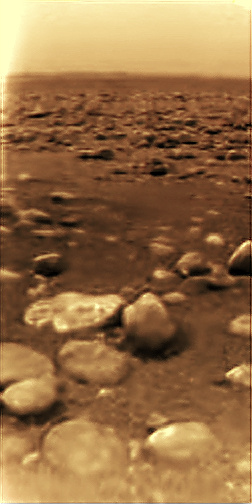
Image from the surface.
: LINK
Dragonfly will launch in 2026 and arrive in 2034. The rotorcraft will fly to dozens of promising locations on Titan looking for prebiotic chemical processes common on both Titan and Earth. Dragonfly marks the first time NASA will fly a multi-rotor vehicle for science on another planet; it has eight rotors and flies like a large drone. It will take advantage of Titan’s dense atmosphere – four times denser than Earth’s – to become the first vehicle ever to fly its entire science payload to new places for repeatable and targeted access to surface materials.
Titan is an analog to the very early Earth, and can provide clues to how life may have arisen on our planet. During its 2.7-year baseline mission, Dragonfly will explore diverse environments from organic dunes to the floor of an impact crater where liquid water and complex organic materials key to life once existed together for possibly tens of thousands of years. Its instruments will study how far prebiotic chemistry may have progressed. They also will investigate the moon’s atmospheric and surface properties and its subsurface ocean and liquid reservoirs. Additionally, instruments will search for chemical evidence of past or extant life.
Titan Wiki
Titan is the sixth gravitationally rounded moon from Saturn. Frequently described as a planet-like moon, Titan is 50% larger than Earth's moon and 80% more massive. It is the second-largest moon in the Solar System after Jupiter's moon Ganymede, and is larger than the planet Mercury, but only 40% as massive.
Titan is primarily composed of ice and rocky material. Much as with Venus before the Space Age, the dense opaque atmosphere prevented understanding of Titan's surface until the Cassini–Huygens mission in 2004 provided new information, including the discovery of liquid hydrocarbon lakes in Titan's polar regions. The geologically young surface is generally smooth, with few impact craters, although mountains and several possible cryovolcanoes have been found.
We’ve actually already been there with the Huygens probe launched from Cassini.
Image from the surface.
 7
7

Posted on 6/30/19 at 12:15 am to DavidTheGnome
That’s super neat and all but I’d just rather see Uranus.


Posted on 6/30/19 at 12:18 am to DavidTheGnome
Trump is doing work.


Posted on 6/30/19 at 12:22 am to DavidTheGnome
Lolnasa

Posted on 6/30/19 at 12:23 am to DavidTheGnome
Looks like it's a giant ball of ghost in the machine

Posted on 6/30/19 at 12:41 am to DavidTheGnome
Titan has always been my favorite body in our star system.
It's so pretty and mysterious.
It's so pretty and mysterious.

Posted on 6/30/19 at 12:45 am to DavidTheGnome
Cool Reddit.com post.
#FreeLucasP
#FreeLucasP


Posted on 6/30/19 at 12:50 am to DavidTheGnome

Posted on 6/30/19 at 12:51 am to Dead End
Ever since NASA started doing that Muslim outreach things seem to be progressing.

 Page 1 of 1


Popular
Back to top
 Follow TigerDroppings for LSU Football News