




- My Forums
- Tiger Rant
- LSU Recruiting
- SEC Rant
- Saints Talk
- Pelicans Talk
- More Sports Board
- Fantasy Sports
- Golf Board
- Soccer Board
- O-T Lounge
- Tech Board
- Home/Garden Board
- Outdoor Board
- Health/Fitness Board
- Movie/TV Board
- Book Board
- Music Board
- Political Talk
- Money Talk
- Fark Board
- Gaming Board
- Travel Board
- Food/Drink Board
- Ticket Exchange
- TD Help Board
Customize My Forums- View All Forums
- Topic Sort Options
- Trending Topics
- Recent Topics
- Active Topics
Skip Bertman's First LSU Recruit Remembers the Birth of a Dynasty
 1
1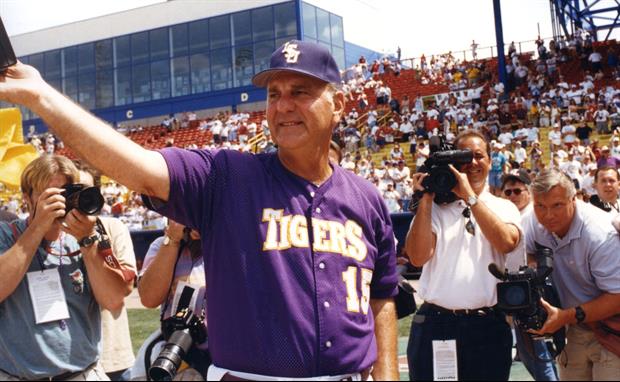
LSU Sports Photography
Chicken had a chance to speak with the first player Skip Bertman recruited to LSU. Mitch Gaspard was a standout middle infielder on Port Arthur Thomas Jefferson’s 1983 Class 5A state championship team in Texas.
Gaspard later spent many years coaching under Jim Wells at Alabama. Wells had served as a graduate assistant under Bertman at LSU, and Gaspard eventually succeeded him as Alabama’s head coach. That connection gave Gaspard a unique perspective on Bertman’s influence as both a coach and program builder.
On being recruited by Skip Bertman
Gaspard arrived in Baton Rouge expecting LSU to be little more than another stop on his recruiting tour. He loved the campus, but the rundown baseball facilities did little to sell him on the program. Then he sat behind home plate at Alex Box Stadium and listened as Bertman described exactly what LSU baseball would eventually become.
“I played at Port Arthur Thomas Jefferson, and we had won a state championship in 1983. This really dates me, because it tells you how different recruiting was then compared to now: I was being recruited in May and June to go somewhere that fall.
“I had visited Texas A&M, Baylor, the University of Houston and most of the Texas schools. I was pretty well locked in on going to one of those schools when I received a packet in the mail from the University of Miami. Miami had won the national championship in 1982, and Skip was an assistant there under Ron Fraser.
“Then Skip called me. I’m thinking, ‘Oh my God, Miami is calling.’ But he said, ‘I’m calling from Miami, but there’s a really good chance I’m going to get the LSU job.’
“A few days later, Smoke Laval called me and said, ‘Skip is getting the job. We’re going to be at LSU, and we’d love for you to come visit.’
“Smoke and a graduate assistant came to my house for a home visit. Skip was still in Miami, but he had gotten the LSU job by that point. They invited me to Baton Rouge, so I went - but I really had no intention of going to LSU.
“Once I got off the plane and started walking around, I loved the campus. I was already somewhat familiar with LSU because a few football players from Port Arthur Thomas Jefferson had played there.
“Smoke took me through the baseball facilities, and the old locker room was pretty ratty. It had already been torn up because they were beginning to put their stamp on the place.
“Jack Lamabe, who had been the coach before Skip, was sitting in a La-Z-Boy that had a big hole in the back of it, spitting chewing tobacco onto the locker-room floor. I remember thinking, ‘Holy shite, where am I?’
“Then I met with Skip. He walked me out to old Alex Box Stadium, and we sat behind home plate. The stadium had wooden bleachers. The ballpark looked bad. The grass was horrible, and the fence was practically falling down.
“Skip started laying out his vision for the program. Thirty minutes later, I was thinking, ‘I’m coming to LSU.’
“He was so innovative. He could talk baseball, but he could also talk about life and everything else. He went through his entire plan to resurrect the program—how he was going to recruit the best players, how he was going to change baseball in the state of Louisiana and how they were going to fill the stadium with fans.
“He covered every little detail: the locker room, the hitting facility, the grandstand and the experience for the fans.
“Having spent as long as I did in the coaching profession, and knowing what I know now, it’s amazing to look back on that conversation. He nailed everything he said he was going to do - from winning conference championships to winning national championships.”
On Skip’s attention to the fan experience
Bertman’s vision extended well beyond recruiting players and winning games. He wanted LSU fans to enjoy every part of a night at Alex Box Stadium - even the quality of the food and drinks served at the concession stand.
“Here’s a quick story, and this happened many times during my first year there: During the game, Skip would have a graduate assistant go to the concession stand and get a coffee, a Coke and a hot dog and bring everything down to the dugout. Skip would make sure the coffee was hot, the Coke had enough ice and the hot dog tasted good and was cooked properly.
“He paid attention to little things like that from the very beginning because the fan experience mattered so much to him.”
On Skip’s remarkable feel for the game
Bertman’s attention to detail was just as evident in the dugout. Gaspard remembers one pitch that demonstrated how far ahead Bertman could see the game - even before his players understood what he had seen.
“I remember during my sophomore year, Mark Guthrie threw a pitch against Kentucky. As the ball was coming out of his hand, Skip put his hand on his head and said, ‘Oh no.’ Of course, the guy hit a three-run homer.
“When you’re 18 or 19 years old, sitting behind him on the bench, you’re thinking, ‘Oh my God, how did he know that?’ His vision for the game was incredible.”
On playing for Skip
Bertman demanded long hours and held his players accountable, but Gaspard said his criticism rarely felt arbitrary. His players respected him because they understood that there was a purpose behind what he demanded.
“Skip was hard, but he was fair. He didn’t hold back. We practiced long hours, seven days a week, and he would rattle your cage when you didn’t play well.
“But rarely did you leave the ballpark thinking he had treated you unfairly. When he gave it to you, you usually knew you deserved it. He knew his team, and he knew when to push the right buttons.”
Bertman also seemed to notice everything happening around him, even when his attention appeared to be somewhere else.
“Skip had eyes in the back of his head. He could be working with the pitchers while you were taking batting practice, and you’d think he wasn’t watching. Then he would come over and talk to you about something you had done during batting practice. You’d think, ‘How in the hell did he see that?’”
On building an audience for LSU baseball
Before winning became enough to fill Alex Box Stadium, Bertman used creative promotions to attract fans - and made sure they remained in their seats long enough to become invested in the game.
“During those first two or three years, Skip did all kinds of promotions to get people into the ballpark. I remember one night they drove a car around Alex Box Stadium that someone was going to win. There was another promotion involving a diamond ring.
“They wouldn’t announce the winner until the sixth or seventh inning, so everybody stayed, bought concessions and watched the game. Then the product took off and LSU started winning. Before long, he didn’t need those promotions anymore because they were selling out the stadium.”
On what LSU baseball became
Gaspard later returned to Alex Box Stadium as an opposing coach, including during Alabama’s battles with LSU in the late 1990s, and saw firsthand what had become of the program Bertman described during that first recruiting visit. The rundown ballpark had become one of college baseball’s most intimidating environments, and LSU had become a destination for elite players across the country.
“LSU became an absolute monster. Every young player in the country wanted to go to LSU - and it’s still like that today. That’s because of Skip.
“There was nothing like playing at old Alex Box Stadium. Even when I came back as a coach on the other side, you knew that when the crowd got going late in a close game, you had better hang on for dear life.
“If your pitcher didn’t have some stones on the mound at the end of the game, you weren’t going to win. You had to buckle up because you were going to earn every win you got at Alex Box.”
On what made Skip exceptional
To Gaspard, Bertman’s success was not simply the product of his knowledge of baseball. He understood people, motivation, marketing and business at a level that could have made him successful in almost any profession.
“Skip could have been the CEO of AT&T. It didn’t matter that it happened to be baseball. He was brilliant, he knew how to motivate people, and he understood the business world as well as he understood baseball.”
On the legacy Skip left behind
More than four decades after Bertman recruited him, Gaspard said former players can still spend hours exchanging stories about their old coach. That, as much as the championships and everything Bertman built at LSU, illustrates the lasting effect he had on the people around him.
“Skip is one of those guys you can sit around with former players and tell stories about for hours and hours. The stories just go on and on, even today.
“There are only a handful of people you come across in a lifetime who have that kind of impact. Skip was one of them. What a life he led - and what a career.”
Gaspard later spent many years coaching under Jim Wells at Alabama. Wells had served as a graduate assistant under Bertman at LSU, and Gaspard eventually succeeded him as Alabama’s head coach. That connection gave Gaspard a unique perspective on Bertman’s influence as both a coach and program builder.
On being recruited by Skip Bertman
Gaspard arrived in Baton Rouge expecting LSU to be little more than another stop on his recruiting tour. He loved the campus, but the rundown baseball facilities did little to sell him on the program. Then he sat behind home plate at Alex Box Stadium and listened as Bertman described exactly what LSU baseball would eventually become.
“I played at Port Arthur Thomas Jefferson, and we had won a state championship in 1983. This really dates me, because it tells you how different recruiting was then compared to now: I was being recruited in May and June to go somewhere that fall.
“I had visited Texas A&M, Baylor, the University of Houston and most of the Texas schools. I was pretty well locked in on going to one of those schools when I received a packet in the mail from the University of Miami. Miami had won the national championship in 1982, and Skip was an assistant there under Ron Fraser.
“Then Skip called me. I’m thinking, ‘Oh my God, Miami is calling.’ But he said, ‘I’m calling from Miami, but there’s a really good chance I’m going to get the LSU job.’
“A few days later, Smoke Laval called me and said, ‘Skip is getting the job. We’re going to be at LSU, and we’d love for you to come visit.’
“Smoke and a graduate assistant came to my house for a home visit. Skip was still in Miami, but he had gotten the LSU job by that point. They invited me to Baton Rouge, so I went - but I really had no intention of going to LSU.
“Once I got off the plane and started walking around, I loved the campus. I was already somewhat familiar with LSU because a few football players from Port Arthur Thomas Jefferson had played there.
“Smoke took me through the baseball facilities, and the old locker room was pretty ratty. It had already been torn up because they were beginning to put their stamp on the place.
“Jack Lamabe, who had been the coach before Skip, was sitting in a La-Z-Boy that had a big hole in the back of it, spitting chewing tobacco onto the locker-room floor. I remember thinking, ‘Holy shite, where am I?’
“Then I met with Skip. He walked me out to old Alex Box Stadium, and we sat behind home plate. The stadium had wooden bleachers. The ballpark looked bad. The grass was horrible, and the fence was practically falling down.
“Skip started laying out his vision for the program. Thirty minutes later, I was thinking, ‘I’m coming to LSU.’
“He was so innovative. He could talk baseball, but he could also talk about life and everything else. He went through his entire plan to resurrect the program—how he was going to recruit the best players, how he was going to change baseball in the state of Louisiana and how they were going to fill the stadium with fans.
“He covered every little detail: the locker room, the hitting facility, the grandstand and the experience for the fans.
“Having spent as long as I did in the coaching profession, and knowing what I know now, it’s amazing to look back on that conversation. He nailed everything he said he was going to do - from winning conference championships to winning national championships.”
On Skip’s attention to the fan experience
Bertman’s vision extended well beyond recruiting players and winning games. He wanted LSU fans to enjoy every part of a night at Alex Box Stadium - even the quality of the food and drinks served at the concession stand.
“Here’s a quick story, and this happened many times during my first year there: During the game, Skip would have a graduate assistant go to the concession stand and get a coffee, a Coke and a hot dog and bring everything down to the dugout. Skip would make sure the coffee was hot, the Coke had enough ice and the hot dog tasted good and was cooked properly.
“He paid attention to little things like that from the very beginning because the fan experience mattered so much to him.”
On Skip’s remarkable feel for the game
Bertman’s attention to detail was just as evident in the dugout. Gaspard remembers one pitch that demonstrated how far ahead Bertman could see the game - even before his players understood what he had seen.
“I remember during my sophomore year, Mark Guthrie threw a pitch against Kentucky. As the ball was coming out of his hand, Skip put his hand on his head and said, ‘Oh no.’ Of course, the guy hit a three-run homer.
“When you’re 18 or 19 years old, sitting behind him on the bench, you’re thinking, ‘Oh my God, how did he know that?’ His vision for the game was incredible.”
On playing for Skip
Bertman demanded long hours and held his players accountable, but Gaspard said his criticism rarely felt arbitrary. His players respected him because they understood that there was a purpose behind what he demanded.
“Skip was hard, but he was fair. He didn’t hold back. We practiced long hours, seven days a week, and he would rattle your cage when you didn’t play well.
“But rarely did you leave the ballpark thinking he had treated you unfairly. When he gave it to you, you usually knew you deserved it. He knew his team, and he knew when to push the right buttons.”
Bertman also seemed to notice everything happening around him, even when his attention appeared to be somewhere else.
“Skip had eyes in the back of his head. He could be working with the pitchers while you were taking batting practice, and you’d think he wasn’t watching. Then he would come over and talk to you about something you had done during batting practice. You’d think, ‘How in the hell did he see that?’”
On building an audience for LSU baseball
Before winning became enough to fill Alex Box Stadium, Bertman used creative promotions to attract fans - and made sure they remained in their seats long enough to become invested in the game.
“During those first two or three years, Skip did all kinds of promotions to get people into the ballpark. I remember one night they drove a car around Alex Box Stadium that someone was going to win. There was another promotion involving a diamond ring.
“They wouldn’t announce the winner until the sixth or seventh inning, so everybody stayed, bought concessions and watched the game. Then the product took off and LSU started winning. Before long, he didn’t need those promotions anymore because they were selling out the stadium.”
On what LSU baseball became
Gaspard later returned to Alex Box Stadium as an opposing coach, including during Alabama’s battles with LSU in the late 1990s, and saw firsthand what had become of the program Bertman described during that first recruiting visit. The rundown ballpark had become one of college baseball’s most intimidating environments, and LSU had become a destination for elite players across the country.
“LSU became an absolute monster. Every young player in the country wanted to go to LSU - and it’s still like that today. That’s because of Skip.
“There was nothing like playing at old Alex Box Stadium. Even when I came back as a coach on the other side, you knew that when the crowd got going late in a close game, you had better hang on for dear life.
“If your pitcher didn’t have some stones on the mound at the end of the game, you weren’t going to win. You had to buckle up because you were going to earn every win you got at Alex Box.”
On what made Skip exceptional
To Gaspard, Bertman’s success was not simply the product of his knowledge of baseball. He understood people, motivation, marketing and business at a level that could have made him successful in almost any profession.
“Skip could have been the CEO of AT&T. It didn’t matter that it happened to be baseball. He was brilliant, he knew how to motivate people, and he understood the business world as well as he understood baseball.”
On the legacy Skip left behind
More than four decades after Bertman recruited him, Gaspard said former players can still spend hours exchanging stories about their old coach. That, as much as the championships and everything Bertman built at LSU, illustrates the lasting effect he had on the people around him.
“Skip is one of those guys you can sit around with former players and tell stories about for hours and hours. The stories just go on and on, even today.
“There are only a handful of people you come across in a lifetime who have that kind of impact. Skip was one of them. What a life he led - and what a career.”
Popular Stories
 13
13
Latest Headlines

 Follow TigerDroppings for LSU Football News