




- My Forums
- Tiger Rant
- LSU Recruiting
- SEC Rant
- Saints Talk
- Pelicans Talk
- More Sports Board
- Fantasy Sports
- Golf Board
- Soccer Board
- O-T Lounge
- Tech Board
- Home/Garden Board
- Outdoor Board
- Health/Fitness Board
- Movie/TV Board
- Book Board
- Music Board
- Political Talk
- Money Talk
- Fark Board
- Gaming Board
- Travel Board
- Food/Drink Board
- Ticket Exchange
- TD Help Board
Customize My Forums- View All Forums
- Show Left Links
- Topic Sort Options
- Trending Topics
- Recent Topics
- Active Topics
Started By
Message

On this date 155 years ago....
Posted on 5/5/19 at 1:56 pm

Posted on 5/5/19 at 1:56 pm
The Battle of the Wilderness begins.
After making the mistake of encamping in the dense thicket on the evening of May 4, George Meade rouses his army early on the morning of the 5th to continue its march out of the Wilderness. He still hopes that Lee and his army are miles away and won't be able to intercept the Union force until they were in the open country south of their present position.
Robert E. Lee, however, had no intention of letting the Army of the Potomac reach the open country and was currently marching his forces with all possible speed to give battle with the Union army in the Wilderness. Even though a third of his army won't be able to reach the battlefield until May 6 (James Longstreet's Corps), Lee decided to take the remaining two-thirds he had on hand (Richard S. Ewell and A.P. Hill's Corps) to surprise attack the Union forces under Grant and Meade.
Initial movement of forces on May 5, 1864 (7:00 AM)
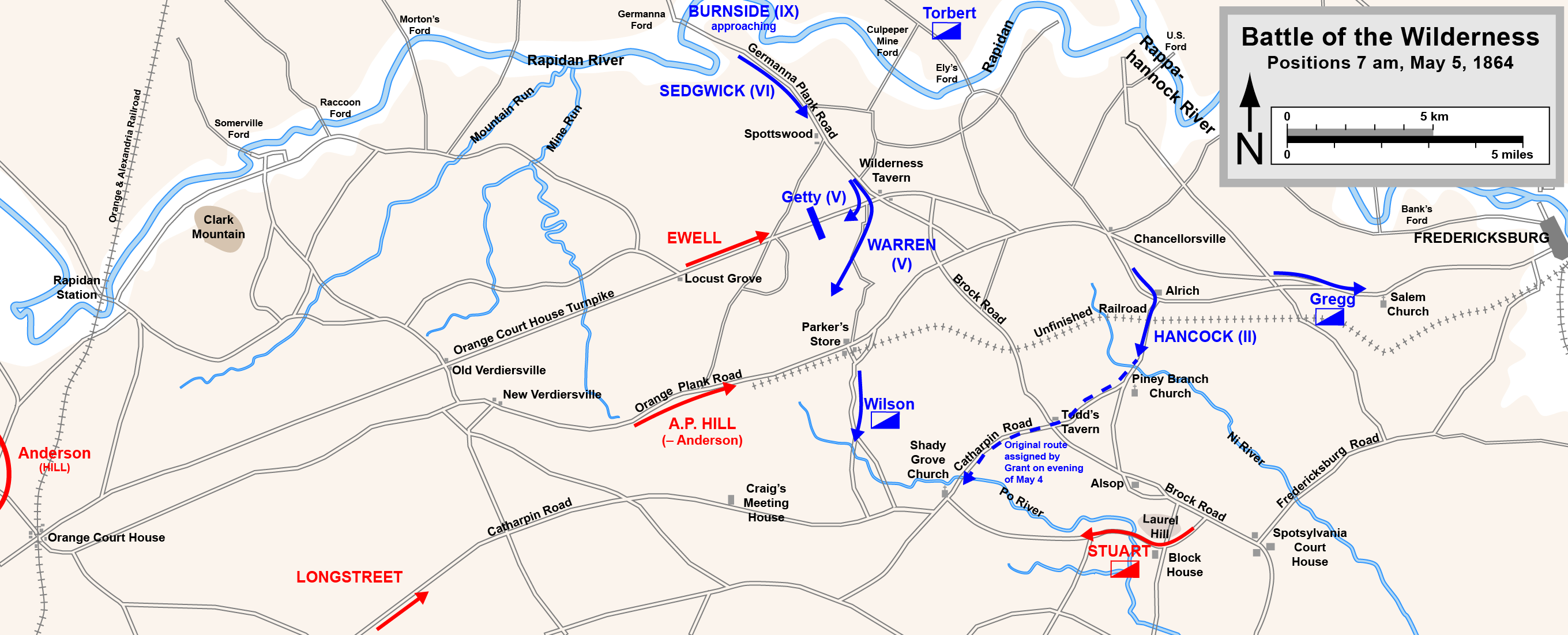
First contact came when elements of Warren's V Corps were advancing over farm lanes toward the Orange Plank Road. It was in this area where Ewell's Corps appeared in the west. The two sides engaged and the battle had begun. Word was immediately sent to Grant of the encounter. Upon hearing word that battle had been joined, Grant coolly replied: "If any opportunity presents itself of pitching into a part of Lee's army, do so without giving time for disposition."
Meade halted the advance of his army and directed Warren to attack, assuming it was just a small reconnaissance force as Meade still believed it impossible for the balance of Lee's army to be in the area. Ewell, expecting to receive a large attack, ordered his men to make barricades on the edge of a clearing called Saunders Field. It was in this clearing that the bloodiest fighting of the first day's battle would occur.
The Battle of the Wilderness - May 5, 1864

As you can see by the above map, the first day's fighting in the Wilderness were really two separate battles along two separate roads. Between the two battles was a dense thicket of impenetrable forest that made it impossible for maneuver. The fighting began in earnest on the Orange Turnpike, where Ewell's forces had set up a defensive line anchored on Saunders Field.
It soon became very apparent to Warren that the Confederates here in the Wilderness were not just some token force on a reconnaissance expedition. Somehow, someway, the Wiley Grey Fox had outmaneuvered the Army of the Potomac once again and had the bulk of his army blocking their line of advance.
Cautious and wanting to feel out the Confederate position, Warren's attack did not begin until after 1 PM. Fearing enfilading fire as the Confederate line extended past his corps's right flank, he had dithered all morning trying to find a better avenue of attack. Meade, frustrated, finally ordered Warren to go forward. Warren's fears of enfilading fire immediately became apparent as his infantry advanced across Saunders Field. His right flank was torn apart by enfilading Confederate fire and his far-right brigade - under the command of Brigadier General Romeyn B. Ayres - broke and took cover in a gully.
Other brigades had better luck as they advanced through the field and in the woods surrounding it. Confederate fire was heavy, and though there were initial gains made by some of Warren's units, they were pushed back with heavy losses by sweeping counterattacks. The Iron Brigade - the most famed unit in the Army of the Potomac - broke and ran for the first time in their history during the battle for Saunders Field. The main reason for this was a large number of green troops now present in their ranks after the brigade was virtually destroyed on the first day of the Battle of Gettysburg in July of the previous year.
Warren, finally frustrated with the lack of progress in the battle, ordered an artillery section into Saunders Field to support the attack. This was a mistake, however, as the guns were quickly seized in a Confederate counterattack across the field. The Confederates couldn't make good use of them, however, as they were pinned down by rifle fire as well as bloody charges meant to re-take the guns from them. In the midst of intense hand-to-hand combat around the guns, the field caught fire and men from both sides watched in horror as scores of their wounded comrades were engulfed in flame.
By 3 PM, just two hours after it had begun, Warren called a halt to his attack. His V Corps was burnt out and now awaited reinforcements from John Sedgewick's VI Corps to carry on the fight around Saunders Field. Sedgewick's men attacked north of the turnpike. After an hour of attacks and counter-attacks that gained absolutely no ground, Ewell and Sedgewick broke off the engagement and immediately began to erect earthworks to prepare for further fighting in that area of the battlefield.
South of the battle for the Orange Turnpike, the forces of A.P. Hill and George W. Getty's VI Corps division were locked in a close-quarters action that devolved quickly into chaos and confusion. The fighting was so close and the smoke so dense, each man essentially became his own general. Men could near properly hear the orders being shouted from their officers over the den of battle. Men could not tell if their regiment was moving forward or backward due to the dense smoke being kept close to the ground due to the heavily wooded terrain.
Robert E. Lee had set up his headquarters tent a mile behind A.P. Hill's lines at the Widow Tapp's farm. Here he was conferring with A.P. Hill and JEB Stuart when a small Union force emerged from the trees not far away. Due to the confusion of battle and the terrain of the field, this unit had gotten lost on its way to battle and somehow had slipped behind Hill's lines. Now it was confronted by the commander of the Army of Northern Virginia himself. The three generals ran for safety and the Union men, who were equally surprised by the encounter, returned to the woods, unaware of how close they had come to changing the course of history.
Meade sent orders to Hancock directing him to move his II Corps north to come to Getty's assistance. By 4 PM, the initial elements of Hancock's II Corps were arriving and Meade ordered Getty to assault the Confederate line. As the Union men approached the Confederate positions, they were pinned down by fire from a shallow ridge to their front. As each II Corps division arrived, Hancock sent it forward to assist, bringing enough combat power to bear that Lee was forced to commit his reserves. Fierce fighting continued until nightfall with neither side gaining an advantage.
The first day of the Battle of the Wilderness was over. It was a meeting engagement, as chaotic and as disorderly as any battle of the Civil War. Neither side had gained an advantage over the other and thousands of men lay dead or wounded in the fields and thickets between the two armies. The high commands for both armies anticipated a massive fight on May 6 and both Lee and Grant began preparations to attack the other before the opposition could react.
Thus the stage was now set for the bloodiest day of the Battle of the Wilderness to begin.
After making the mistake of encamping in the dense thicket on the evening of May 4, George Meade rouses his army early on the morning of the 5th to continue its march out of the Wilderness. He still hopes that Lee and his army are miles away and won't be able to intercept the Union force until they were in the open country south of their present position.
Robert E. Lee, however, had no intention of letting the Army of the Potomac reach the open country and was currently marching his forces with all possible speed to give battle with the Union army in the Wilderness. Even though a third of his army won't be able to reach the battlefield until May 6 (James Longstreet's Corps), Lee decided to take the remaining two-thirds he had on hand (Richard S. Ewell and A.P. Hill's Corps) to surprise attack the Union forces under Grant and Meade.
Initial movement of forces on May 5, 1864 (7:00 AM)
First contact came when elements of Warren's V Corps were advancing over farm lanes toward the Orange Plank Road. It was in this area where Ewell's Corps appeared in the west. The two sides engaged and the battle had begun. Word was immediately sent to Grant of the encounter. Upon hearing word that battle had been joined, Grant coolly replied: "If any opportunity presents itself of pitching into a part of Lee's army, do so without giving time for disposition."
Meade halted the advance of his army and directed Warren to attack, assuming it was just a small reconnaissance force as Meade still believed it impossible for the balance of Lee's army to be in the area. Ewell, expecting to receive a large attack, ordered his men to make barricades on the edge of a clearing called Saunders Field. It was in this clearing that the bloodiest fighting of the first day's battle would occur.
The Battle of the Wilderness - May 5, 1864
As you can see by the above map, the first day's fighting in the Wilderness were really two separate battles along two separate roads. Between the two battles was a dense thicket of impenetrable forest that made it impossible for maneuver. The fighting began in earnest on the Orange Turnpike, where Ewell's forces had set up a defensive line anchored on Saunders Field.
It soon became very apparent to Warren that the Confederates here in the Wilderness were not just some token force on a reconnaissance expedition. Somehow, someway, the Wiley Grey Fox had outmaneuvered the Army of the Potomac once again and had the bulk of his army blocking their line of advance.
Cautious and wanting to feel out the Confederate position, Warren's attack did not begin until after 1 PM. Fearing enfilading fire as the Confederate line extended past his corps's right flank, he had dithered all morning trying to find a better avenue of attack. Meade, frustrated, finally ordered Warren to go forward. Warren's fears of enfilading fire immediately became apparent as his infantry advanced across Saunders Field. His right flank was torn apart by enfilading Confederate fire and his far-right brigade - under the command of Brigadier General Romeyn B. Ayres - broke and took cover in a gully.
Other brigades had better luck as they advanced through the field and in the woods surrounding it. Confederate fire was heavy, and though there were initial gains made by some of Warren's units, they were pushed back with heavy losses by sweeping counterattacks. The Iron Brigade - the most famed unit in the Army of the Potomac - broke and ran for the first time in their history during the battle for Saunders Field. The main reason for this was a large number of green troops now present in their ranks after the brigade was virtually destroyed on the first day of the Battle of Gettysburg in July of the previous year.
Warren, finally frustrated with the lack of progress in the battle, ordered an artillery section into Saunders Field to support the attack. This was a mistake, however, as the guns were quickly seized in a Confederate counterattack across the field. The Confederates couldn't make good use of them, however, as they were pinned down by rifle fire as well as bloody charges meant to re-take the guns from them. In the midst of intense hand-to-hand combat around the guns, the field caught fire and men from both sides watched in horror as scores of their wounded comrades were engulfed in flame.
By 3 PM, just two hours after it had begun, Warren called a halt to his attack. His V Corps was burnt out and now awaited reinforcements from John Sedgewick's VI Corps to carry on the fight around Saunders Field. Sedgewick's men attacked north of the turnpike. After an hour of attacks and counter-attacks that gained absolutely no ground, Ewell and Sedgewick broke off the engagement and immediately began to erect earthworks to prepare for further fighting in that area of the battlefield.
South of the battle for the Orange Turnpike, the forces of A.P. Hill and George W. Getty's VI Corps division were locked in a close-quarters action that devolved quickly into chaos and confusion. The fighting was so close and the smoke so dense, each man essentially became his own general. Men could near properly hear the orders being shouted from their officers over the den of battle. Men could not tell if their regiment was moving forward or backward due to the dense smoke being kept close to the ground due to the heavily wooded terrain.
Robert E. Lee had set up his headquarters tent a mile behind A.P. Hill's lines at the Widow Tapp's farm. Here he was conferring with A.P. Hill and JEB Stuart when a small Union force emerged from the trees not far away. Due to the confusion of battle and the terrain of the field, this unit had gotten lost on its way to battle and somehow had slipped behind Hill's lines. Now it was confronted by the commander of the Army of Northern Virginia himself. The three generals ran for safety and the Union men, who were equally surprised by the encounter, returned to the woods, unaware of how close they had come to changing the course of history.
Meade sent orders to Hancock directing him to move his II Corps north to come to Getty's assistance. By 4 PM, the initial elements of Hancock's II Corps were arriving and Meade ordered Getty to assault the Confederate line. As the Union men approached the Confederate positions, they were pinned down by fire from a shallow ridge to their front. As each II Corps division arrived, Hancock sent it forward to assist, bringing enough combat power to bear that Lee was forced to commit his reserves. Fierce fighting continued until nightfall with neither side gaining an advantage.
The first day of the Battle of the Wilderness was over. It was a meeting engagement, as chaotic and as disorderly as any battle of the Civil War. Neither side had gained an advantage over the other and thousands of men lay dead or wounded in the fields and thickets between the two armies. The high commands for both armies anticipated a massive fight on May 6 and both Lee and Grant began preparations to attack the other before the opposition could react.
Thus the stage was now set for the bloodiest day of the Battle of the Wilderness to begin.
 3
3


Posted on 5/5/19 at 1:59 pm to RollTide1987
quote:
Plank Road
quote:checks out
Wilderness

Posted on 5/5/19 at 2:16 pm to RollTide1987
Previous Union Army commanders likely would have retreated after the Battle of the Wilderness, admitting defeat. That was the difference between them and U.S. Grant.
I can imagine few horrors greater than being a seriously wounded man trapped in the path of the approaching flames and being unable to escape. Hearing their agonized screams must have been absolutely chilling.
quote:
In the midst of intense hand-to-hand combat around the guns, the field caught fire and men from both sides watched in horror as scores of their wounded comrades were engulfed in flame.
I can imagine few horrors greater than being a seriously wounded man trapped in the path of the approaching flames and being unable to escape. Hearing their agonized screams must have been absolutely chilling.

Posted on 5/5/19 at 2:20 pm to RollTide1987
General Lee. Nearly three years in command and still straight bringing it.

Posted on 5/5/19 at 2:22 pm to TigersFan64
quote:
can imagine few horrors greater than being a seriously wounded man trapped in the path of the approaching flames and being unable to escape. Hearing their agonized screams must have been absolutely chilling.
I’d muster all my might and end it (hopefully) before the flames got to me. Burning to death has to be one of the worst ways to go out.

 Page 1 of 1


Popular
Back to top
 Follow TigerDroppings for LSU Football News