




- My Forums
- Tiger Rant
- LSU Recruiting
- SEC Rant
- Saints Talk
- Pelicans Talk
- More Sports Board
- Fantasy Sports
- Golf Board
- Soccer Board
- O-T Lounge
- Tech Board
- Home/Garden Board
- Outdoor Board
- Health/Fitness Board
- Movie/TV Board
- Book Board
- Music Board
- Political Talk
- Money Talk
- Fark Board
- Gaming Board
- Travel Board
- Food/Drink Board
- Ticket Exchange
- TD Help Board
Customize My Forums- View All Forums
- Show Left Links
- Topic Sort Options
- Trending Topics
- Recent Topics
- Active Topics
Started By
Message
re: Breakdown of how Alabama became so much richer than Canada
Posted on 4/11/26 at 9:00 am to northshorebamaman

Posted on 4/11/26 at 9:00 am to northshorebamaman
quote:
You’re reinforcing my point, and you also seem to be narrowing the inputs in a way that hides it.
And what you’re citing isn’t Alabama operating independently, it’s Alabama functioning as a node inside the U.S. system. The jobs, investment, and industry all depend on national markets, federal infrastructure, and policy stability.
And only counting “entitlements” as federal inflow massively mischaracterizes and massively understates the support. Federal money isn’t just transfers, it’s defense spending, infrastructure, contracts, grants, subsidies, and payrolls. That’s a large share of the activity you’re pointing to.
So you’re taking outputs that depend on that system, undercounting how much of that system feeds them, and then presenting the result as if it stands on its own.
You turned around and did the exact same thing you accuse me of doing. You won't count the massive sunk costs of the infrastructure investments that were made in CA and NY over nearly a century while states like AL languished in poverty, but now you want to count every dime of catchup investment in infrastructure while ignoring the massive entitlements payments going to both of those states.
Now, to get back to the original discussion ITT, compare AL to any individual Canadian state. Only the mineral-rich, but sparsely to extremely sparsely populated provinces compare well to AL. The provinces where all the Canucks live are at rock bottom in GDP per capital. Here's the link with the data. Ontario and Quebec are the most populous provinces with around 60% of Canada's total population, and are well behind AL.
 1
1


Posted on 4/11/26 at 9:07 am to DesScorp
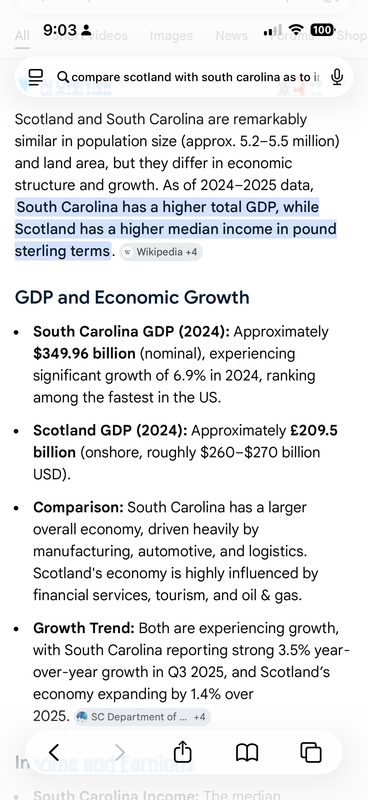
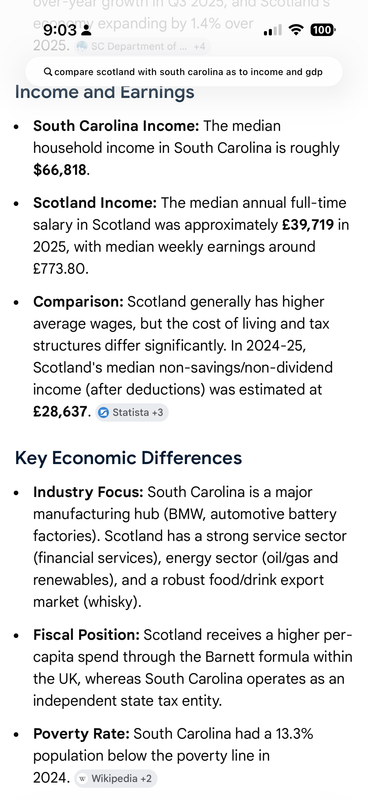
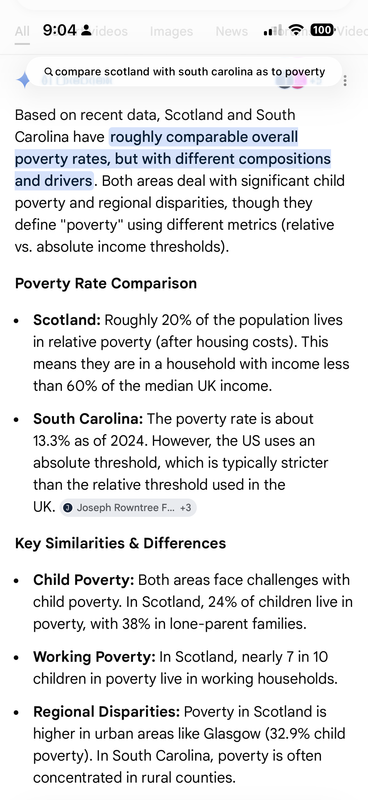
quote:Pretty damn close to South Carolina in size and population.
We already knew that Scotland was one big welfare case,
This post was edited on 4/11/26 at 9:11 am


Posted on 4/11/26 at 9:08 am to TheRealTigerHorn
quote:No, I didn’t. I’m pointing out the dependency, not ignoring it. You’re the one treating outputs that rely on a larger system as if they stand on their own. That’s the whole issue.
You turned around and did the exact same thing you accuse me of doing. You won't count the massive sunk costs of the infrastructure investments that were made in CA and NY over nearly a century while states like AL languished in poverty, but now you want to count every dime of catchup investment in infrastructure while ignoring the massive entitlements payments going to both of those states.
And I'll happily point out the same applies to CA and NY. Don't put words in my mouth. You can disagree with what I say but don't make up shite to disagree with.
Saying “Alabama benefits from the U.S. system” isn’t the same as using that benefit and then pretending it doesn’t exist when making the comparison. That’s what you’re doing.
Posted on 4/11/26 at 9:12 am to rintintin
quote:The discussion I'm having is about the validity of comparing Alabama’s GDP to a sovereign country as if they’re equivalent. If you want to argue about how effective the U.S. system is, that’s a separate conversation.
So you're telling me that a historically poor and abject region can become highly successful and desirable by making strategically good economic decisions within the U.S. system? And that the U.S. system can support and promote such economic development and prosperity?
Do you think Alabama would be able to accomplish this in Canada?
I don't think the argument here is that Alabama in and of itself is a testament to economic prosperity. The overlying point is that under the U.S. system, everyone has the opportunity to prosper if you make the right strategic decisions. Can the same be said about Canada?
Posted on 4/11/26 at 9:14 am to FearlessFreep
quote:Thank you for actually addressing my point and not trying to shift it into a different conversation. And I agree.
the better comparison isnt Alabama 2026 vs Canada 2026
its Alabama 2026 vs Alabama 1966
contrast that with Canada 2026 vs Canada 1966


Posted on 4/11/26 at 9:21 am to northshorebamaman
quote:
that’s a separate conversation.
I don't think it is. That's essentially the point of such an exercise, but I digress.
Carry on
Posted on 4/11/26 at 9:28 am to rintintin
quote:My point is this is a flawed exercise.
I don't think it is. That's essentially the point of such an exercise, but I digress.
Carry on
You can see it if you run the same comparison inside the U.S. Compare a city like Houston to a state like Arkansas using GDP per capita. Houston will likely come out “richer.” That doesn’t mean Houston is a better standalone economy. It means it’s a dense, specialized part of a larger system.
Houston depends on the rest of Texas and the U.S. for food, labor flows,
infrastructure, and stability. It concentrates high-value activity, but it doesn’t operate independently or carry full system costs.
Same issue with Alabama vs Canada. You’re taking a piece of a larger system, keeping the benefits of that system, and comparing it to something that has to function on its own.
eta- and I just pulled Houston and Arkansas out of a hat. I have no idea how they compare. I just picked a city and state to illustrate the point.
This post was edited on 4/11/26 at 9:32 am


Posted on 4/11/26 at 9:31 am to northshorebamaman
All I've learned from this thread is, if that I'm arrested for armed robbery and murder in Alabama, I'm buying a law book and giving it to northshorebamaman.
That is if Vinny Gambini isn't available.
That is if Vinny Gambini isn't available.
Posted on 4/11/26 at 9:33 am to N2cars


Posted on 4/11/26 at 9:33 am to rintintin
quote:
So you're telling me that a historically poor and abject region can become highly successful and desirable by making strategically good economic decisions within the U.S. system?
In US terms, Alabama is still relatively poor. It's poorer than near neighbors to the east and the north. It's just also a bad comparison to make between a US state and another nation, as they have none of the costs of running an independent nation and all the relative benefits of American economic power.

Posted on 4/11/26 at 9:37 am to N2cars
And what I've learned from this thread is that a lot of people can’t separate a critique of the method from a critique of the subject. Pointing out the comparison is flawed isn’t an attack on Alabama. It’s an attack on how it's measured here.
Posted on 4/11/26 at 9:43 am to northshorebamaman
Not critical of you at all.
More in recognition of your critical-thinking skills.
(Which are typically in short supply here )
)
More in recognition of your critical-thinking skills.
(Which are typically in short supply here
)Posted on 4/11/26 at 9:46 am to N2cars


Posted on 4/11/26 at 10:10 am to northshorebamaman
Well I made the original post and agree it isn’t a fair comparison, but the original Canadian news article that started the comparison did manage to wake up a bunch of Canadians about the direction of their economy, which isn’t a good trend. It also highlighted the creative approaches that a team of people in Alabama came up with and have been implementing to improve the state. This has been happening all across the south among the historically poor southern states. With the current trends, in 50 years the populations and wealth demographics will look a lot different among the US regions and states than they did at the turn of the century. The midwest, California, and New York have been in a downward trend for a decade while southern states continue to improve. This won’t continue if the politics from those states migrate here.
Posted on 4/11/26 at 10:19 am to Ramblin Wreck
quote:Alabama’s rise is a real success story. No argument there. A historically poor state attracting industry, building out sectors, and improving over time is exactly what you want to see in America. And I don't give a frick about Canada. I don't hate them, I just rarely think about them.
Well I made the original post and agree it isn’t a fair comparison, but the original Canadian news article that started the comparison did manage to wake up a bunch of Canadians about the direction of their economy, which isn’t a good trend. It also highlighted the creative approaches that a team of people in Alabama came up with and have been implementing to improve the state. This has been happening all across the south among the historically poor southern states. With the current trends, in 50 years the populations and wealth demographics will look a lot different among the US regions and states than they did at the turn of the century. The midwest, California, and New York have been in a downward trend for a decade while southern states continue to improve. This won’t continue if the politics from those states migrate here.
My only pushback here has been that the way Alabama is being measured against Canada doesn't tell you much and definitely doesn't tell you what a lot of posters think it does. But yeah, credit where it’s due on Alabama.
Posted on 4/11/26 at 10:26 am to Ramblin Wreck
Having recently spent some time in Canada, and having some close Canadian friends, their economy is the least of their problems.
It is good they are evidently addressing some of the economic issues, but with their immigration situation, coupled with the rapid demographic shift ( immigrants are younger and reproducing), Canada is rapidly changing.
Is it for the better?
When this has happened in other countries, with this specific type of immigration, history says, "No".
JMO.
It is good they are evidently addressing some of the economic issues, but with their immigration situation, coupled with the rapid demographic shift ( immigrants are younger and reproducing), Canada is rapidly changing.
Is it for the better?
When this has happened in other countries, with this specific type of immigration, history says, "No".
JMO.
Posted on 4/11/26 at 10:38 am to Ramblin Wreck
quote:
With the current trends, in 50 years the populations and wealth demographics will look a lot different among the US regions and states than they did at the turn of the century. The midwest, California, and New York have been in a downward trend for a decade while southern states continue to improve. This won’t continue if the politics from those states migrate here.
If the standard is GDP, then this is a bad argument to make. The GDP growth for California is especially good for the suggestion to be that they are on a 'downward trend.' California's problem is building housing to the degree to meet the rather intense demand. That by itself drives population flight and limits population growth despite it's robust economy. The same is true of New York.
It's an incredibly hard argument to make to suggest California and New York, which is the center of American economic might, are on a downward trend based on GDP numbers. In terms of population, taking Alabama's population growth the last decade (from the census), Alabama's projected growth over the next 5 decades would put it at 6.5 million people. Based on current growth projections, I really don't think the population and wealth demographics will look all that different.
Posted on 4/11/26 at 10:47 am to N2cars
quote:
It is good they are evidently addressing some of the economic issues, but with their immigration situation, coupled with the rapid demographic shift ( immigrants are younger and reproducing), Canada is rapidly changing.
Canada's issues have as much to do with poor urban planning and using real estate to buttress their economy while also kicking the can down the road with regards to how and where to invest internally. The US can easily poach talented Canadians and the Canadians recognized this 15 or so years ago. Their solution was to increase Canada's population so that it reached around 100 million people so as to develop a more resilient internal economy and to fill in more of the border areas (where much of their development happens). It was a bad plan in that it did not address the housing issue and rather made the housing issue more acute. As far as I'm aware, the Canadians still have that plan to increase their population by the same degree though.
quote:
When this has happened in other countries, with this specific type of immigration, history says, "No".
I mean, where exactly has this happened? The type of demographic shift is explained in the Demographic Transition Model, but no one is actually willing to live through the last stage of the model, which is where both death rates and birth rates decline, except for Japan, and Japan's Lost Decade has straight up scared policymakers from ever seeing the results of that policy.
Posted on 4/11/26 at 11:15 am to crazy4lsu
quote:
Alabama's projected growth over the next 5 decades would put it at 6.5 million people. Based on current growth projections
Population growth in cities and states in the US hasn’t been consistently linear. You may be correct but there are numerous cities that were on the largest cities in the US list in 1960 that are no longer in the top and cities on that list today that would have been huge surprises in 1960 if they had a sneak peak of what it is today. I think southern state populations will continue to be on a different curve than the midwest, New York and California.
Posted on 4/11/26 at 11:33 am to wm72
quote:
ust read an article about the Amazon Headquarters that went to Virginia instead and so far failing to come anywhere close to meeting proposed/promised jobs to the area.
Amazon and a Mercedes factory are two very different examples.
My point was that AOC didnt want to give tax breaks to Amazon. They then chose to move their HQ to another state and now NY will miss out on any taxes from Amazon.

 Page 4 of 5

Popular
Back to top
 Follow TigerDroppings for LSU Football News