




- My Forums
- Tiger Rant
- LSU Recruiting
- SEC Rant
- Saints Talk
- Pelicans Talk
- More Sports Board
- Fantasy Sports
- Golf Board
- Soccer Board
- O-T Lounge
- Tech Board
- Home/Garden Board
- Outdoor Board
- Health/Fitness Board
- Movie/TV Board
- Book Board
- Music Board
- Political Talk
- Money Talk
- Fark Board
- Gaming Board
- Travel Board
- Food/Drink Board
- Ticket Exchange
- TD Help Board
Customize My Forums- View All Forums
- Show Left Links
- Topic Sort Options
- Trending Topics
- Recent Topics
- Active Topics
Started By
Message
re: Louisiana Tropical Fruit Gardening - Experiences and Updates
Posted on 3/10/25 at 1:57 pm to 10tiger

Posted on 3/10/25 at 1:57 pm to 10tiger
quote:
We have several citrus in pots… what is your advice for best fertilizer for pots and how frequent do you fertilize them?
Osmocote a few times per year and foliage pro once per week. Sometimes I back off the foliage pro and do once or twice a month in the winter. Depends on what the tree is doing. But these two have been fantastic for me and it's what a lot of experts recommend.
Osmocote has almost all the minor nutrients plants need and foliage pro does have all of them.
This post was edited on 3/10/25 at 2:02 pm
 1
1

Posted on 3/12/25 at 3:47 pm to Tigerlaff
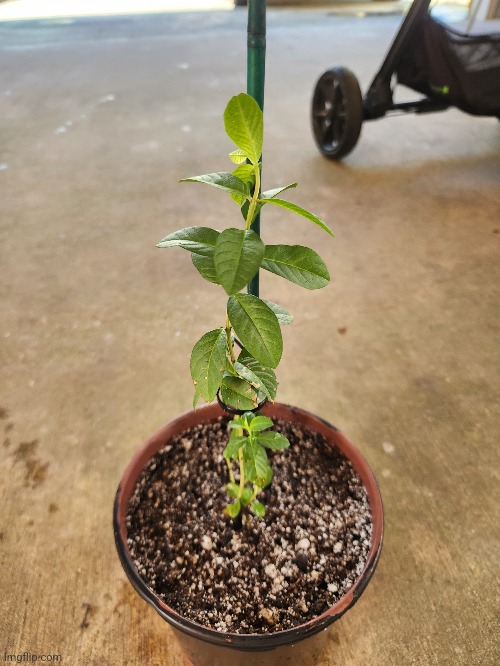
Psidium guajava nana, a rare dwarf guava cultivar that stays small and bushy, making 1-2 inch guava fruits. Can't wait to see how this one turns out. It allegedly fruits year round if kept out of the cold. I really like bite size snack fruit trees like cattley guavas and Jamaican cherries. It's great to have small things that ripen fast and that you just eat right off the tree and don't need to store.
This post was edited on 3/12/25 at 3:50 pm

Posted on 3/13/25 at 9:38 pm to Tigerlaff
Items started arriving today. Received the Hawaiian Mango, Ruby Supreme Guava, and the Mandevilla Vine. Hoping the Spanish Lime arrives tomorrow.
Posted on 3/13/25 at 11:40 pm to Tigerlaff
Thanks for all your time and insight you’ve put into this thread! I do have a question about peat. Are you differentiating from peat moss? Because finding peat by itself seems to be hard. Did a google search of differences and seems there is an obvious one. I’ve heard peat moss isn’t good for your plants but I’m guessing that’s probably in bigger ratios. Most of the big box store brands like miracle grow put that crap in there soil. I saw you mentioned coco coir and rice rolls which is nice but what about vermiculite as an alternative?
Posted on 3/14/25 at 12:04 am to TimeOutdoors
quote:
Received the Hawaiian Mango, Ruby Supreme Guava, and the Mandevilla Vine. Hoping the Spanish Lime arrives tomorrow.
Awesome. Post some pics if you can. And get that soil right!
Will be getting my 15gal Pickering mango, a 15gal Makok sapodilla, and a 7gal loquat at the end of the month. Exciting times.
This post was edited on 3/14/25 at 12:29 am
Posted on 3/14/25 at 12:24 am to Albino Potato
quote:
Thanks for all your time and insight you’ve put into this thread! I do have a question about peat. Are you differentiating from peat moss? Because finding peat by itself seems to be hard. Did a google search of differences and seems there is an obvious one. I’ve heard peat moss isn’t good for your plants but I’m guessing that’s probably in bigger ratios. Most of the big box store brands like miracle grow put that crap in there soil. I saw you mentioned coco coir and rice rolls which is nice but what about vermiculite as an alternative?
This is exactly why I started this thread. First, no. Peat is not bad for your container plants unless you have one of the very few things that cannot tolerate slightly acidic soil. Peat is great at holding moisture, wicking moisture laterally through the soil mixture, is light weight, and decays very very slowly. The vast majority of plants you want to grow do best in mildly acidic soil because they absorb nutrients better and peat provides great long lasting acidity. Here is a chart of how soil pH affects nutrient uptake:
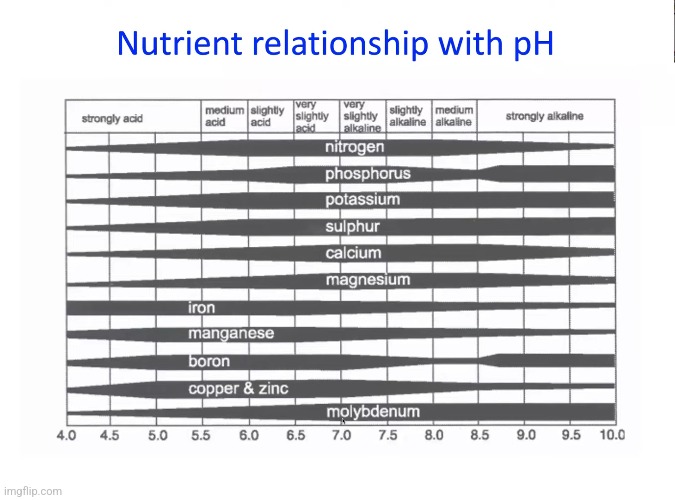
My tapwater comes out of the faucet with a pH of 8.7(!). Using peat as my only organic soil component has worked wonders with solving minor nutrient deficiencies caused by my very alkaline water.
Here is the peat I buy when I need to mix my own container soil:
LINK
Vermiculite is an inorganic material and I am of the opinion that your soil mixture should have some organic content (about a third) because symbiotic mychorhizzae fungus grows better with an organic substrate. Mychorhizzae are hugely important for plant root health and I innoculate all new plantings with mychorhizzae spores.
I also believe that vermiculite holds on to water a bit too much. When container gardening, always err on the side of better drainage. Yes, you will have to water more but you will be far less likely to induce root rot and kill your plant. More drainage = more oxygen available to the roots.
The main drawback of peat is the cost. Stuff ain't cheap and it will only get worse.
This post was edited on 3/14/25 at 12:28 am
Posted on 3/14/25 at 6:17 am to Tigerlaff
quote:
The main drawback of peat is the cost. Stuff ain't cheap and it will only get worse.
I've noticed some of the home building suppliers are not even carrying peat moss anymore and only carry the coconut coir as an alternative. I use peat, but was curious about your take on the coir instead of peat moss?
I used the course grade vermiculite in my soil. Perlite seems to upset my allergies. I also add the Mykos mycelium mix to the soil. The soil mix I used was a mixture of peat moss, pro mix, a couple different kinds of paver sand at the local store, vermiculite, and the Mykos. (This is very similar to my raised garden bed mix, except I didn't add composts/wood products and I usually add very little sand to my raised beds). That was based off your comments on not using wood products in the mix.
This post was edited on 3/14/25 at 6:22 am
Posted on 3/14/25 at 7:02 am to TimeOutdoors
Overall I think coir is probably fine with only slight disadvantages compared to peat. The main one being that coir is freshly killed tissue and peat has been dead thousands of years. We know more about how peat decomposes than we do about coir. Coir being so recently alive also still contains lots of anti-pathogen plant tannins that have long since leached out of peat. Will the coir serve as a substrate for bacteria, fungus, etc. when those tannins eventually dissapate? I don't know. If I didn't have access to peat I'd use coir.
Your mix sounds legit. We must banish the bark. People are realizing this every day. The entire idea was cooked up to cut growing and shipping costs. Hell, we use wood chips to PREVENT plant growth. It's called mulch. My first priority on getting a plant home is to blast all the bark based soil out of the rootball with a hose.
Your mix sounds legit. We must banish the bark. People are realizing this every day. The entire idea was cooked up to cut growing and shipping costs. Hell, we use wood chips to PREVENT plant growth. It's called mulch. My first priority on getting a plant home is to blast all the bark based soil out of the rootball with a hose.
This post was edited on 3/14/25 at 7:05 am
Posted on 3/14/25 at 9:40 am to Tigerlaff
Yeah I didn’t think peat was end of the world I just heard make sure you don’t have too much because box stores will sometimes sell you plants caked in that stuff and crappy soil. We’ve always completely freed our plants of the soil they came with before putting them in our mixture. But are you making a distinction between peat moss and peat? Because it seems like there is based off what I’ve read. I never thought of them as different until your brought it up just referring to it as peat. Pear by itself seems very hard to come by, where do you get yours for the mix?
Posted on 3/14/25 at 3:02 pm to Albino Potato
Peat and peat moss are the same thing. Plants that have partially decayed at the bottom of a bog over a long period of time.
I get my peat from Amazon and Home Depot.
I get my peat from Amazon and Home Depot.

Posted on 3/14/25 at 3:14 pm to Tigerlaff
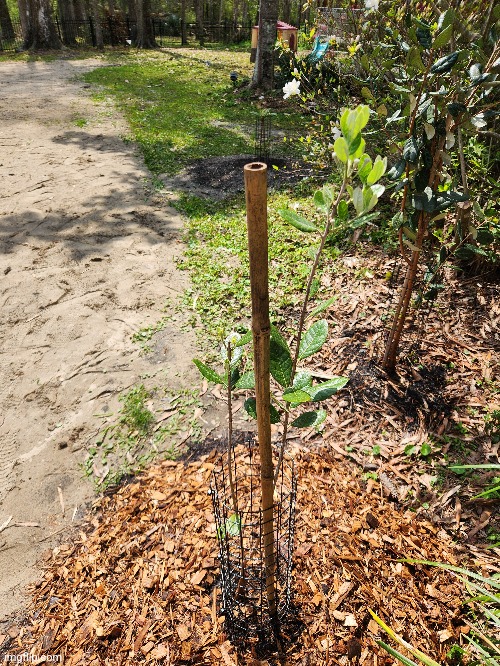
Got my Unique feijoa in the ground today next to the Improved Coolidge feijoa.
Also, I am 90% confident that my huge potted namwah is going to blow over in the wind tomorrow and ruin the fruit. Here's to hoping I'm wrong.
Also, I am 90% confident that my huge potted namwah is going to blow over in the wind tomorrow and ruin the fruit. Here's to hoping I'm wrong.
This post was edited on 3/14/25 at 9:22 pm

Posted on 3/16/25 at 11:07 am to Tigerlaff
I fenced off an Acre or so of my pasture last winter and planted two satsumas, two orange, two grapefruit, and two fig trees. Ran irrigation and also planted 4 blackberry and 4 blueberry bushes. I covered all of them during the freeze, but im pretty sure most of them are destroyed.
Pretty bummed out. Not sure I’ll get to restart this spring but I’ll try again eventually.
Pretty bummed out. Not sure I’ll get to restart this spring but I’ll try again eventually.
Posted on 3/16/25 at 2:31 pm to Slickback
I have a lot of experience with citrus. Honestly more experience with with citrus than anything else. A few observations I've gleaned over the years:
1) No citrus is safe in ground in LA until at least year 3. I trust nothing until year 4. That includes your most cold hardy satsumas and all kumquats except Nagami. Arctic Frost satsuma? The one they tell you will tolerate 15F? Don't even think about it. For the first 3 years at least you need to cover every citrus anytime there is a freeze. I cover at 32. The lemon gets covered anytime the forecast is 34. This is the only way to get citrus to maturity where they can actually take some cold.
2) Just covering is not enough. I have extensive experience with this. When you are covering citrus you need to do a few things. First, the cover needs to go all the way to the ground. You cannot wrap just the canopy or trunk. The whole thing must be under the shelter with the cover reaching the earth. Second, you need a supplemental heat source. Even a weak one like C9 incandescent Christmas lights will be infinitely better than covering alone. I use infrared incubation bulbs on an extention cord. They put out a ton of heat and no need to wrap and unwrap Christmas lights. Third, if you are using plastic to cover (tarp, visqueen, etc.), you need to be absolutely certain to disconnect the heat source and vent or uncover it the next day in direct sunlight. You will absolutely cook your tree by heating it under plastic and then letting it spend 6 hours in the sun.
3) Use thick mulch and water the trees deeply before a freeze. You want the earth around the tree to hold its temperature as well as it possibly can.
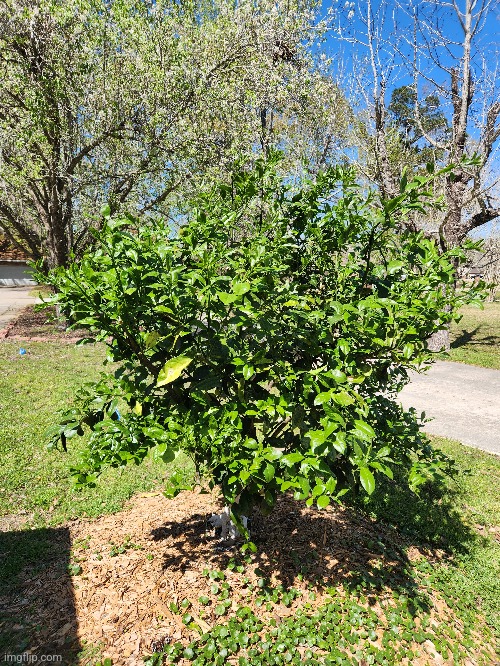
Every citrus tree in my neighborhood is either dead or just barely flushing new leaves. I'll post a picture of my lemon from today below.
1) No citrus is safe in ground in LA until at least year 3. I trust nothing until year 4. That includes your most cold hardy satsumas and all kumquats except Nagami. Arctic Frost satsuma? The one they tell you will tolerate 15F? Don't even think about it. For the first 3 years at least you need to cover every citrus anytime there is a freeze. I cover at 32. The lemon gets covered anytime the forecast is 34. This is the only way to get citrus to maturity where they can actually take some cold.
2) Just covering is not enough. I have extensive experience with this. When you are covering citrus you need to do a few things. First, the cover needs to go all the way to the ground. You cannot wrap just the canopy or trunk. The whole thing must be under the shelter with the cover reaching the earth. Second, you need a supplemental heat source. Even a weak one like C9 incandescent Christmas lights will be infinitely better than covering alone. I use infrared incubation bulbs on an extention cord. They put out a ton of heat and no need to wrap and unwrap Christmas lights. Third, if you are using plastic to cover (tarp, visqueen, etc.), you need to be absolutely certain to disconnect the heat source and vent or uncover it the next day in direct sunlight. You will absolutely cook your tree by heating it under plastic and then letting it spend 6 hours in the sun.
3) Use thick mulch and water the trees deeply before a freeze. You want the earth around the tree to hold its temperature as well as it possibly can.
Every citrus tree in my neighborhood is either dead or just barely flushing new leaves. I'll post a picture of my lemon from today below.
This post was edited on 3/18/25 at 5:06 am
Posted on 3/16/25 at 3:20 pm to Tigerlaff
We covered all the way to the ground, but with the weight of the snow and the wind, combined with the low temps and the length of sub-freezing temps, we lost the battle. I’ll have to be better prepared when I replant.
Posted on 3/16/25 at 3:43 pm to Slickback
If you didn't provide an external heat source it's all for nought. When you replant think about where you can realistically get extension cords to without running power. I feel your pain. Learned it all the hard way by experience.
An emergency measure I have on hand is a whole box of 18hr hand warmers. Those thing get HOT and last forever. If you need heat to keep something alive in a pinch, shake 4 or 5 of them up and put them at the base of the covered tree.
An emergency measure I have on hand is a whole box of 18hr hand warmers. Those thing get HOT and last forever. If you need heat to keep something alive in a pinch, shake 4 or 5 of them up and put them at the base of the covered tree.
This post was edited on 3/16/25 at 3:51 pm

Posted on 3/16/25 at 9:21 pm to Tigerlaff
I used pipe warmers and halogen flood lights this year
Posted on 3/17/25 at 6:47 am to Tigerlaff
quote:
For the first 3 years at least you need to cover every citrus anytime there is a freeze
Anything special you use for the cover?
Posted on 3/17/25 at 12:00 pm to TimeOutdoors
I used the zippered shrub covers off of Amazon this year. They worked better than my previous homemade attempts. I also used strands of 25 ct incandescent C9 Christmas Lights. All my citrus made it through unscathed.
Posted on 3/17/25 at 8:02 pm to TimeOutdoors
quote:
Anything special you use for the cover?
I use tarps. Light guage on small trees and big trees get heavy duty 16mil tarps.
I will say that this is probably not the best method. A special frost cloth or bedsheet would probably be better in most cases because it breathes and won't cook your plant if you leave it covered in the sun. But I've only got so much time and patience. Tarps fold up and store easily and don't have to be washed in between uses. They don't absorb water or get moldy. The tarp method is what works for me and I am very conscious about cutting off my heat source and uncovering or at least venting during the daylight hours.
quote:
I used the zippered shrub covers off of Amazon this year. They worked better than my previous homemade attempts. I also used strands of 25 ct incandescent C9 Christmas Lights.
This is exactly what I used on my bananas this year. Instead of using the zippered cloths as a "tent," I simply wrapped the stalks in C9 lights and then wrapped the cloth around the lighted stalk. Bananas are more cold sensitive than citrus and mine also made it through great.
This post was edited on 3/17/25 at 8:08 pm
Posted on 3/17/25 at 8:09 pm to Tigerlaff
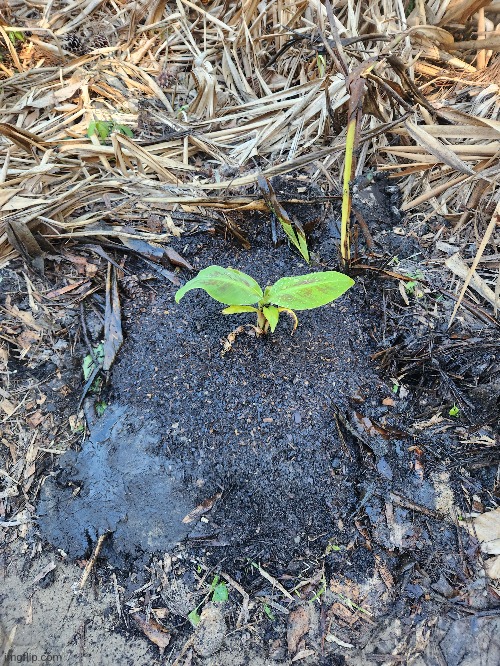
Dwarf namwah banana in the ground today.
Pride of Barbados seeds getting ready for soaking and planting tomorrow.
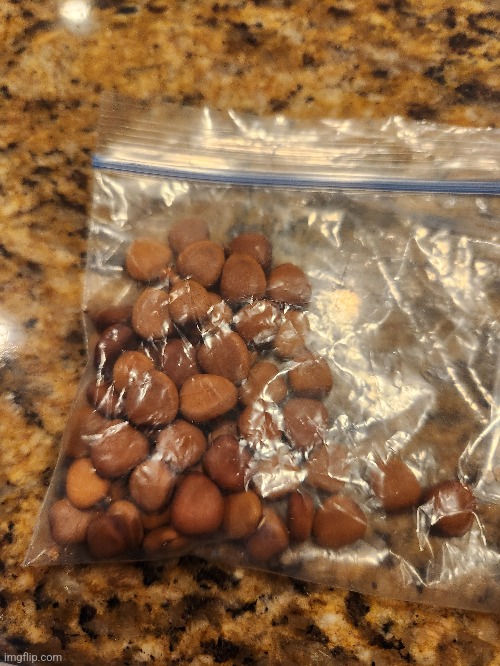
Pride of Barbados seeds getting ready for soaking and planting tomorrow.
This post was edited on 3/17/25 at 8:10 pm

 Page 5 of 110

Popular
Back to top
 Follow TigerDroppings for LSU Football News