




- My Forums
- Tiger Rant
- LSU Recruiting
- SEC Rant
- Saints Talk
- Pelicans Talk
- More Sports Board
- Fantasy Sports
- Golf Board
- Soccer Board
- O-T Lounge
- Tech Board
- Home/Garden Board
- Outdoor Board
- Health/Fitness Board
- Movie/TV Board
- Book Board
- Music Board
- Political Talk
- Money Talk
- Fark Board
- Gaming Board
- Travel Board
- Food/Drink Board
- Ticket Exchange
- TD Help Board
Customize My Forums- View All Forums
- Show Left Links
- Topic Sort Options
- Trending Topics
- Recent Topics
- Active Topics
Started By
Message
12 string tuned down whole step frequency
Posted on 1/3/20 at 9:59 pm
Posted on 1/3/20 at 9:59 pm
Anyone know where to find the individual string frequencies for a guitar tuned down a whole step. (DGCFAD)
I have the frequencies for standard EADGBE.
Probably a formula out there somewhere on World Wide Web, just can’t find it.
Thanks
I have the frequencies for standard EADGBE.
Probably a formula out there somewhere on World Wide Web, just can’t find it.
Thanks
 3
3


Posted on 1/4/20 at 2:31 am to Nicky Parrish
A whole step? I don't think you are going to care for it.
The easy way to do it, is capo on the second fret, tune standard, then take the capo off. Or just fret each string on the second fret, whichever way you want to do it.
I suppose you are trying to get that Baritone guitar sound?
I have tried tuning down a whole step on a 6 string and I thought it sounded awful. 1/2 step works ok though.
Maybe it will be better on a 12 string? IDK.
EDit:
Learn something new everyday. I've always just went by the 440 hz. on my tuner. That always worked for me. Turns out, there are specific individual frequencies. I just don't know why you would need to know them, if you have a good chromatic tuner.
However, it appears that once you get your thick strings tuned to D, G, C, F, and know the frequency for each of those, the corresponding thinner string for each, will be exactly double of that frequency. Both bottom pairs will tune exactly the same of course.
You could also use a really good calculator, and reduce the standard frequency of each of the strings by a divisor of .153 (this is a close estimate, there is a perfect formula that will work, but I don't know it). That will put you pretty damn close, but not perfect.
The easy way to do it, is capo on the second fret, tune standard, then take the capo off. Or just fret each string on the second fret, whichever way you want to do it.
I suppose you are trying to get that Baritone guitar sound?
I have tried tuning down a whole step on a 6 string and I thought it sounded awful. 1/2 step works ok though.
Maybe it will be better on a 12 string? IDK.
EDit:
Learn something new everyday. I've always just went by the 440 hz. on my tuner. That always worked for me. Turns out, there are specific individual frequencies. I just don't know why you would need to know them, if you have a good chromatic tuner.
However, it appears that once you get your thick strings tuned to D, G, C, F, and know the frequency for each of those, the corresponding thinner string for each, will be exactly double of that frequency. Both bottom pairs will tune exactly the same of course.
You could also use a really good calculator, and reduce the standard frequency of each of the strings by a divisor of .153 (this is a close estimate, there is a perfect formula that will work, but I don't know it). That will put you pretty damn close, but not perfect.
This post was edited on 1/4/20 at 5:18 am
Posted on 1/4/20 at 6:35 am to auggie
Thanks for all of that info.
Just getting up in age and read about tuning down a whole step makes it’s easier on the fingers.
I do have a chromatic tuner. For the twelve string was just wondering where to find or figure out the strings frequencies tuned down a whole step. Wanting to make sure the octave strings
(EADG) are actually an octave higher and not just a smaller string tuned the same octave.
Probably overthinking this by a lot.
Will try the the divisor of .153.
Again thanks for your detailed answer.
Just getting up in age and read about tuning down a whole step makes it’s easier on the fingers.
I do have a chromatic tuner. For the twelve string was just wondering where to find or figure out the strings frequencies tuned down a whole step. Wanting to make sure the octave strings
(EADG) are actually an octave higher and not just a smaller string tuned the same octave.
Probably overthinking this by a lot.
Will try the the divisor of .153.
Again thanks for your detailed answer.
Posted on 1/4/20 at 6:43 am to Nicky Parrish
You are welcome. And yes the answer is, the thinner strings tune 1 octave higher than the thick ones. Good luck, I hope it works for you.

Posted on 1/4/20 at 7:18 am to Nicky Parrish
I've read this is also a fairly common practice on 12strings to reduce tension on the neck, especially on some of the old ones and they simply capo it back up.
BTW: Also had Bob Tedrow (local music shop owner) suggest doing this to reduce fretting pressure as well. I was looking for something easier to fret after a pretty severe wrist injury involving surgery and he suggested why not just tune down a step or two. Lucky day, I was ready to buy a short scale parlor with silk and steel strings and he talked me out of it. Turned out he had been a hand therapist before the music store and down this path before.
Good Luck
BTW: Also had Bob Tedrow (local music shop owner) suggest doing this to reduce fretting pressure as well. I was looking for something easier to fret after a pretty severe wrist injury involving surgery and he suggested why not just tune down a step or two. Lucky day, I was ready to buy a short scale parlor with silk and steel strings and he talked me out of it. Turned out he had been a hand therapist before the music store and down this path before.
Good Luck
Posted on 1/4/20 at 7:44 am to Nicky Parrish
Also just remembered this video of James Taylor discussing tuning and compensation for capo'ing. It's a 6 minute talk about strings and what he likes... you might find it interesting since you seem to have the ear for it.
Posted on 1/4/20 at 7:56 am to awestruck
If you are trying to make the 12-string guitar easier to play due to diminishing left hand strength or agility.
- Use a lighter string gauge to reduce the pounds of tension per tuned string. D'Addario String Tension Chart
- Set up your guitar for lowest possible action for your playing style, with particular focus on a properly slotted nut as it pertains to open chord positions.
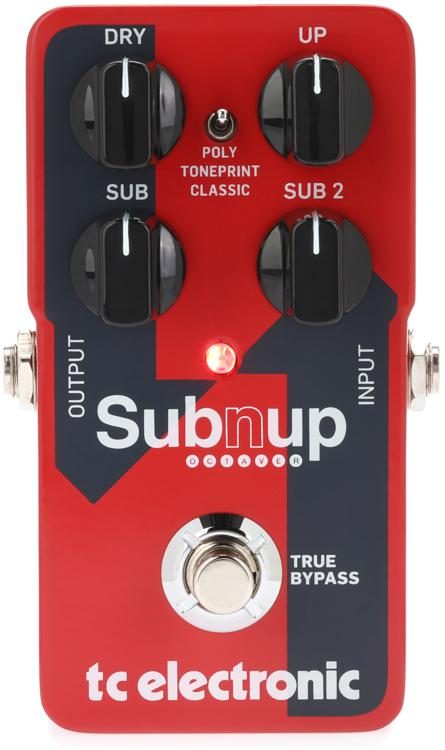
- Use an electric six-string with a modern octaver in the chain that can mix one-octave-up notes with the fundamental signal. My TC Electronic Sub 'n' Up pedal does this. I haven't researched it, but I'm sure there are other stand-alone pedals, multi-effect units or rackmounts on the market that can do this. MAKE SURE your octaver has what TC specifically polytronic tracking, or the ability to octave multiple notes simultaneously. For extra convincing shimmer and glassiness, add a chorus pedal for a gentle layer of modulation. When it's all said and done, it won't sound identical to a 12-string, but it will sound close enough for hobbyists trying to scratch the 12-string itch.
Edited to add a Sub 'n' Up pedal pic. You can independently mix in an "up" octave, a "down one" and/or a "down two." They also make a "mini" version with a few less features and a smaller physical footprint.
- Use a lighter string gauge to reduce the pounds of tension per tuned string. D'Addario String Tension Chart
- Set up your guitar for lowest possible action for your playing style, with particular focus on a properly slotted nut as it pertains to open chord positions.
- Use an electric six-string with a modern octaver in the chain that can mix one-octave-up notes with the fundamental signal. My TC Electronic Sub 'n' Up pedal does this. I haven't researched it, but I'm sure there are other stand-alone pedals, multi-effect units or rackmounts on the market that can do this. MAKE SURE your octaver has what TC specifically polytronic tracking, or the ability to octave multiple notes simultaneously. For extra convincing shimmer and glassiness, add a chorus pedal for a gentle layer of modulation. When it's all said and done, it won't sound identical to a 12-string, but it will sound close enough for hobbyists trying to scratch the 12-string itch.
Edited to add a Sub 'n' Up pedal pic. You can independently mix in an "up" octave, a "down one" and/or a "down two." They also make a "mini" version with a few less features and a smaller physical footprint.
This post was edited on 1/4/20 at 8:01 am
Posted on 1/4/20 at 9:38 am to Nicky Parrish
Thanks to all for taking time to respond.
I’m an older low tech acoustic guy and a lot of this is way over my head.
I envy the knowledge that you all have, understand and are willing to share.
I’ll read, re-read and try to decipher all of this and will definitely watch the video.
I figure if I can tune like James Taylor I should be able to play like him.
Just kidding, believe me I do know better.
Hope our music wishes all come true in the New Year.
I’m an older low tech acoustic guy and a lot of this is way over my head.
I envy the knowledge that you all have, understand and are willing to share.
I’ll read, re-read and try to decipher all of this and will definitely watch the video.
I figure if I can tune like James Taylor I should be able to play like him.
Just kidding, believe me I do know better.
Hope our music wishes all come true in the New Year.


Posted on 1/5/20 at 2:34 am to Nicky Parrish
frequencies of notes
This post was edited on 1/5/20 at 2:36 am
Posted on 1/5/20 at 4:03 am to Nicky Parrish
Nicky, if you don't mind, I hope you will let me know how that divisor (.153) worked out.
I just used a rough median between 1/7th(.142) and 1/6th(.167) and leaned slightly to the lower end.
I did it that way, because there are 7 whole notes and 5 sharps/flats, instead of the scale being equally divided.
I just would like to know if my logic paid off.
No matter what, I think you can use this number to tune down, and be in tune yourself. The question would be: Will you be in tune with other people?
If you are playing by yourself, it won't matter.
I just used a rough median between 1/7th(.142) and 1/6th(.167) and leaned slightly to the lower end.
I did it that way, because there are 7 whole notes and 5 sharps/flats, instead of the scale being equally divided.
I just would like to know if my logic paid off.
No matter what, I think you can use this number to tune down, and be in tune yourself. The question would be: Will you be in tune with other people?
If you are playing by yourself, it won't matter.
This post was edited on 1/5/20 at 4:49 am
Posted on 1/5/20 at 12:36 pm to auggie
Good Morning Auggie
I took the the divisor of .153 and used that to figure frequencies from E to D.
What I found was that the numbers I came up with were close but all were a little flat.
I had a clip on chromatic tuner on the headstock and a Hz frequency meter open on my phone.
When I tuned to the frequencies I figured I had to tune up to come up to the correct frequencies per the chromatic tuner.
After I had done this I saw the post from YesYesYall with the table of all the frequencies.
Comparing my numbers to those, the E 6th string was closest with - 3.61 Hz difference.
The octave D4 string going to C4 was the greatest with -14.46 difference.
These were using my numbers. I must say that towards the end I was seeing double.
I recently came into a virtually untouched Yamaha FG 720S-12 twelve string. I think it had the original strings. Not being familiar with tuning a twelve string I wanted to verify tuning down from E to D and especially the octave strings.
Thanks for your help.
I took the the divisor of .153 and used that to figure frequencies from E to D.
What I found was that the numbers I came up with were close but all were a little flat.
I had a clip on chromatic tuner on the headstock and a Hz frequency meter open on my phone.
When I tuned to the frequencies I figured I had to tune up to come up to the correct frequencies per the chromatic tuner.
After I had done this I saw the post from YesYesYall with the table of all the frequencies.
Comparing my numbers to those, the E 6th string was closest with - 3.61 Hz difference.
The octave D4 string going to C4 was the greatest with -14.46 difference.
These were using my numbers. I must say that towards the end I was seeing double.
I recently came into a virtually untouched Yamaha FG 720S-12 twelve string. I think it had the original strings. Not being familiar with tuning a twelve string I wanted to verify tuning down from E to D and especially the octave strings.
Thanks for your help.
Posted on 1/5/20 at 12:42 pm to yesyesyall
Thanks for the frequency scale.
I was looking for something like that.
Used it to compare frequency numbers I had figured out.
Copied and saved. Printed a copy too. Will definitely use in the future.
Thanks for your help.
Go Saints
Go Tigers
I was looking for something like that.
Used it to compare frequency numbers I had figured out.
Copied and saved. Printed a copy too. Will definitely use in the future.
Thanks for your help.
Go Saints
Go Tigers
Posted on 1/5/20 at 9:01 pm to Nicky Parrish
quote:
Go Saints

quote:
Go Tigers

Posted on 1/5/20 at 9:16 pm to yesyesyall
quote:
quote: Go Saints quote: Go Tigers
I feel your pain
Posted on 1/5/20 at 10:09 pm to Nicky Parrish
Quite The trial! I wish I had done better for you, but man, you got it.
Endeavor to persevere Endeavor to persevere.
Endeavor to persevere Endeavor to persevere.

 Page 1 of 1


Popular
Back to top
 Follow TigerDroppings for LSU Football News