





 2
2


- My Forums
- Tiger Rant
- LSU Recruiting
- SEC Rant
- Saints Talk
- Pelicans Talk
- More Sports Board
- Fantasy Sports
- Golf Board
- Soccer Board
- O-T Lounge
- Tech Board
- Home/Garden Board
- Outdoor Board
- Health/Fitness Board
- Movie/TV Board
- Book Board
- Music Board
- Political Talk
- Money Talk
- Fark Board
- Gaming Board
- Travel Board
- Food/Drink Board
- Ticket Exchange
- TD Help Board
Customize My Forums- View All Forums
- Show Left Links
- Topic Sort Options
- Trending Topics
- Recent Topics
- Active Topics
Started By
Message
AI Drug discovery - ABSI
Posted on 9/23/26 at 12:33 pm
Posted on 9/23/26 at 12:33 pm
This is kind of like HGRAF in the sense that it could 100x
Invest at your own risk. This could be a NBIS or a MRLN or somewhere in between, and it's largely based on clinical trials and your time horizon/risk tolerance.
The only reason I bought this is because I'd feel negligent if I didn't try to diversify into what could be one of the most positive outcomes of the entire AI revolution.
There are a few companies that have real potential in this space, but I went with ABSI as they are a pure play.
It's down more than 10% today so the entry could be worse, but make no mistake, like all small cap biotech stocks this could be $2 if trials fail.
But I think it's a reasonable investment if sized appropriately.
Other opinions are certainly welcome.
Yes, the stock is up a lot YTD, and it's up for good reason.
No, the stock is nowhere near its potential.
 >
>
Reasons for being up 175% YTD:
1. Eli Lilly Backing & $100M Funding:
In June 2026, Absci secured a $100 million underwritten financing round, which included a high-profile $40 million strategic equity investment from Eli Lilly. This validated Absci’s platform and extended its operational runway into late 2028.
2. Positive Clinical Data for ABS-201:
The company reported encouraging interim Phase 1 safety data for ABS-201, its AI-designed antibody targeting hair loss (androgenetic alopecia) and endometriosis. The drug showed no serious adverse events, prompting Wall Street analysts to lift their targets ahead of further proof-of-concept readouts
This trial is the entire thesis of the company so far.
Further readouts are expected before 2027.
 >
>
WHAT ARE THEY DOING?
Absci exists to create better biologics for patients, faster.
Historically, biologics drug discovery has been a long, expensive process with a high failure rate. Absci is uncovering novel biology to create better biologics from scratch with AI, and ultimately get life-changing medicines to patients.
The Traditional Problem
What are biologics?
Unlike traditional drugs (like aspirin) which are simple, chemically synthesized molecules, biologics are complex medicines made from living organisms (like proteins or antibodies). They are used to treat severe diseases like cancer and autoimmune disorders
The Bottle-neck: Discovering and developing these complex molecules historically takes 10 to 15 years and costs over $1 billion per drug.High Failure Rate: Because human biology is incredibly complex, about 90% of drug candidates fail during clinical trials because they either don't work or are unsafe.
The AI Solution
Uncovering Novel Biology:
Instead of relying on slow, trial-and-error laboratory experiments to find treatments, Absci uses AI to screen billions of biological possibilities and simulate how molecules interact. This helps them discover biological pathways humans might never find on their own.
From Scratch (De Novo Design):
Instead of modifying existing antibodies found in nature, Absci uses generative AI to design completely new, optimized proteins from scratch specifically tailored to target a disease.
The Goal:
By using AI to handle the initial design and prediction phases, Absci aims to drastically cut down drug development timelines, lower costs, and create more effective, life-changing medicines with a much higher probability of success in human trials.
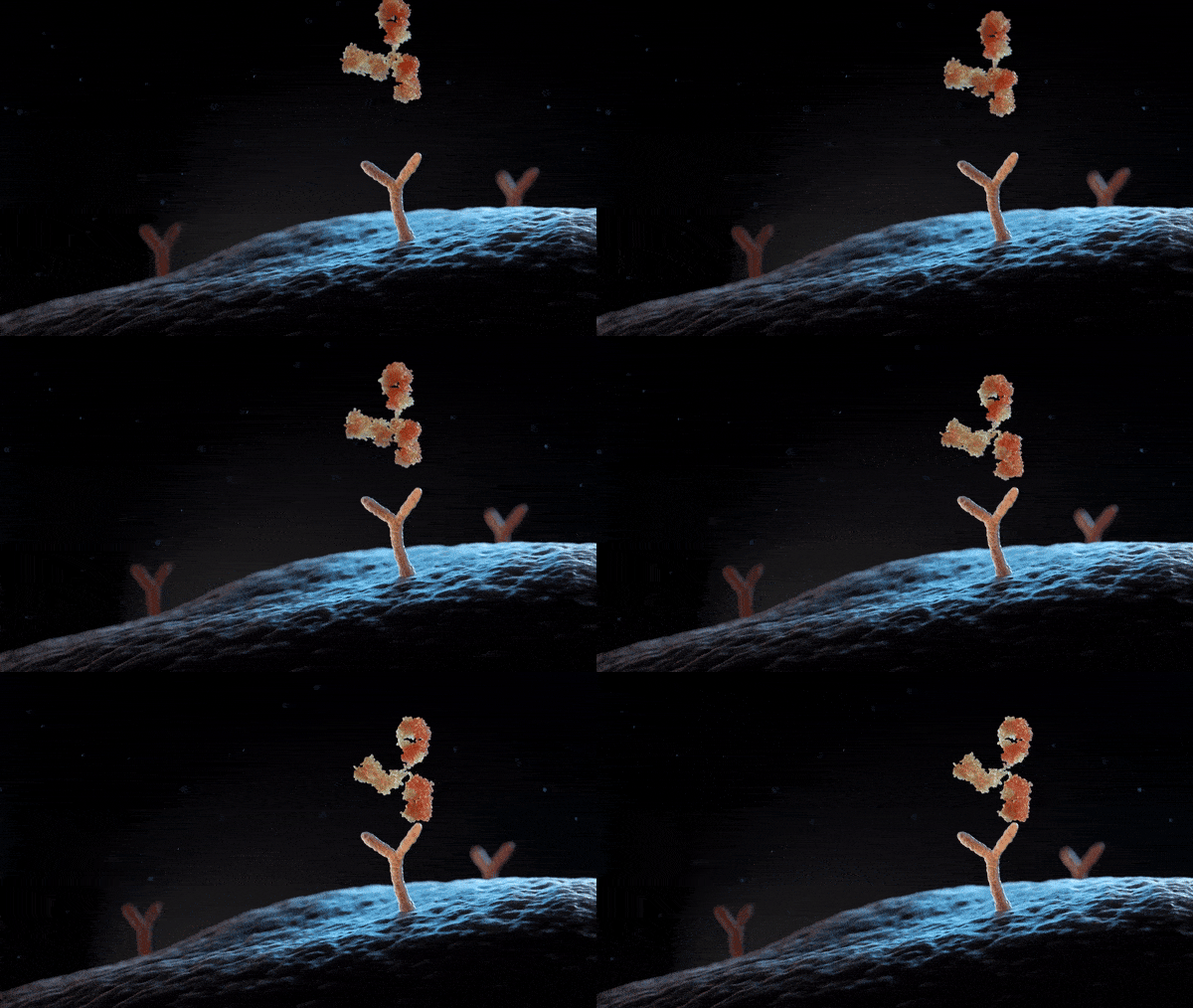
Antibody structure: The Y-shaped protein represents an antibody designed to recognize and attach to specific biological targets.
ABSCI (ABSI) — VERIFIED SUMMARY
Platform: Generative AI designs novel antibodies from scratch. First company to dose an entirely AI-designed biologic in humans and receive positive clinical data.
Pipeline:
ABS-101 (anti-TL1A, IBD) — Phase 1 positive safety, being partnered/out-licensed
ABS-201 (anti-PRLR, hair loss + endometriosis) — Phase 1/2a HEADLINE trial active; 65-day half-life confirmed (2-3 injections over 6 months); interim POC data due H2 2026
ABS-202 — undisclosed target, added Q1 2026
Partners: AstraZeneca, Genentech, Merck KGaA, Memorial Sloan Kettering, Eli Lilly ($40M strategic investment, August 2026)
Financials: ~$225M cash, runway into H2 2028, burning ~$25-30M/quarter, ~155M shares, ~$1.7B market cap
Analysts: 6 Buy, 1 Hold, consensus target ~$9-10, Guggenheim $15
BULL CASE
2 years (Sept 2028) — $4-5B market cap (~$26-32/share)
The H2 2026 ABS-201 interim POC shows meaningful hair regrowth in pattern alopecia patients. The first proof that generative AI produces drugs that actually work in humans triggers a re-rating. Lilly's $40M strategic investment looks prescient; other pharma companies initiate platform partnerships generating non-dilutive milestone cash. The endometriosis Phase 2 interim in H2 2027 shows early efficacy, expanding the PRLR franchise. ABS-101 is partnered for a disclosed sum. Absci raises from strength rather than desperation and runway extends through 2030. Market re-rates it as a platform company rather than a pre-revenue biotech.
5 years (Sept 2031) — $15-25B market cap (~$100-160/share)
ABS-201 completes a registrational trial in hair loss and files BLA. Endometriosis Phase 3 underway. The PRLR franchise alone represents two blockbuster-scale markets with no approved disease-modifying competition. ABS-102 and ABS-202 are in clinic. Platform licensing becomes a second revenue stream as pharma pays per-candidate fees rather than milestone-dependent partnerships. Lilly exercises its option for deeper collaboration. The 100x requires this path plus a third major indication and the platform becoming infrastructure for the broader industry.
BEAR CASE
2 years — $200-400M market cap (~$1.30-2.60/share)
ABS-201 interim data is inconclusive or negative — the AI-designed antibody grows no hair in the MAD cohort. The narrative that generative AI can produce clinically effective drugs collapses. Lilly's strategic rationale is questioned. No ABS-101 partnership materializes. Burn continues at $25-30M/quarter against $225M of cash; a dilutive raise happens below $5. The platform is real but unproven, and the market reprices it accordingly.
5 years — $100-300M or acquired below fair value
Multiple clinical setbacks across ABS-201 and subsequent programs confirm that AI-designed molecules fail at Phase 2 at the same historical rate as conventionally designed ones. The differentiation between generative design and traditional methods proves theoretical rather than clinical. Cash runs low by 2029, forcing a distressed raise or acquisition by a larger company at a modest premium to cash. The 100x never arrives because the biology doesn't cooperate with the algorithm.
Final summary:
Absci is the only publicly traded company to have designed a biologic entirely using generative AI, dosed it in humans, received positive safety data, confirmed a 65-day half-life that enables best-in-class dosing convenience, received validation from Eli Lilly via a $40M strategic investment, and is now weeks to months from the first-ever efficacy readout on an AI-designed antibody in a Phase 2 indication — with $225M of cash, runway into H2 2028, and the platform's second major indication (endometriosis) initiating in parallel. The 100x thesis requires the platform to work, and the next catalyst is the first time anyone will know whether it does.
Invest at your own risk. This could be a NBIS or a MRLN or somewhere in between, and it's largely based on clinical trials and your time horizon/risk tolerance.
The only reason I bought this is because I'd feel negligent if I didn't try to diversify into what could be one of the most positive outcomes of the entire AI revolution.
There are a few companies that have real potential in this space, but I went with ABSI as they are a pure play.
It's down more than 10% today so the entry could be worse, but make no mistake, like all small cap biotech stocks this could be $2 if trials fail.
But I think it's a reasonable investment if sized appropriately.
Other opinions are certainly welcome.
Yes, the stock is up a lot YTD, and it's up for good reason.
No, the stock is nowhere near its potential.
> Reasons for being up 175% YTD:
1. Eli Lilly Backing & $100M Funding:
In June 2026, Absci secured a $100 million underwritten financing round, which included a high-profile $40 million strategic equity investment from Eli Lilly. This validated Absci’s platform and extended its operational runway into late 2028.
2. Positive Clinical Data for ABS-201:
The company reported encouraging interim Phase 1 safety data for ABS-201, its AI-designed antibody targeting hair loss (androgenetic alopecia) and endometriosis. The drug showed no serious adverse events, prompting Wall Street analysts to lift their targets ahead of further proof-of-concept readouts
This trial is the entire thesis of the company so far.
Further readouts are expected before 2027.
> WHAT ARE THEY DOING?
Absci exists to create better biologics for patients, faster.
Historically, biologics drug discovery has been a long, expensive process with a high failure rate. Absci is uncovering novel biology to create better biologics from scratch with AI, and ultimately get life-changing medicines to patients.
The Traditional Problem
What are biologics?
Unlike traditional drugs (like aspirin) which are simple, chemically synthesized molecules, biologics are complex medicines made from living organisms (like proteins or antibodies). They are used to treat severe diseases like cancer and autoimmune disorders
The Bottle-neck: Discovering and developing these complex molecules historically takes 10 to 15 years and costs over $1 billion per drug.High Failure Rate: Because human biology is incredibly complex, about 90% of drug candidates fail during clinical trials because they either don't work or are unsafe.
The AI Solution
Uncovering Novel Biology:
Instead of relying on slow, trial-and-error laboratory experiments to find treatments, Absci uses AI to screen billions of biological possibilities and simulate how molecules interact. This helps them discover biological pathways humans might never find on their own.
From Scratch (De Novo Design):
Instead of modifying existing antibodies found in nature, Absci uses generative AI to design completely new, optimized proteins from scratch specifically tailored to target a disease.
The Goal:
By using AI to handle the initial design and prediction phases, Absci aims to drastically cut down drug development timelines, lower costs, and create more effective, life-changing medicines with a much higher probability of success in human trials.
Antibody structure: The Y-shaped protein represents an antibody designed to recognize and attach to specific biological targets.
ABSCI (ABSI) — VERIFIED SUMMARY
Platform: Generative AI designs novel antibodies from scratch. First company to dose an entirely AI-designed biologic in humans and receive positive clinical data.
Pipeline:
ABS-101 (anti-TL1A, IBD) — Phase 1 positive safety, being partnered/out-licensed
ABS-201 (anti-PRLR, hair loss + endometriosis) — Phase 1/2a HEADLINE trial active; 65-day half-life confirmed (2-3 injections over 6 months); interim POC data due H2 2026
ABS-202 — undisclosed target, added Q1 2026
Partners: AstraZeneca, Genentech, Merck KGaA, Memorial Sloan Kettering, Eli Lilly ($40M strategic investment, August 2026)
Financials: ~$225M cash, runway into H2 2028, burning ~$25-30M/quarter, ~155M shares, ~$1.7B market cap
Analysts: 6 Buy, 1 Hold, consensus target ~$9-10, Guggenheim $15
BULL CASE
2 years (Sept 2028) — $4-5B market cap (~$26-32/share)
The H2 2026 ABS-201 interim POC shows meaningful hair regrowth in pattern alopecia patients. The first proof that generative AI produces drugs that actually work in humans triggers a re-rating. Lilly's $40M strategic investment looks prescient; other pharma companies initiate platform partnerships generating non-dilutive milestone cash. The endometriosis Phase 2 interim in H2 2027 shows early efficacy, expanding the PRLR franchise. ABS-101 is partnered for a disclosed sum. Absci raises from strength rather than desperation and runway extends through 2030. Market re-rates it as a platform company rather than a pre-revenue biotech.
5 years (Sept 2031) — $15-25B market cap (~$100-160/share)
ABS-201 completes a registrational trial in hair loss and files BLA. Endometriosis Phase 3 underway. The PRLR franchise alone represents two blockbuster-scale markets with no approved disease-modifying competition. ABS-102 and ABS-202 are in clinic. Platform licensing becomes a second revenue stream as pharma pays per-candidate fees rather than milestone-dependent partnerships. Lilly exercises its option for deeper collaboration. The 100x requires this path plus a third major indication and the platform becoming infrastructure for the broader industry.
BEAR CASE
2 years — $200-400M market cap (~$1.30-2.60/share)
ABS-201 interim data is inconclusive or negative — the AI-designed antibody grows no hair in the MAD cohort. The narrative that generative AI can produce clinically effective drugs collapses. Lilly's strategic rationale is questioned. No ABS-101 partnership materializes. Burn continues at $25-30M/quarter against $225M of cash; a dilutive raise happens below $5. The platform is real but unproven, and the market reprices it accordingly.
5 years — $100-300M or acquired below fair value
Multiple clinical setbacks across ABS-201 and subsequent programs confirm that AI-designed molecules fail at Phase 2 at the same historical rate as conventionally designed ones. The differentiation between generative design and traditional methods proves theoretical rather than clinical. Cash runs low by 2029, forcing a distressed raise or acquisition by a larger company at a modest premium to cash. The 100x never arrives because the biology doesn't cooperate with the algorithm.
Final summary:
Absci is the only publicly traded company to have designed a biologic entirely using generative AI, dosed it in humans, received positive safety data, confirmed a 65-day half-life that enables best-in-class dosing convenience, received validation from Eli Lilly via a $40M strategic investment, and is now weeks to months from the first-ever efficacy readout on an AI-designed antibody in a Phase 2 indication — with $225M of cash, runway into H2 2028, and the platform's second major indication (endometriosis) initiating in parallel. The 100x thesis requires the platform to work, and the next catalyst is the first time anyone will know whether it does.
This post was edited on 9/23/26 at 1:34 pm
Posted on 9/23/26 at 2:37 pm to bayoubengals88
i'm gonna need THE OCEANS input on this.
Posted on 9/23/26 at 2:40 pm to Fat Bastard
quote:Me too...
i'm gonna need THE OCEANS input on this.
Posted on 9/23/26 at 2:45 pm to Fat Bastard
Understanding how AI is actually used to modify a drug. Pretty important to the thesis.
Finding One Sequence in a Universe of Possibilities
What an Antibody Actually Is
An antibody is a chain of amino acid building blocks — think of them as beads on a necklace. There are only twenty types of beads in nature. The exact order of those beads dictates the precise three-dimensional shape the chain folds into, how tightly it grips a target receptor, and how long it survives in human blood.
A typical antibody contains roughly 150 of these building blocks. The number of possible sequences is 20^150 — larger than the number of atoms in the observable universe. Traditional drug discovery explores this space by synthesizing thousands of random candidates and testing them in a lab, hoping something useful appears. It takes years. Hope Medicine found their anti-PRLR antibody — which targets the same receptor as Absci's drug — this way. It works. It just needs frequent dosing because the sequence was never optimized for longevity.
How Software Creates a Physical Molecule
The AI does not physically touch or sculpt molecules. Think of it as an architect drawing a blueprint — the physical world then uses that blueprint to build the real structure.
Absci gave their AI a specific assignment: find the sequence that grips the prolactin receptor tightly *and* stays active in human blood for at least 60 days. Here is how a digital answer becomes a physical drug:
1. The AI writes the blueprint.
The generative AI operates entirely on a computer. Trained on millions of prior experiments, it searches the sequence space and determines the exact letter sequence of amino acid beads needed to produce the target shape and the desired half-life. It outputs a digital text file — the complete instruction manual for the molecule.
2. A DNA synthesizer converts code to chemistry.
That text file goes to a specialized lab machine. The synthesizer converts the digital letters into a physical strand of DNA — the instruction manual that living cells know how to read.
3. Living cell factories assemble the drug.
The DNA strand is inserted into microscopic living cells — specialized yeast or mammalian cells in lab tanks. The cells read the instructions and assemble the physical antibody protein from real amino acid molecules in the growth medium. The cells are the factory. The DNA is the blueprint. The AI wrote the blueprint.
4. The lab tests the result and teaches the AI.
The harvested antibodies are filtered out and tested. Does it bind the receptor tightly? How long does it survive in simulated blood? Every measurement goes back into the AI. The model gets more accurate with every experiment. This feedback loop — design, build, test, learn, repeat — is what no competitor can simply purchase. Five years of wet-lab data produced a system that correctly predicted the 65-day half-life before the molecule was ever synthesized. A competitor starting today inherits none of that learning.
The Moat Is the Data
That feedback loop — design, build, test, learn, repeat — is what no competitor can simply purchase. The model gets more accurate with every experiment — and Absci has been running those experiments since 2017. When the task was to design ABS-201, the accumulated learning predicted the 65-day half-life before the molecule was synthesized. A competitor starting today inherits none of that data.
The Result
ABS-201 came out with an estimated half-life of at least 65 days. Confirmed in humans. No serious adverse events. Two or three injections over six months — versus daily pills or topical application for every competing hair loss drug on the market. The dosing advantage wasn't a marketing decision. It was the sequence the algorithm chose.
Hope Medicine's drug (hair loss competitor) works, but requires frequent dosing. The molecule wasn't built for longevity. Absci assigned the AI one additional constraint: engineer a 65-day half-life into the same receptor target. The result is two or three injections over six months versus a daily regimen. Conventional drug discovery can find a molecule that works. Generative AI can specify exactly how long it works.
The Investment
Eli Lilly reviewed the Phase 1 data and wrote a $40M strategic equity check — not a research deal, ownership. Six analysts rate Buy. The interim efficacy readout — does ABS-201 actually grow hair — arrives before year-end 2026. That data answers whether the AI found a better sequence than conventional methods ever could. If it did, the implications extend well beyond hair loss.
Finding One Sequence in a Universe of Possibilities
What an Antibody Actually Is
An antibody is a chain of amino acid building blocks — think of them as beads on a necklace. There are only twenty types of beads in nature. The exact order of those beads dictates the precise three-dimensional shape the chain folds into, how tightly it grips a target receptor, and how long it survives in human blood.
A typical antibody contains roughly 150 of these building blocks. The number of possible sequences is 20^150 — larger than the number of atoms in the observable universe. Traditional drug discovery explores this space by synthesizing thousands of random candidates and testing them in a lab, hoping something useful appears. It takes years. Hope Medicine found their anti-PRLR antibody — which targets the same receptor as Absci's drug — this way. It works. It just needs frequent dosing because the sequence was never optimized for longevity.
How Software Creates a Physical Molecule
The AI does not physically touch or sculpt molecules. Think of it as an architect drawing a blueprint — the physical world then uses that blueprint to build the real structure.
Absci gave their AI a specific assignment: find the sequence that grips the prolactin receptor tightly *and* stays active in human blood for at least 60 days. Here is how a digital answer becomes a physical drug:
1. The AI writes the blueprint.
The generative AI operates entirely on a computer. Trained on millions of prior experiments, it searches the sequence space and determines the exact letter sequence of amino acid beads needed to produce the target shape and the desired half-life. It outputs a digital text file — the complete instruction manual for the molecule.
2. A DNA synthesizer converts code to chemistry.
That text file goes to a specialized lab machine. The synthesizer converts the digital letters into a physical strand of DNA — the instruction manual that living cells know how to read.
3. Living cell factories assemble the drug.
The DNA strand is inserted into microscopic living cells — specialized yeast or mammalian cells in lab tanks. The cells read the instructions and assemble the physical antibody protein from real amino acid molecules in the growth medium. The cells are the factory. The DNA is the blueprint. The AI wrote the blueprint.
4. The lab tests the result and teaches the AI.
The harvested antibodies are filtered out and tested. Does it bind the receptor tightly? How long does it survive in simulated blood? Every measurement goes back into the AI. The model gets more accurate with every experiment. This feedback loop — design, build, test, learn, repeat — is what no competitor can simply purchase. Five years of wet-lab data produced a system that correctly predicted the 65-day half-life before the molecule was ever synthesized. A competitor starting today inherits none of that learning.
The Moat Is the Data
That feedback loop — design, build, test, learn, repeat — is what no competitor can simply purchase. The model gets more accurate with every experiment — and Absci has been running those experiments since 2017. When the task was to design ABS-201, the accumulated learning predicted the 65-day half-life before the molecule was synthesized. A competitor starting today inherits none of that data.
The Result
ABS-201 came out with an estimated half-life of at least 65 days. Confirmed in humans. No serious adverse events. Two or three injections over six months — versus daily pills or topical application for every competing hair loss drug on the market. The dosing advantage wasn't a marketing decision. It was the sequence the algorithm chose.
Hope Medicine's drug (hair loss competitor) works, but requires frequent dosing. The molecule wasn't built for longevity. Absci assigned the AI one additional constraint: engineer a 65-day half-life into the same receptor target. The result is two or three injections over six months versus a daily regimen. Conventional drug discovery can find a molecule that works. Generative AI can specify exactly how long it works.
The Investment
Eli Lilly reviewed the Phase 1 data and wrote a $40M strategic equity check — not a research deal, ownership. Six analysts rate Buy. The interim efficacy readout — does ABS-201 actually grow hair — arrives before year-end 2026. That data answers whether the AI found a better sequence than conventional methods ever could. If it did, the implications extend well beyond hair loss.
This post was edited on 9/23/26 at 3:00 pm
Posted on 9/23/26 at 4:45 pm to bayoubengals88
Like always, the cure for balding is always 5 years away. This is really interesting though. I’ve been hopeful that one of the benefits of the COVID shots and AI could really leap us forward in medicine
Posted on 9/24/26 at 9:25 am to jamiegla1
The fly in the ointment for androgenic alopecia is we have finasteride and dutasteride for men and post menopausal women, spirinolactone for women already. These drugs are cheap. I’m sure this new drug will be far from inexpensive and will insurers pay ? Me thinks they will not.
Posted on 9/24/26 at 10:48 am to Wolfmanjack
I’ve always thought a real cure for baldness is a massive market. People are going to Turkey to get transplants. There’s a demand for a more permanent fix. Hell, I’d consider it but I’d be so gray that I may not like it

 Page 1 of 1



Popular

Back to top
 Follow TigerDroppings for LSU Football News