




- My Forums
- Tiger Rant
- LSU Recruiting
- SEC Rant
- Saints Talk
- Pelicans Talk
- More Sports Board
- Fantasy Sports
- Golf Board
- Soccer Board
- O-T Lounge
- Tech Board
- Home/Garden Board
- Outdoor Board
- Health/Fitness Board
- Movie/TV Board
- Book Board
- Music Board
- Political Talk
- Money Talk
- Fark Board
- Gaming Board
- Travel Board
- Food/Drink Board
- Ticket Exchange
- TD Help Board
Customize My Forums- View All Forums
- Show Left Links
- Topic Sort Options
- Trending Topics
- Recent Topics
- Active Topics
Started By
Message
Question about cordless tools
Posted on 11/6/19 at 1:05 am

Posted on 11/6/19 at 1:05 am
I'm curious about something, want to get some feedback and some actual info on this topic.
I own several Dewalt 20V tools and batteries; I also own several Ryobi 18v tools and batteries too.
This isn't about which brand is better, I'm comfortable that the Dewalt brand is. In comparing the drills and impact drivers (where I have overlap), the Dewalt does seem to be better made.
This question is about - BATTERIES.
Both sets are Lithium 18v (Dewalt calls theirs 20V max, which is what 18v batteries are).
For around 20-30 bucks, I could buy an aftermarket battery for either; or I could buy a Dewalt-to-Ryobi adapter.
Re the aftermarket batteries, the general concern online is that some Chinese company tossing these batteries together might not employ due diligence, and I might get a lithium bomb on the charger (something that seems to be exceedingly rare, but does have a valid point).
Re the adapter- that concern should be eliminated, correct? I mean, Dewalt batteries are considered pretty good.
For those curious about this, Dewalt makes a battery that slides on in a horizontal manner, while Ryobi continues to make it in the old style, like the Ni-Cad batteries (has a vertical post that inserts into the base of the tool).
Ryobi advertises that this allows for usage of their new lithium batteries, in their older 18v tools that came with Ni-cad. They claim this is good and safe, and reviews seem to confirm.
Dewalt has a different design with their lithium, but sells an adapter, ... to allow using their new lithium batteries in, you guessed it, their old 18v ni-cad tools. And again, says it is safe and works, and reviews seem to bear this out.
In other words, 18v Lithium batteries are powering 18v tools, and working fine.
So, somebody has taken the next step, and has combined the two concepts... crossing the Dewalt adapter, but instead of mating it with a Dewalt 18v Ni-cad end, they are mating it with a Ryobi end.
I've seen online reviews and comments that say this works just fine, that the Dewalt batteries power the Ryobi tools without issue.
I've also seen some "expert commentary" saying that this is dangerous and can damage the battery, the tool, or both.
So, my question is- why? Both lines are actively stating that you can power OLDER, Ni-Cad based tools with the new lithium tools. They simply limit their compatibility to their own brand, by means of physical attachments. This D-to-R adapter would be allowing Dewalt Lithium batteries to power Ryobi Lithium-designed tools. The lithium cells should be the same specs, right?
Just to clarify- I do NOT intend to charge any batteries using the adapter, I will continue to use the correct chargers. I have several of both. I just want to use Dewalt batteries as a backup to the Ryobi's, for tools I might have in that brand.
Why... Ryobi is cheaper, and offers things Dewalt doesn't have (or have as cheaply). If it's something I might use just once in awhile, I don't see the need to get a top-line tool, if the other brand works.
Anyone have experience in this, with yea or nay votes? If nay, why, other than preference? Is there some real danger to this?
Thanks for the feedback.
I own several Dewalt 20V tools and batteries; I also own several Ryobi 18v tools and batteries too.
This isn't about which brand is better, I'm comfortable that the Dewalt brand is. In comparing the drills and impact drivers (where I have overlap), the Dewalt does seem to be better made.
This question is about - BATTERIES.
Both sets are Lithium 18v (Dewalt calls theirs 20V max, which is what 18v batteries are).
For around 20-30 bucks, I could buy an aftermarket battery for either; or I could buy a Dewalt-to-Ryobi adapter.
Re the aftermarket batteries, the general concern online is that some Chinese company tossing these batteries together might not employ due diligence, and I might get a lithium bomb on the charger (something that seems to be exceedingly rare, but does have a valid point).
Re the adapter- that concern should be eliminated, correct? I mean, Dewalt batteries are considered pretty good.
For those curious about this, Dewalt makes a battery that slides on in a horizontal manner, while Ryobi continues to make it in the old style, like the Ni-Cad batteries (has a vertical post that inserts into the base of the tool).
Ryobi advertises that this allows for usage of their new lithium batteries, in their older 18v tools that came with Ni-cad. They claim this is good and safe, and reviews seem to confirm.
Dewalt has a different design with their lithium, but sells an adapter, ... to allow using their new lithium batteries in, you guessed it, their old 18v ni-cad tools. And again, says it is safe and works, and reviews seem to bear this out.
In other words, 18v Lithium batteries are powering 18v tools, and working fine.
So, somebody has taken the next step, and has combined the two concepts... crossing the Dewalt adapter, but instead of mating it with a Dewalt 18v Ni-cad end, they are mating it with a Ryobi end.
I've seen online reviews and comments that say this works just fine, that the Dewalt batteries power the Ryobi tools without issue.
I've also seen some "expert commentary" saying that this is dangerous and can damage the battery, the tool, or both.
So, my question is- why? Both lines are actively stating that you can power OLDER, Ni-Cad based tools with the new lithium tools. They simply limit their compatibility to their own brand, by means of physical attachments. This D-to-R adapter would be allowing Dewalt Lithium batteries to power Ryobi Lithium-designed tools. The lithium cells should be the same specs, right?
Just to clarify- I do NOT intend to charge any batteries using the adapter, I will continue to use the correct chargers. I have several of both. I just want to use Dewalt batteries as a backup to the Ryobi's, for tools I might have in that brand.
Why... Ryobi is cheaper, and offers things Dewalt doesn't have (or have as cheaply). If it's something I might use just once in awhile, I don't see the need to get a top-line tool, if the other brand works.
Anyone have experience in this, with yea or nay votes? If nay, why, other than preference? Is there some real danger to this?
Thanks for the feedback.
 1
1

Posted on 11/6/19 at 6:21 am to Scoob
Voltage is voltage. The tool should not care. The Li batteries simply last longer and appear to have a much steeper drop off when discharged. Older batteries begin to fade, while my Li batteries seem to run much longer but then just drop to zero.
Only concern with the adapters is the tools that require higher inputs from high aH batteries. I’ve seen reviews on my Dewalt adapter that the contacts inside the adapter cannot handle the higher amperage and will burn up the contact.
The inside of the adapters are very simple. It’s just a plastic mold to fit the batteries, and then a few wires crossing over from one connection standard to another.
Only concern with the adapters is the tools that require higher inputs from high aH batteries. I’ve seen reviews on my Dewalt adapter that the contacts inside the adapter cannot handle the higher amperage and will burn up the contact.
The inside of the adapters are very simple. It’s just a plastic mold to fit the batteries, and then a few wires crossing over from one connection standard to another.
Posted on 11/6/19 at 10:02 am to LSUtigerME
quote:
Voltage is voltage. The tool should not care.
The tools don't but the batteries do. Li-ion batteries require current and temperature regulation and that is done either in the tool itself or with a micro-controller built into the battery. In some, the tool micro-controller talks to the one in the battery to handle regulation. Ni-Cad/Ni-MH batteries never needed such in the small format of cordless power tools, the chemistry was limited enough as it was. Chinese knock-off batteries often don't have the protections needed, I don't waste money on them.
Posted on 11/6/19 at 12:33 pm to Clames
quote:ok, good. I see something online about this, I sorta understand some of it, but admit a lot is going over my head.quote:
Voltage is voltage. The tool should not care.
The tools don't but the batteries do. Li-ion batteries require current and temperature regulation and that is done either in the tool itself or with a micro-controller built into the battery. In some, the tool micro-controller talks to the one in the battery to handle regulation. Ni-Cad/Ni-MH batteries never needed such in the small format of cordless power tools, the chemistry was limited enough as it was. Chinese knock-off batteries often don't have the protections needed, I don't waste money on them.
So: Li-ion batteries are unstable, and need tighter parameters than Ni-cad batteries, or else...
either could go dead, or other end go boom? Am I getting this right?
So, this scratches the cheap aftermarket batteries off the list. Fine, I have 4 Dewalt, and 4 Ryobi.
Now, with tools, I have 6 Dewalt, and 8 Ryobi (one is the multi-tool with the interchangeable head, and I have a couple extra heads so that bumps the Ryobi count to 10 or so).
Back to the Dewalt to Ryobi adapter:
If we're saying avoid cheap knockoff batteries, I assume the Dewalts are built right and good to go.
I'm assuming that Dewalt solved any such issues, with their 20v-to-18v adapter
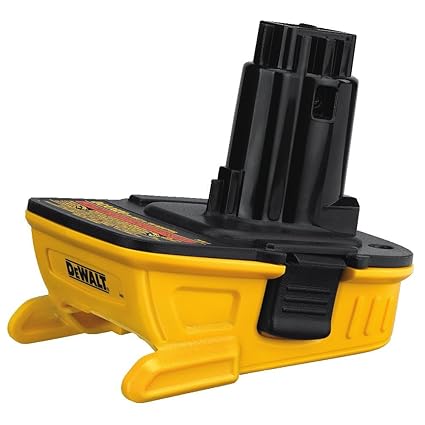
you clip the 20v battery on the base, stick the adapter into the older tool just as you would an old Ni-cad battery. Liability issues suggest that if this wasn't done right, they would not be selling this thing.
And with Ryobi- their Li-ion batteries have the same physical layout as their older Ni-cad batteries, they state that you buy their new Li-ion battery (and charger), and continue to use their older tools.
quote:
The RYOBI® 18V ONE+™ Upgrade Kit is a great choice whether you currently use Ni-Cd or lithium-ion batteries to power your ONE+ tools. It is the perfect way to upgrade battery performance and have a spare battery charged and ready to go. The charger works with all 18V ONE+ batteries, and the battery works with all 18V ONE+ blue and green tools
quote:Sounds TO ME, that in both cases, Dewalt and Ryobi are counting on their batteries to handle this, since such tech would not be present in the older tools. Is this correct?
Li-ion batteries require current and temperature regulation and that is done either in the tool itself or with a micro-controller built into the battery
So re: the Dewalt-to-Ryobi adapter:
use the correct charger for the batteries. But the Dewalt batteries should function in the Ryobi tools, just as they would within an older Dewalt- right?
Where do we stand on the adapter?
Posted on 11/6/19 at 1:08 pm to Scoob
So, the tools, and why this question;
I needed to have some home repairs, and I'd done some of this handyman stuff while going to college when younger. And what I had around the house was old, and cheap brands, and the batteries were dead at this point. Old crap like McCullough etc.
So the Home Depot near me ran some clearance sales on stuff, and I went ahead and picked up some Dewalt combo kits. 1st was just a drill and a driver, with 2 batteries and a hard box. About 150, figured I would get 'a good brand' at that price.
Then a few weeks later, they had a 4 tool kit marked for the same price, 150. Duplicate on the drill and driver, but with a multitool and an LED light, and 2 more batteries and a bigger hard box. I got that, and definitely see the use of the multitool , I've already used that a few times. Great tool!
THEN, I wander into Home Depot and see a couple Ryobi kits... oh boy. 6 tool kit, same as the Dewalt 4, along with a small circular saw and a reciprocating saw. Marked down to, again, 150. And for under 100, a 2-pack over in Lawn and Garden, cordless weedeater and blower 2-pack, and 2 more batteries.
So: $300 in Dewalt, $250 in Ryobi, bunch of drills etc, but with enough extras to make it worthwhile.
The Ryobi stuff works ok, I was able to edge the driveway, and blow off the roof and driveway, with the 2 batteries that came with that kit.
The two saws function as expected to, I've taken 4" limbs with the reciprocating saw, and cut 3/4 plywood easily with the circular.
The 2 multi-tools: I used the Dewalt when doing some flooring in the kitchen, and it was a lifesaver. It cuts/grinds/sands like a boss.
I helped my brother do some window trim stuff at his house before repainting, and used both tools. Dewalt for cutting in, Ryobi for sanding down. Fantastic in that approach.
The Ryobi multitool is neat, it has a detachable head, and takes Ridgid Jobmax heads... so more tool compatibility. I used the included oscillating head for cutting and sanding, that works fine. Maybe not quite as strong as the dewalt, but if they weren't side by side I wouldn't know the difference.
I picked up the 'drywall rotary cutter' head from HD for another 30ish, and that makes it basically the same as a Dremel (same attachments).
They also have right-angle driver, router, reciprocating saw, metal shear, and 3/8 ratchet heads. I ordered a ratchet head off ebay (AEG brand, cheaper price than Ridgid), and am considering the router head for what minimal usage I might need.
Hate to say it, but before I had these, I didn't see the use. But now, I've already used everything quite a bit, and have some more things planned, so I think they're worth it.
Definitely curious about being able to use the Dewalt batteries as needed, on the Ryobi multi-tool.
I needed to have some home repairs, and I'd done some of this handyman stuff while going to college when younger. And what I had around the house was old, and cheap brands, and the batteries were dead at this point. Old crap like McCullough etc.
So the Home Depot near me ran some clearance sales on stuff, and I went ahead and picked up some Dewalt combo kits. 1st was just a drill and a driver, with 2 batteries and a hard box. About 150, figured I would get 'a good brand' at that price.
Then a few weeks later, they had a 4 tool kit marked for the same price, 150. Duplicate on the drill and driver, but with a multitool and an LED light, and 2 more batteries and a bigger hard box. I got that, and definitely see the use of the multitool
, I've already used that a few times. Great tool! THEN, I wander into Home Depot and see a couple Ryobi kits...
oh boy. 6 tool kit, same as the Dewalt 4, along with a small circular saw and a reciprocating saw. Marked down to, again, 150. And for under 100, a 2-pack over in Lawn and Garden, cordless weedeater and blower 2-pack, and 2 more batteries. So: $300 in Dewalt, $250 in Ryobi, bunch of drills etc
, but with enough extras to make it worthwhile. The Ryobi stuff works ok, I was able to edge the driveway, and blow off the roof and driveway, with the 2 batteries that came with that kit.
The two saws function as expected to, I've taken 4" limbs with the reciprocating saw, and cut 3/4 plywood easily with the circular.
The 2 multi-tools: I used the Dewalt when doing some flooring in the kitchen, and it was a lifesaver. It cuts/grinds/sands like a boss.
I helped my brother do some window trim stuff at his house before repainting, and used both tools. Dewalt for cutting in, Ryobi for sanding down. Fantastic in that approach.
The Ryobi multitool is neat, it has a detachable head, and takes Ridgid Jobmax heads... so more tool compatibility. I used the included oscillating head for cutting and sanding, that works fine. Maybe not quite as strong as the dewalt, but if they weren't side by side I wouldn't know the difference.
I picked up the 'drywall rotary cutter' head from HD for another 30ish, and that makes it basically the same as a Dremel (same attachments).
They also have right-angle driver, router, reciprocating saw, metal shear, and 3/8 ratchet heads. I ordered a ratchet head off ebay (AEG brand, cheaper price than Ridgid), and am considering the router head for what minimal usage I might need.
Hate to say it, but before I had these, I didn't see the use. But now, I've already used everything quite a bit, and have some more things planned, so I think they're worth it.
Definitely curious about being able to use the Dewalt batteries as needed, on the Ryobi multi-tool.
Posted on 11/6/19 at 5:00 pm to Scoob
Like I mentioned before, the adapters are just wires. There’s nothing more to them except crossing and making the proper connections.
Now, as Clames mentioned, some use a combination of controllers in the tool and/or the battery. I’m not sure which Ryobi or Dewalt use so you may want to be cautious crossing up the brands.
I personally have no reservations using my 20v Max batteries in my old 18v tools. I don’t recall if I bought the official Dewalt adapter or a knockoff, but doesn’t matter either way to me. There were plenty reviews of them cut apart to see they were the same. I also wouldn’t have an issue crossing them over, but that’s a decision only you can make.
Now, as Clames mentioned, some use a combination of controllers in the tool and/or the battery. I’m not sure which Ryobi or Dewalt use so you may want to be cautious crossing up the brands.
I personally have no reservations using my 20v Max batteries in my old 18v tools. I don’t recall if I bought the official Dewalt adapter or a knockoff, but doesn’t matter either way to me. There were plenty reviews of them cut apart to see they were the same. I also wouldn’t have an issue crossing them over, but that’s a decision only you can make.

Posted on 11/6/19 at 11:45 pm to Scoob
quote:
So: Li-ion batteries are unstable, and need tighter parameters than Ni-cad batteries, or else...
either could go dead, or other end go boom? Am I getting this right?
Not unstable, just very powerful. They hold a big charge and are willing to discharge at very high current rates if allowed. With a couple of Dewalt 20V batteries, spliced in parallel, you can stick weld with them.
quote:
So, this scratches the cheap aftermarket batteries off the list.
Well, they tend to use cells recycled out of discarded laptops so they are already used up before you use them.
quote:
So re: the Dewalt-to-Ryobi adapter:
use the correct charger for the batteries. But the Dewalt batteries should function in the Ryobi tools, just as they would within an older Dewalt- right?
Where do we stand on the adapter?
I don't see why they wouldn't work outside of requiring some particular sense signal from the tool. Think the DeWalt batteries are a little more involved than Ryobi's.
Posted on 11/7/19 at 12:08 pm to Clames
quote:Clames, you sound more knowledgeable on Li-Ion battery construction than I am, which is great- it's why I posted the question here.
I don't see why they wouldn't work outside of requiring some particular sense signal from the tool. Think the DeWalt batteries are a little more involved than Ryobi's.
My basic understanding is "battery", it works or it doesn't. And as far as I could gather, all these 18v-20v batteries and tools are BASICALLY the same, and thus the batteries should be interchangeable across the board.
Based on your replies and some stuff online, while it might/can work that way, there's more to it than that, and could be problematic if not done right.
Here's a quote from a hackaday posting, describing a homemade adapter (and why I'm hesitant towards buying one premade off ebay):
quote:
Mechanically, this was pretty easy — a dead Ryobi pack from the recycling bin at Home Depot was stripped down for its case, which was glued to a Dewalt 20-v to 18-v battery adapter. The tricky part came from dealing with the battery control electronics. Luckily, the donor DeWalt line has that circuitry in the adapter, while Ryobi puts it in the battery. That meant simply transplanting the PCB from the adapter to the Ryobi battery shell would be enough.
I'm uncertain exactly what that is, although the concept itself comes across clearly.
Circuitry that regulates output, to keep you from dumping current too fast, possibly burning up the tool and/or overdraining the battery (which I understand is basically fatal to Li-Ion batteries).
I'm leery of just buying the adapter off ebay, because one of the comments on that page:
quote:
This is yet another hackaday.io useless article. There are, BTW, dozens of 3D printed models in thingiverse to adapt almost any battery to almost any device (if voltages are compatible, and yes… 20 V DeWalts are really the same as 18 V everyone else’s).
Report comment
Reply
42Fab (@42Fab2) says:
February 21, 2018 at 5:47 pm
The point isn’t just to physically mate the two together, as the 3d printed and ebay options do, it is to preserve the over-discharge and temperature protections afforded by the 20v-18v adapter, thereby protecting the battery.
So, yes or no:
New Li-Ion batteries can/will overpower, and dump charge out, bricking the battery in another tool, unless regulated.
Apparently, Ryobi can use new Li-Ion batteries in their old tools, because their batteries self-regulate.
Apparently, Dewalt Li-ion batteries simply discharge, and their new line of tools regulate output.
*this makes sense, actually; as you can buy Dewalt Flexvolt batteries that can power 60v tools or 20v. The TOOL would regulate the output, the battery would just hook up and go.
Their adapter does the regulating when applied to an older tool.
The safe, correct way to do a Dewalt-to-Ryobi adapter would be a DIY, as described on this page
LINK
The ebay version might "work", but not properly with all safeguards in place. While this one would.
Correct?


Posted on 11/7/19 at 1:08 pm to Scoob
At this point, why risk it? Home Depot normally puts these batteries on sale during Black Friday.
Posted on 11/7/19 at 3:41 pm to Scoob
I can open up a 20V DeWalt and a li-ion Ryobi 18V battery, as well as look at the chargers later tonight. I also have an old DeWalt 14.4V XRP kit than I'm about to overhaul along with sending the batteries off for rebuilding to compare everything with.
Posted on 11/7/19 at 9:55 pm to The Nino
quote:It's not a risk, it's a clarification.
At this point, why risk it? Home Depot normally puts these batteries on sale during Black Friday.
In the old days of these tools, we'd have different tools with different batteries, and everything had their own charger. I've got stuff laying around that I don't even know I had. I have chargers for things I can't find, and tools that I can't find the chargers. Cheap stuff, mostly.
I now have a good core group of tools, with 2 sets of batteries.
Dewalt makes very good stuff that can take a lot of abuse. Ryobi makes pretty good stuff that you can get cheaper, and if it's not going to be a commonly used tool (or something you don't push to extremes) it makes a lot of sense to get that instead.
if I can establish that Dewalt batteries run both brands in the way they're supposed to, that goes a long way towards laying out future buys.
Posted on 11/8/19 at 10:24 am to Scoob
So you're trying to essentially do away with your Ryobi batteries and only use Dewalt batteries with your Dewalt and Ryobi tools?
Posted on 11/11/19 at 5:46 pm to The Nino
quote:Sorry for the delayed response- had a busy weekend.
So you're trying to essentially do away with your Ryobi batteries and only use Dewalt batteries with your Dewalt and Ryobi tools?

Yeah, that's kinda the thought, if possible. Obviously I wouldn't just toss the Ryobi batteries into the garbage, but in concept, it would be nice to consolidate into as few TYPES of batteries as possible, and be able to run them across the entire group.

 Page 1 of 1


Popular
Back to top
 Follow TigerDroppings for LSU Football News