




- My Forums
- Tiger Rant
- LSU Recruiting
- SEC Rant
- Saints Talk
- Pelicans Talk
- More Sports Board
- Fantasy Sports
- Golf Board
- Soccer Board
- O-T Lounge
- Tech Board
- Home/Garden Board
- Outdoor Board
- Health/Fitness Board
- Movie/TV Board
- Book Board
- Music Board
- Political Talk
- Money Talk
- Fark Board
- Gaming Board
- Travel Board
- Food/Drink Board
- Ticket Exchange
- TD Help Board
Customize My Forums- View All Forums
- Show Left Links
- Topic Sort Options
- Trending Topics
- Recent Topics
- Active Topics
Started By
Message
re: Tariffs. What libertarian Economists don't grasp and more.
Posted on 3/26/25 at 12:26 am to stuntman

Posted on 3/26/25 at 12:26 am to stuntman
quote:
This is why I brought up Smoot/Hawley and the Great Depression. We should have never had those problems if what you said about tariffs is true.
What did the tariffs have to do with a severe global economic downturn beginning in 1929, was triggered by the stock market crash of 1929, but its roots lay in a complex mix of factors including overproduction, unsustainable credit practices, and weak international economic policies.
We were going to have a great depression with or without. All of those things had to do with world wide policies by the governments of those empires and nations.
Milton Friedman even stated that Smoot/Hawley had little to do with it. Anna Schwartz argued the same thing.
 1
1



Posted on 3/26/25 at 12:30 am to BCreed1
quote:
What did the tariffs have to do with a severe global economic downturn beginning in 1929,
They jacked up costs.

Also, the rest of the world retaliated by jacking up their tariffs.
It's literally the last thing you want when people are getting poorer.
After the market crash and until, the summer of the next year, unemployment never went above 10%. Enter Smoot/Hawley. POOF, unemployment rate starts to skyrocket.
When your input costs go even higher while the economy is already struggling, it's just going to make things worse. Does this really not make any sense to you?
Posted on 3/26/25 at 12:36 am to Taxing Authority
quote:
Manufacturing drives innovation.
Backwards.
So you are saying that McKinsey Global Institute is wrong. Economists are wrong?
Posted on 3/26/25 at 12:40 am to stuntman
quote:
No, it's the level of tariffs that matter.
We agree on that. Protectionism can go too far: Insulating firms from any concern about foreign competition could lead to stagnation. Completely foreclosing access to imported components would make domestic production harder. I never meant to suggest that the level did not matter.

quote:
What were the typical tariff rates before income taxes came along?
Depends on the year.. In 1910, the average U.S. tariff rate on dutiable imports was around 38.5%.
From 1871 to 1913, the average U.S. tariff on dutiable imports never fell below 38%.
Posted on 3/26/25 at 12:41 am to stuntman
quote:
Good lord.
Those 2 are about as dishonest as can be. Nobody has suggested any of those people are commies. Nobody.
Posted on 3/26/25 at 12:41 am to BCreed1

Posted on 3/26/25 at 12:45 am to Taxing Authority
quote:
Backwards. If it was so, we cold be rich by making finding innovative ways to make buggy whips and wagon wheels.
Are you trying to say that if manufacturing drove innovation that we would never progress technologically, that we would just spend all of our time and energy creating new ways to make the same old products? I hope not.
It's dumb to not think that manufacturing drives innovation. It's not the sole cause. I don't think anyone is claiming that. But to think that separating the design engineers from the assembly engineers doesn't make innovation more difficult doesn't make sense.
You're removing a ton of innovators from the equation. If manufacturing was done here, we would need engineers and skilled tradesmen. These are the people who innovate. Without their jobs here, all that innovation either doesn't occur or occurs in a foreign country who doesn't pass on the savings to the US.
The idea that manufacturing doesn't increase innovation is absurd.
Posted on 3/26/25 at 12:50 am to stuntman
quote:
Why aren't those businesses here already?
Due to policies of the gov. We elected people who worried about their pockets and not the American people's pockets.
We raised taxes on businesses and they left the nation. The tax rate on businesses peaked at 53% in 1968. We talked 1910. In 1910 it was 1%.
We literally drove them out. Alot of people blame unions, and they were a big issue with that too, but taxes were the biggest issue.
quote:
They are going to charge more than they otherwise would have had the tariffs not been put in place.
quote:
You're only doing first level thinking, bud.
No. I'm going way beyond first level. Tariffs mix with policies on regulations, taxes...etc.
Back to Reagan. Placed quotas on Japan. That is and of itself would give you a point, but it did not end there. Companies moved here and the prices dropped. Then the quotas were removed.
When firms have incentives to invest in the United States, American workers prove every bit as capable as foreigners of producing efficiently and driving costs down. The standard anti-tariff narrative ignores all of this.


Posted on 3/26/25 at 12:51 am to BCreed1

Posted on 3/26/25 at 12:58 am to BCreed1
quote:
Due to policies of the gov. We elected people who worried about their pockets and not the American people's pockets.
If you're talking about regulations, compliance costs, and cronies wanting to make starting a business here cost prohibitive, I totally agree w/ that.
But if tariffs are what bring them here, then that means their costs, before tariffs, to do business are lower or otherwise they wouldn't move here, right?
I'm not familiar w/ your example of Japan. I'd have to do some reading on that before I have an opinion on it. Got any links you'd like me to check out?

Posted on 3/26/25 at 1:02 am to stuntman
quote:
What did the tariffs have to do with a severe global economic downturn beginning in 1929,
They jacked up costs.
Smoot/Hawley was not a thing in 1929.
quote:
Enter Smoot/Hawley. POOF, unemployment rate starts to skyrocket.
So you disagree with Milton?
When they were first enacted, it helped. But money dried up. Creditanstalt of Austria failed. etc....
FDR ended Smoot in 1934. Unemployed remained relatively the same for 2 years and barely dropped in 1936 and 1937. It went back up in 1938 and 1939.
Posted on 3/26/25 at 1:14 am to BCreed1
quote:
Smoot/Hawley was not a thing in 1929.
Correct. It was passed like 9 months later...after unemployment came down from 9% to just over 6%. Then after the passage of that law, the unemployment rate really started to take off.
I disagree w/ Milton on a few things. Not a lot, but a few. He's a monetarist and he also helped w/ the idea of withholdings for taxes. Sowell is the one who opened my eyes to what happened to really make that depression "great".
For clarity's sake, I've gone from being a borderline socialist, slowly moved over to conservatism, and now I'm a full blown AnCap, philosophically. I am pragmatic, though. Milei is showing the way in Argentina. He's an AnCap too, but understands that the state has to be whittled away from the inside out. Check out his views on tariffs. Check out how fast and how spectacular the turnaround in Argentina has been.
When you allow more freedom and less hurdles into the market, "spontaneous order" happens relatively fast. Government putting more hurdles in the way and spending tons more does nothing to really help us.
The only argument for tariffs that makes the slightest bit of sense to me is the national security angle, but even that argument isn't solid.
Posted on 3/26/25 at 1:16 am to stuntman
quote:
If you're talking about regulations, compliance costs, and cronies wanting to make starting a business here cost prohibitive, I totally agree w/ that.
It's exactly what I'm talking about. Even taxes. 53%... that's insanity.
quote:
But if tariffs are what bring them here, then that means their costs, before tariffs, to do business are lower or otherwise they wouldn't move here, right?
If I understand you, yes.
Company "A" sells us a widget at $10. A tariff is placed at 25%, the natural though is that the price of the widget would go up by at least that. That's problematic.
Company "A" sells us a widget at $10. A tariff is placed at 25%. If they move production to the USA, the tariff doesn't effect it. Just the cost to make it. When you throw in good policies like lower business taxes, it more than off sets any cost.
quote:
I'm not familiar w/ your example of Japan. I'd have to do some reading on that before I have an opinion on it. Got any links you'd like me to check out?
I assume you want a conservative economist source. Here you go LINK
Just some quotes from the link:
quote:
In 1980, Japanese automakers were trouncing Detroit’s “Big Three” in the American car market. After decades of intensive state support, Japanese firms had developed the world’s most efficient production processes and made the highest-quality cars. Without the time and resources to retool, American automakers risked bankruptcy and mass layoffs. President Ronald Reagan negotiated a quota on Japanese imports that stemmed competition for four years, bought Detroit time to retool, and spurred massive foreign investment in a new manufacturing base in the South that created hundreds of thousands of American jobs.
quote:
Trade barriers create new incentives for investment. Cars made in America were exempt from the import quota, which led Japanese automakers to invest in U.S.-based assembly facilities.
Production is a function of past policy and investment choices. Once assembly moved onshore, Japanese firms had incentives to onshore the rest of their value chain—production, research, and design—and they’ve chosen to continue their American investments long after the import quota was lifted.
quote:
Within a decade, the import quota generated:
$25+ billion in foreign capital investment (2022 dollars)
8 new auto assembly plants
300+ new production facilities
100,000+ new American jobs
Today, Honda and Toyota have among the highest domestic content of cars sold in America.
Posted on 3/26/25 at 1:17 am to BCreed1
Will check this out.
Posted on 3/26/25 at 1:23 am to stuntman
quote:
For clarity's sake, I've gone from being a borderline socialist, slowly moved over to conservatism, and now I'm a full blown AnCap, philosophically. I am pragmatic, though. Milei is showing the way in Argentina.
Well that's a wide range of beliefs in a lifetime. LOL
I have no problem with Milei. And if he wants an actual no barrier trade agreement, I'm all for it.
AnCap. I will look into this.
Posted on 3/26/25 at 1:26 am to BCreed1
quote:
AnCap. I will look into this.
Just check out the Mises Institute, or better yet, just listen to the audiobook from Murray Rothbard called "The Anatomy of the State". That's probably the best starting point.
Alright, I've got to catch some z's. Thanks for the back and forth.
This post was edited on 3/26/25 at 1:29 am
Posted on 3/26/25 at 1:29 am to stuntman
Posted on 3/26/25 at 1:30 am to BCreed1
Got it. Thanks again.
Posted on 3/26/25 at 7:04 am to stuntman
quote:quote:Correct.
Smoot/Hawley was not a thing in 1929.
Well, it was introduced and had passed the House in 1929, so it was definitely "a thing."
It was also passed after a bunch of know-nothing politicians ignored the recommendation of economists to end tariffs.
Then, predictably, the tariffs were harmful to the American people for years.
Posted on 3/26/25 at 7:06 am to stuntman
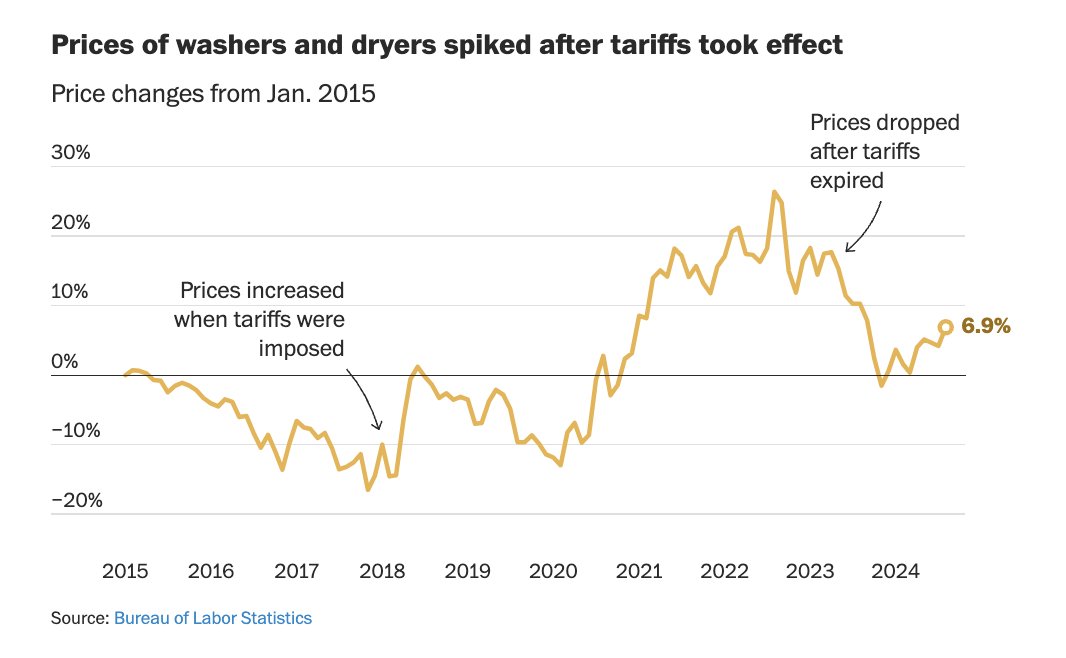
...and don't forget to look at ALL of the data.

 Page 2 of 15

Popular
Back to top
 Follow TigerDroppings for LSU Football News