




- My Forums
- Tiger Rant
- LSU Recruiting
- SEC Rant
- Saints Talk
- Pelicans Talk
- More Sports Board
- Fantasy Sports
- Golf Board
- Soccer Board
- O-T Lounge
- Tech Board
- Home/Garden Board
- Outdoor Board
- Health/Fitness Board
- Movie/TV Board
- Book Board
- Music Board
- Political Talk
- Money Talk
- Fark Board
- Gaming Board
- Travel Board
- Food/Drink Board
- Ticket Exchange
- TD Help Board
Customize My Forums- View All Forums
- Show Left Links
- Topic Sort Options
- Trending Topics
- Recent Topics
- Active Topics
Started By
Message
AC replacement (AC board pros)
Posted on 6/29/26 at 6:51 pm


Posted on 6/29/26 at 6:51 pm
I see the normal recommendation is 200 square inches of return grill per ton, so 1,000 for a 5 ton unit. That’s about what I’m at currently but feel like I need an additional return put in due to the layout of my house with multiple areas of vaulted ceilings.
My 2 current returns are on one side of the house and considering of adding another one on the other side.
Is going over 1000 and adding a return to the side of the house without one a bad call?
My 2 current returns are on one side of the house and considering of adding another one on the other side.
Is going over 1000 and adding a return to the side of the house without one a bad call?
This post was edited on 6/29/26 at 6:55 pm
 1
1


Posted on 6/29/26 at 11:04 pm to DukeSilver
5 ton unit at a nominal air flow rate of 400 cfm per ton = 2000 cfm air flow. Thus your return air ducting should be sized to provide at least 2000 cfm.
Use this table to determine how much return air is being provided by the two existing return air grills. You may have square/rectangular return air grills on the ceiling but with round air ducts attached to them to send air back to the air handler/furnace, so take that into account when calculating.
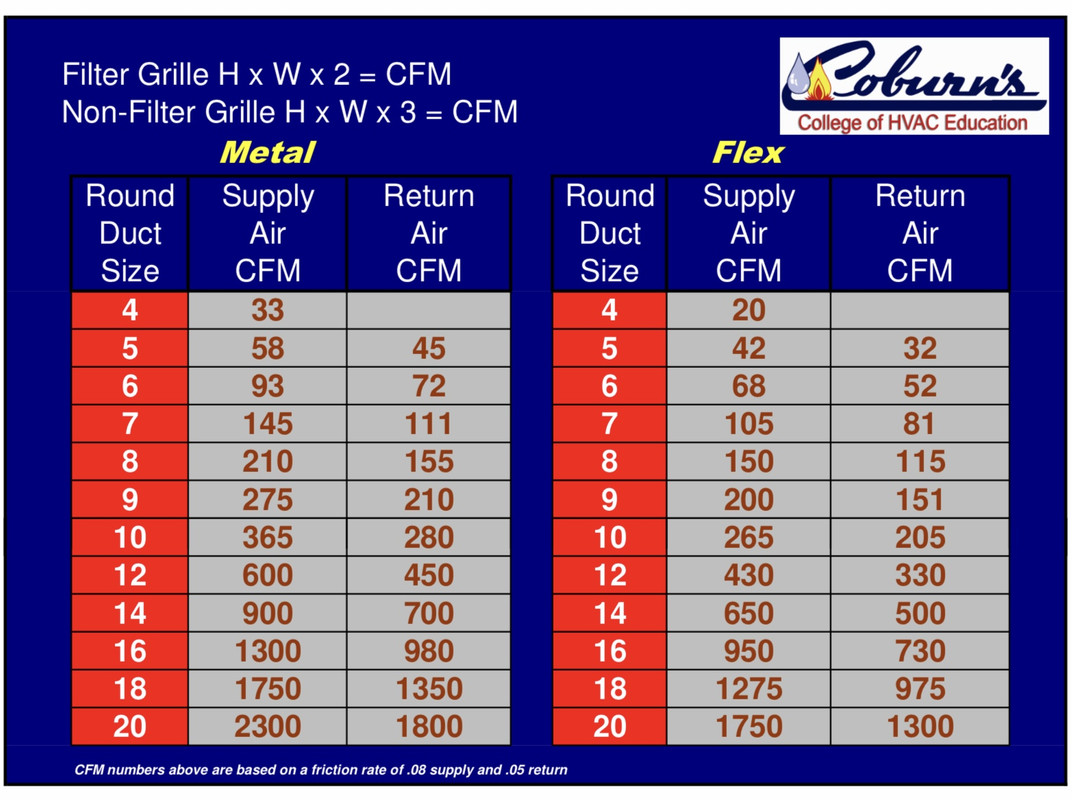
So for example, if you had a 20 inch diameter flex duct attached to the filter grill, it would would send 1300 cfm air back to the air handler/furnace. Now, from the the formula at the top left of the table, if you had, for example, a 24 x 24 in return air grill, with filter, with 24 x 24 square return air duct back to the air handler/furnace then 1152 cfm of return air would be supplied to the air handler/furnace (24 x 24 x 2).
Using this, calculate how much return air your 2 air returns are supplying. If you are short of 2000 cfm, then add the 3 return grill- duct on the other side of the house to make up the shortfall. It’s OK to over-size the return air volume - it’s not an issue. So even if your 2 air returns provide the 2000 cfm, it would OK to add a 3rd return on the other side of the house, say another 500 cfm, to help aid with comfort.
I did this 3 years with a HVAC changeout. I was 500 cfm short on return air for my 4 ton system (1600 cfm required, 24 x 24 return duct provided 1152 cfm, so I was 448 cfm short). When the new unit was added I had them add another return air duct on the other side of the house to provide ~ 500 cfm (14 inch dia round flex duct attached to a rectangular air return grill with filter) of additional return air. It has improved comfort on that side of the house.
Use this table to determine how much return air is being provided by the two existing return air grills. You may have square/rectangular return air grills on the ceiling but with round air ducts attached to them to send air back to the air handler/furnace, so take that into account when calculating.
So for example, if you had a 20 inch diameter flex duct attached to the filter grill, it would would send 1300 cfm air back to the air handler/furnace. Now, from the the formula at the top left of the table, if you had, for example, a 24 x 24 in return air grill, with filter, with 24 x 24 square return air duct back to the air handler/furnace then 1152 cfm of return air would be supplied to the air handler/furnace (24 x 24 x 2).
Using this, calculate how much return air your 2 air returns are supplying. If you are short of 2000 cfm, then add the 3 return grill- duct on the other side of the house to make up the shortfall. It’s OK to over-size the return air volume - it’s not an issue. So even if your 2 air returns provide the 2000 cfm, it would OK to add a 3rd return on the other side of the house, say another 500 cfm, to help aid with comfort.
I did this 3 years with a HVAC changeout. I was 500 cfm short on return air for my 4 ton system (1600 cfm required, 24 x 24 return duct provided 1152 cfm, so I was 448 cfm short). When the new unit was added I had them add another return air duct on the other side of the house to provide ~ 500 cfm (14 inch dia round flex duct attached to a rectangular air return grill with filter) of additional return air. It has improved comfort on that side of the house.
Posted on 6/30/26 at 9:00 am to CrawDude
So oversizing is not an issue which is good.
My 2 current returns are actually both on the same void in the wall, one downstairs and one upstairs but same void. So I'm assuming the restriction would be whatever size of connection is connecting the void to the actual air handler.
Which if it is just one connection to the handler, should that connection be the only thing calculated since they share it? Would the 2 grill sizes then not matter?
My 2 current returns are actually both on the same void in the wall, one downstairs and one upstairs but same void. So I'm assuming the restriction would be whatever size of connection is connecting the void to the actual air handler.
Which if it is just one connection to the handler, should that connection be the only thing calculated since they share it? Would the 2 grill sizes then not matter?
This post was edited on 6/30/26 at 9:28 am
Posted on 6/30/26 at 10:38 am to DukeSilver
Yes, from everything I’ve read on ducting, having return air volume in excess of required by the unit, within reason, is no issue and sometimes recommended by those who really understand duct work sizing in HVAC. It’s very rare for HVAC ductwork to be oversized, and far too common for it to be undersized.
Yes, I think so, in your case as you’ve explained it, the 2 grill sizes would not matter, as they are connected, and not independent of each other. So in your case, measure the size/dimension of that 1, single return air connection (whether it’s is round - rigid pipe or flex, or square/rectangular) at the return air plenum, and then use the table to estimate the volume of return air your HVAC system is receiving.
As an aside, just so you’ll know, a very knowledgeable HVAC tech would use a total external static pressure (TESP) to estimate the volume of air flow. Static pressure is a measure of resistance to air flow, and it equivalent to measuring blood pressure in a human - too high is not good. Simple measurement, using a manometer and drilling 2 holes, 1 in the return air plenum, and another on the supply side - takes 10 min max. If the return air static pressure is excessively high, then the return air volume is too low, ditto for the supply side. Here short video to help explain LINK
In some states/jurisdictions building code for HVAC require that a return air duct be placed in each room that has a supply air duct - though more costly, that set up provides best overall comfort.
quote:
Which if it is just one connection to the handler, should that connection be the only thing calculated since they share it? Would the 2 grill sizes then not matter?
Yes, I think so, in your case as you’ve explained it, the 2 grill sizes would not matter, as they are connected, and not independent of each other. So in your case, measure the size/dimension of that 1, single return air connection (whether it’s is round - rigid pipe or flex, or square/rectangular) at the return air plenum, and then use the table to estimate the volume of return air your HVAC system is receiving.
As an aside, just so you’ll know, a very knowledgeable HVAC tech would use a total external static pressure (TESP) to estimate the volume of air flow. Static pressure is a measure of resistance to air flow, and it equivalent to measuring blood pressure in a human - too high is not good. Simple measurement, using a manometer and drilling 2 holes, 1 in the return air plenum, and another on the supply side - takes 10 min max. If the return air static pressure is excessively high, then the return air volume is too low, ditto for the supply side. Here short video to help explain LINK
In some states/jurisdictions building code for HVAC require that a return air duct be placed in each room that has a supply air duct - though more costly, that set up provides best overall comfort.
This post was edited on 6/30/26 at 10:56 am
Posted on 6/30/26 at 10:55 am to CrawDude
quote:
As an aside, just so you’ll know, a very knowledgeable HVAC tech would use a total external static pressure (TESP) to estimate the volume of air flow. Static pressure is a measure of resistance to air flow, and it equivalent to measuring blood pressure in a human - too high is not good. Simple measurement, using a manometer and drilling 2 holes, 1 in the return air plenum, and another on the supply side - takes 10 min max. If the return air static pressure is excessively high, then the return air volume is too low, ditto for the supply side. Here short video to help explain
So this test should be done after install (and additional return is added) to confirm everything is flowing properly?
Also is there anything I need to look out for in regards to the ducting and room registers other than making sure the ducts are well insulated and hung properly with no sharp turns or is there anything else to it? Anything to look out for with the registers in each room?
Posted on 6/30/26 at 11:38 am to DukeSilver
quote:
So this test should be done after install (and additional return is added) to confirm everything is flowing properly? Also is there anything I need to look out for in regards to the ducting and room registers other than making sure the ducts are well insulated and hung properly with no sharp turns or is there anything else to it? Anything to look out for with the registers in each room?
Ideally yes - it would be great to know the TESP, before and after installation of a additional air return duct, if no more than to determine if your duct work is properly sized, both on the return & supply sides, so you can know if you are getting all the air flow that 5-ton unit unit is designed to provide you. And of course it’s always a good idea to check duct insulation, if they are hung properly, no sharp 90 degree elbows, check for crushed or kinked ducts, etc. Registers - pretty standard, can’t think of anything off hand.
On a professional HVAC message board I peruse, one of the techs that answers question has this statement in his avatar “the equipment just cools and heats the air, and removes humidity, but the duct work provides comfort”. Simple but true - likely most homeowners focus on equipment - is it too big, too small, do I need another unit, etc - when duct work is as important, and in most cases more important, as it relates to home comfort issues.
Posted on 6/30/26 at 12:45 pm to CrawDude
I have the typical shiny flexible ducts, is that good enough as long as its not torn up and the insulation is in good order? Or did you upgrade to something better?
Posted on 6/30/26 at 1:05 pm to DukeSilver
quote:
I have the typical shiny flexible ducts, is that good enough as long as its not torn up and the insulation is in good order? Or did you upgrade to something better?
Yes flex duct is fine as long as it’s in good shape. My house was built in 1993 so I have rigid ducts. I had a chance to look inside them when the replacement HVAC was installed as the supply plenum was also replaced and they were clean as a whistle.
I also had another company do a pressurized duct leakage test before the changeout and air leakage from ducts was minimal (5% leakage if I recall from memory, which was very good, and the duct testing guys told me they routinely see 20%+ duct leakage in many homes, which on a 5 ton system is equivalent to losing 1 ton of conditioned air into the attic). I did this to make sure I had no major duct issues that needed to be addressed while doing the equipment changeout. When the HVAC crew added a second, new return air duct, as I specified, flex duct was used, which I was fine with.
This post was edited on 7/1/26 at 9:50 am

Posted on 6/30/26 at 1:36 pm to CrawDude
Good deal, I appreciate your responses.
Posted on 7/1/26 at 4:04 pm to CrawDude
quote:
CrawDude
Thoughts on Ruud as a brand?
Also thoughts on 14 seer vs 16 seer.
Googling it seems pretty conflicted on if the extra money for the 16 is actually worth it or not.
Posted on 7/1/26 at 7:19 pm to DukeSilver
quote:
Thoughts on Ruud as a brand? Also thoughts on 14 seer vs 16 seer. Googling it seems pretty conflicted on if the extra money for the 16 is actually worth it or not.
Rudd=Rheem is as good as the other major manufacturers Trane=American Standard, Carrier=Byrant, Daikin=Goodman=Amana, etc. The most important factor is the quality of the install, attention to detail, by the HVAC company you choose. Shop the installer more so than the name brand of the equipment.
SEER - obviously higher SEER, better efficiency, lower cost to operate, but at a higher up front cost. But just one significant repair not covered by warranty will offset any long-term savings from energy efficiency. If this your forever house maybe consider SEER 16. If you think you may move in 5 years or so, go with SEER 14.
Another option, use the difference in cost between a SEER 14 & SEER 16, and apply it towards improving the air sealing the house, more attic insulation etc. which are permanent improvements to the house that should result in better overall comfort.
Here are a couple cost savings calculator on SEER you can play around with.
LINK
LINK
Posted on 7/1/26 at 10:16 pm to CrawDude
14 would be single speed and 16 variable. Although I’ve read the 14 these days are more like 14.8 and motors these days are almost a small version of variable?
I’m not moving. Both would have 10 year parts and labor. Just not sure the price difference is justifiable since they’re all prob gonna go out shortly after that 10 year mark. Unlike the older ones that seemed to be able to go 20 years.
I’m not moving. Both would have 10 year parts and labor. Just not sure the price difference is justifiable since they’re all prob gonna go out shortly after that 10 year mark. Unlike the older ones that seemed to be able to go 20 years.
Posted on 7/1/26 at 11:42 pm to DukeSilver
quote:
14 would be single speed and 16 variable. Although I’ve read the 14 these days are more like 14.8 and motors these days are almost a small version of variable? I’m not moving. Both would have 10 year parts and labor. Just not sure the price difference is justifiable since they’re all prob gonna go out shortly after that 10 year mark. Unlike the older ones that seemed to be able to go 20 years.
Like everything in life there are pros & cons to each. Before my change out I considered all options single speed, two speed, multi-stage/variable capacity, priced them all. Bottom line with a change out I decided to stay with single speed - simplicity has its advantages, but the multistage/variable capacity can provide unparalleled comfort when installed properly. With a new build I would have gone in a different direction. As far as I’m concerned there is no right or wrong answer to your choice.
It’s been stated the average life of a well maintained HVAC in the Deep South is 13-15 years, but I agree with these new units I wouldn’t count on it.
Usually two-speed units have a higher SEER rating than 16. Is that a 2 speed compressor & blower motor in the furnace/air handler? EMC blower motors in the air handler or furnace are constant torque or variable speed - so they have many advantages over the old PSC blower motor motors.
Of course having a 10 year labor warranty adds $2 to 3K to cost of the unit - it’s built into the price structure. I also have a 10 year labor warranty, but that is not the norm.
Posted on 7/2/26 at 10:38 am to CrawDude
Thanks.
Ended up going with a 16 Seer variable speed Ruud full replacement. He came down on his price a little to where it wasn't that much more over the 14 so figured might as well.
Ended up going with a 16 Seer variable speed Ruud full replacement. He came down on his price a little to where it wasn't that much more over the 14 so figured might as well.
Posted on 7/3/26 at 8:37 am to DukeSilver
quote:
Ended up going with a 16 Seer variable speed Ruud full replacement. He came down on his price a little to where it wasn't that much more over the 14 so figured might as well.
Good choice.

 Page 1 of 1


Popular
Back to top
 Follow TigerDroppings for LSU Football News