




- My Forums
- Tiger Rant
- LSU Recruiting
- SEC Rant
- Saints Talk
- Pelicans Talk
- More Sports Board
- Fantasy Sports
- Golf Board
- Soccer Board
- O-T Lounge
- Tech Board
- Home/Garden Board
- Outdoor Board
- Health/Fitness Board
- Movie/TV Board
- Book Board
- Music Board
- Political Talk
- Money Talk
- Fark Board
- Gaming Board
- Travel Board
- Food/Drink Board
- Ticket Exchange
- TD Help Board
Customize My Forums- View All Forums
- Show Left Links
- Topic Sort Options
- Trending Topics
- Recent Topics
- Active Topics
Started By
Message
VELO - Low Float turnaround opportunity
Posted on 3/19/26 at 4:28 pm

Posted on 3/19/26 at 4:28 pm
CLOSED POSITION on 3/24
I wouldn't have mentioned this if the CEO hadn't purchase a note AND converted it well above the current share price. Seems really bullish ahead of earnings.
This is the kind of name I’d throw $500 at initially. We’ll know more after earnings next week.
CEO Arun Jeldi acquired a $5M promissory note from an existing holder and immediately converted into common stock at $16.38/share. That's a ~56% premium to where the stock was trading at the time.
• Director Ken Thieneman converted a $10M note into equity at $10.50/share.
• Net effect: ~60% of total outstanding debt eliminated, leaving only ~$10M on the balance sheet.
WEBSITE
Company Profile
Velo3D is a specialized metal additive manufacturing (3D printing) company that produces complex, high-performance metal parts for aerospace, defense, space, energy, and semiconductor markets. Its fully integrated platform — Sapphire printers, Flow software, Assure quality system, and Intelligent Fusion process — enables geometries impossible with traditional manufacturing. Founded in 2014, it went public in September 2021 via SPAC merger with JAWS Spitfire (initial ticker VLD, ~$1.6B valuation at debut).
The Downfall (2023–Early 2025)
Post-SPAC hype faded as commercial adoption slowed, shipments delayed, and backlog contracted. Revenue collapsed (full-year 2024 only $41M, down sharply), while annual cash burn stayed ~$30–33M. Cash reserves plunged from $24.5M (end-2023) to $1.2M by Dec 31, 2024 (and ~$854K low in mid-2025), triggering going-concern warnings, NYSE delisting, and OTC trading. Two reverse splits followed: 1-for-35 (June 2024) and 1-for-15 (July 2025).
Leadership Overhaul & Turnaround
Founder/CEO Benny Buller stepped down in late 2023 amid a strategic review. Brad Kreger was brought in as CEO in 2024 and focused on cost cuts, but results remained weak. In December 2024, Arrayed Notes Acquisition executed a massive debt-for-equity exchange, gaining 95% control. Arun Jeldi (Arrayed CEO) immediately replaced Kreger as CEO and joined the board; the board shrank from 10 to 5 members, with Buller and five others resigning. Kreger stayed on as COO. In 2025, defense veterans Rear Admiral Jason Lloyd and Ken Thieneman joined the board, and Jeldi accelerated the shift to high-margin Rapid Production Solutions (RPS) parts business while uplisting to Nasdaq with a $17.5M raise.
2026 Momentum
Feb 2026: Secured $11.5M multi-year full-rate production defense contract for a high-profile U.S. national security program.
Mar 11, 2026: CEO Jeldi converted a $5M note at $16.38/share (premium); Director Thieneman converted $10M at $10.50/share — slashing total debt 60% to ~$10M.
Cash now ~$11.8M (Sep 2025 figure, improved further).
Current Fundamentals
Market cap: 310 million
2025 revenue run-rate on track for $50–60M in 2026 (+30%+ growth).
Capex: $15–20M. Burn rate falling rapidly.
EBITDA positive targeted H1 2026 (company first).
Q4/FY2025 earnings release: March 24, 2026.
Float: ~3.53 million shares; short interest ~65% of float (squeeze setup).
A word on the low float
The public float is only 3.53 million shares because roughly 52% of total shares outstanding (~22mm) are held by insiders (primarily Arrayed Notes post-2024 debt exchange) and the rest are restricted or locked up. This tiny tradable float, combined with 65% short interest, creates extreme squeeze potential on any positive catalyst (e.g., strong March 24 earnings or contract follow-ons).
Bull Case – 2026
Strong defense ramp (RPS could deliver 40%+ of revenue at 50–60% margins), multiple follow-on contracts ($20–30M+ potential), RPS scaling to $25M+, EBITDA +$8–12M by year-end, and short squeeze (65% of tiny float) on March 24 beat could drive stock to $20–$30+ (2–3x from current levels).
Bear Case – 2026
If defense contract delays or single-customer concentration (potentially 30–40% of revenue) hits, RPS scaling misses, or capex overruns by $5M, burn rate stays elevated, possible $5–8M dilution needed and cash runway under 12 months, keeping stock in $6–$10 range with high volatility.
This is a high-risk, high-reward turnaround with fresh insider conviction and real revenue momentum.
I wouldn't have mentioned this if the CEO hadn't purchase a note AND converted it well above the current share price. Seems really bullish ahead of earnings.
This is the kind of name I’d throw $500 at initially. We’ll know more after earnings next week.
CEO Arun Jeldi acquired a $5M promissory note from an existing holder and immediately converted into common stock at $16.38/share. That's a ~56% premium to where the stock was trading at the time.
• Director Ken Thieneman converted a $10M note into equity at $10.50/share.
• Net effect: ~60% of total outstanding debt eliminated, leaving only ~$10M on the balance sheet.
WEBSITE
Company Profile
Velo3D is a specialized metal additive manufacturing (3D printing) company that produces complex, high-performance metal parts for aerospace, defense, space, energy, and semiconductor markets. Its fully integrated platform — Sapphire printers, Flow software, Assure quality system, and Intelligent Fusion process — enables geometries impossible with traditional manufacturing. Founded in 2014, it went public in September 2021 via SPAC merger with JAWS Spitfire (initial ticker VLD, ~$1.6B valuation at debut).
The Downfall (2023–Early 2025)
Post-SPAC hype faded as commercial adoption slowed, shipments delayed, and backlog contracted. Revenue collapsed (full-year 2024 only $41M, down sharply), while annual cash burn stayed ~$30–33M. Cash reserves plunged from $24.5M (end-2023) to $1.2M by Dec 31, 2024 (and ~$854K low in mid-2025), triggering going-concern warnings, NYSE delisting, and OTC trading. Two reverse splits followed: 1-for-35 (June 2024) and 1-for-15 (July 2025).
Leadership Overhaul & Turnaround
Founder/CEO Benny Buller stepped down in late 2023 amid a strategic review. Brad Kreger was brought in as CEO in 2024 and focused on cost cuts, but results remained weak. In December 2024, Arrayed Notes Acquisition executed a massive debt-for-equity exchange, gaining 95% control. Arun Jeldi (Arrayed CEO) immediately replaced Kreger as CEO and joined the board; the board shrank from 10 to 5 members, with Buller and five others resigning. Kreger stayed on as COO. In 2025, defense veterans Rear Admiral Jason Lloyd and Ken Thieneman joined the board, and Jeldi accelerated the shift to high-margin Rapid Production Solutions (RPS) parts business while uplisting to Nasdaq with a $17.5M raise.
2026 Momentum
Feb 2026: Secured $11.5M multi-year full-rate production defense contract for a high-profile U.S. national security program.
Mar 11, 2026: CEO Jeldi converted a $5M note at $16.38/share (premium); Director Thieneman converted $10M at $10.50/share — slashing total debt 60% to ~$10M.
Cash now ~$11.8M (Sep 2025 figure, improved further).
Current Fundamentals
Market cap: 310 million
2025 revenue run-rate on track for $50–60M in 2026 (+30%+ growth).
Capex: $15–20M. Burn rate falling rapidly.
EBITDA positive targeted H1 2026 (company first).
Q4/FY2025 earnings release: March 24, 2026.
Float: ~3.53 million shares; short interest ~65% of float (squeeze setup).
A word on the low float
The public float is only 3.53 million shares because roughly 52% of total shares outstanding (~22mm) are held by insiders (primarily Arrayed Notes post-2024 debt exchange) and the rest are restricted or locked up. This tiny tradable float, combined with 65% short interest, creates extreme squeeze potential on any positive catalyst (e.g., strong March 24 earnings or contract follow-ons).
Bull Case – 2026
Strong defense ramp (RPS could deliver 40%+ of revenue at 50–60% margins), multiple follow-on contracts ($20–30M+ potential), RPS scaling to $25M+, EBITDA +$8–12M by year-end, and short squeeze (65% of tiny float) on March 24 beat could drive stock to $20–$30+ (2–3x from current levels).
Bear Case – 2026
If defense contract delays or single-customer concentration (potentially 30–40% of revenue) hits, RPS scaling misses, or capex overruns by $5M, burn rate stays elevated, possible $5–8M dilution needed and cash runway under 12 months, keeping stock in $6–$10 range with high volatility.
This is a high-risk, high-reward turnaround with fresh insider conviction and real revenue momentum.
This post was edited on 3/24/26 at 4:20 pm
 2
2

Posted on 3/19/26 at 4:33 pm to bayoubengals88
Found out about this one from NBIS bull Daniel Koss:
Loading Twitter/X Embed...
If tweet fails to load, click here.Posted on 3/19/26 at 4:44 pm to bayoubengals88
Ok, I really like this.
Loading Twitter/X Embed...
If tweet fails to load, click here.This post was edited on 3/19/26 at 8:34 pm
Posted on 3/19/26 at 5:22 pm to bayoubengals88
According to the company's SEC filings and related announcements (from an 8-K filing around February 2026), the CEO is eligible for annual stock option grants equal to 2-3% of the company's total common stock outstanding at the time of each grant.
These stock options are performance-based and vest (become exercisable) in stages tied to enterprise valuation milestones (likely based on market capitalization or enterprise value at the time the milestones are achieved):
- 10% of the options vest when the company reaches a $1 billion valuation.
- 20% vest at $3 billion.
- 30% vest at $5 billion.
- 40% vest at $10 billion.
That’s starting at around $40/share
These stock options are performance-based and vest (become exercisable) in stages tied to enterprise valuation milestones (likely based on market capitalization or enterprise value at the time the milestones are achieved):
- 10% of the options vest when the company reaches a $1 billion valuation.
- 20% vest at $3 billion.
- 30% vest at $5 billion.
- 40% vest at $10 billion.
That’s starting at around $40/share
This post was edited on 3/19/26 at 5:25 pm
Posted on 3/19/26 at 5:34 pm to bayoubengals88

Posted on 3/19/26 at 8:10 pm to bayoubengals88
I appreciate the way you bring stuff to this board. I don’t always agree with you, but the information is helpful nonetheless.
Posted on 3/19/26 at 8:18 pm to slackster
I appreciate any and all feedback on picks 
Here’s more on cutting expenses:
Velo3D's operating expenses (OpEx) have indeed been high relative to its revenue scale—contributing to ongoing net losses despite the impressive customer base—but the company has been **aggressively reducing them** as part of its turnaround strategy. The perception of it being a "low capex" company is partially accurate but nuanced, especially with the pivot to Rapid Production Services (RPS, their outsourced parts printing business).
Why Expenses Have Been High (and Are Improving)
From recent quarters (through Q3 2025, the latest detailed public data as of early 2026):
- **GAAP operating expenses** have dropped sharply YoY due to restructuring, workforce reductions, and cost discipline:
- Q1 2025: $12.6M (down from $18.6M in Q1 2024)
- Q2 2025: $10.5M (down from $17.6M in Q2 2024)
- Q3 2025: $11.1M (down from $22.9M in Q3 2024)
- **Non-GAAP adjusted OpEx** (excluding stock-based compensation, a big non-cash item) tells a similar story of cuts:
- Q1 2025: ~$8.8M
- Q2 2025: ~$8.1M
- Q3 2025: ~$9.0M
- Full-year 2025 guidance: $40M–$50M non-GAAP OpEx (implying quarterly run-rate ~$10–$12.5M, but trending lower sequentially in many cases)
Breakdown of key drivers (from earnings releases and filings):
- **R&D** — Still meaningful (e.g., ~$3M in Q3 2025) to maintain tech edge in support-free printing and alloys for defense/space, but reduced from prior years.
- **Sales & Marketing** — Down significantly (e.g., ~$2M in Q3 2025 vs. higher earlier), reflecting a shift to higher-value, targeted customers rather than broad sales efforts.
- **General & Administrative** — The largest bucket (~$6M in Q3 2025), including overhead, legal, compliance (post-Nasdaq uplisting), and executive costs. Past high G&A included one-time items like bad debt provisions or restructuring charges.
- Historical drag: Earlier periods (2023–early 2024) had elevated costs from legacy overhead, inventory writedowns, and scaling attempts that didn't fully materialize. The company right-sized aggressively in 2024–2025 (e.g., 25%+ OpEx reduction noted in some periods), focusing on profitability path to positive EBITDA in H1 2026.
These reductions are tied to the strategic pivot: less emphasis on volume hardware sales (volatile, lower margins) toward higher-margin RPS (recurring parts production) and selective high-ASP system deals. This has helped improve gross margins sequentially (e.g., from negative in Q2 2025 to 3.2% in Q3 2025), though still low overall due to fixed overhead absorption at ~$50–60M revenue guide.
Is It Truly a "Low Capex" business?
Velo3D has historically described itself as **asset-light** (e.g., in older investor decks: manufacturing largely outsourced to contract partners, limited in-house heavy assets beyond final assembly/test). This keeps traditional manufacturing capex low compared to full-scale producers.
However, with the RPS pivot (hosting printers for customer parts production), capex has risen:
- 2025 guidance: $15M–$20M (for printer capacity, facilities, and infrastructure to support growing RPS demand in defense/space).
- This is higher than pure "low capex" software-like models but still modest relative to revenue potential (once scaled). It's an investment phase to build recurring revenue streams—think of it as capex to enable high-margin services, not endless hardware expansion.
In short: Expenses were high due to past scaling attempts, overhead, and transition costs—but the company has cut them meaningfully (30–50%+ YoY in non-GAAP terms in recent quarters) while guiding for controlled levels. Capex isn't "zero" anymore with RPS ramp-up, but it's targeted and not ballooning like a heavy industrial play. The path to profitability hinges on revenue hitting the $50–60M+ range, margins expanding (>30% targeted by Q4 2025), and these efficiencies sticking—watch the March 24, 2026 full-year 2025 earnings for the latest trajectory and any Q4 updates.
Here’s more on cutting expenses:
Velo3D's operating expenses (OpEx) have indeed been high relative to its revenue scale—contributing to ongoing net losses despite the impressive customer base—but the company has been **aggressively reducing them** as part of its turnaround strategy. The perception of it being a "low capex" company is partially accurate but nuanced, especially with the pivot to Rapid Production Services (RPS, their outsourced parts printing business).
Why Expenses Have Been High (and Are Improving)
From recent quarters (through Q3 2025, the latest detailed public data as of early 2026):
- **GAAP operating expenses** have dropped sharply YoY due to restructuring, workforce reductions, and cost discipline:
- Q1 2025: $12.6M (down from $18.6M in Q1 2024)
- Q2 2025: $10.5M (down from $17.6M in Q2 2024)
- Q3 2025: $11.1M (down from $22.9M in Q3 2024)
- **Non-GAAP adjusted OpEx** (excluding stock-based compensation, a big non-cash item) tells a similar story of cuts:
- Q1 2025: ~$8.8M
- Q2 2025: ~$8.1M
- Q3 2025: ~$9.0M
- Full-year 2025 guidance: $40M–$50M non-GAAP OpEx (implying quarterly run-rate ~$10–$12.5M, but trending lower sequentially in many cases)
Breakdown of key drivers (from earnings releases and filings):
- **R&D** — Still meaningful (e.g., ~$3M in Q3 2025) to maintain tech edge in support-free printing and alloys for defense/space, but reduced from prior years.
- **Sales & Marketing** — Down significantly (e.g., ~$2M in Q3 2025 vs. higher earlier), reflecting a shift to higher-value, targeted customers rather than broad sales efforts.
- **General & Administrative** — The largest bucket (~$6M in Q3 2025), including overhead, legal, compliance (post-Nasdaq uplisting), and executive costs. Past high G&A included one-time items like bad debt provisions or restructuring charges.
- Historical drag: Earlier periods (2023–early 2024) had elevated costs from legacy overhead, inventory writedowns, and scaling attempts that didn't fully materialize. The company right-sized aggressively in 2024–2025 (e.g., 25%+ OpEx reduction noted in some periods), focusing on profitability path to positive EBITDA in H1 2026.
These reductions are tied to the strategic pivot: less emphasis on volume hardware sales (volatile, lower margins) toward higher-margin RPS (recurring parts production) and selective high-ASP system deals. This has helped improve gross margins sequentially (e.g., from negative in Q2 2025 to 3.2% in Q3 2025), though still low overall due to fixed overhead absorption at ~$50–60M revenue guide.
Is It Truly a "Low Capex" business?
Velo3D has historically described itself as **asset-light** (e.g., in older investor decks: manufacturing largely outsourced to contract partners, limited in-house heavy assets beyond final assembly/test). This keeps traditional manufacturing capex low compared to full-scale producers.
However, with the RPS pivot (hosting printers for customer parts production), capex has risen:
- 2025 guidance: $15M–$20M (for printer capacity, facilities, and infrastructure to support growing RPS demand in defense/space).
- This is higher than pure "low capex" software-like models but still modest relative to revenue potential (once scaled). It's an investment phase to build recurring revenue streams—think of it as capex to enable high-margin services, not endless hardware expansion.
In short: Expenses were high due to past scaling attempts, overhead, and transition costs—but the company has cut them meaningfully (30–50%+ YoY in non-GAAP terms in recent quarters) while guiding for controlled levels. Capex isn't "zero" anymore with RPS ramp-up, but it's targeted and not ballooning like a heavy industrial play. The path to profitability hinges on revenue hitting the $50–60M+ range, margins expanding (>30% targeted by Q4 2025), and these efficiencies sticking—watch the March 24, 2026 full-year 2025 earnings for the latest trajectory and any Q4 updates.
Posted on 3/19/26 at 8:47 pm to bayoubengals88
BB-have you purchased any?
Posted on 3/19/26 at 8:53 pm to JoeByron
Tomorrow…
I think anything below $15 is a good hold.
This one is not for the faint of heart. I think it swings more than HGRAF due to the low float and short interest.
10-15 % daily swings will be common.
I think anything below $15 is a good hold.
This one is not for the faint of heart. I think it swings more than HGRAF due to the low float and short interest.
10-15 % daily swings will be common.
Posted on 3/19/26 at 9:41 pm to bayoubengals88

Posted on 3/19/26 at 9:42 pm to bayoubengals88

Posted on 3/19/26 at 10:42 pm to bayoubengals88
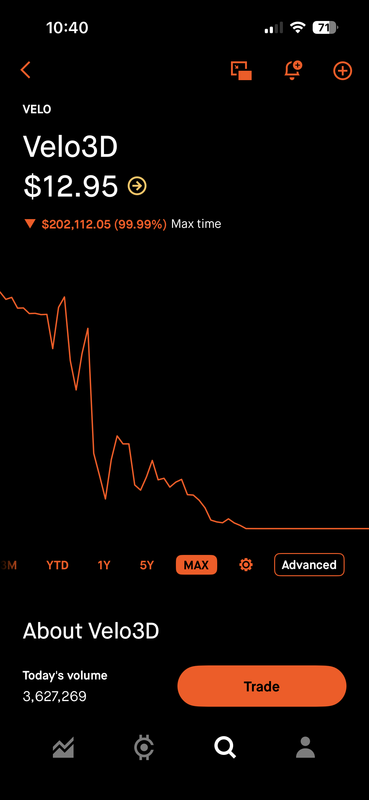 Yikes.
 Posted on 3/20/26 at 6:03 am to Crescent Connection
That’s what happens when you reverse split twice to stay alive.
They’ve totally shifted business and appear to be heading in the right direction.
They now print metals for aerospace and defense whereas they used to sell the printers. The tech is undeniably good. It’s literally used for rocket ships.
Did you read where upper management bought most of the remaining debt?
Only 10mm now and a much cleaner balance sheet.
We are a forward looking market.
Like I said, very small speculative play here.
—————————
More on the pivot:
Velo3D has significantly shifted its business model toward producing and supplying metal parts (via additive manufacturing/3D printing) for aerospace and defense customers, rather than primarily focusing on selling its Sapphire family of metal 3D printers as it did in earlier years.
- The company introduced Rapid Production Solutions (RPS) in early 2025 as a key offering. RPS allows Velo3D to act as a service provider:
it uses its own fleet of printers (including large-format Sapphire XC systems) to manufacture high-quality, mission-critical metal parts directly for customers. This includes consulting, qualification, scaling production, and providing surge capacity without customers needing to buy printers themselves.
- This pivot has been a core part of the turnaround strategy under CEO Arun Jeldi, emphasizing recurring revenue, higher margins, and resilience in U.S.-based supply chains—especially for defense and space sectors where domestic production is prioritized.
- While printer/system sales still contribute to revenue (and remain part of the model), RPS has grown in importance, with management targeting it to represent a substantial and increasing portion of revenue (e.g., up to 40% in some projections), backed by multi-year production contracts.
These printed metals are indeed used in applications involving rocket ships (space launch vehicles and related hardware):
- Partnerships include work with companies like iRocket (for reusable launch vehicles, propulsion, and structural components for rockets and solid rocket motors/interceptors).
- Other collaborations and qualifications involve space exploration hardware, such as components for Orbital Service Vehicles (via Momentus), heat exchangers, and mission-critical parts for extreme conditions in space.
- Velo3D's technology supports materials like Inconel 718, aluminum alloys, and others suitable for high-performance rocket and aerospace parts that must withstand heat, pressure, and complexity—enabling designs previously difficult or impossible with traditional manufacturing.
Overall, Velo3D now positions itself as a leader in producing these mission-critical metal parts for aerospace and defense (including rocket-related applications), with RPS as the vehicle for much of that production shift.
They’ve totally shifted business and appear to be heading in the right direction.
They now print metals for aerospace and defense whereas they used to sell the printers. The tech is undeniably good. It’s literally used for rocket ships.
Did you read where upper management bought most of the remaining debt?
Only 10mm now and a much cleaner balance sheet.
We are a forward looking market.
Like I said, very small speculative play here.
—————————
More on the pivot:
Velo3D has significantly shifted its business model toward producing and supplying metal parts (via additive manufacturing/3D printing) for aerospace and defense customers, rather than primarily focusing on selling its Sapphire family of metal 3D printers as it did in earlier years.
- The company introduced Rapid Production Solutions (RPS) in early 2025 as a key offering. RPS allows Velo3D to act as a service provider:
it uses its own fleet of printers (including large-format Sapphire XC systems) to manufacture high-quality, mission-critical metal parts directly for customers. This includes consulting, qualification, scaling production, and providing surge capacity without customers needing to buy printers themselves.
- This pivot has been a core part of the turnaround strategy under CEO Arun Jeldi, emphasizing recurring revenue, higher margins, and resilience in U.S.-based supply chains—especially for defense and space sectors where domestic production is prioritized.
- While printer/system sales still contribute to revenue (and remain part of the model), RPS has grown in importance, with management targeting it to represent a substantial and increasing portion of revenue (e.g., up to 40% in some projections), backed by multi-year production contracts.
These printed metals are indeed used in applications involving rocket ships (space launch vehicles and related hardware):
- Partnerships include work with companies like iRocket (for reusable launch vehicles, propulsion, and structural components for rockets and solid rocket motors/interceptors).
- Other collaborations and qualifications involve space exploration hardware, such as components for Orbital Service Vehicles (via Momentus), heat exchangers, and mission-critical parts for extreme conditions in space.
- Velo3D's technology supports materials like Inconel 718, aluminum alloys, and others suitable for high-performance rocket and aerospace parts that must withstand heat, pressure, and complexity—enabling designs previously difficult or impossible with traditional manufacturing.
Overall, Velo3D now positions itself as a leader in producing these mission-critical metal parts for aerospace and defense (including rocket-related applications), with RPS as the vehicle for much of that production shift.
This post was edited on 3/20/26 at 6:38 am
Posted on 3/20/26 at 6:11 am to bayoubengals88
This is a far more meaningful chart for today.


Posted on 3/20/26 at 9:19 am to bayoubengals88
quote:
Found out about this one from NBIS bull Daniel Koss:
I will look more into this one when I get time. Off the cuff a few thoughts on the Koss post:
1) Maybe I missed it but he infers the CEO converted - I do not see that in the 8K. It was modified to add the conversion feature but I do not see it was converted (I could be wrong was looking quickly)
2) Note was purchased off another insider (BoD) so yeah bullish CEO wants it but another insider was willing to sell it.
3) My reading of the 8k says there are 2 notes - a $5 million where the conversion feature added was in the 16 range, but also a $10 million where the conversion feature is in the $10 range. Not sure why Koss is ignoring the bigger note at a much lower conversion.
None of that changes the thesis - just some early observations. Unfotunately will not be able to dive in to April probably - after the K

Posted on 3/20/26 at 9:25 am to bayoubengals88
Thanks for the info, I limped in for 50 shares.
Posted on 3/20/26 at 9:28 am to RedHawk
quote:I'm with you with 70
Thanks for the info, I limped in for 50 shares.
Posted on 3/20/26 at 9:32 am to igoringa
quote:
1) Maybe I missed it but he infers the CEO converted - I do not see that in the 8K. It was modified to add the conversion feature but I do not see it was converted (I could be wrong was looking quickly)
A few days later, the company issued a formal press release and subsequent filings (including a Form 4) confirming that the conversion was complete.
The CEO's Action: Dr. Arun Jeldi acquired a $5 million note and converted it into common stock at $16.38 per share.
quote:The Director's Action: Ken Thieneman converted a $10 million note at $10.50 per share.
but also a $10 million where the conversion feature is in the $10 range.
The Result: This wiped out 60% of the company's total outstanding debt (reducing it to approximately $10 million).
Posted on 3/20/26 at 9:47 am to bayoubengals88
And that is why I should not respond until I have the time lol
Posted on 3/20/26 at 10:25 am to igoringa
I appreciate it nonetheless.
What do you think of this play?

 Page 1 of 3

Popular
Back to top
 Follow TigerDroppings for LSU Football News